Enterprise PPM software
Enterprise Project Portfolio Management Software
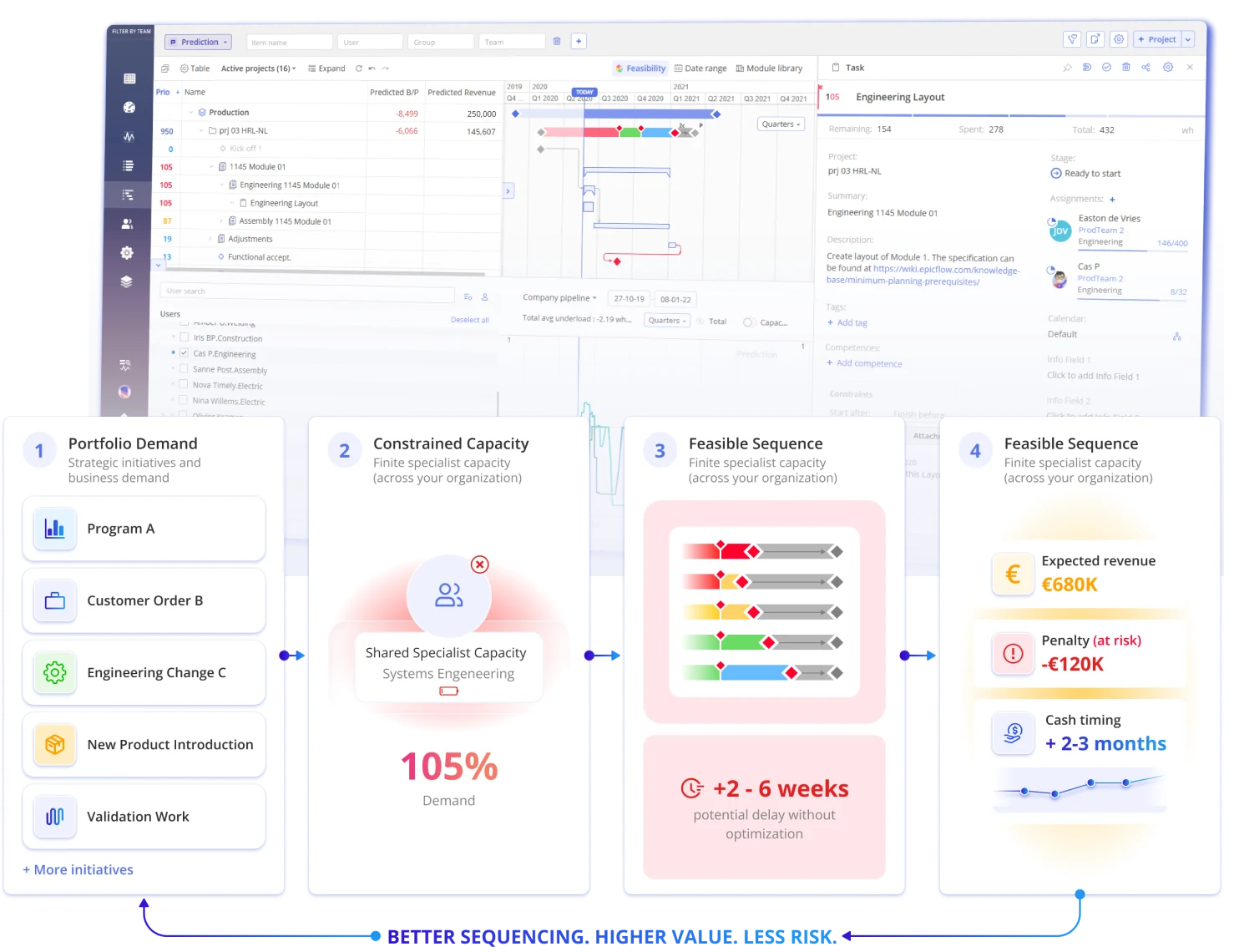
Put a price on every portfolio decision. Epicflow is enterprise project portfolio management software for organizations where many projects depend on the same scarce specialists. It shows what your bottleneck costs the business each week, and which plan your people can deliver, before you commit them to it.
- Find the specialist group that sets the pace of the whole portfolio, and what each week of delay there costs.
- Test a new project or a priority change across every business unit before the live plan changes.
- See what each plan does to delivery dates, invoicing and expected cash.
- Our AI searches millions of combinations for the plan that earns the most. You decide.



-
KPN: due-date performance raised in less than a year
-
of hidden overload, found in a 60-engineer group at the Dutch Ministry of Defence
-
UK defense company: room for 10% more work with the same people, identified in one department
Your Projects Have Separate Plans.
They Share the Same Bottlenecks
Every business unit has a reason its project must come first. Your shared specialists cannot put them all first. Moving one project ahead can push another commitment, and its invoice, back.
Your bottleneck is a resource constraint: the specialists every project needs at the same time. Approving each project on its own does not make the portfolio deliverable. Epicflow weighs these trade-offs across the whole portfolio, so no project improves at the expense of the rest.
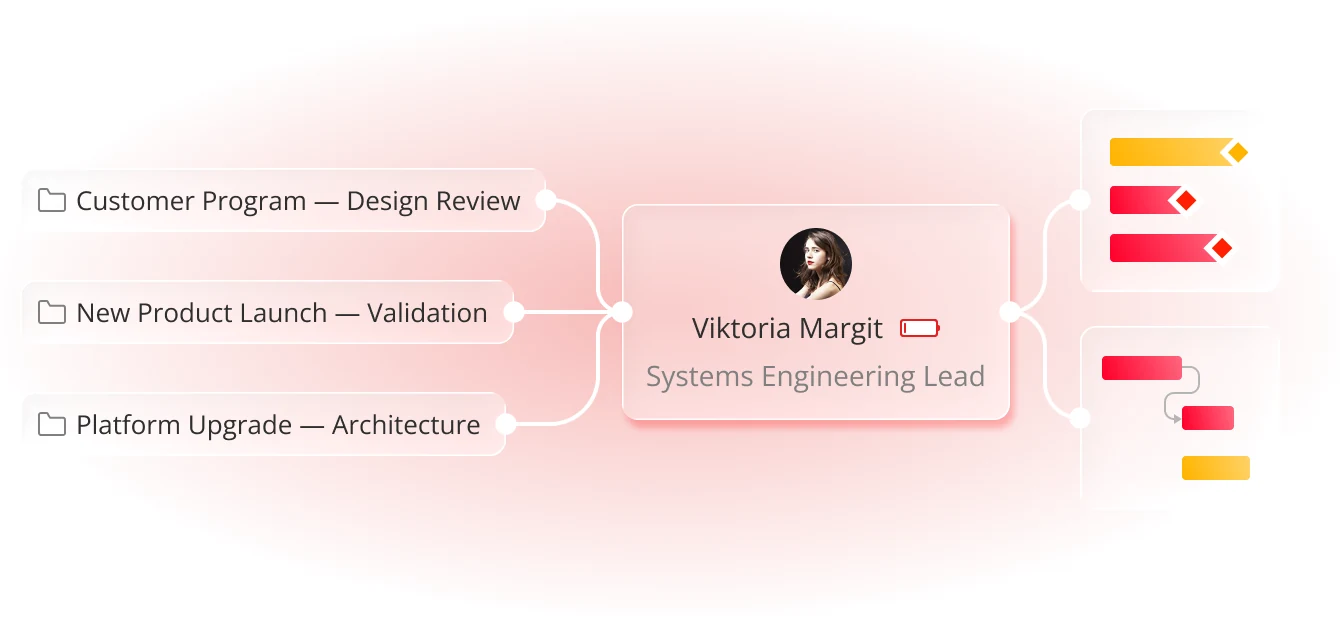
One project too many can turn a profitable portfolio into a loss.
-

Set priorities you can defend.
Give leadership a defensible answer to what can be promised, what must wait, and what changes when a new priority enters the portfolio.
-

Get more delivered with the people you have.
Keep scarce expertise on the work the portfolio is waiting for. A fully occupied workforce is not the same as a portfolio delivering more.
-

Price the wait.
A week of delay costs one project nothing and another its margin. Epicflow shows which is which.


Know What You Can Commit to Before You Commit
Epicflow works as enterprise portfolio planning software built on the people you actually have. It forecasts the shared specialists your projects depend on, shows where demand exceeds their capacity, and which commitments are at risk before you accept more work.

Portfolio-level capacity management
Epicflow’s Future Load Graph forecasts load per team across every project and the pipeline, months in advance. You see two projects planning on the same specialist before that week arrives, in time to resequence, move people or hire where it counts.

Bottleneck detection and relief
Epicflow finds the specialist group that limits the whole portfolio and shows which projects put it there. Instead of optimizing teams in isolation, you see where work is waiting and how that wait spreads across the portfolio. Then relieve it with the move that saves the most money: resequence, move tasks off the bottleneck, outsource just that work, or add AI capacity.
Once you know which commitments are at risk, the next question is what their delay costs.
See What a Delivery Delay Does to Your Financial Outlook
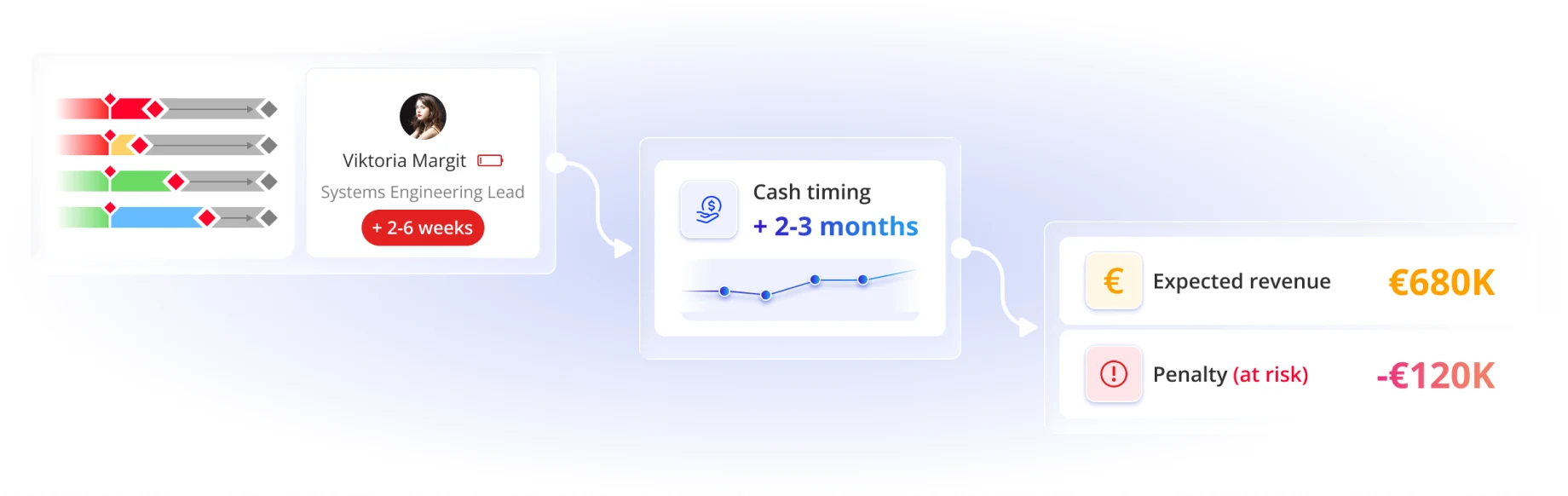
A delayed milestone changes when you invoice, when cash comes in, and your exposure to contractual penalties. Epicflow connects each of these to the resource-constrained forecast behind the delivery date.
-

Cost of delay.
See what a week of delay costs on each piece of work held up at the bottleneck, so you know which delays matter and which do not. If you want the technical name, Stephen Devaux calls this figure drag cost.
-

Invoice and cash timing.
Invoice Forecast shows when milestones become invoiceable from the feasible delivery date. Cash Flow applies your payment terms to show when payments are expected. It is a forecast from the schedule, not your bank balance.
Portfolio cash flow forecasting


-

Bonus and penalty exposure.
Epicflow shows the current and predicted bonus or penalty from the due date and the resource-aware predicted end date. Act on a penalty while it is still a prediction.
-

Project financials across the portfolio.
PMO, delivery and finance see the same financial and delivery picture, each in a role-specific view: which projects drive revenue and profit, and where exposure is growing. Predicted Profit is an early signal from predicted revenue and costs to date, not a full estimate at completion.
-

Is it still worth finishing?
Return on Remaining Investment (RRI) compares the contract value still to be earned with the investment still to be made, shown as a multiple next to ROI. Sunk cost stops steering.


Seeing the exposure is only useful if you can compare ways to change it.
Turn Scarce Capacity Into the Right Portfolio Sequence
Compare project sequences and resource allocations before you change the live plan. See which commitments move forward, what must wait, and what each alternative does to dates and expected cash.

Priorities that follow the bottleneck
Epicflow ranks projects by what an hour of your bottleneck earns on each of them: the value per constrained resource hour. That replaces static priority lists and scoring by whoever escalates loudest. As reality changes, priorities are recalculated across the portfolio. When options are too close to call, people decide.

Epicflow Portfolio Optimizer
Picking the right projects is half the answer. The other half is the order the work runs in when projects share people. The Epicflow Portfolio Optimizer (EPO) searches millions of combinations within your limits and keeps only the plans your people can deliver. The best plan arrives as a What-If beside your live plan: your bottleneck and the few moves that pay. We run the optimization for you as PMO as a Service, on your own instance. Nothing changes in the live plan without your sign-off.

Scenario analysis before you commit
Epicflow’s What-If analysis is the safe place to test a decision. See how a change in priorities, capacity or sequencing affects timelines, workload and expected cash. Compare how accelerating one project changes delivery dates and shared-resource load across the rest of the portfolio.

Put AI capacity where it can move delivery
Everyone has AI agents. Only at your bottleneck do they pay. When resequencing is not enough, test whether AI can take suitable work off your scarce specialists. Give an AI resource work only where three tests pass: something is waiting on that work, the wait costs money, and a machine can do it well enough for a person to sign off. An AI resource joins your resource pool with capacity, a rate and dates, and its work is planned alongside your people’s.
Make the Chosen Scenario the Plan Your Teams Execute
The scenario you choose becomes the schedule your teams execute, with the priorities in every person’s daily task list.
-

Resolve portfolio issues at the source
When a delivery or financial issue emerges, quickly trace it to the work, resource, or project causing it. Adjust the plan where the problem starts and see the wider portfolio impact before moving on.
-
Keep the forecast connected to the work
Within the selected plan, execution priorities adapt as capacity and demand change. Progress feeds back into delivery and expected-cash forecasts, keeping the financial outlook connected to the work being done.


One plan for capacity, cash, and execution.
PPM Software for Enterprise Teams That Share the Same Specialists
Most PPM software for enterprises collects status from every department. Enterprise portfolio software also has to decide what the people those departments share should work on next. Epicflow models every project and every shared resource group in one resource-constrained forecast, so a new department adds its demand to the same plan.
-
One forecast across business units.
Every department’s projects queue for the same specialists in one model. A priority change in one unit shows its effect on the others before anyone commits.
-
Each team keeps its tools.
Developers stay in Jira. Planners stay in Microsoft Project or Oracle Primavera. Epicflow adds the portfolio layer above them.
-
A view for each role.
PMO, delivery and finance work from the same plan, each through a role-specific view.
-
Approve now, release later.
Approving a project and starting it are separate decisions. Release the work when the capacity is there.


One enterprise portfolio management platform, one plan, and every department deciding on the same numbers.
Enterprise Project Portfolio Management Software Built for Precision Delivery Environments
Epicflow is purpose-built software for portfolio management in organizations where projects are technically complex, the people who do the work are scarce specialists, and late delivery has direct commercial or contractual consequences.
| Industry | Why Epicflow fits |
|---|---|
| Aerospace & Defense | Plans concurrent program delivery across shared specialist engineers, with feasibility forecasting, bottleneck visibility, and a price on each week of delay. |
| Manufacturing (ETO) | Forecasts capacity shortages before new orders are committed to. What-If simulation shows the downstream impact of demand spikes, resource changes, or schedule shifts across all active engineering and production groups simultaneously. |
| Defense Contractors | Sequences program portfolios by what each bottleneck hour earns, with critical chain buffer management to protect milestone accountability. Delivery leadership sees which program the bottleneck is delaying and what that delay costs, without manual reporting. |
| Pharmaceutical | Sequences R&D work across shared scientists and validation specialists, so a slipping milestone shows its cost while the plan can still change. |
| Telecoms & Infrastructure | Detects which shared engineering or design role is holding back the most rollout value and resequences concurrent programs to relieve that bottleneck before it compounds across the portfolio. For projects with recurring revenue after launch, see how delayed completion shifts the expected payment stream. |
Enterprise PPM Software Requirements
A good enterprise project portfolio management tool answers two questions: can the portfolio deliver what you have committed with the people you have, and what does it cost when it cannot? Test every EPPM tool on your shortlist against these eight requirements. The full list is in our PPM requirements checklist.
-
A portfolio forecast on real capacity
Plans that assume unlimited people look feasible until the shared specialists are booked twice.
One resource-constrained forecast of every project and the pipeline, months ahead.
-
The bottleneck and its price
Without a price, the loudest escalation wins.
The specialist group that limits the portfolio, and what each week of delay there costs.
-
Decisions tested before they go live
A priority change in one business unit moves dates in others.
What-If scenarios on dates, workload and expected cash, beside the live plan.
-
Priorities ranked by value
Static scoring ignores who is free to do the work.
Priorities recalculated across the portfolio by what a bottleneck hour earns.
-
Delivery linked to money
Finance needs to know when a slip moves invoicing and cash.
Invoice Forecast, Cash Flow, bonus and penalty, and RRI on the same schedule.
-
Integration with ERP, CRM and delivery tools
Portfolio decisions are only as current as the data underneath.
Ready-made integrations with Jira, Microsoft Project and Oracle Primavera, plus SAP, HR systems, API and CSV.
-
Enterprise security and deployment
Defense and regulated buyers set the bar.
Hosted on ISO 27001-certified infrastructure, JOSCAR-registered, role-based access control, DataGuard.
-
Adoption without replacing team tools
A rollout that forces every team onto a new tool stalls.
Teams keep their tools. Epicflow adds the portfolio layer above them.
-
Comparing the best enterprise PPM software for CRM and ERP integration
Ask which systems connect ready-made, which connect through the API, and which data each portfolio decision needs. Epicflow starts from the projects, the people and their availability, and the money attached to each project. See all integrations
Choosing the Best PPM Software for Large Enterprise Portfolios
The best enterprise project portfolio management software depends on what limits your portfolio. Enterprise portfolio management software built for governance decides which projects to approve. Epicflow decides what your people can deliver, and in what order. Match the tool to the problem:
-
An enterprise portfolio management tool built for governance and reporting (a PPM or SPM suite)
Demand intake, stage gates and investment governance across hundreds of programs
-
A work management tool
Task coordination and work visibility for teams
-
A scheduling tool
One large schedule with a fixed critical path, such as a construction project
-
Epicflow: a resource-constrained portfolio forecast that prices each decision and finds the plan that earns the most
Many projects that share scarce specialists, where delay has a price
Epicflow is built for the last case: portfolios where the bottleneck, not the approval process, decides what gets delivered.

Connect Your Enterprise Tools: Integrations
Epicflow project and portfolio management software connects with the systems your teams already work in, so capacity forecasts, workload analysis and sequencing decisions run on current execution data, not manually updated plans. Jira users don’t have to switch. Neither do Microsoft Project or Primavera teams.
- Ready-made integrations with Jira, Microsoft Project and Oracle Primavera, plus SAP.
- HR systems, API and CSV for everything else.
- One portfolio model: every project and every shared resource, without changing how teams work.
Keep Your Data Where Your Security Team Wants It
Built for defense, aerospace and regulated industries, with data secured according to the EU GDPR.
-

JOSCAR
JOSCAR-registered
-

Penetration tested
The platform is penetration tested regularly by one of our UK defense clients as part of that client’s own Ministry of Defence approval process.

-

ISO 27001
Hosted on ISO 27001-certified infrastructure
-

Deployment options
Managed cloud, a dedicated regional deployment, or installation in your own environment
-

Permissions and change log
Role-based access control. Decide who sees what. Every change is on the record.
-

DataGuard
Keep your project data on your own premises while Epicflow runs as a cloud service.


See What One Priority Change Does to Your Portfolio
Send us your project list. We build a model of your own portfolio and show you, in one session:
✓ The team that holds your portfolio back
✓ Two or three ways to change the plan
✓ What each one does to dates and expected cash
All we need: one row per department and one row per project. A spreadsheet is enough.
Explore: AI Portfolio Optimizer (EPO) · Capacity Planning Software · What-If Analysis · PMO Software · Aerospace & Defense Solutions · Manufacturing Solutions
FAQ
What is enterprise project portfolio management software?
Enterprise project portfolio management software (EPPM software, enterprise PPM software) is a platform that helps large organizations govern, prioritize, resource, and deliver a portfolio of concurrent projects as a unified system. It connects strategic investment decisions to live resource capacity, surfaces bottlenecks, quantifies the cost of delivery risk, and gives PMO leaders the data to make faster, higher-value sequencing decisions across the full portfolio.
What is enterprise project portfolio management?
Enterprise project portfolio management (EPPM) is the discipline of managing a large organization’s full project portfolio as a single governed system. It includes balancing demand against finite capacity, aligning project priorities with business value, and sequencing delivery to maximize throughput per constrained resource. Enterprise portfolio and project management operates above the level of individual project management and program management, giving executives and PMO leaders a portfolio-wide view of delivery health, risk exposure, and strategic alignment.
PPM vs EPPM vs SPM: What's the Difference?
| Category | Scope | Who It’s For |
|---|---|---|
| Project Portfolio Management (PPM) | Project prioritization, governance, and resource allocation | PMO leads, portfolio managers |
| Enterprise Project Portfolio Management (EPPM) | Portfolio management across business units, programs, and shared resources | Heads of PMO, enterprise delivery executives |
| Strategic Portfolio Management (SPM) | Strategy execution, investment planning, and portfolio value optimization | C-suite, Strategy & Finance |
Analysts such as Gartner and Forrester increasingly use Strategic Portfolio Management (SPM) as an umbrella term to describe the evolved category that includes both execution-focused platforms (EPPM) and strategy-focused ones.
Who benefits from EPPM software?
The primary users and buyers of enterprise PPM software are Heads of PMO, COOs, portfolio managers, program managers, and resource managers in organizations running multiple concurrent, interdependent projects. Secondary beneficiaries of enterprise project portfolio management tools include delivery executives who need accurate portfolio-level forecasts, CFOs and finance teams forecasting expected cash against feasible delivery, and project managers who need clear prioritization direction from above.
Why should enterprises invest in PPM software?
Without portfolio-level software, organizations default to managing each project in isolation, which means resource conflicts are discovered late, prioritization is based on stakeholder pressure rather than business value, and the true cost of delivery delay is never quantified. Enterprise PPM software pays back its investment by increasing throughput per specialist, reducing late commitments, and replacing escalation cycles with data-driven sequencing decisions.
Some examples across industries:
- enterprise project portfolio management software for aerospace helps organizations coordinate shared engineering resources across concurrent programs and align delivery with contractual and operational priorities;
- enterprise PPM software for manufacturing supports the optimization of engineering and production capacity across multiple initiatives, reducing bottlenecks and improving throughput;
- enterprise portfolio management software for engineering helps engineering-driven organizations manage resource allocation, prioritize high-value work, and improve planning accuracy across complex project portfolios.
What is the best enterprise project portfolio management software?
The best EPPM software for your organization depends on your industry, resource model, and portfolio complexity. For engineering-intensive enterprises, where shared specialist resources are the primary bottleneck and a late milestone has a contractual price, Epicflow’s AI-driven portfolio optimization, critical chain scheduling, and bottleneck analytics are purpose-built for that operating environment.
Who offers advanced PPM software for managing enterprise-level portfolios?
Advanced PPM software for enterprise-level portfolios comes from two kinds of vendor. Governance suites such as Planview, Planisware and Broadcom Clarity are built for demand intake, stage gates, financial planning and portfolio reporting across large organizations. Epicflow is built for a narrower, harder problem: portfolios where many projects compete for the same specialists. It forecasts the whole portfolio from the people you actually have, puts a price on each week of delay at the bottleneck, and finds the plan your people can deliver that earns the most.
What features are essential in enterprise PPM software?
Essential features of enterprise PPM tools include: portfolio-level resource capacity planning, skill-based resource allocation, demand intake and prioritization, multi-project scheduling with dependency management, What-If planning, risk and budget tracking, configurable portfolio views, project portfolio management dashboard, integrations, and data security.
In shared-resource environments, evaluate how these capabilities work together: whether forecasts use feasible delivery dates, priorities reflect value per constrained hour, invoice and expected-cash timing update from the schedule, and the selected scenario guides execution.
How does Epicflow differ from traditional enterprise PPM software?
Traditional enterprise project management software focuses on visibility, reporting, and portfolio governance. Epicflow goes further by optimizing portfolio flow around resource constraints. It identifies bottlenecks, prioritizes work based on value per constrained resource hour, and continuously recalculates execution priorities as conditions change. The same resource-constrained schedule drives invoice and expected-cash forecasts, so the financial outlook changes with the plan teams execute.
What is the fastest way to implement project portfolio management software across an enterprise?
Start with the bottleneck, not with every team at once. Take the resource pool everyone is fighting over, with every project it works on, and model it from the data you already hold: one row per department and one row per project is enough to begin. You see what the bottleneck costs on your own portfolio before a wider rollout. Then extend department by department while teams keep their own tools. Full implementation typically takes 8 to 12 weeks.
What types of organizations benefit most from Epicflow?
As enterprise project portfolio management software, Epicflow is particularly effective in engineering-intensive environments where specialist resources are shared across multiple projects and programs. This includes aerospace and defense, manufacturing, engineering-to-order, R&D, pharmaceuticals, and other organizations where constrained capacity drives delivery performance.
What enterprise project portfolio management software scales across departments and teams?
Software that scales across departments has to model the people those departments share, not only their projects. Epicflow puts every project and every shared resource group into one resource-constrained forecast, so a priority change in one business unit shows its effect on the others before anyone commits. Teams keep working in Jira, Microsoft Project or Primavera, and PMO, delivery and finance each get a role-specific view of the same plan. KPN used this approach to raise due-date performance from 18% to 80%.
Does Epicflow support Strategic Portfolio Management (SPM)?
Yes. While Epicflow is an enterprise project portfolio management platform, it also supports Strategic Portfolio Management by connecting strategic objectives, portfolio decisions, resource capacity, and execution outcomes. This helps organizations align investments and priorities with their ability to deliver.
How does Epicflow help PMOs become Value Management Offices (VMOs)?
Epicflow enables PMOs to move beyond project tracking and reporting by quantifying the economic impact of portfolio decisions. Through capabilities such as portfolio optimization, value-per-constrained-hour prioritization, and cost-of-delay analysis, organizations can manage portfolios based on business value delivered rather than activity completed.
Can Epicflow connect delivery forecasts to project financial outcomes?
Yes. Epicflow PPM software can display approved monetary budgets, actual costs, remaining budget, revenue, current and predicted bonus or penalty, and actual and predicted revenue and profit at project level in the Pipeline. Predicted bonus or penalty is calculated from the resource-aware predicted end date, helping portfolio leaders see likely contractual exposure early enough to change priorities or resource allocation. Predicted Profit is calculated as Predicted Revenue minus Actual Costs, so it should be treated as an early financial signal rather than a full estimate-at-completion margin.
How can contract-specific bonus and penalty rules be configured?
In Epicflow’s enterprise PPM software, you can define contract-specific schemas with linear or threshold-based rules, grace periods, rates, and caps. The Project Impact Simulator lets you test any rule change before it’s applied.
Does Epicflow forecast cash flow or track money received?
Epicflow enterprise project portfolio management software forecasts when milestones become ready to invoice and, after configurable payment terms, when cash is expected. Those dates come from the resource-constrained portfolio schedule and update with its predictions. It does not track bank balances, collections, disputes, or confirmed receipts; those remain in your ERP.
-

Enterprise Project Portfolio Management Explained: Key Components, Process & Best Practices [2026 Guide]
-
PPM Tool Requirements: The Complete Guide to Selecting the Right Project Portfolio Management Tool
-
Value-Based Portfolio Management Explained: How to Maximize Business Value with Available Resources
-
Project Portfolio Optimization: A Guide to Maximizing Business Value