

One project too many can turn a profitable portfolio into a loss
Scenario Planning Software for Project Portfolio Decisions
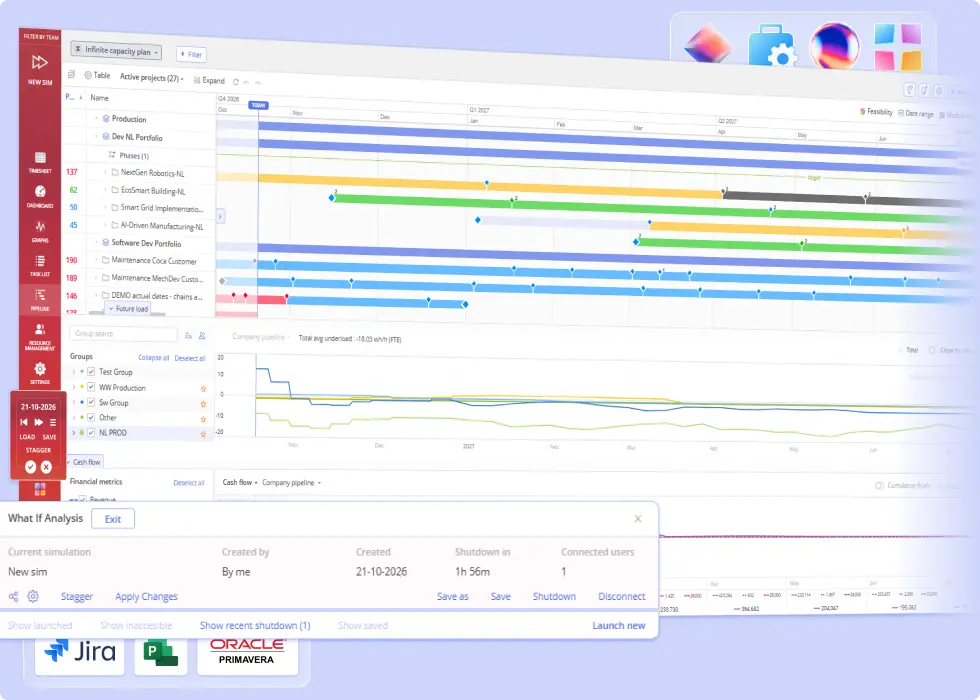
Epicflow scenario planning software lets you test a portfolio decision before anyone acts on it: a new project, a key engineer out for six weeks, a hire, a different order of work. What-If Analysis runs the change on an isolated copy of your whole portfolio, planned around the people you actually have. You see which projects move, which team overloads and what each option does to profit, penalties and cash. Then you choose, and apply only what you chose.
Every what-if has a cost of delay. Epicflow shows it before you commit.
Runs on the project data you already keep in Jira, Microsoft Project and Primavera.











Why are portfolio what-ifs so hard to answer?
In a multi-project environment, most what-if questions arrive as project questions. Can we pull this launch forward? Can we take the new contract? What if our lead test engineer is out until June? Each one gets answered inside the project that asked. The cost lands somewhere else: in the other projects that need the same people in the same weeks.
10
the IT projects VieCuri Medical Center's team could run in parallel. The hospital kept sending requests for hundreds.
-
The answer stops at the project.
A spreadsheet or a single-project schedule shows what a change does to one project. It cannot show the queue the change creates at a team that five other projects depend on.
-
Delay looks free.
A hire shows up as a salary. A delay shows up as nothing, because a late project rarely has a line in the budget. So the option that looks cheaper wins, whether it is cheaper or not.
-
"This project waits" is a political risk.
Most PMOs know there is too much work in flight. They do not act, because the consequence of telling a sponsor "not yet" feels unknowable. So every request gets a yes, and the portfolio slips past the point where one more project turns the profit into a loss.
What-If takes the risk out of that conversation. You show the whole portfolio before and after: which projects finish sooner, what the delay costs, what the wait buys. The question changes from whose project goes first to which order earns the most.
Every what-if lands on the people your projects share.
Which portfolio decisions can you test?
What-if scenario analysis in Epicflow covers any decision that changes what your teams work on, or when: a new project, a resource allocation, a date, a hire. Project and resource scenario planning are one exercise here, because projects and people sit in one model.
-

Take on a new project
What you change in the simulation
Add the project with its milestones and the hours it needs from each team
What you see
When it can really land, which projects move, which team overloads, what the delay costs
-

A key person or team is unavailable
What you change in the simulation
Availability or capacity of a person or group for a period
What you see
Which milestones slip, behind which team, and the cost of delay
-

Pull a milestone forward or change scope
What you change in the simulation
Milestone dates, tasks, effort, dependencies
What you see
The knock-on effect on every project that shares the same people
-

Change the order of work
What you change in the simulation
Project start dates, by hand or with Project Staggering
What you see
How many projects finish on time, and how far the overload at your bottleneck drops
-

Put more people on a large task
What you change in the simulation
The number of people assigned, with Load Simulation
What you see
Whether the task gets shorter, and what that does to the projects behind it
-

Hire, borrow or contract
What you change in the simulation
People or groups added to the resource pool for a period
What you see
Which projects finish sooner, and whether that is worth the cost

Project Staggering: start fewer projects at once, finish more of them on time
Projects that start together turn red together: your bottleneck team splits its weeks across all of them, and every one waits. Project Staggering, built into Epicflow's what-if scenario planning software, pauses what can wait. It sequences project starts against that team's availability, highest business value first, so the bottleneck's hours go to the projects that earn the most for each of them.
You set three things:

Which projects. The projects in scope for staggering.

Which team. The bottleneck team or teams to stagger on. A single project can also be staggered against the Future Load of the teams it needs.

How much overload. Zero is strict. A little above zero suits a team that absorbs a short peak. Below zero keeps room for urgent work, because new work always comes in between.
The result: lower-value starts move later, and the new plan shows in the Pipeline. Same projects, same team, different Mondays: more projects on time with the people you have, without extra cost or headcount. If projects you must deliver still run late, the choices are explicit: add capacity at the bottleneck, lower other priorities or change the mix.

Load Simulation: check whether more people make a task shorter
Load Simulation, part of What-If Analysis, shows how changing the number of people on a large task changes its duration. Epicflow takes each person's capacity, availability, group and competences into account, so you do not have to keep them in your head.
A shorter task only helps the portfolio if it sat at the bottleneck. Anywhere else, the work finishes early and then waits for the team that was holding everything up.
How to create what-if scenarios for project planning in Epicflow
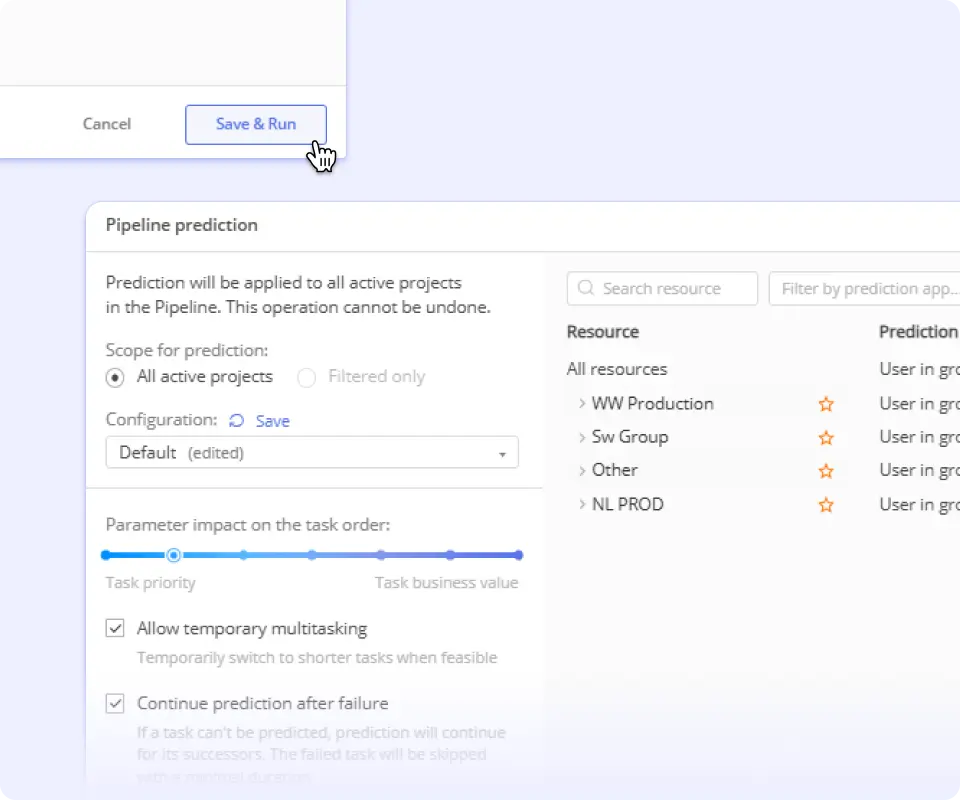
Epicflow what-if analysis software runs the scenario planning process in five steps. The live plan stays exactly as it is until the last one.
Epicflow makes an isolated copy of the whole portfolio: every project, task, person and team capacity, re-planned from the latest data. You name the scenario and give each colleague a role in it: viewer, editor or owner.

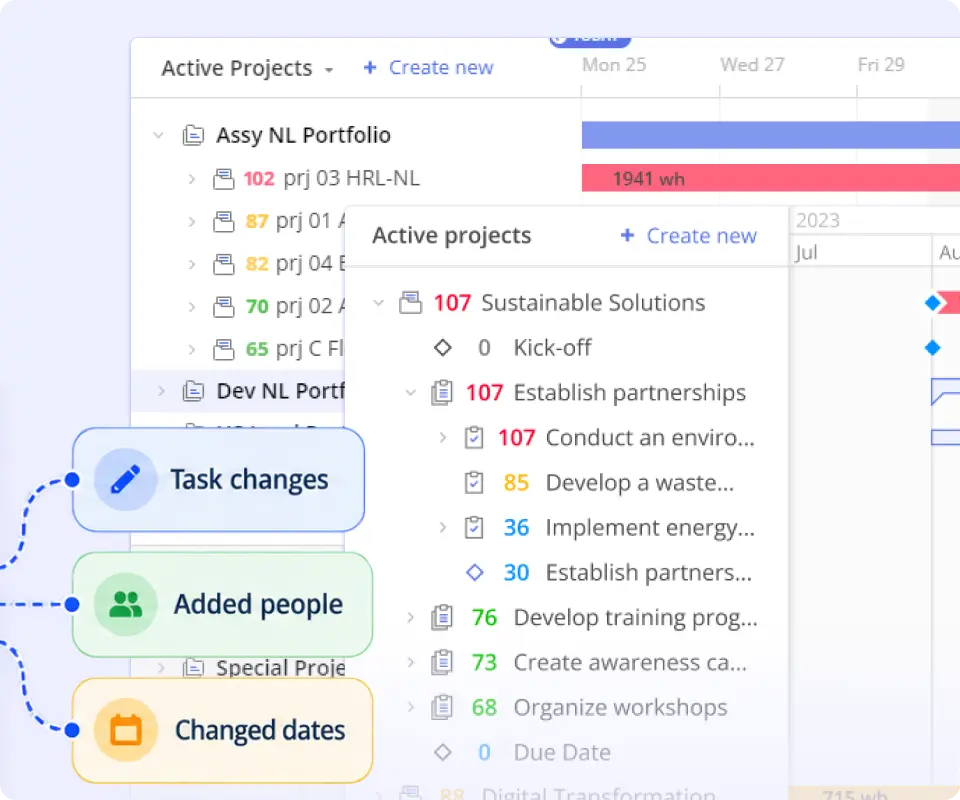
Add the new project, move a milestone, take a specialist out for a month, add a contractor or stagger starts. In simulation mode, the copy is your test environment: every change stays inside it.

Epicflow recalculates every project on the people available: delivery dates, priorities, team load and the money.

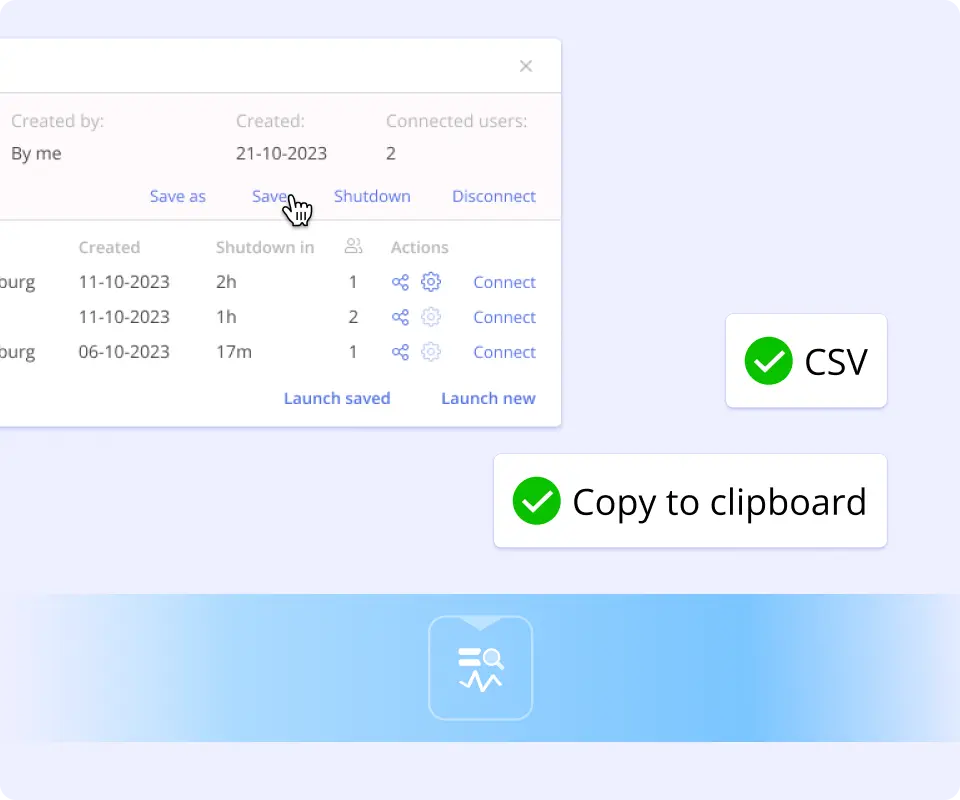
Save the scenario, build an alternative, and reopen either one later to walk the PMO, finance or the board through the options. Export results as CSV or copy them to the clipboard.

When the decision is made, carry the changes from the chosen scenario into the live plan.

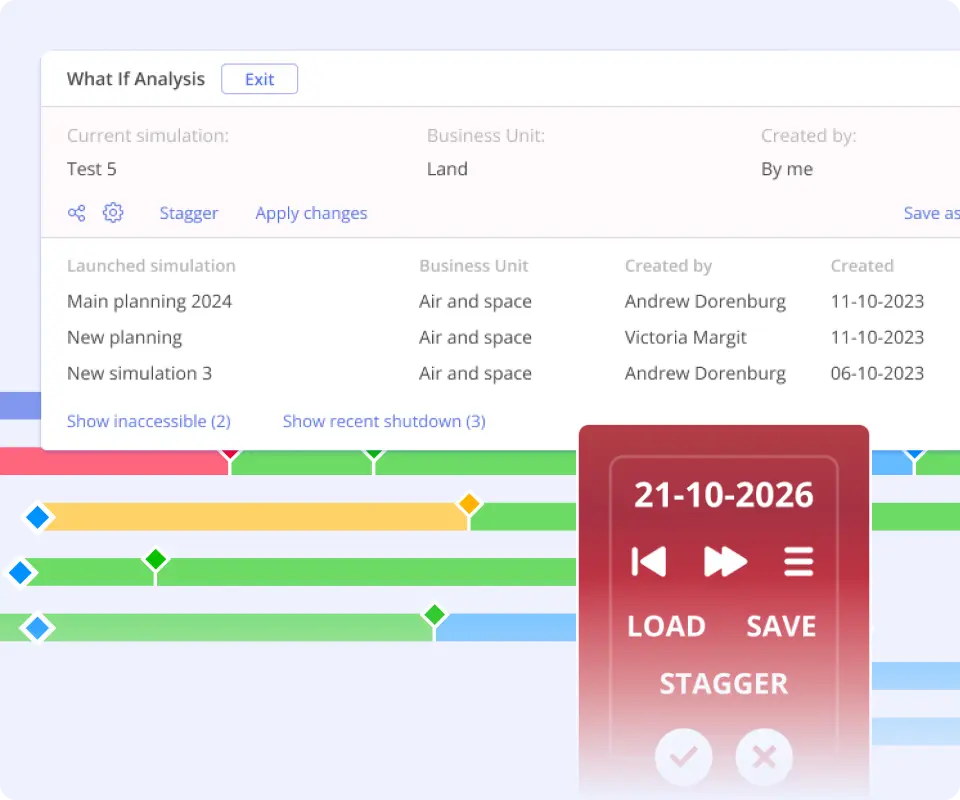
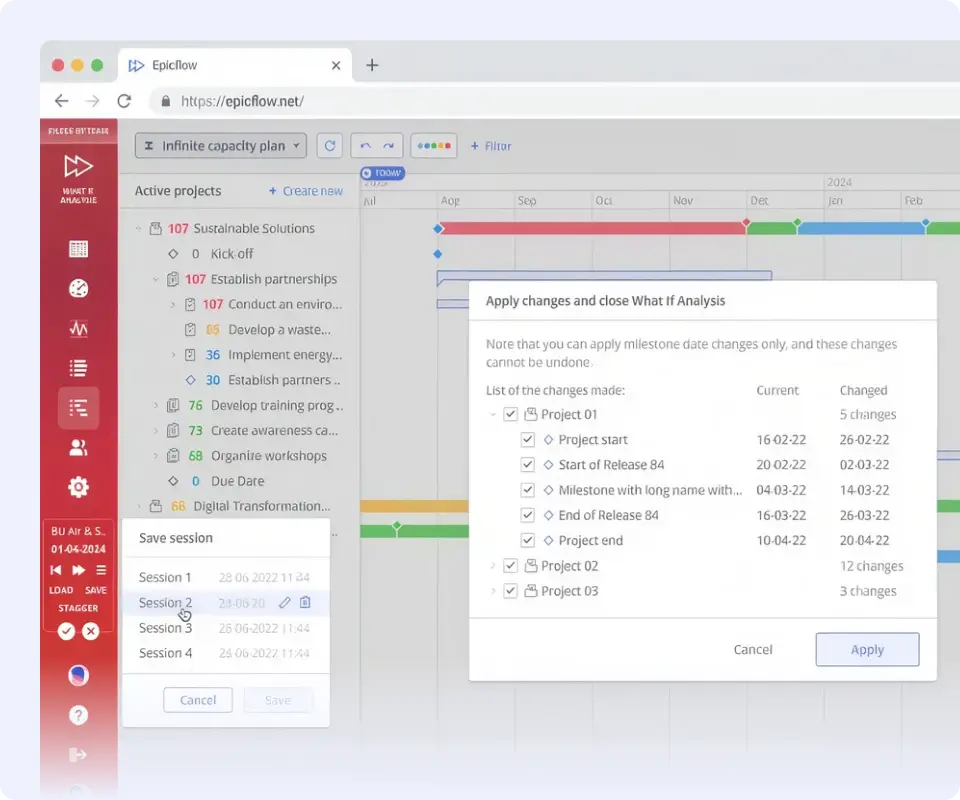
If no option is good enough, shut the simulation down. Nothing in the live plan has changed.
Send us your project list. We build a model of your own portfolio and show it to you in one session.
Compare the impact on projects, teams and money
Scenario analysis software is only as useful as the view you judge a scenario in. A project can show green while the team it depends on is already heading into overload. That is why Epicflow shows every scenario at three levels, in the Pipeline, the Future Load graph and the Historical Load graph, and then in money.

Project level: see which projects move in the Pipeline
In the Pipeline, priorities and feasibility colors update as soon as the scenario runs: red when a milestone is no longer feasible, yellow when the buffer is shrinking, green and blue when there is room. You see which projects a change moves, and by how much. Green is not the end of the check, so the next view is the teams.

Team level: see the next overload on the Future Load graph
The Future Load graph forecasts each team's load against its capacity, months ahead, including projects that have not started. This is capacity planning what-if analysis: change the scenario and see whether the overload at your bottleneck grows, shrinks or disappears. Team overload is the early signal; late projects are the late one. One overloaded team can hold up every project that needs it, and here it shows months before any project turns red.

Past load: check your assumptions on the Historical Load graph
The Historical Load graph shows how load, capacity and ready-to-start work developed per team. Use it to test the assumptions behind a scenario. A team that looks underloaded while its availability is normal is often waiting for work from an overloaded team upstream, because task dependencies pass one team's overload on to the next. A scenario changes the future plan, never the record.
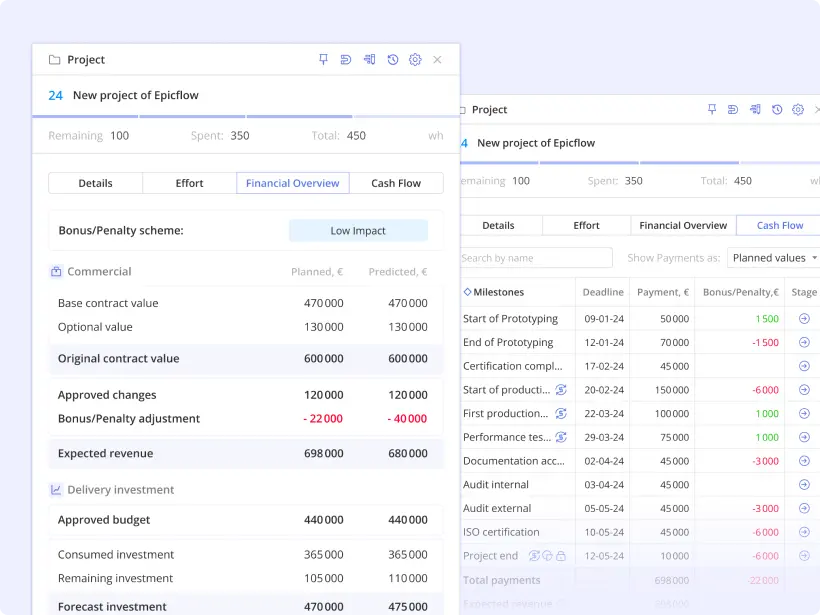
The money: what each scenario earns or costs
Every Epicflow scenario carries the same financial picture as the live plan: revenue and predicted profit per project, the bonus or penalty a new date triggers, and the cash flow from invoiceable milestones. Slip a milestone two weeks in a scenario and you see the penalty, the margin and the expected cash move with it, before anyone commits. Next to it, one figure answers whether a project is still worth what is left to spend.
The cash flow is forecast from the schedule: when milestones become invoiceable and when payment is expected. It is not your bank balance.
If you want the technical names: what each week of delay costs is what Stephen Devaux called drag cost, and the worth-finishing figure is RRI, return on remaining investment.
| View | It answers | Judge a scenario by | It cannot tell you |
|---|---|---|---|
| Pipeline | Which projects move | Feasibility colors, delivery dates, priority rank | Whether the teams behind them are overloaded |
| Future Load graph | Which team overloads, and when | Load against capacity per team, months ahead | Which project should give way |
| Historical Load graph | How teams really performed | Past load, capacity and ready-to-start work | The future on its own |
| Money | What the option is worth | Predicted profit, bonus or penalty, expected cash | Cash already in the bank |
Example: can we take on one more project?
The example is illustrative: round numbers in dollars, chosen to show the logic, not taken from a customer portfolio.
Approving a project and starting it are two decisions. Most portfolios take the first with care and let the second happen by itself. This is what the second one looks like with the cost of delay on it.
A PMO runs 14 projects. Six of them need the same team of eight test engineers between April and July, and that team is already at 95% of capacity. Sales has a new contract, Project N, worth $1.2 million, and the customer wants work to start on March 1. Project N needs nearly three test engineers' worth of hours in those months. Two existing projects carry late-delivery penalties: Project A at $20,000 a week and Project B at $10,000 a week. Project N's contract would carry $15,000 a week from its target date.
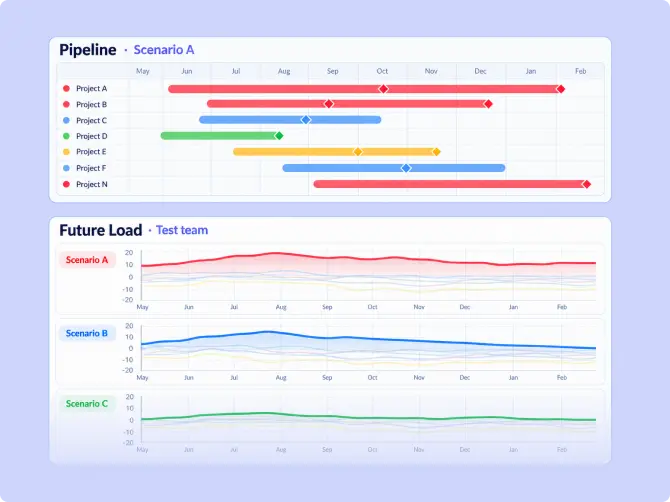
The PMO builds three scenarios in What-If Analysis.
-
A: start N on March 1
$185,000
Penalties in the forecast
-
B: stagger N to June 1
$0
Penalties in the forecast
-
C: March 1, plus three contract testers
$150,000
Extra cost
| A: start N on March 1 | B: stagger N to June 1 | C: March 1, plus three contract testers | |
|---|---|---|---|
| What changes | N added, all starts as planned | Project Staggering moves N's start | N added, three contract test engineers from April to July |
| Test team load, April to July | 130% | Under 100% | 95% |
| Projects late | A by 4 weeks, B by 3, N by 5 | None | None |
| Penalties in the forecast | $185,000 | $0 | $0 |
| Extra cost | $0 | $0 | $150,000 |
| Project N | Lands 5 weeks after the date promised | Lands on a date you can commit to before signing; first invoice a quarter later | Lands on the promised date |
Saying yes as requested costs $185,000 in penalties, and most of it lands on projects that were on time this morning. Staggering costs nothing and keeps every commitment. What it costs: Project N's revenue arrives a quarter later. Contract testers keep the customer's start date for $150,000, which is $35,000 less than the penalties.
So, B or C? That depends on what the earlier start is worth to the customer and to your cash flow. It is a management decision, and now it has a number on both sides. Project N gets its yes, just not necessarily this Monday. Whichever option you choose, it reaches the live plan with the start date and the capacity you tested.
Saying yes was never the question. When to start, and at whose expense, was.
When there are too many scenarios to test by hand
What-if scenario analysis software tests the scenarios you think of. Three projects can run in six different orders. Ten projects can run in 3,628,800. With dozens of projects and several scarce teams, nobody thinks of them all. That is where AI scenario planning software earns its place. Our AI searches millions of combinations within your limits, keeps only the plans your people can actually deliver, and returns the best portfolio plan as a What-If beside your live plan: your bottleneck and the three to five moves that pay. You test your own moves there too.
You set the target: maximum profit, every mandatory date met, or the best cash flow. We run the optimization for you as PMO as a Service. On a sample portfolio, a $330,000 loss became nearly $1.3 million of profit, with every project on time. That is a sample, not a promise for yours. The software computes the options; the people closest to the work make the call. Nothing in the live plan changes until you approve it.
Scenario planning in a real multi-project environment
VieCuri Medical Center is a Dutch teaching hospital with more than 3,000 staff. Its IT department had to support a hospital opening its doors to twice as many patients, and management needed to know whether IT had the capacity for the flow of project requests. It did not, by a wide margin. The PMO counted 26 projects in progress and about 350 waiting to start within one to three years.
VieCuri added Epicflow above MS Project to plan at the multi-project level. What-If Analysis calculates how many more projects the team can take on without being overloaded. That gave management the warning signal early, and the basis to hire the number of people IT actually needed.
-

26 in progress, 350 waiting
Read the VieCuri story"One of the features I like most in Epicflow is the What-If Analysis, which gives us the ability to see the future. ... The What-If Analysis provides us with this opportunity so that I may act now and prevent bottlenecks before they appear."
 Nancy Underwood, PMO, VieCuri Medical Center


Use your existing project and resource data
Jira users don't have to switch
Neither do Microsoft Project or Primavera teams. Ready-made integrations with Jira, Microsoft Project and Oracle Primavera bring their projects and work into one portfolio model. Availability can come from your HR system, and API, CSV and custom integrations cover everything else. Teams keep working in their own tools. Epicflow adds the project portfolio management layer above them, and scenarios run on that model. See all integrations


What a useful scenario needs
- Your projects, with their milestones and target dates.
- The hours each project still needs from each team. Rough estimates at project or phase level are enough to start.
- Team capacity and availability: people, calendars, holidays.
- Business value per project, for Project Staggering.
- Contract values, bonus and penalty terms and payment milestones, for the money in each scenario.
A scenario is only as good as the hours and dates behind it. If the bottleneck's capacity or a penalty is wrong, every scenario is wrong in the same direction, so give each input an owner who keeps it current. A portfolio-level model can be built in weeks from the data you already hold.
-

Hosted on ISO 27001-certified infrastructure.
-

JOSCAR-registered.
-

Role-based permissions decide who sees what, and the change log records every change.
-

With DataGuard, project data stays on your own premises while Epicflow runs as a cloud service.
Scenario planning software pricing and plans
What-If Analysis, including Project Staggering and Load Simulation, is part of the Epicflow Enterprise plan. Enterprise starts at 50 users and is priced on a quote. The Growth plan does not include What-If. The pricing page lists what each plan includes.
The quickest way to judge the value is a demo on your own portfolio. Questions worth bringing:
Which decision do we need to test first: a new project, a hire or a different order of work?
Which projects and teams should the first scenario include?
Are effort, calendars and availability current enough to trust the result?
What is a week of delay worth on our most important projects?
Which integrations and permissions does our environment need?
What would the PMO and the executive sponsor need to see before acting on a scenario?
Test the decision before you make it
Every what-if lands on the people your projects share. Epicflow's what-if scenario planning platform shows where, when and at what cost, on a copy of your portfolio, before anything live changes. Send us your project list. We build a model of your own portfolio and show you, in one session:
- The team that holds your portfolio back
- Two or three ways to change the plan
- What each one does to dates, penalties and expected cash
All we need: one row per department and one row per project. A spreadsheet is enough.
Frequently asked questions about What-If Analysis
What is scenario planning software?
Scenario planning software, also called what-if software or scenario analysis software, lets you change selected assumptions in a plan and compare the outcomes before you decide. It serves strategic foresight, financial planning, risk analysis and project portfolio management. In project portfolio scenario planning, the assumptions are projects, dates, scope, priorities and people, and the outcome you need is when each project can really land, which team holds it up and what that is worth.
How is what-if scenario planning different from forecasting?
A forecast projects the current plan forward. A what-if scenario changes something in it: a start date, a team's availability, a new contract. Good software for forecast scenario planning does both on one model. In Epicflow both run on the same resource-constrained prediction of the whole portfolio, so every scenario starts from a forecast you already use. Project forecasting does the first job, What-If Analysis the second. Neither is a guarantee: both are as good as the hours, dates and capacity they run on.
What kinds of scenario planning are there?
Four. Strategic foresight changes trends and uncertainties and gives alternative futures. Financial planning (FP&A) changes revenue, cost and business drivers and gives alternative budgets. Project portfolio and resource scenario planning changes projects, dates, scope, priorities and people and gives delivery dates, team load and the money each option moves: that is Epicflow's focus. Quantitative risk analysis gives confidence ranges; Epicflow gives one resource-constrained forecast per scenario instead. Epicflow is not an FP&A tool. To compare vendors across all four, see our guide to scenario planning tools, including the scenario modeling software built for finance teams.
Is Epicflow a fit for our portfolio?
Epicflow is portfolio scenario planning software and resource planning software with scenario modeling built in. It fits when there is too much work for the people you have, specialists are shared across many projects (roughly 200 people or more in shared pools), and a PMO answers for delivery dates. Projects, milestones and the hours each needs per team, even at phase level, are enough to start. It is less useful for single-project task planning, FP&A or strategic foresight, and if the problem is too little demand rather than too much work, it is the wrong tool.
Do What-If scenarios change our live project plans?
No. A simulation is an isolated copy of the portfolio, and changes stay inside it. The live plan changes only when you carry the chosen changes over. If no scenario is good enough, shut the simulation down and the live plan stays as it was.
What project and resource changes can we model?
New projects, dates, scope, tasks, effort, dependencies, priorities and business value; availability, capacity, assignments and new people or groups in the resource pool. Project Staggering re-sequences starts against your bottleneck, and Load Simulation tests more people on a large task.
What data do we need before running scenarios?
Projects with milestones and target dates, the hours each needs from each team, and team capacity and availability. Business value for staggering; contract values, bonus and penalty terms and payment milestones for the money. Estimates at project or phase level are enough to start.
Can we save, compare and export scenarios?
Yes. Epicflow works as multi-scenario planning software: save a scenario under a name, build alternatives, and reopen any of them to compare or present. Each colleague gets a role per scenario: viewer, editor or owner. Results export as CSV or copy to the clipboard.
Which Epicflow plan includes scenario planning, and how is it priced?
What-If Analysis is part of the Enterprise plan, which starts at 50 users and is priced on a quote. It is not in the Growth plan. The pricing page shows what each plan includes. A demo on your own data is the quickest way to judge whether it pays.
How does Epicflow use AI for scenario planning?
The What-If prediction itself is deterministic: the same inputs give the same plan, so every result can be explained from your own projects, people and dates. AI comes in when there are too many options to test by hand: our AI searches millions of combinations to find the most valuable portfolio plan, and we run it for you as PMO as a Service. The plan arrives as a What-If beside your live plan. AI recommends. People decide.
Can Epicflow connect to our current planning tools?
Yes. Ready-made integrations connect Jira, Microsoft Project and Oracle Primavera; availability can come from your HR system, and API, CSV and custom integrations cover other tools. Teams keep working where they are, and Epicflow is the scenario analysis platform above them.