Best Resource Management Tools in 2026
 Victoria Sokolova
.
Victoria Sokolova
.
 Anna Balyuk
.
Updated
.
Resource Management
.
62 mins READ
Anna Balyuk
.
Updated
.
Resource Management
.
62 mins READ

Resource management tools help organizations plan people and project capacity, assign work, and compare demand with availability. Their useful differences become clearer when two projects need the same person at the same time. Some tools help you move a booking. Others forecast a staffing gap or show how a change affects delivery across the portfolio. As AI adds capacity across teams, the question gets sharper: where does extra capacity, human or AI, actually move a delivery date?
This guide compares resource management software for team scheduling, professional services and complex project environments. The aim is to help you find software for resource management that supports the decisions your organization actually needs to make, with clear boundaries around pricing, integrations and automation.
Resource Management Tools Compared at a Glance
Product information checked on 30 September 2026. Prices below identify the charging basis and relevant offer; links lead to official commercial information. Entry prices do not necessarily include the configuration discussed. The order is not a performance ranking.
| Tool | Strong fit | Useful capabilities | Main caveat | Price and basis |
|---|---|---|---|---|
| Epicflow | Shared specialists across projects | Bottleneck forecast; portfolio optimization, cost of delay; AI resources in the plan | Effort estimates required on tasks | Growth €22.50/person/month annually; 20 minimum; Enterprise quote |
| Jira Premium | Teams using Jira | Dependencies; scenarios; individual capacity | Fixed 40-hour capacity week | Per user; Premium/Enterprise; calculator rate |
| EG Silverbucket | Engineering staffing | Role requests; tentative allocations | Optional time tracking and integrations | Quote per active resource-pool person |
| Celoxis | PMO and portfolio controls | Workload heatmaps, capacity planning, resource-conflict alerts, and timesheets. | Integration add-ons below Enterprise | Essentials US$25/Standard user/month annually; 5 full-access users minimum |
| Parallax | Services sales and staffing | Pipeline capacity; revenue and margin | Maintain sales and time mappings | Quote by managed resources; term unconfirmed |
| Resource Guru | People and asset bookings | Clash management; tentative bookings | Reporting starts at Blackbelt | Grasshopper US$5/person/month monthly; assets US$2.50/resource/month |
| Float | Visual staffing and budgets | Allocations; placeholders; actuals | Pro for time tracking | Starter US$7/scheduled person/month annually; Pro US$12 |
| Runn | Future staffing demand | Tentative demand; capacity forecasts | Standard for integrations | Lite US$7/resource/month annually; Standard US$11; 20 minimum |
| Forecast / Accelo | Services pipeline planning | Placeholders; firm and tentative allocations | Confirm offered configuration | Custom quote; unit and term unconfirmed |
| Mosaic | Staffing and hiring forecasts | Role demand; workload forecasts | Enterprise forecasting; paid integrations | Base rate unpublished; contracted per-user pricing |
| Productive | Services staffing and finance | Bookings; costs; financial scenarios | Ultimate for Scenario Builder | Per user; 3-seat minimum; current rate unconfirmed |
| Milient Resource Flow | Skills-based service staffing | Scheduling; skills; utilization | Skills matching starts in Premium | UK £7/resource/month annually; Premium £18; onboarding extra |
| ProjectManager | Integrated project delivery | Workload; timesheets; portfolio reports | Business resource scope | Per user; monthly/yearly; current rate unconfirmed |
| Project Professional 2024 | Detailed Windows scheduling | Dependencies; desktop leveling | Desktop differs from Online | US$1,129.99 perpetual license for one PC |
| Paymo | Small service teams | Bookings; time; invoicing | Pro for team scheduling | Pro US$23.90/user/month on monthly billing |
How this comparison was researched
Epicflow publishes this comparison and is included first. The 15 products cover dedicated scheduling, project planning and professional-services workflows. Each profile compares capabilities, integrations and pricing using official vendor information. No comparative product trials were conducted, so this is not a set of resource management software reviews.
Each profile addresses the same questions: which decision the product supports, how it works, where it connects, what it costs and what the buyer must verify. Commentary from Ben Rawson's Flow Economics and Epicflow's co-founders informs our evaluation questions; it does not independently verify product capabilities. The worked example is fictional and reproducible.
Resource Management Software for Different Project Environments
1. Epicflow for deciding where scarce capacity goes across projects
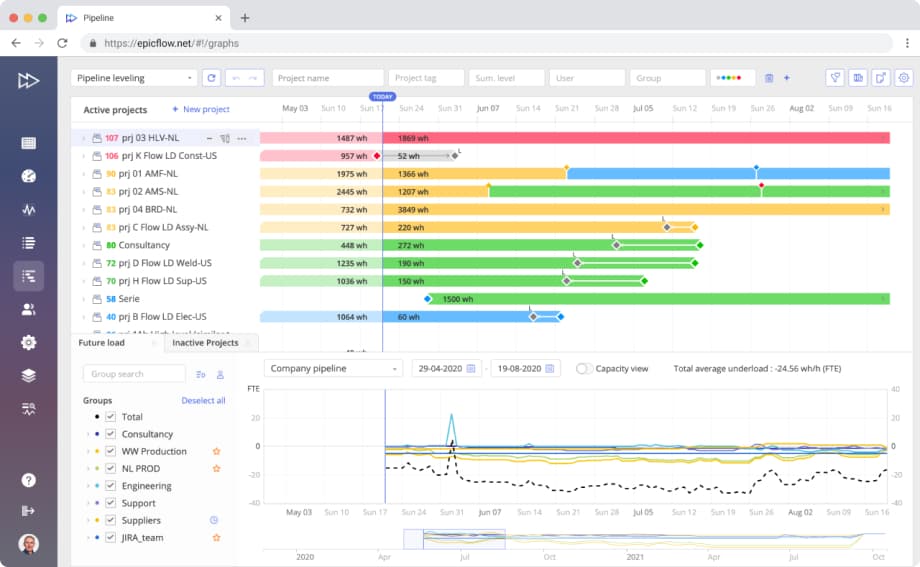
Best for: engineering-driven organizations running dozens of projects on shared specialists, where a late delivery carries contractual or revenue consequences.
Epicflow schedules every project against finite team capacity, identifies the team the portfolio is waiting on and forecasts when that queue will move delivery dates. Future Load shows load months ahead; Historical Load shows the output each team actually achieved. The Resource Allocation Advisor suggests candidates by competencies and attributes; managers confirm the assignment.
Projects can carry a cost of delay per week and contract bonus or penalty rules, so work can be ranked by value per constrained hour: what a project returns for each hour it takes from the bottleneck team. What-If tests reallocation, resequencing or added capacity without changing the live plan, and the Epicflow Portfolio Optimizer (EPO) proposes capacity-feasible sequences. Invoice Forecast and Cash Flow translate the schedule into expected invoice and payment timing. AI resources can be planned in the pool with capacity, a rate and dependencies; EpicStaff, a separate agent platform, executes the work for human review.
The Jira connector brings projects, issues and updates into Epicflow while teams keep working in Jira; confirm field mappings and any write-back requirement. Other documented connections include Microsoft Project and Oracle Primavera.
Security: Epicflow is hosted on ISO 27001-certified infrastructure and is JOSCAR-certified. The platform is penetration tested regularly by defense clients: a UK defense client as part of its own Ministry of Defence approval process, and the Netherlands Ministry of Defence. That testing belongs to the clients, so Epicflow holds no certificate for it and cannot share the reports. Deployment options are a managed cloud service, a dedicated regional deployment or a customer-managed installation inside the client’s own environment.
Limitation: effort estimates are required on tasks, and forecasts are only as good as the remaining-work data teams maintain. Economic ranking also needs defensible value and delay-cost inputs. Teams that need only a booking calendar will find this more than they need.
Pricing: Growth starts at €22.50 per person/month billed annually, with a 20-user minimum. Enterprise is quoted separately, with a 50-user minimum, and includes scenario planning and assisted allocation. Confirm which tier carries the economic and AI-resource capabilities you need. Licenses are annual even when paid monthly; a 30-day trial is available.
2. Jira Premium for capacity planning within Jira
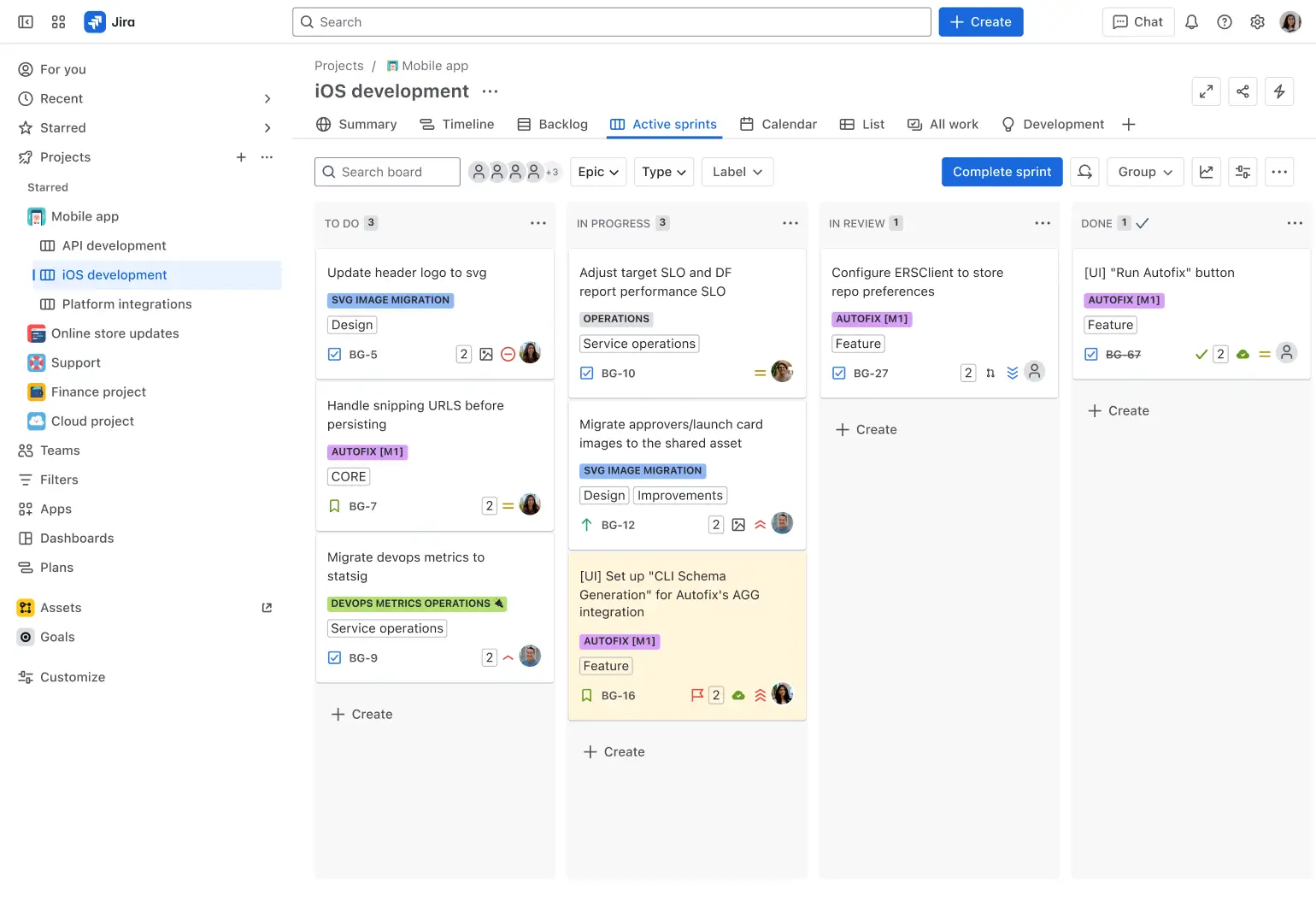
Best for: Organizations that already manage delivery in Jira and want capacity discussions tied to their work hierarchy.
Jira Cloud Premium and Enterprise include Plans, which combine work from boards, projects and filters into a cross-team plan. Teams can map dependencies, compare scenarios and schedule against capacity and velocity, the amount of work a team completes per iteration. Changes stay in the planning environment until users choose to apply them to Jira work items.
Native individual capacity planning also allocates people to projects or epics, large bodies of related work, in hours, days or percentages, with both people and work views. For communication, Plans can be embedded in Confluence through Smart Links; viewers still need the appropriate Jira permissions.
Security: Atlassian lists SOC 2 Type II, ISO 27001 and ISO 27018 among its certifications. SAML single sign-on requires a separate Atlassian Guard subscription on Premium and is included in Enterprise. Data residency can be set to regions including the US, EU, UK, Canada and Australia.
Limitation: Individual capacity plans currently assume a fixed 40-hour week and do not reflect custom working-day or time-tracking settings. Test that assumption against part-time and specialist availability. Marketplace extensions should be assessed as separate products, with their own licensing and capabilities.
Pricing: Plans requires Premium or Enterprise. Jira pricing varies by user count and billing term; use Atlassian's calculator for the relevant configuration. Marketplace extensions have separate licensing. For implementation considerations, see our Jira resource management guide.
3. EG Silverbucket for structured specialist staffing
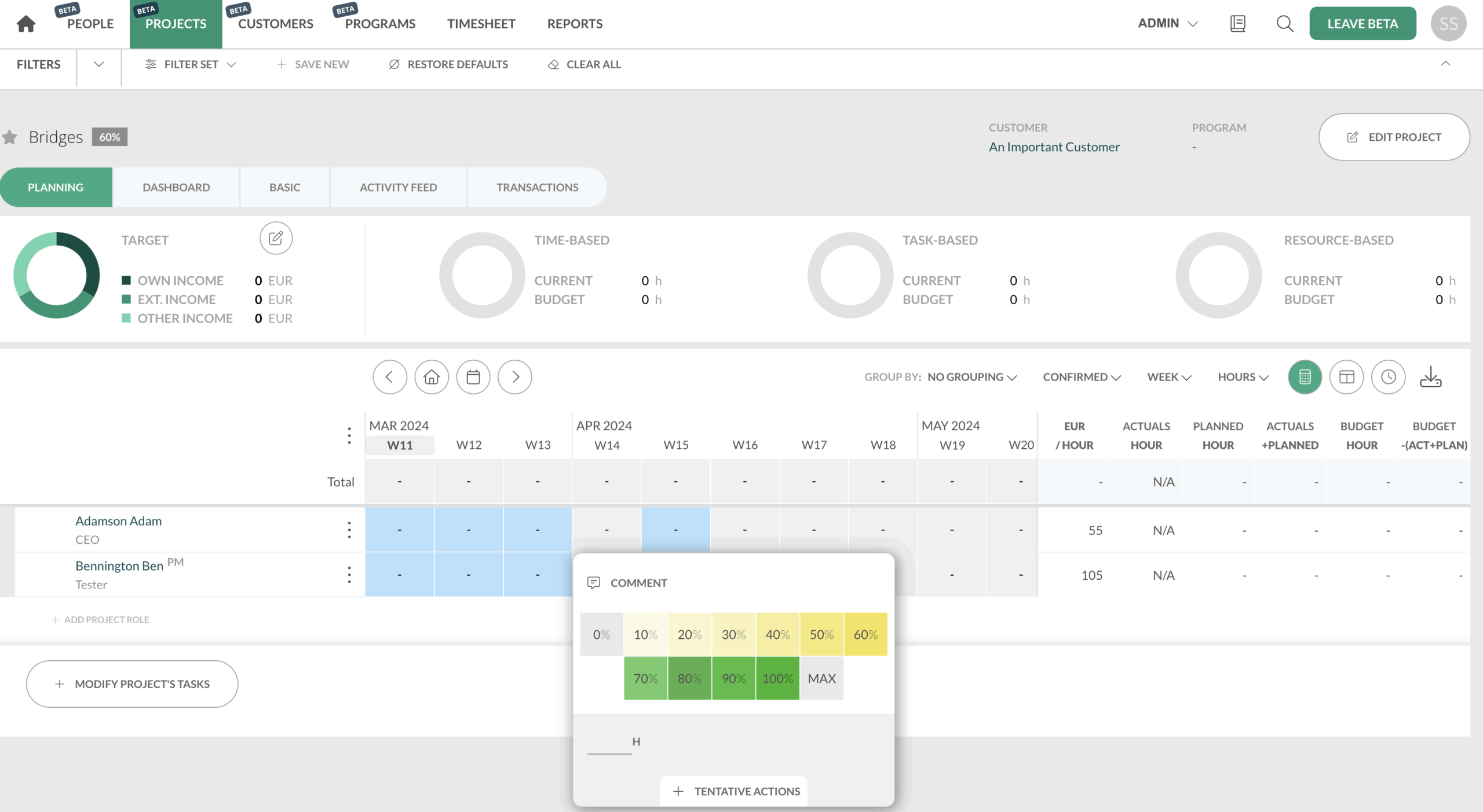
Best for: Engineering, architecture and consulting organizations that need structured staffing requests and forward visibility of specialist demand.
EG Silverbucket brings resource capacity, project demand and allocations into one planning view. Managers can reserve a percentage of a named person's capacity or use an unassigned role placeholder. Resourcing requests then let resource owners compare availability and confirm who will fill the role, connecting project demand to an explicit staffing decision.
Tentative allocations support comparisons of unconfirmed projects before commitments become fixed. Project and program milestones add context to the staffing timeline. Reporting compares planned allocations with actual hours and costs, while Power BI integration can feed resource and project data into existing management dashboards.
Security: The EG Silverbucket product and pricing pages do not publish certifications, single sign-on or hosting details. EG’s group privacy policy covers processing under GDPR and EU Standard Contractual Clauses; request product security documentation during evaluation.
Limitation: Agree the integration and time-tracking scope in the proposal. The pricing page identifies time tracking as optional and integration, maintenance and training as services available on demand.
Pricing: Vendor quote based on active people in the resource pool, rather than login users. Archived users do not count. No numeric rate is published on the current pricing page; the product offers a 30-day trial.
4. Celoxis for resource planning and portfolio controls
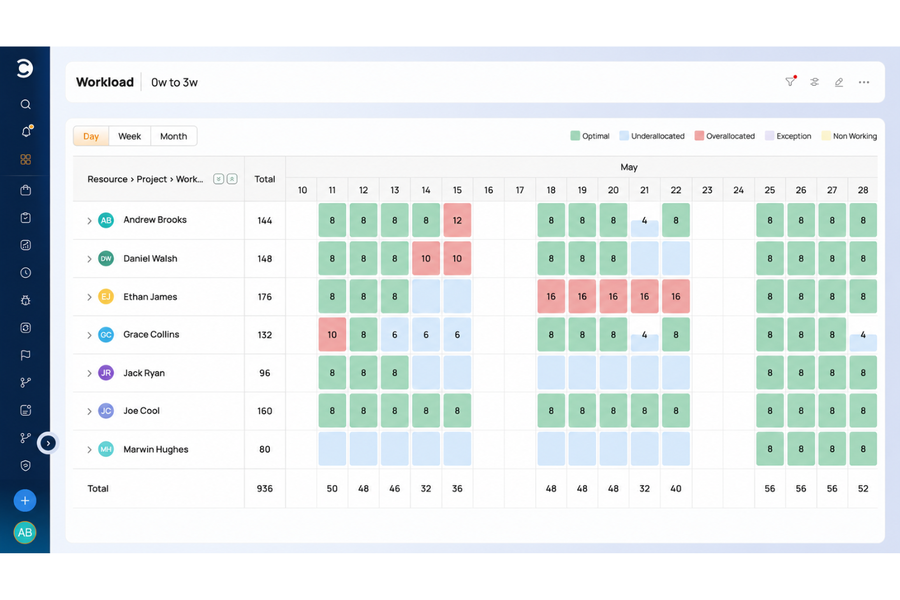
Best for: PMOs in mid-sized and large organizations that want resourcing tied to project schedules, costs and portfolio reporting. Celoxis lists manufacturing, medical devices, technology and healthcare among its industries.
A color-coded workload heatmap shows each person’s load by day, week or month across projects and flags over- and underallocation. Capacity planning by job role compares current and upcoming demand with available people. Resources are allocated by percentage or, with hours-based allocation in beta, by hours; the setting applies company-wide. Work calendars account for shifts, leave and locations, while scheduling supports inter-project dependencies.
Timesheets on the web and in the iOS and Android apps feed planned-versus-actual comparisons of effort and cost for each project. Because resource data sits next to schedules, budgets and actuals, staffing and financial reviews draw on the same records.
Microsoft Project import brings across hierarchy, dependencies, constraints and allocations. Jira and Azure DevOps connect development work, approved time can flow to QuickBooks Online, and Zapier, a REST API and webhooks support further connections. Celoxis also reports an MCP server, in beta, that lets users query projects, tasks and reports from ChatGPT, Claude Desktop and Cursor within their existing permissions.
Security: Celoxis lists SOC 2 Type II and ISO 27001 audits, GDPR compliance and SAML single sign-on. Deployment is cloud, hosted in the US or EU, or on-premise.
Limitation: Integration routes and charges vary: Jira, Azure DevOps, QuickBooks Online and Zapier are listed as add-ons below Enterprise. Hours-based allocation is still in beta.
Pricing: Core starts at US$10 per Standard user/month, billed annually. Role-based planning and instant conflict alerts start at Essentials, US$25; costing requires Professional and billing requires Business. Minimum purchase is five full-access users. The 14-day trial uses the Business feature set, so match the purchased tier to the capabilities you evaluated.
5. Parallax for staffing against sales and margins
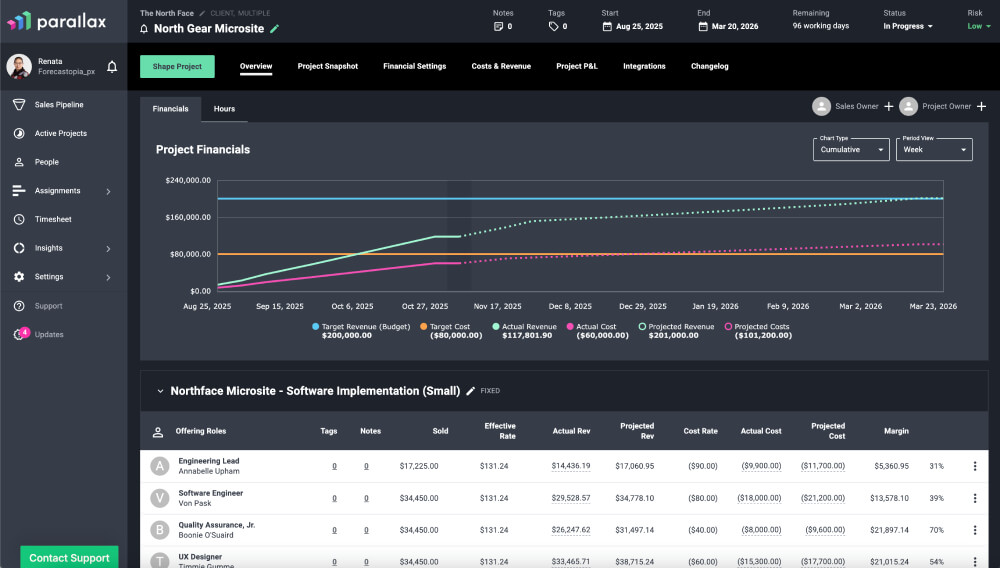
Best for: Professional services firms that need to connect sales opportunities with staffing, delivery revenue and project margin.
Parallax combines sold work and the open sales pipeline in a forecast of capacity, revenue and margin. Before winning a project, managers can compare demand with availability and assess staffing, hiring or commercial changes. Resource matching and project-margin monitoring connect those decisions to delivery performance.
Parallax connects to Salesforce, HubSpot and Harvest. In the documented Harvest connection, recorded time becomes actuals in Parallax, while Harvest projects map to service offerings within a Parallax project. This supports comparison of the delivery plan with the effort actually consumed. Parallax also offers its own Pipeline and Timesheets options.
Security: Parallax has no public security page. Its privacy policy states SOC 2 Type 2 compliance, encryption and annual penetration testing, with GDPR legal bases and transfers to the US under Standard Contractual Clauses. Single sign-on and hosting regions are not stated.
Limitation: Integration mapping and ownership need attention. Harvest access requires an administrator, and changing or archiving that administrator can interrupt the data flow. The quality of the forecast therefore depends on maintained pipeline and actual-hours data.
Pricing: Quote-based, scaled by resources managed. The public page describes configurations from 15 to 1,500 or more resources but publishes no numeric rate or billing term.
6. Resource Guru for people and equipment bookings
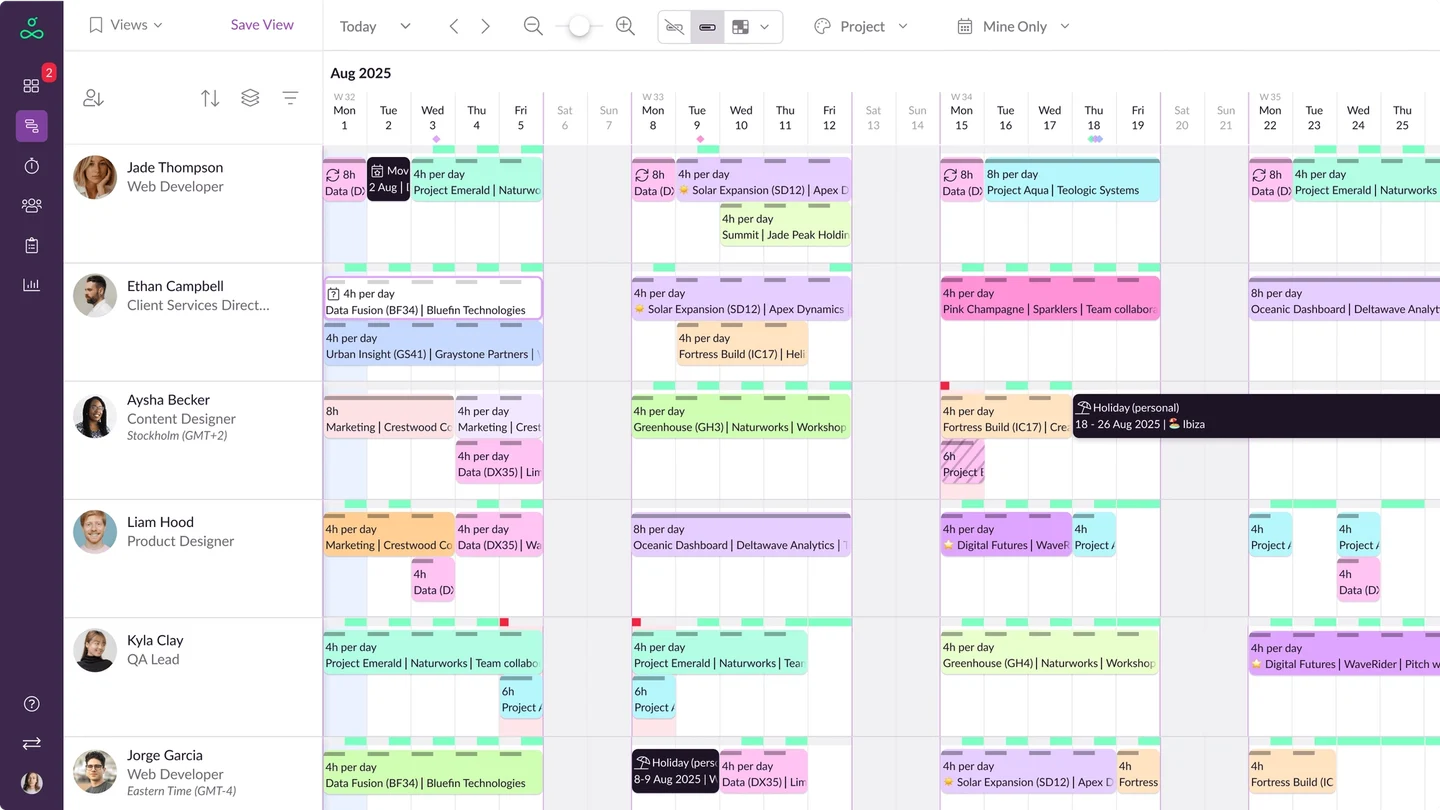
Best for: Teams that need a shared booking schedule for people, equipment and other limited resources.
Resource Guru focuses on allocation and availability. Managers can schedule people alongside equipment, vehicles or rooms, use tentative bookings for unconfirmed demand and filter resources by skills or other attributes. Clash management makes conflicting bookings explicit, with a waiting list for work that cannot yet be accommodated. Custom availability, leave and calendar synchronization help distinguish theoretical capacity from bookable time.
Its native Jira integration schedules Jira tickets in Resource Guru; Google and Outlook calendar connections synchronize events and bookings. The separate Zapier route supports additional workflows and may introduce its own subscription cost.
Security: Resource Guru states SOC 2 Type II compliance verified by independent audit and compliance with EU and UK GDPR. Data is hosted on Google Cloud. Single sign-on requires Master.
Limitation: Feature coverage changes materially by tier. Grasshopper excludes reports; Blackbelt adds reporting, timesheets, project rates and budgets. Booking approval workflows and single sign-on (SSO) require Master. Buyers who need booking governance should price that tier rather than compare only the entry price.
Pricing: Grasshopper costs US$5 per person/month on monthly billing, with non-human resources US$2.50 each. Blackbelt is US$8 and Master US$12 per person/month on the same basis. Annual billing is discounted. A fully featured 30-day trial is available without a credit card.
7. Float for visual staffing and project economics
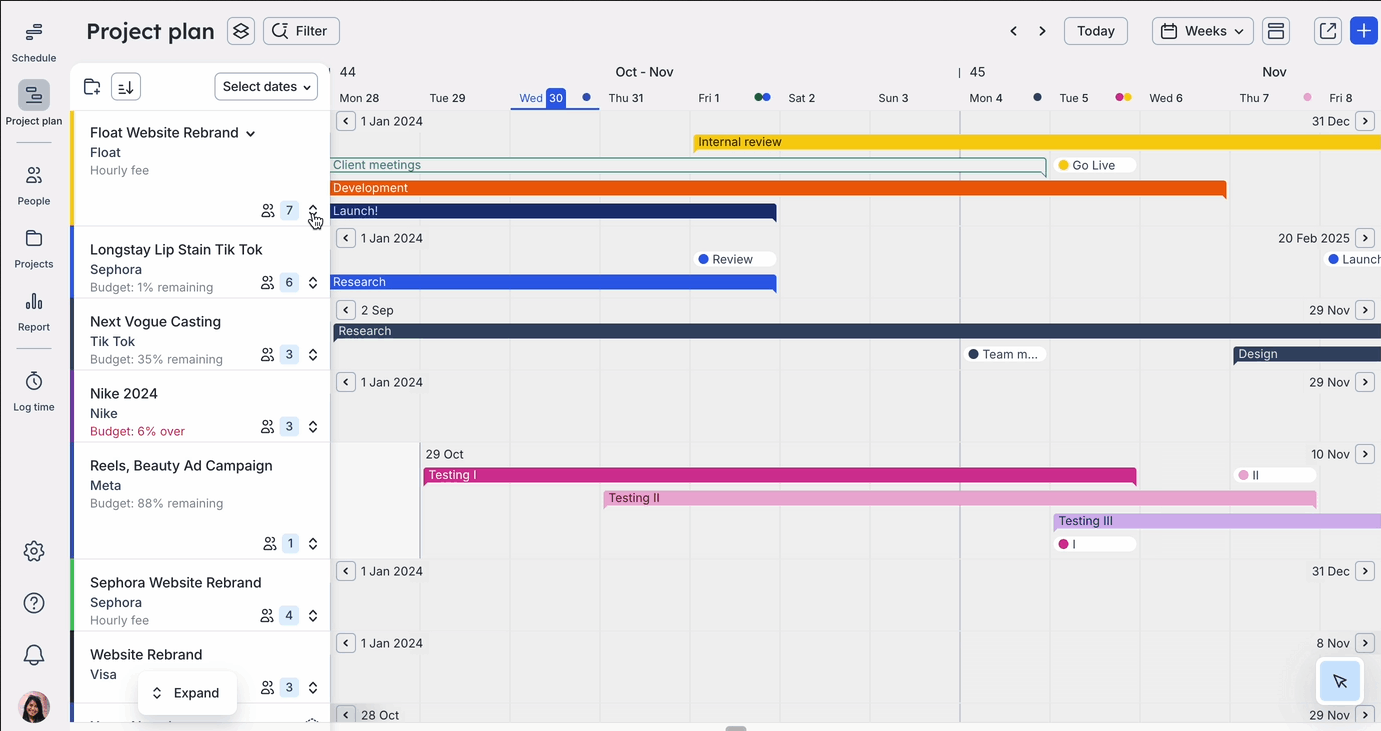
Best for: Professional services teams that want visual staffing, capacity planning and project economics in a common workspace.
Float schedules people against project work while accounting for working hours, time off and availability. Its planning features include project scoping, role suggestions and placeholders for demand that has not yet been assigned to a named person. Pro adds time tracking and compares estimates, scheduled effort and actual hours to expose departures from commercial assumptions.
The Outlook integration can import calendar events into Float and send Float allocations back to Outlook. Jira and Asana connections are currently described through Zapier, so buyers should distinguish those workflows from native calendar synchronization.
Security: Float states that it is SOC 2 certified and GDPR compliant, with data hosted on Google Cloud in the United States. Single sign-on requires Pro or Enterprise.
Limitation: Time tracking and estimates-versus-actuals comparisons require Pro. Starter includes one complimentary placeholder, while Pro includes five. Check the placeholder requirement if much of your pipeline is planned by role before named staffing.
Pricing: Starter is US$7 and Pro US$12 per scheduled person/month, billed annually. Users who only need guest access are free; Enterprise uses custom pricing. A 30-day Pro trial is available without a credit card. Monthly billing is also offered at different rates.
8. Runn for forward capacity planning
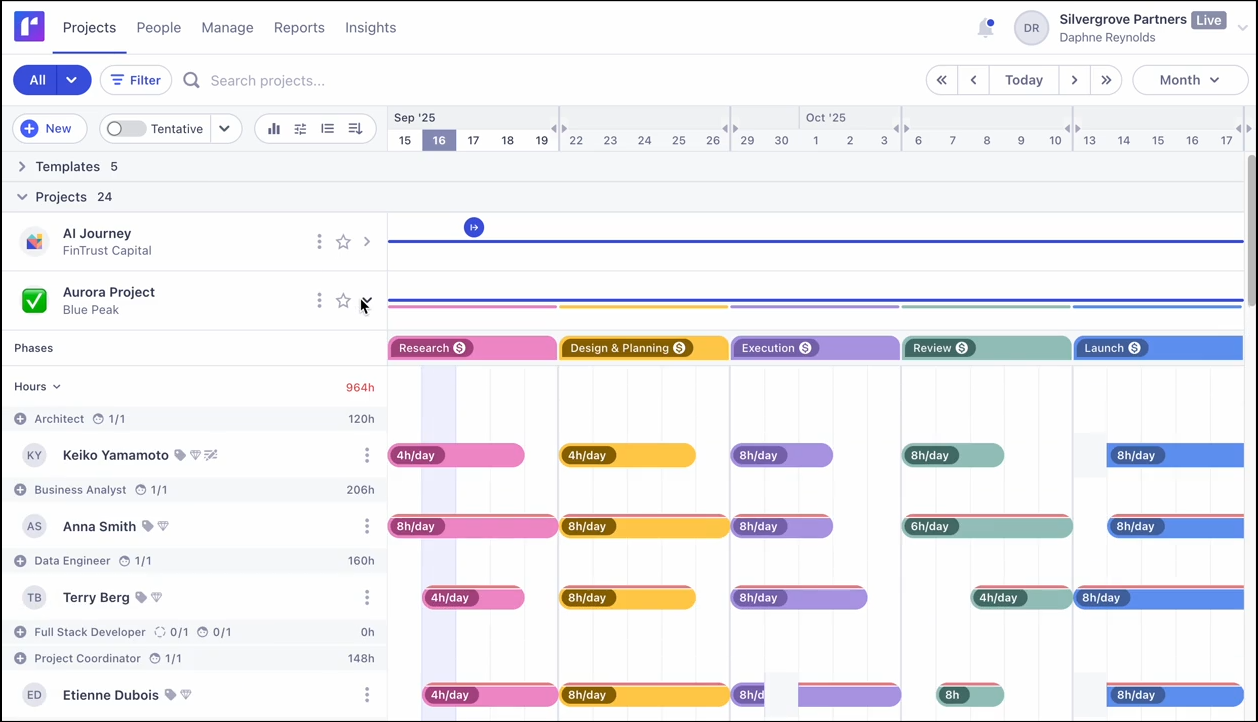
Best for: Runn suits delivery and engineering teams that need project resource planning software to assess future staffing before accepting more work.
Its resource planner brings allocations across projects into one view, while capacity and utilization charts reveal whether proposed demand fits available time. Tentative projects and placeholders let managers represent work before a named person is assigned. Role rates and project financials add a commercial view to staffing decisions.
Security: Runn states SOC 2 Type II and GDPR alignment, with hosting in US or EU data centers. SAML single sign-on requires the Advanced plan; Standard includes Google sign-in only.
Limitation: Runn positions itself as a dedicated planning layer rather than a complete project-management or professional-services-automation system. That boundary matters if the buying requirement also includes detailed execution workflows or client billing.
Its Jira connection imports projects and identifies their team members for scheduling in Runn. Confirm any requirement to synchronize Jira time records before purchase: the public integration page and help documentation currently differ on that scope.
Pricing: US$7 per resource seat/month for Lite or US$11 for Standard, billed annually; monthly billing costs US$9 and US$13. Plans start at 20 resource seats. A 30-day Standard trial requires no credit card.
9. Forecast under Accelo for pipeline demand and staffing
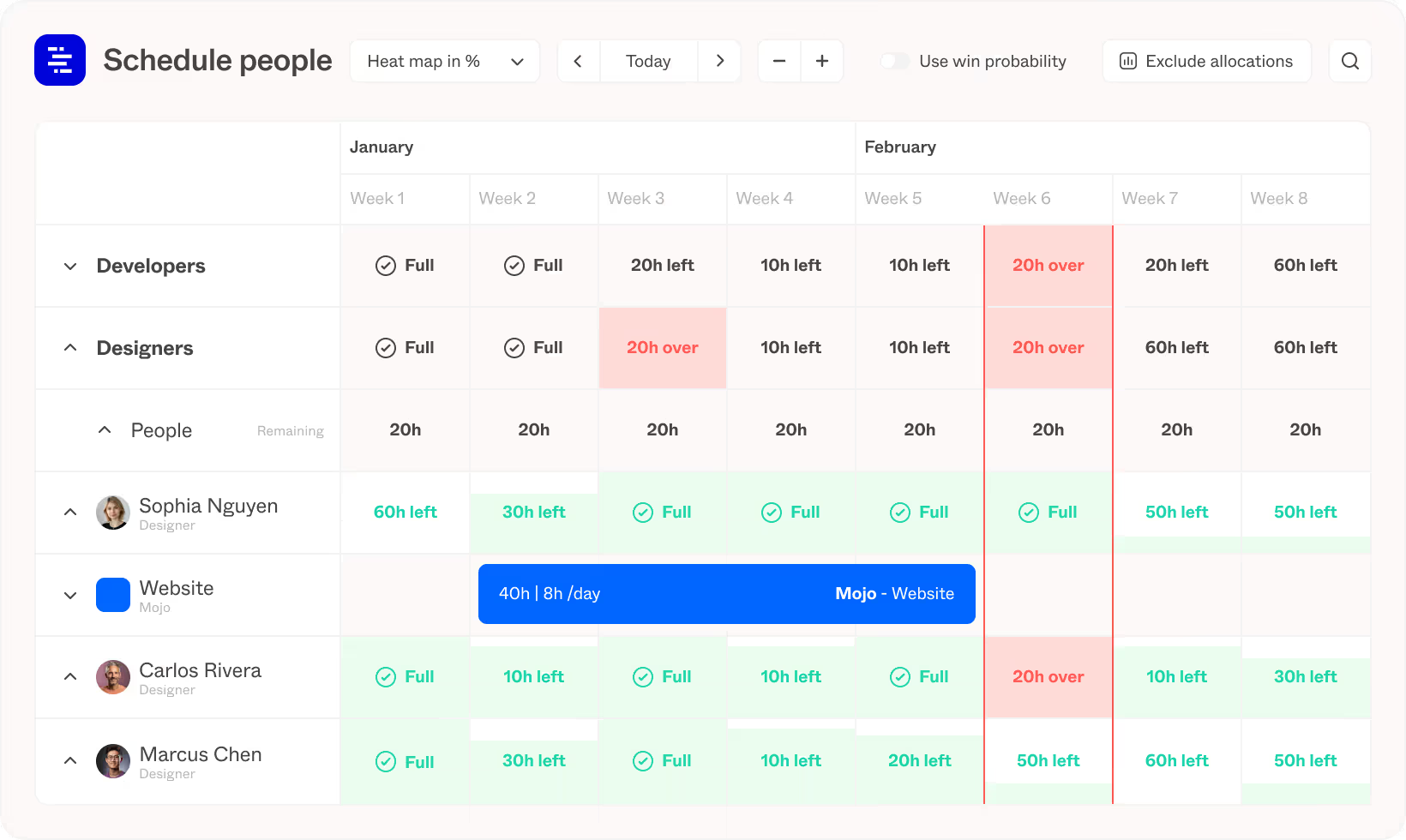
Best for: Forecast is relevant to professional-services firms connecting potential client work with staffing and financial expectations.
Its capacity-planning workflow uses role or skill placeholders before people are assigned and displays demand by win probability. Managers can test hiring or start dates, then replace placeholders with named allocations.
Soft allocations tentatively reserve a person's time for unconfirmed work; hard allocations commit time to confirmed work. Both affect utilization in the applicable project-allocation mode.
Jira integration supports two-way linking of issues and Forecast tasks, bringing delivery activity into the planning workflow.
Security: Accelo holds a SOC 2 Type 2 report, available to subscribers under NDA. Forecast data is processed in the EU on AWS in Ireland. Okta single sign-on is documented; the required plan is not stated.
Limitation: A documented boundary is its maximum three-level task hierarchy: deeper Jira items are excluded from synchronization. Capacity planning also depends on the configured resource-management mode.
Forecast completed its brand and website integration with Accelo on 28 May 2026. Existing Forecast logins, data and integrations remain intact, but the former pricing page now leads to Accelo’s custom-quote page.
Pricing: Request a quote specifying the product configuration, capacity features and Jira connector. A current standalone Forecast price, minimum user count and trial entitlement were not confirmed in the public sources reviewed. Do not budget using older standalone price cards.
10. Mosaic for collaborative staffing and hiring forecasts
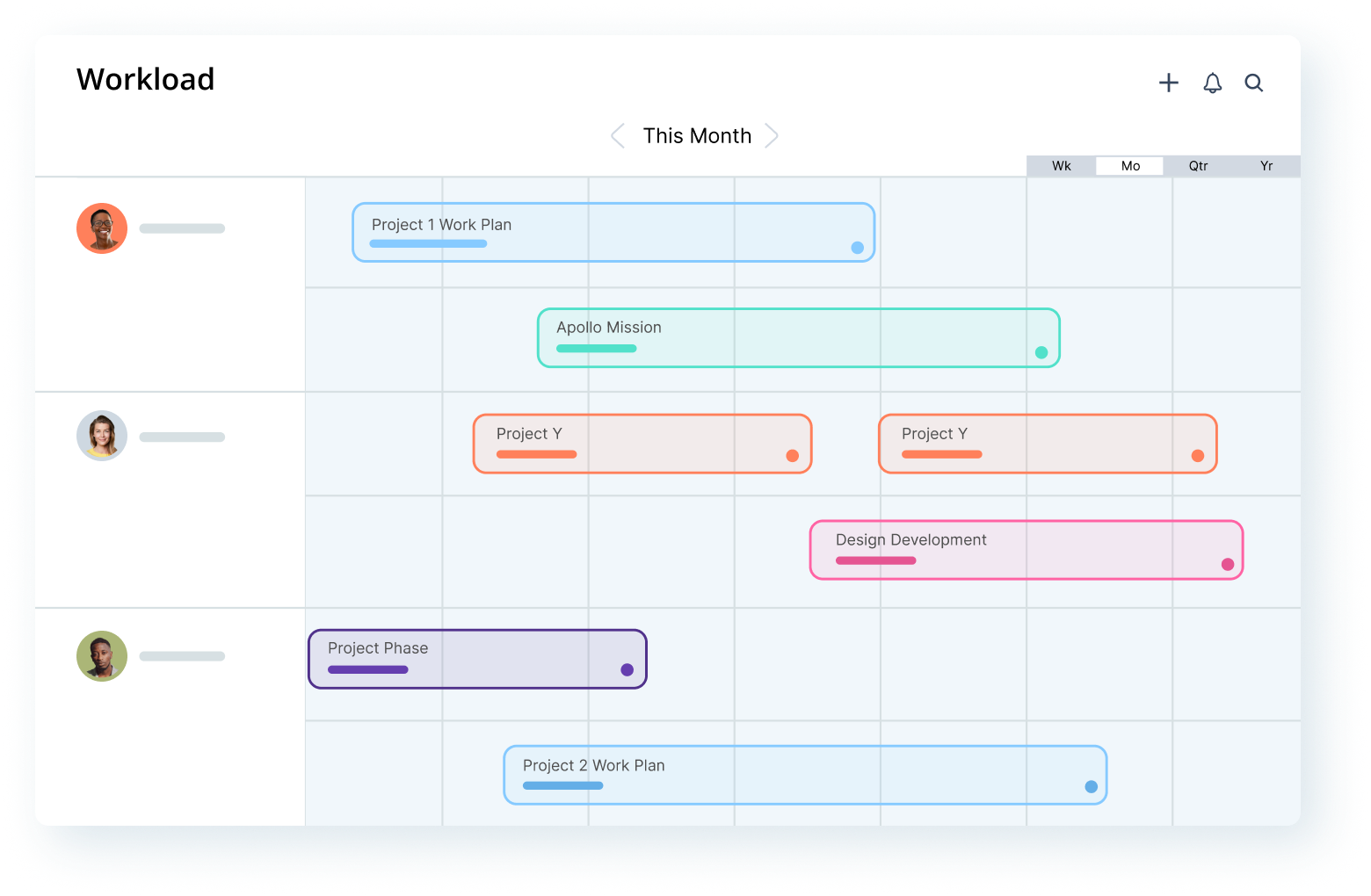
Best for: Mosaic suits project businesses that need managers to coordinate staffing across teams and identify future hiring needs.
Its people and project planners connect schedules with available capacity; a workload heatmap highlights overloaded and underallocated people. Role-demand analysis compares incoming requirements with existing capacity, while workload forecasting draws on planning, budget and pipeline inputs.
Asana integration pulls employees, projects, sections mapped as phases, milestones and tasks into Mosaic. The mapping is documented, so buyers can check whether the planning information they rely on will survive the connection.
Security: Mosaic states an annual SOC 2 Type II examination and acts as a GDPR data processor under a DPA. Data is hosted primarily on AWS in the US, with other regions by contract. SAML single sign-on is included in Enterprise and a paid add-on below it.
Limitation: Professional includes utilization, workload and budget reporting; workload, revenue and hiring forecasts sit in Enterprise. The pricing page states that integrations carry additional charges. Do not assume a connector or forecasting capability is included in the starter subscription.
Pricing: Base subscription rates are not published. Mosaic’s terms refer to contracted per-user pricing and an agreed billing frequency; confirm currency, minimum seats and the complete quote. An official resource-management landing page advertises a 30-day free trial.
11. Productive for staffing and professional services finances
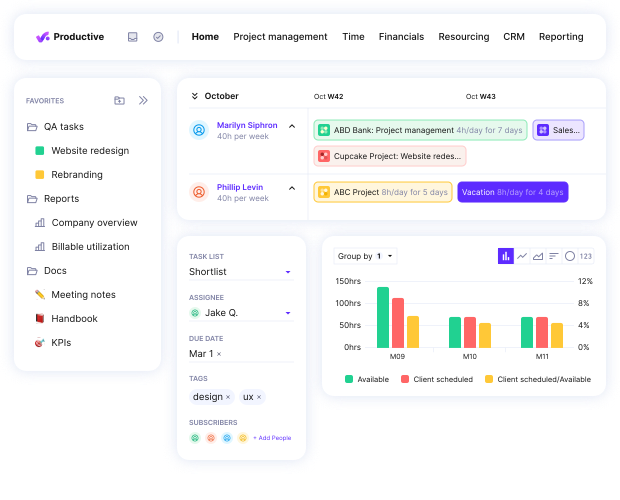
Best for: Productive is a strong fit for agencies, consultancies and other service businesses that need staffing decisions to connect with project budgets.
Its resource planner combines bookings, available capacity and time off. Tentative bookings and placeholders let managers represent prospective work or future hires before assigning a named employee. Scheduled work informs cost and margin forecasts for assessing another engagement’s feasibility.
Its broader workflow includes time tracking, budgeting, invoicing and utilization reporting. The integration directory distinguishes concrete exchanges: BambooHR can synchronize time off, Xero can receive invoices and expenses, and Slack receives notifications and task updates. API access supports further connections.
Security: Productive states SOC 2 Type II, confirmed by independent audit, and offers a GDPR DPA with Standard Contractual Clauses. Data is hosted on AWS in Ireland. SAML single sign-on is available on all plans; enforcing it requires Ultimate.
Limitation: The published comparison places revenue forecasting and Scenario Builder in Ultimate; an entry-level resource-planning subscription does not include every financial capability.
Pricing: All plans require at least three seats, and a 14-day trial is available without a credit card. Numeric pricing was not confirmed for this comparison. Use the live calculator to establish the rate and billing term for your seat count.
12. Milient Resource Flow for skills based scheduling
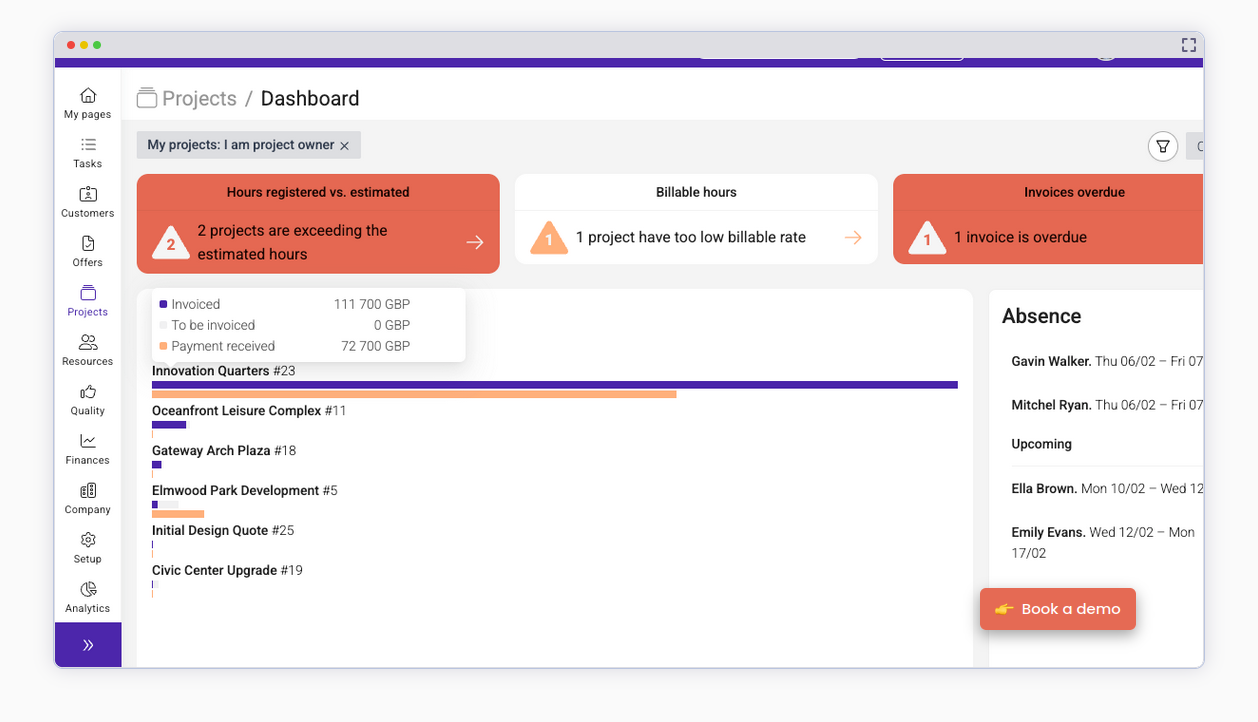
Best for: Milient Resource Flow, formerly Hub Planner, suits consultancies and professional-services teams coordinating people across several projects.
Its scheduler brings availability, workload, skills and time off into one view. Managers can filter the resource pool by skills, role or location, then adjust assignments against project dates. Forecasted-utilization reports expose future capacity pressure, while timesheets support comparison with actual work.
Resource Flow is a specific Milient offering; it should not be treated as a generic label for every capability in Milient’s wider suite. Its documented integrations include calendar booking visibility, Slack notifications, Basecamp project/resource synchronization and an API for custom connections. Verify the exact solution and data exchange; Milient distinguishes integrations from file transfers.
Security: Milient states GDPR-compliant processing under EU and Swedish and Norwegian law; no vendor-held security certification is published. Single sign-on and multi-factor authentication require Business Leader.
Limitation: Premium adds skills matching and timesheet approvals; Capacity Finder and Smart Schedules are in Business Leader. Onboarding costs extra. Compare the tier needed for the decision you want to make, rather than only the scheduler’s entry price.
Pricing: The UK pricing page lists Plug & Play at £7, Premium at £18 and Business Leader at £54 per resource/month on annual pricing, with a 14-day trial.
13. ProjectManager for workload within project delivery
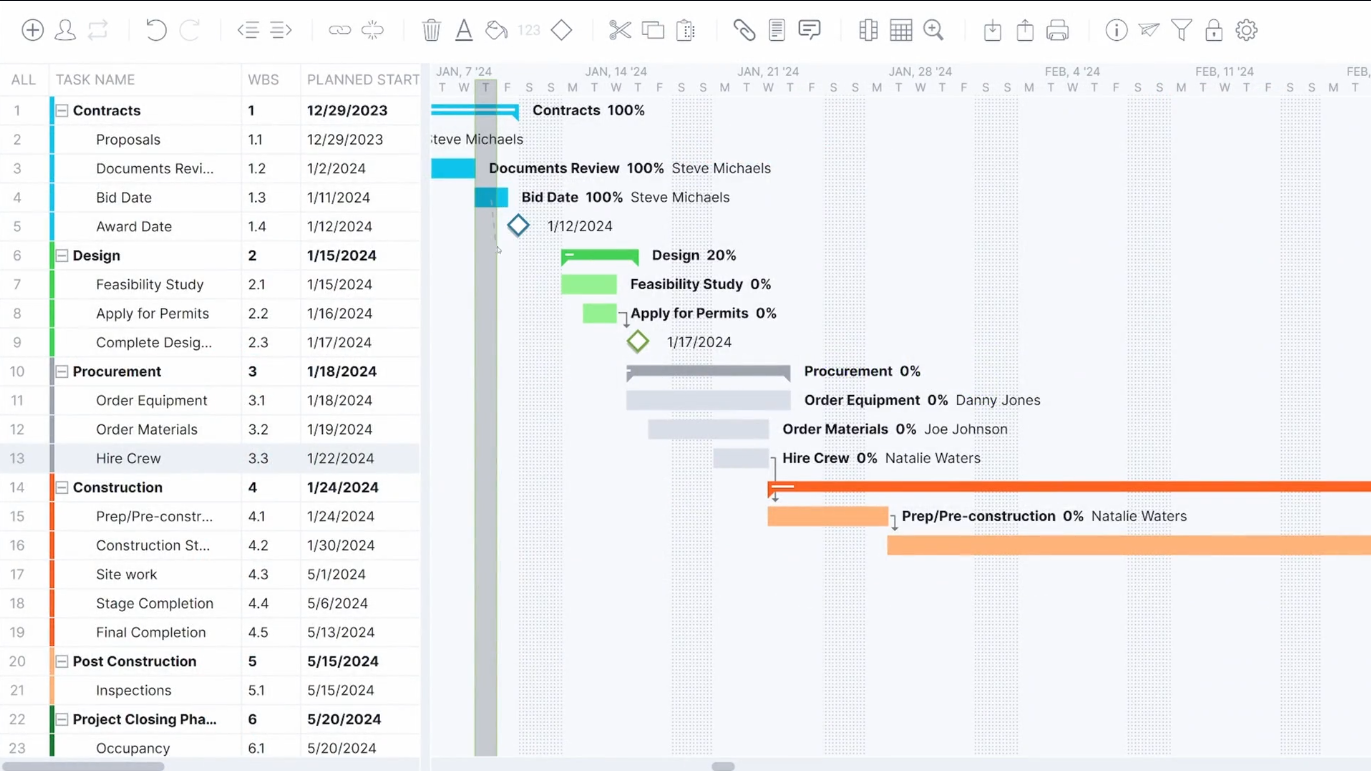
Best for: ProjectManager is a useful candidate for teams that want project and resource management software, with resource decisions inside a broader project-management workspace.
Managers assign planned effort, set working days and leave, and inspect workload before reallocating hours or tasks. Its Gantt views combine dependencies with costs and effort, while timesheets and dashboards bring actual work back into the plan. Managers can identify overload, move an assignment and monitor delivery and labor costs.
Security: ProjectManager monitors SOC 2 Type 2 compliance through Drata and lists SOC 2 Type 2 certification as an Enterprise feature. Services are hosted on AWS in the United States. SAML single sign-on requires Enterprise.
Limitation: Business is the relevant plan for this comparison. It includes resource management, workload planning, timesheets, portfolio dashboards and advanced reports; the entry Team plan focuses on project planning and collaboration.
Business also documents QuickBooks Online synchronization of approved hours and actual task costs, plus Slack and Microsoft Teams integrations. Native Power BI and Excel integrations are listed under Enterprise; API access is listed in Team.
Pricing: The commercial model is per user/month with monthly or yearly billing, and a 30-day trial has no credit-card requirement or user minimum. Numeric pricing was not confirmed for this comparison. Confirm the applicable rate and project limits before purchase: Business currently allows up to 100 projects, while Enterprise offers unlimited projects.
14. Microsoft Project Professional 2024 for desktop scheduling
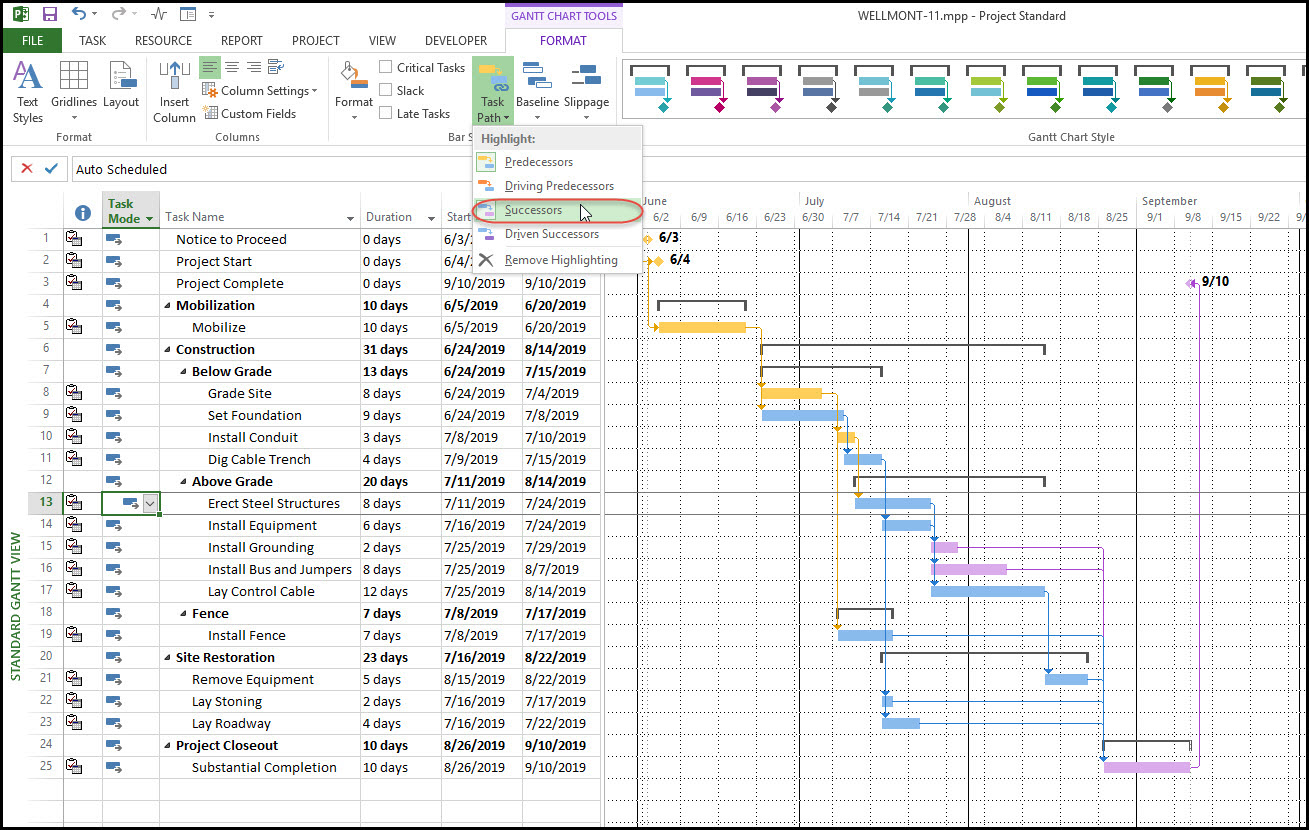
Best for: Microsoft Project Professional 2024 is appropriate when experienced planners need a Windows desktop tool for dependencies, resource assignments and schedule analysis.
As project resource scheduling software, it builds dates from task relationships, saves a baseline for comparison with later progress, and provides resource reports.
Resource leveling can delay or split tasks to remove overallocation; task and project priorities influence the calculation. It does not select a different person, and resolving overload can move the project finish date. Test the resulting schedule and the process for coordinating shared specialists.
Security: Project files stay on the user’s PC or on a customer-run Project Server, so protection depends on the organization’s own controls. Microsoft’s ISO 27001 scope covers its cloud services, not the perpetual desktop app. Support for Project 2024 ends on 9 October 2029.
Limitation: The desktop license does not itself include an online enterprise resource-management service. The Microsoft Store documents Project Server synchronization and separately licensed Teams collaboration.
Pricing: The US Microsoft Store lists Project Professional 2024 at US$1,129.99 for a perpetual license on one PC. This profile does not describe Planner or Project Online. Microsoft names 30 September 2026 as Project Online’s retirement date and states that Project desktop is unaffected. Organizations replacing that online service need a separate evaluation of collaboration, migration and portfolio requirements.
15. Paymo for scheduling time and billing in small teams
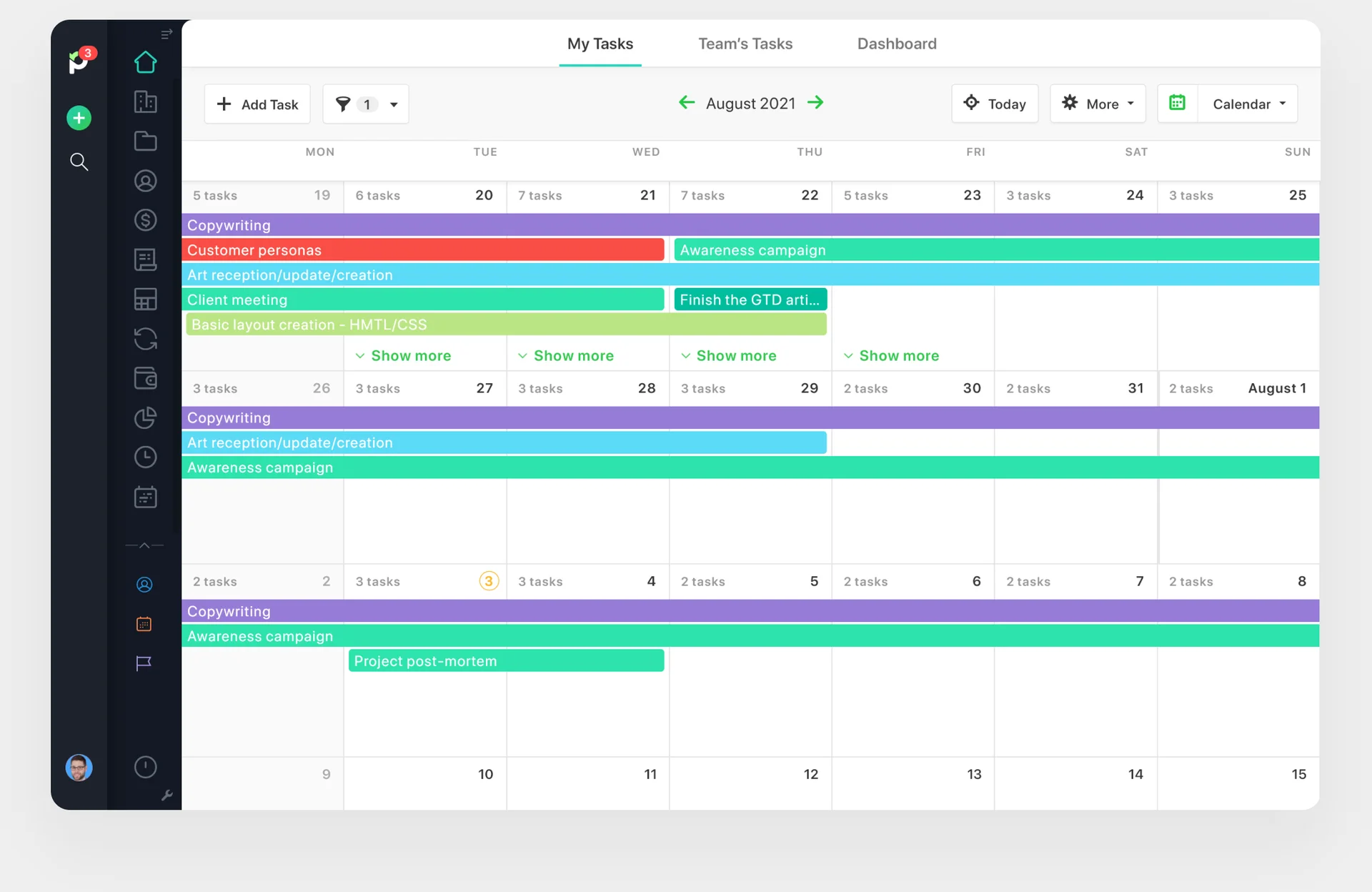
Best for: Paymo fits small client-service teams that want task delivery, resource scheduling and billing in the same workspace.
Its scheduling timeline shows bookings by employee or project, flags overbooked and underbooked people, and lets managers change bookings by dragging or resizing them. Leave appears in the same schedule, helping prevent apparently available hours from becoming unrealistic commitments.
A distinctive mechanism is automatic ghost bookings. Paymo creates provisional bookings from existing task details, which a manager can convert into confirmed bookings. Time tracking, project profitability and invoicing complete the service-business workflow.
Integration scope is documented clearly: Google Calendar supports task/event updates, Slack can create tasks and track time, and QuickBooks Online can receive invoices and return payment information. Zapier and Make provide additional automation routes.
Security: Paymo describes a risk-based information security program and GDPR commitments, including a named data protection officer and 72-hour breach notice. Data is hosted on AWS; no security certification or single sign-on option is published.
Limitation: Resource scheduling, workload, leave management and ghost bookings require Pro.
Pricing: Its regular monthly price is US$23.90 per user on monthly billing. A 15-day trial is available. The free plan is limited to one user and two projects and excludes team scheduling.
Features That Change Resource Decisions
Epicflow co-founder Albert Ponsteen explains: “But in multi-project management, you have to start with something you share among all those projects – human resources.” The comparison below applies this principle to two projects needing one specialist, a situation that not any project resource management tool can handle. It covers selected documented mechanisms, not trial results or complete feature inventories. Both projects must be represented in the planning data; tiers and configuration apply.
| Planning question | Resource Guru | Microsoft Project desktop | Epicflow |
|---|---|---|---|
| What does it detect? | Bookings exceeding recorded availability or clashing with other bookings. | Resource demand exceeding availability in the schedules being leveled. | Future overload, the team the portfolio is waiting on, and what each week of delay costs. |
| What action is supported? | Reschedule or reassign bookings; put unresolved work on the waiting list. | Delay or split tasks through resource leveling; assignees stay unchanged. | Test reallocation, resequencing or added capacity, human or AI, in What-If; EPO proposes capacity-feasible sequences. |
| What changes afterward? | Booked time, availability and clash indicators. | Assignment timing and task dates; the finish date can move. | Delivery forecasts, cost of delay, predicted penalties and expected payment timing. |
| What does the manager decide? | Booking priority and whether a substitute is qualified. | Priorities, leveling settings and whether resulting dates are acceptable. | Which scenario to implement and whether planning and financial assumptions are valid. |
Capacity planning and availability
Can the organization meet projected demand with the people and skills available? Resource planning software should expose working calendars, leave, part-time hours, operational support and tentative demand across the relevant planning horizon. A resource planner tool that shows only headcount cannot answer that question, so compare project resource planning tools on these inputs rather than on how their calendars look.
Ben Rawson, founder of Flow Economics, writes in Phantom Capacity: “Plan against demonstrated capacity, not nominal capacity.” Reconcile recorded availability with competing demands on specialists. See resource capacity planning for the underlying process.
Demo question: Make one qualified specialist unavailable next week and commit one tentative project. Does the product update a view, recalculate a forecast or require a manually built alternative?
Allocation scheduling and skill matching
Who should do the work, and when can it be scheduled? Resource allocation software should distinguish available people from qualified candidates. Check roles, skills and required approvals; a searchable skills field does not establish automatic matching. Resource scheduling software should also show when each assignment happens. Compare resource scheduling tools on whether changing a date updates availability, and test them on a real conflict rather than a clean demo calendar.
A useful resource allocation planning tool exposes conflicting assignments and supports a feasible change across affected projects. A resource allocation tool or resource allocation management tool that only lists names does not meet that test. Establish whether resource allocation tools book a suggested match immediately or hold it for approval.
Rawson's Full Kit adds a readiness test: inputs, decisions and access must be ready before scarce expertise is committed. A booking against incomplete inputs may consume attention without progressing the deliverable.
Demo question: Find a qualified substitute and change the assignment. Show affected dependencies and approvals. Compare the scheduling process with the product's resource scheduling workflow.
Utilization tracking and remaining work
Does the plan reflect work still to be done? Resource tracking software can follow assignments, availability and effort. Time tracking is resource tracking tools record effort already spent; forecasting also needs estimates of remaining work. Forty hours logged does not establish that a task is nearly finished.
Utilization expresses a defined category of work as a share of available time over a stated period. A resource utilization tool may show planned, actual or billable hours. Compare the available-hour basis as well: excluding leave changes the denominator and therefore the percentage provided by resource utilization software.
Rawson's analysis of queuing and variability explains why average utilization alone cannot settle waiting time. Examine uneven arrivals, work sizes, queues and completed output before pursuing higher utilization.
Demo question: Increase remaining effort without changing logged hours. Which forecasts change, and what time does the utilization measure include?
Forecasting and scenario planning
What happens under the current plan, and under a different assumption? Resource forecasting software projects demand and capacity from its inputs; a scenario deliberately changes those inputs. Neither promises a probability or confidence level.
Check tentative work, unassigned roles and realistic calendars. Scenarios should identify changed assumptions and preserve the operational plan until approval. A hiring alternative needs a plausible start date, skills and onboarding allowance. An instantly productive placeholder can conceal the actual staffing problem. On project timing, Epicflow co-founder Jan Willem Tromp notes, “Starting later sometimes really does mean finishing faster”. See the scenario planning tools comparison.
Demo question: Compare a later project start with additional qualified capacity. Show differences in demand and delivery dates while retaining the original plan.
Shared resource bottlenecks and priority conflicts
Which work gets scarce capacity next, and what moves elsewhere? Over-allocation means demand exceeds availability in a defined period. A delivery constraint limits completion across the system. A red workload bar does not by itself identify that constraint.
Rawson writes, “Value per constrained resource hour is the single number that ranks work by what it returns on your scarcest resource.” Use defensible values and comparable scope, and respect mandatory commitments. Epicflow computes this ranking from the resource-constrained plan; in other tools, check whether it is supported or must be built by hand.
His Expedite Tax highlights displaced work: advancing one job can delay another. Where supported, inspect both delivery effects and the resulting contractual exposure or payment timing.
Pricing delay makes the trade explicit. If each week of delay on a project carries a cost, moving the specialist becomes a comparison of two numbers. Stephen Devaux called that figure drag cost.
Demo question: Reassign the specialist to the urgent project. Show consequences for every affected project and assumptions behind any financial estimate.
Integrations and data maintenance
How will the plan stay consistent with the systems people use? Identify where assignments, calendars, skills, progress, remaining work and financial inputs are maintained. An API enables development; it is not a finished connector.
Check exchanged fields, direction, update frequency, permissions and conflict handling. A one-time import differs from continuing synchronization. Assign responsibility for failed updates and duplicate resources. Where security certification matters, verify the certified entity and scope; a customer logo proves neither.
Demo question: Change progress in the source system. Show what updates in the plan, what stays unchanged and who resolves conflicting edits.
AI support and AI resources
What does AI do? Planning assistance summarizes information or suggests assignments. An optimizer proposes portfolio alternatives. An executable AI resource performs assigned work. Each requires different inputs, costs and controls.
Many organizations now find that AI makes every team faster while delivery dates stay put, because output is set by the team everything waits on. Before crediting an AI resource with capacity, apply three tests: is anything waiting on the work, does the wait cost real money, and can a machine do it well enough for a person to sign off? Epicflow plans AI resources alongside people, an approach often called agents as a resource, and points them at the bottleneck; EpicStaff executes the work with human review. Rawson explains the constraint principle: “Releasing work upstream faster than the constraint can consume it does not speed delivery, it builds the queue that slows it.” For AI resource management, count accepted output together with human review and rework effort.
Demo question: Show the input, AI action, human decision, failed-output handling and acceptance. Which constrained human hours are recovered after review and rework?
Which Resource Management Tools Fit Your Team
Engineering and multi project PMOs
Engineering resource management software should handle the relationships between scarce expertise, technical approvals and delivery commitments. In aerospace or manufacturing, a certification specialist may support several projects while an upstream design change shifts the required review window. Evaluate skills, dependencies and the effect of reallocating that specialist across the affected plans. Project resource allocation software should make that effect visible before a change is committed. Engineering resource planning software that cannot show such a review window leaves the planner to track it by hand.
Defense portfolios show what is at stake. At the Dutch Ministry of Defence, an analysis of resource-based prioritization found that expected on-time performance could rise from 24%, the customer’s own baseline, to 77% with no increase in headcount, and that the top half of projects by business value could be delivered up to 424 days earlier. The analysis predates Epicflow’s optimizer and AI layer.
Shortlist Epicflow when you need to know which team the portfolio is waiting on, what that wait costs, and where added capacity, human or AI, moves delivery dates; EG Silverbucket when structured staffing requests and role-based allocations are central; and Celoxis when resourcing must sit within broader project and financial controls. PMO resource management software should be judged on who owns the data as well as on features. Use the PMO resource management guide for governance and ownership beyond the software comparison.
IT project teams
Here, IT resource management software means planning people's delivery capacity. It does not mean managing servers, cloud consumption or an IT asset inventory, and the same holds for IT resource management tools. Jira Premium can serve as project resource management software for teams already planning work in Jira. Test individual availability and cross-team dependencies in the exact configuration, then establish whether an additional resource layer is justified. Resource project management software that starts from the project plan may still need that extra layer for shared specialists.
Agencies consulting and professional services
Agency resource management software aka professional services resource management software may need staffing alone or a wider commercial workflow. Professional services automation, or PSA, connects functions such as resourcing, project delivery, time and financial administration. Consider Parallax for sales-pipeline demand and staffing, Productive for staffing connected to budgeting and invoicing, and Resource Flow for skills-based scheduling. Required tiers still matter. PSA resource management reaches beyond staffing, so the best PSA software for resource management is the one that covers the functions your firm actually uses. Standalone resourcing tools cover staffing only, so compare them with the time and finance functions a PSA adds.
For consulting resource management software, inspect how tentative sales opportunities become staffed commitments, which rates drive the financial view and where invoices are produced. Utilization reporting alone will not explain margin if budgets, discounts or subcontractor costs sit elsewhere.
Small teams and bookable assets
A small team with a stable calendar and no material cross-project conflicts can reasonably choose simple team resource management tool for scheduling. Resource Guru or Float may warrant evaluation; a carefully maintained spreadsheet can also suffice when one owner can keep the whole plan accurate. Resource management software for small business, like resource management apps generally, should be judged by this maintenance effort and the necessary subscription tier. The best resource scheduling software for such a team is the one that stays accurate with the least upkeep.
If equipment or rooms matter, check their support explicitly. Resource Guru distinguishes human and non-human resources commercially. Do not infer equipment scheduling from a vendor's manufacturing audience, or assume that every kind of resource uses the same calendar and license.
Resource Management Software Pricing and Free Options
Compare the configuration you need rather than the smallest number on a pricing page. When choosing the best resource management software for enterprise use, compare tier-gated features such as single sign-on and forecasting, not only the entry price. A planner license, a scheduled person and a non-human resource can be different billable units. Annual billing also differs from an annual commitment paid monthly. Epicflow, for example, states that licenses are annual even where monthly payments are available.
Prepare one buying scenario with a fixed number of planners, scheduled people and equipment items. Add the capabilities that drove the shortlist, such as scenarios, skills, financial reports or source-system synchronization. Obtain a quote for that exact arrangement. Check minimum seats, implementation, training, support and any separately priced integrations or AI usage. Do not assume an unlisted cost is included.
Four offers need separate treatment:
- An ongoing free plan remains available within stated limits. Jira's free tier does not include the Premium planning configuration reviewed here; Paymo's free offer also differs from its scheduling tier.
- A time-limited trial lets a buyer evaluate software for a defined period. Establish which features and data remain accessible when it ends.
- A guided demo shows the product with vendor assistance. It does not provide continuing free access to the software.
- A paid pilot is a scoped evaluation with its own commercial terms. Agree on data preparation, support and acceptance criteria before committing.
Free resource management tools can suit simple workflows. Evaluate their limits against maintenance effort and the decisions your team needs to make.
How to Choose Resource Management Software
Begin with a decision your team cannot make reliably today. Define the resource types, planning horizon, source systems and consequences the resource management platform must reveal. Shortlist two or three products, then use the same representative data in each evaluation. Record who maintains calendars, remaining effort and priorities; those responsibilities continue after purchase.
Test two projects sharing one specialist
This fictional test assumes one qualified specialist has 32 available hours next week. Project A requires 24 hours, and Project B requires 20 hours in that week. Neither task has a substitute, and no overtime or alternative calendar is assumed.
| Planning input | Hours next week |
|---|---|
| Project A demand | 24 |
| Project B demand | 20 |
| Combined demand | 44 |
| Available specialist capacity | 32 |
| Capacity gap | 12 |
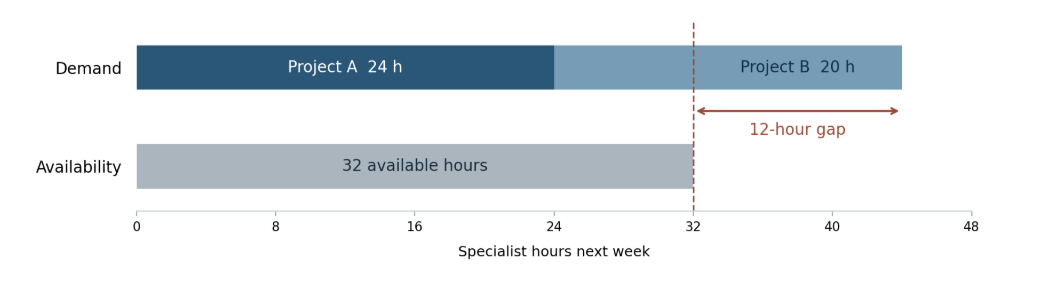
Ask the vendor to show the 44-hour demand against the 32-hour capacity across both projects. Identify the assignments and skill requirements causing the conflict, then compare three interventions: defer twelve hours, add verified qualified capacity, or reduce the workload. Keep the original plan available for comparison.
Inspect the effect on both projects. Does the software recalculate dates, display a warning, retain manual alternatives or leave consequence analysis to the planner? The twelve-hour gap does not determine priority or prove a twelve-hour delivery delay. Deadlines, dependencies and contractual conditions are still needed.
To test economic prioritization, add explicit fictional assumptions: only one deliverable can finish this week, all other inputs are ready, and the two options are independent. Completion by Friday preserves an all-or-nothing contribution of €24,000 for A using 24 specialist hours, or €30,000 for B using 20 hours. Here, contribution means revenue preserved by Friday completion minus incremental delivery costs, calculated consistently for both options; the specialist's unchanged fixed salary is excluded. Partial work preserves none of these amounts this week. That is €1,000 versus €1,500 per constrained hour. B takes priority under these assumptions.
The twelve remaining hours cannot complete A. Mandatory commitments, effects on other projects or different future values could reverse that choice; these amounts are neither vendor results nor invoice forecasts.
For a separate financial test, assume a scenario moves an invoiceable milestone 14 calendar days later, with payment terms unchanged. Ask a product claiming schedule-linked forecasts to show the expected payment shift. Fourteen days is an additional input, not a result calculated from the twelve-hour shortage. Later expected cash does not itself establish lost revenue.
For an AI test, let an agent prepare a first-pass output and include the qualified person's review and rework. Compare the total human effort and the queue for acceptance before crediting any capacity saving.
Record evidence and operating effort
Classify each result as demonstrated in the relevant configuration, documented but not tested, dependent on a tier or integration, or not confirmed. Record setup effort, changed assumptions, approval responsibility and unresolved commercial questions. Select the tool that demonstrates the required result under realistic conditions, recording any unresolved dependency.
Choose the Tool That Supports Your Resource Decisions
A booking calendar, a capacity forecast, a commercial delivery system and a resource-constrained portfolio plan solve different problems. Choose the depth your work requires, then verify it with realistic availability, shared assignments and the systems your team maintains.
If several mission-critical projects compete for the same specialists, bring your project list to an Epicflow demo. You will see which team your portfolio is waiting on and what each week of that wait costs.
Frequently Asked Questions
1. What is resource management software and which tools are used?
Resource management software helps organizations plan availability, demand and assignments. Examples include Resource Guru for bookings, Microsoft Project for tasks and dependencies, and Productive for staffing connected to budgets and billing. Some tools also support equipment or rooms. This guide covers project and team resources rather than infrastructure inventories or general HR administration.
2. What is the best resource management software?
The best resource management software depends on the decision you need to make, whatever a “best resource management software 2026” ranking suggests. Resource Guru merits evaluation for bookings and supported non-human resources; Runn for capacity and tentative demand; Epicflow when projects share constrained specialists and you need the cost of delay behind each priority call. Check the relevant tier, required integrations and maintenance effort. These are conditional shortlist suggestions based on documented capabilities, not results from comparative trials. Is there a best software for AI resource management? Among these profiles only Epicflow documents AI resources and an optimizer, which makes it a candidate to test rather than a verdict.
3. What is the best resource planning software?
A resource planning tool should compare future demand with realistic availability over your planning horizon. Look for unassigned work, relevant skills, tentative projects and changes to capacity. Day-to-day booking may be enough for stable work; Runn, Mosaic or Epicflow deserve closer evaluation when the question concerns future staffing or portfolio demand. Test the exact planning mechanism rather than relying on the category label.
4. Which tools help forecast resource needs?
Runn documents capacity forecasting, Mosaic describes demand and workforce planning, and Epicflow forecasts load against finite capacity and shows which team will become the bottleneck. The usefulness of resource forecasting tools depends on calendars, remaining effort, demand assumptions and the period being examined. A forecast represents the current model; a scenario changes that model deliberately. Neither automatically establishes how likely a particular outcome is.
5. What is the best resource management software?
EG Silverbucket documents competence management, while Epicflow lists competence management and assisted assignments in Enterprise. Milient Resource Flow adds skills matching in Premium. Ask any vendor to distinguish storing skills, filtering eligible people, recommending a match and making an assignment. Resource allocation software with skill matching still needs current qualification data and a way to review availability across relevant work.
6. Can resource planning software help forecast hiring needs?
Yes. Persistent demand above the available capacity of a role or skill can inform hiring. First check whether the gap survives realistic calendars, tentative-work assumptions and revised priorities. Compare recruitment with contracting, training or changed timing, including onboarding effort. A forecast identifies a question for management; it does not independently authorize a hire or establish that a suitable candidate is available.
7. How do resource management tools address over allocation and bottlenecks?
Project resource management tools can expose conflicting assignments, enforce booking controls or warn about future overload. Resolving a delivery bottleneck requires an intervention, such as reallocating qualified capacity, reducing demand or changing sequence. Seeing overload does not guarantee its prevention. Use the shared-specialist test to establish what the product detects, what it changes and which decisions remain with your team.
8. Which resource planning tools support scenario modeling?
Epicflow documents What-If analysis; Jira Premium Plans supports scenarios; Runn can include or exclude tentative demand to explore its effect. The mechanisms differ. Ask whether assumptions can be saved separately, compared consistently and approved without accidentally changing live commitments. For a broader shortlist, use the scenario planning comparison and test the configuration you intend to buy.
9. Are there top platforms for scalable AI resource scheduling?
Scale has several parts: the number of people and projects scheduled, how pricing grows, and whether deployment fits your security requirements. Epicflow is aimed at organizations running dozens of projects on shared specialists and offers a managed cloud service, a dedicated regional deployment or a customer-managed installation; its Enterprise tier has a 50-user minimum. Celoxis lists cloud, hosted in the US or EU, or on-premise deployment, and Parallax describes configurations from 15 to 1,500 or more resources. None of these figures is a performance result, so test your expected volume with your own data and check separately which AI features are included at that scale.
10. Which systems provide real-time AI-driven resource recommendations?
The sources used for this comparison do not establish real-time AI-driven recommendations for any product. They document forecasts and suggestions that managers confirm, such as Epicflow’s Resource Allocation Advisor and Portfolio Optimizer, and booking and clash indicators in Resource Guru. Ask each vendor to change an assumption live, for example by removing a specialist for a week, and show which recommendations update, how quickly, and who approves them.