Project Baseline Plan: How to Separate the Contractual Baseline from the Latest Forecast
 Victoria Sokolova
.
Updated
.
Project Management
.
24 mins READ
Victoria Sokolova
.
Updated
.
Project Management
.
24 mins READ

When managing a project, it’s hardly possible to stick to the original plan without making any changes to it throughout the entire project lifecycle. In most cases, changes are inevitable and even necessary, as they allow the project team to deliver a product that will meet the customers’ needs to the fullest extent. However, we know that uncontrolled changes can put the successful project delivery in doubt. The governance problem starts when every new plan quietly replaces the reference point. If the approved baseline moves whenever the forecast moves, the organization loses the ability to explain what changed, how far delivery has moved from the commitment, and what that movement means for cost or commercial exposure. A useful project baseline plan does the opposite: it preserves the approved reference while the operating plan and forecast remain free to evolve.
What is a Baseline Project Plan?
A project baseline can be defined as an approved project plan with or without any approved changes. In other words, it's a starting point that allows a project manager to measure the progress of a project and overall performance as well as compare the actual state of things with what has been planned. In practical governance terms, the baseline is not the same thing as the live schedule. The baseline answers, 'What did we approve?' The current plan answers, 'What are we administering now?' The forecast answers, 'When is the work likely to finish given current progress, dependencies, priorities, and resource capacity?' Keeping these artifacts separate makes baselines in project management useful rather than ceremonial. A baseline project plan is the approved reference for monitoring progress and performance across scope, schedule, and cost. If the agreement attaches a commercial consequence to the approved finish date, the schedule baseline can also anchor bonus or penalty rules. Otherwise, use the more accurate term approved commitment baseline.
The Three Components of a Project Baseline
Project baselines fall into three types according to the triple constraints: scope, schedule, and cost. All of them must be approved by key stakeholders and monitored regularly to ensure that the project is kept on track: problems with one of the types can affect the other ones or even the project outcome if no necessary actions are taken. Let’s consider the three types of baselines in project management in detail.
Scope baseline
A project scope baseline is an approved version of a scope statement, work breakdown structure (WBS), and related WBS dictionary. It also involves all the requirements to the project and provides an overall vision of what the project is going to deliver in the end. The initial scope may change over time, for example when a customer requests an additional feature. The key is not to prevent change, but to distinguish an approved scope change from ungoverned scope creep. Before the baseline is revised, evaluate the effect on schedule, constrained resources, cost, milestone commitments, and the remaining economic case for the project.
Schedule baseline
A project schedule baseline is the approved version of the planned schedule used to compare subsequent date movement. It normally includes tasks, durations, milestones, dependencies, and the resource assumptions required to make the plan feasible. A Gantt chart can visualize the schedule baseline, but the governance value comes from preserving the approved dates while the live schedule changes. Before approving the project schedule baseline, validate it against real capacity, especially in a multi-project environment. A date that assumes the same scarce engineer, test facility, or regulatory specialist is available to several projects at once is not a credible reference. Resource and capacity validation belongs before baseline approval, not after the first major delay.
Cost baseline
A cost baseline in project management can be defined as the approved variant of the time-phased project budget, which doesn’t include any management reserves. Being the basis for any change management process, it cannot be changed without going through a formal change control process. Also, the costs are distributed across the approved project schedule. A cost baseline is the basis for comparing actual costs with the planned ones. This baseline combined with change requests makes it possible to keep track of increasing project costs. Keep monetary and work-hour budgets separate. A project may have an approved monetary budget and a different work-hour or capacity budget; combining them under one label can hide the type of variance.
How to Create a Project Baseline Plan
If you are deciding how to baseline a project, build the approved reference only after the plan is coherent enough to be measured later. A practical sequence is:
- Confirm the approved scope and WBS. Define what is included, the acceptance criteria, major deliverables, and the change-control path.
- Build the schedule. Estimate task durations, dependencies, milestones, phase boundaries, and the intended finish date.
- Validate resource and capacity assumptions. Check whether shared specialists and other constrained resources can actually support the dates. In a portfolio, this step should consider competing projects rather than only the local project plan.
- Approve the cost baseline and contingency logic. Record the approved monetary reference and keep it distinct from operational work-hour budgets.
- Record assumptions and commercial rules. If early or late delivery affects bonuses, penalties, milestone invoicing, or other contract terms, document the baseline date, grace period, rates or thresholds, and caps that make the date economically meaningful.
- Obtain formal approval and lock the version history. The organization should always be able to answer which baseline was approved, when it became effective, why it changed, and which version preceded it.
If your organization models AI agents or other synthetic capacity as resources, treat them as a capacity assumption in the working plan. Adding AI capacity may improve the predicted finish, but it should not rewrite the historical baseline unless the approved commitment itself is formally changed.
Baseline Date vs Due Date vs Predicted End Date
The most important distinction in baseline governance is between the stable comparison point and the dates that are allowed to move.
| Date | What it means | When it should change | Governance question |
| Baseline end date | Approved comparison point. Contractual only when the agreement makes it so. | Only through controlled, approved rebaselining. | What did we commit to? |
| Current due date | The administered delivery date in the current operating plan. | When the approved working plan or commitment date is updated. | What date are we managing to now? |
| Predicted end date | Resource-aware forecast generated from current progress and portfolio conditions. | Whenever prediction changes because progress, capacity, dependencies, or priorities change. | When are we currently expected to finish? |
Do not use one decision to erase another. Updating a forecast should not move the baseline. Re-ranking a project in the portfolio should not move the baseline. And rebaselining should not be used to conceal ordinary underperformance. Each action answers a different management question.
Baseline governance decision flow
| New information or change | Update live plan | Run / refresh forecast | Has the approved commitment materially changed? | Governance action |
| Progress, resource, priority, dependency, or minor planning change | Yes | Yes | No | Keep the baseline; compare new due/predicted dates against it. |
| Approved contract/scope/commitment reset | Yes | Yes | Yes | Rebaseline through formal change control and preserve the prior baseline/version history. |
Why Is a Project Baseline Important?
As long as any project is likely to be exposed to changes, it’s a good idea to use a project baseline to observe how these changes affect the schedule, scope and budget (e.g. a delay in the schedule will affect the project budget and can even change the scope) as well as identify potential problems The deeper value is traceability. A stable baseline lets leaders separate deterioration in execution from an approved change in commitment. It also preserves the economic meaning of schedule movement when a delivery date is tied to milestone payments, bonuses, penalties, or other commercial terms.
- Performance measurement: compare current and predicted outcomes with the approved reference instead of judging performance against a plan that has already been rewritten.
- Change control: evaluate a proposed scope or date change against the baseline before deciding whether it belongs in the live plan, requires rebaselining, or should be rejected.
- Forecast interpretation: distinguish what has already been formally changed from what is merely predicted to happen.
- Portfolio learning: preserve historical baseline versions so future estimates can use evidence from real schedule, resource, and cost deviations.
- Commercial transparency: where the baseline is tied to contract rules, quantify the consequence of early or late delivery without moving the reference point to make the variance disappear.
How to Measure Performance Against the Baseline
A baseline becomes useful when the comparison is explicit. Depending on the project, you can monitor scope changes, milestone movement, schedule variance, cost variance, forecast delta, and commercial exposure.
For schedule governance, two simple comparisons are especially useful:
- Due-date variance (days) = Current due date - Baseline end date
- Forecast variance (days) = Predicted end date - Baseline end date
For a simple monetary budget view, Remaining Budget = Approved Monetary Budget - Actual Costs. This is different from earned value or a full estimate-at-completion model, so use the metric for the question it actually answers.
Specialized software can apply the baseline to bonus and penalty logic. Epicflow can apply a bonus/penalty schema with a grace period, a linear or threshold-based rule, and caps. The system evaluates the current due date and the predicted end date against the same baseline end date, giving management both a current and forward-looking view of the commercial consequence.
Project Schedule Baseline Example: An Engineering Program
Consider an engineering project with an approved baseline end date of September 30. The contract includes a five-day grace period and a linear penalty of 0.1% of project revenue for each late day after the grace period, capped at 2%. Project revenue is $2,000,000.
| Measure | Date / rule | Illustrative result |
| Baseline end date | Sep 30 | Stable comparison anchor |
| Current due date | Oct 7 | 7 days after baseline; 2 chargeable late days after 5-day grace |
| Predicted end date | Oct 18 | 18 days after baseline; 13 chargeable late days after grace |
| Actual Bonus/Penalty in Release 93 | 0.2% of $2,000,000 | -$4,000 based on the current due date |
| Predicted B/P | 1.3% of $2,000,000 | -$26,000 based on the predicted end date |
The important governance point is not the penalty itself. If the team simply moved the baseline to October 18, the visible variance would disappear even though the commercial promise had deteriorated. Keeping September 30 as the approved reference preserves the story: the administered due date has moved, the resource-aware prediction is worse, and management can decide whether to intervene, renegotiate, or formally rebaseline.
If the final payment is linked to the delivery milestone, the predicted schedule movement can also shift when that amount becomes invoiceable and, with payment terms applied, when cash is expected. That is a forecast of financial timing, not tracking of actual collections, receipts, or bank balances.
When Should a Project Be Rebaselined?
Rebaselining should be the exception that records an approved change in the reference, not the routine response to a bad forecast. Missing a date, exceeding a threshold, or discovering that the current plan is unrealistic may trigger escalation, but these facts alone do not justify erasing the original commitment.
Typical decision moments that may justify controlled rebaselining include:
- A formally approved contract amendment that changes the committed delivery date, scope, or commercial terms.
- A material scope or commitment change approved through change control, where continuing to measure against the former scope would no longer be meaningful.
- A major external event that leads the sponsor or customer to approve a new reference plan.
- A formal governance reset in which leadership explicitly accepts a new comparison point and retains the rationale and prior version for auditability.
Routine forecast updating is different. If a scarce specialist becomes unavailable and the predicted finish slips by two weeks, update the forecast and evaluate the consequence against the existing baseline. If leadership re-ranks the portfolio and changes when the project will receive future capacity, update the plan and prediction. Neither action automatically creates a new baseline.
Managing Project Baselines Across a Portfolio
Baseline governance becomes more important when projects share scarce people, equipment, suppliers, or approvals. A schedule that looks feasible alone can become impossible when several projects assume first access to the same constraint.
- Use consistent baseline definitions and versioning rules across projects so portfolio reports compare like with like.
- Validate schedules against shared-resource capacity before baseline approval, not only against local task logic.
- Track dependencies and milestone changes that can move commercial commitments across more than one project.
- Use permissions and change control to prevent routine date maintenance from silently becoming rebaselining.
- Report exceptions at portfolio level: projects where the current due date or prediction has moved materially from baseline, especially where scarce specialists create the common cause.
Portfolio re-ranking is a capacity decision, not a baseline decision. A lower-priority project may intentionally receive constrained capacity later, and its forecast may move as a result. The baseline should remain visible so management can see the trade-off it has chosen rather than hiding it inside a rewritten reference date.
Managing Project Baselines with Epicflow
Epicflow is a multi-project resource management solution for projects that share resources. Release 93 strengthens baseline governance by keeping the stable reference, current plan, prediction, and economic consequence visible separately.
Keep the baseline, due date, and prediction separate
The baseline end date acts as the reference for Actual and Predicted Bonus/Penalty calculations. The current due date represents the administered state, while Prediction produces the predicted end date. This lets teams update the working plan and forecast without rewriting the comparison point.
Connect schedule movement to commercial exposure
Release 93 introduces Bonus/Penalty Schemas with linear or table-based logic, grace periods, rates or thresholds, and caps. A Project Impact Simulator can be used to test how a projected variance would affect the bonus or penalty before a schema is applied. Actual Bonus/Penalty is recalculated from the current due date versus the baseline; Predicted B/P uses the predicted end date from Prediction.
Keep the financial definitions precise
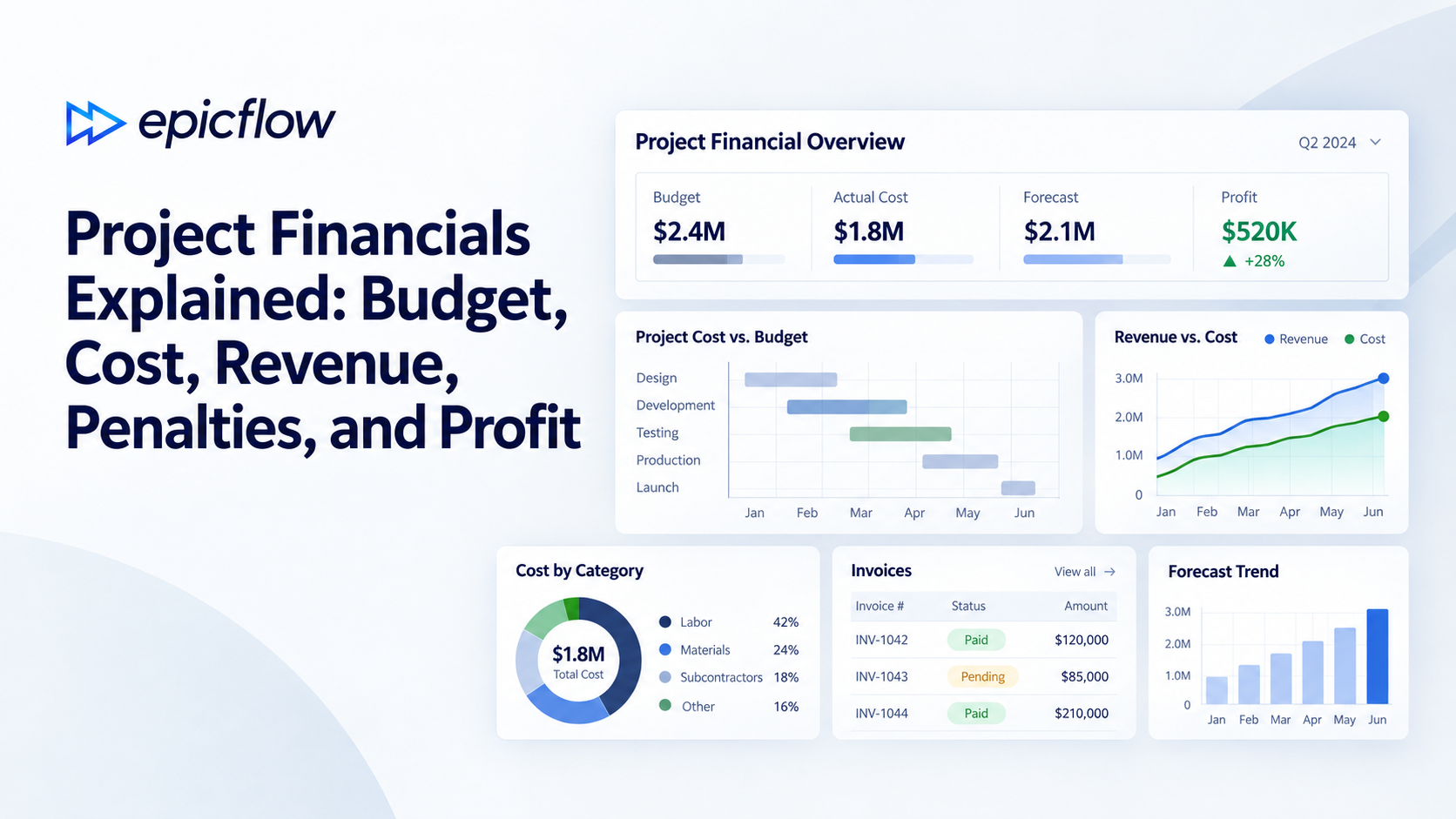
Pipeline 2.0 can show Approved Budget, Actual Costs, Remaining Budget, Revenue, actual and predicted bonus or penalty, Actual Revenue, Predicted Revenue, Actual Profit, and Predicted Profit. In the Release 93 formula, Predicted Profit equals Predicted Revenue minus Actual Costs. It should not be described as a full estimate-at-completion margin unless the product formula changes.
Work from a configurable portfolio intervention view
Pipeline 2.0 can bring baseline-relevant context into one configurable view through columns, Business Value, Custom Fields, Attributes, filters, and direct Gantt actions. Phase start/end linking can help keep phase boundaries aligned with the live project timeline, but it is an operating-plan aid - it does not automatically redefine the approved project baseline. For scenario testing, What-If Analysis lets teams test changes before committing them to the live plan.
Connect baseline context to forecast timing
A resource-aware predicted finish is more useful than a static date because it reflects what shared capacity can actually deliver. Project management forecasting software can help PMO and portfolio leaders distinguish the approved reference from the latest feasible forecast. Where milestone-linked financial forecasting is enabled, schedule movement can also update invoiceable and expected-cash timing from the same plan. Epicflow forecasts those dates; it is not an accounting, invoicing, accounts-receivable, or treasury replacement.
Keep resource augmentation separate from baseline governance
If new capacity becomes available - whether through hiring, contractors, automation, or AI resources - use it to update the live plan and prediction. The baseline still records the commitment against which the effect of that capacity decision can be measured. A better forecast is evidence that the intervention worked, not a reason to erase the original reference.
For portfolio-level governance, see Epicflow’s Pipeline overview and enterprise project portfolio management software.
Conclusion
A project baseline plan is most valuable when it remains a stable, governed reference while the real project keeps changing. Preserve the baseline, update the operating due date when needed, refresh the resource-aware forecast as conditions change, and rebaseline only when the approved commitment itself has materially changed.
That separation makes project performance easier to explain and harder to hide. It also gives PMO and portfolio leaders a consistent way to interpret scope changes, resource constraints, budget movement, predicted delivery, and - where contract terms apply - the economic impact of finishing earlier or later than the approved reference.
See how Epicflow keeps the approved project reference visible while forecasting feasible delivery dates across shared-resource portfolios. Request a tailored demo.
Frequently Asked Questions
What is included in a project baseline plan?
A project baseline plan usually combines the approved scope baseline, project schedule baseline, and cost baseline. Together they define what will be delivered, when it is expected to be delivered, and the approved cost reference. In resource-constrained environments, the schedule should also be validated against realistic shared-resource capacity before approval.
What is the difference between a baseline and a project plan?
The baseline is the approved comparison point; the project plan is the working model used to manage execution. The live plan can change as tasks, dependencies, priorities, and resources change. The baseline should stay stable unless a material change is formally approved through the organization’s change-control process.
What is the difference between a baseline date and a forecast date?
A baseline date records the approved reference date. A forecast date estimates when the project is now expected to finish based on current conditions. Comparing the two shows forecast deviation. In Epicflow Release 93, the baseline end date is also the reference for predicted bonus or penalty calculations where a schema is applied.
When should a project be rebaselined?
Rebaseline when an authorized material change makes the former approved reference no longer suitable, such as a contract amendment, approved scope reset, or formal governance decision. Ordinary underperformance or a worsening forecast should normally remain visible as variance against the existing baseline rather than being removed by resetting it.
Can a project have more than one baseline?
A project can have multiple approved baseline versions over its lifecycle, but only if each rebaseline is controlled and documented. Keep the previous versions and the reason for each change. Version history lets teams distinguish an authorized change in commitment from performance movement that occurred before the reset.