Trends in Project Portfolio Management: What’s Next in PPM
 Victoria Sokolova
.
December 11, 2025
.
Project Portfolio Management
.
21 mins READ
Victoria Sokolova
.
December 11, 2025
.
Project Portfolio Management
.
21 mins READ

Project portfolio management (PPM) has developed significantly over the past few years and is expected to evolve even faster in the years ahead. What can portfolio managers expect in the near future? How will technologies and innovations change PPM over time?
Let’s dive deep into the latest project portfolio management trends and see how they are going to transform.
Why It Is Important To Follow Trends in Project Portfolio Management
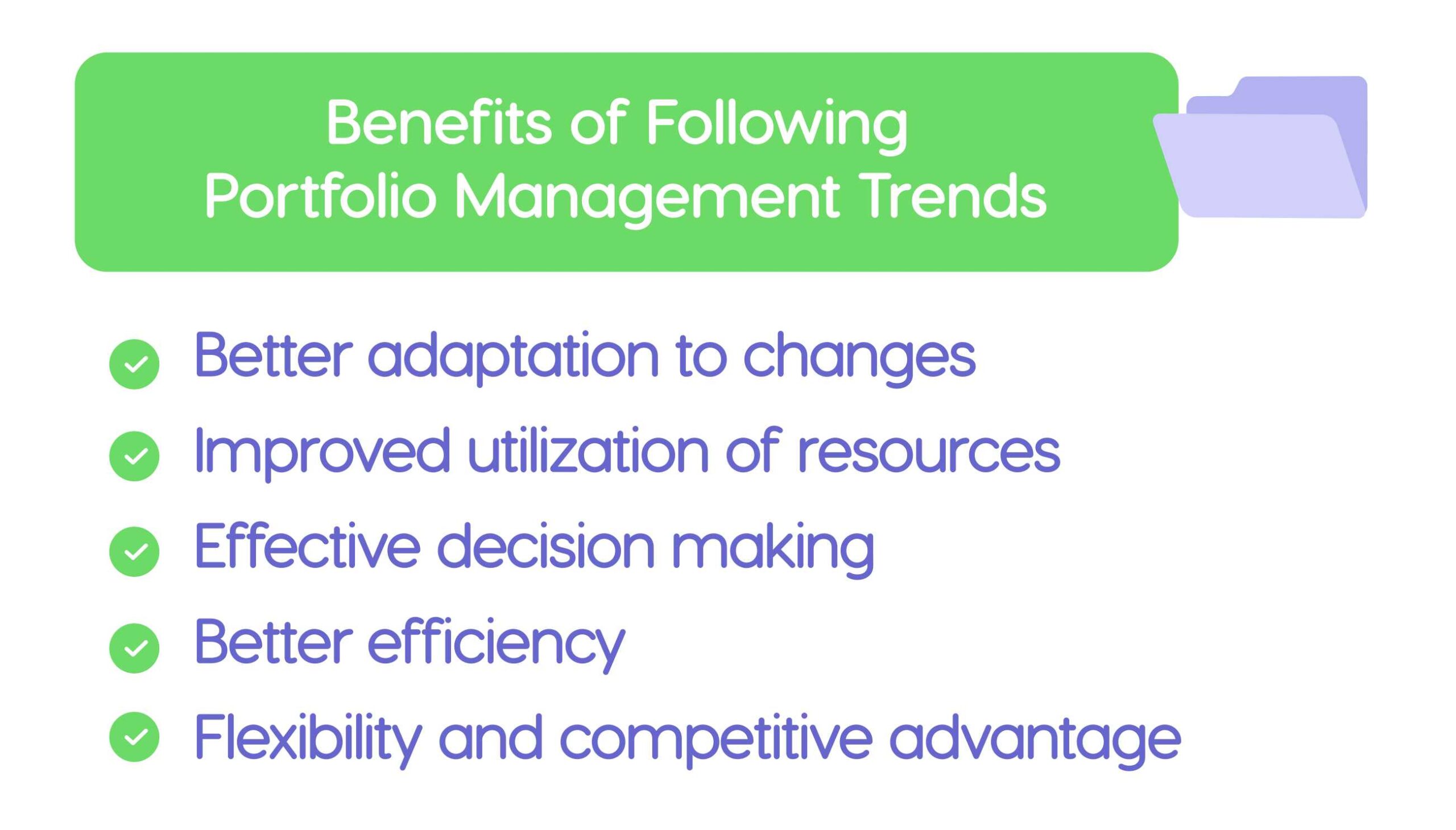
Here are some benefits of following portfolio management trends.
Better adaptation to changes
The business environment is changing faster than ever, and companies that strive to remain competitive should keep up with this pace. Knowing and following the trends will help companies adapt to innovations.
Improved utilization of resources
Most organizations face resource constraints and struggle to meet the increasing demand with limited resources. Following PPM trends allows leaders to adopt new methods and tools that improve the utilization of available resources, e.g., focus on resource capacity planning, apply modern portfolio management tools with AI-driven functionality, or leverage scenario analysis before making resource management decisions.
Effective decision making
Recent trends allow companies to make forecasts and test different scenarios before making management decisions, which allows portfolio leaders to avoid costly mistakes. For example, forecasting helps portfolio leaders prevent bottlenecks that lead to project delays and reduce portfolio performance.
Better efficiency
Studying the newest best approaches allows organizations to adopt more efficient portfolio management processes (e.g., automating some tasks, increasing resource productivity), which will increase overall efficiency at the same time.
Flexibility and competitive advantage
It’s not a secret that companies that respond fast to the newest trends gain an edge over competitors and deliver projects and products quicker, cheaper, and in line with customers’ expectations.
As it was found by the Future Market Insight report, the global project portfolio management market is expected to grow from $6.16 million in 2024 to $14.18 million in 2034. This significant rise, at an average rate of 8.7% per year, happens because companies have started to use more cloud services and virtualization technologies to manage their projects more efficiently. As technology reshapes how portfolios are planned and executed, staying current with emerging trends in project portfolio management is now rather a necessity than an option.
Top Trends in Project Portfolio Management
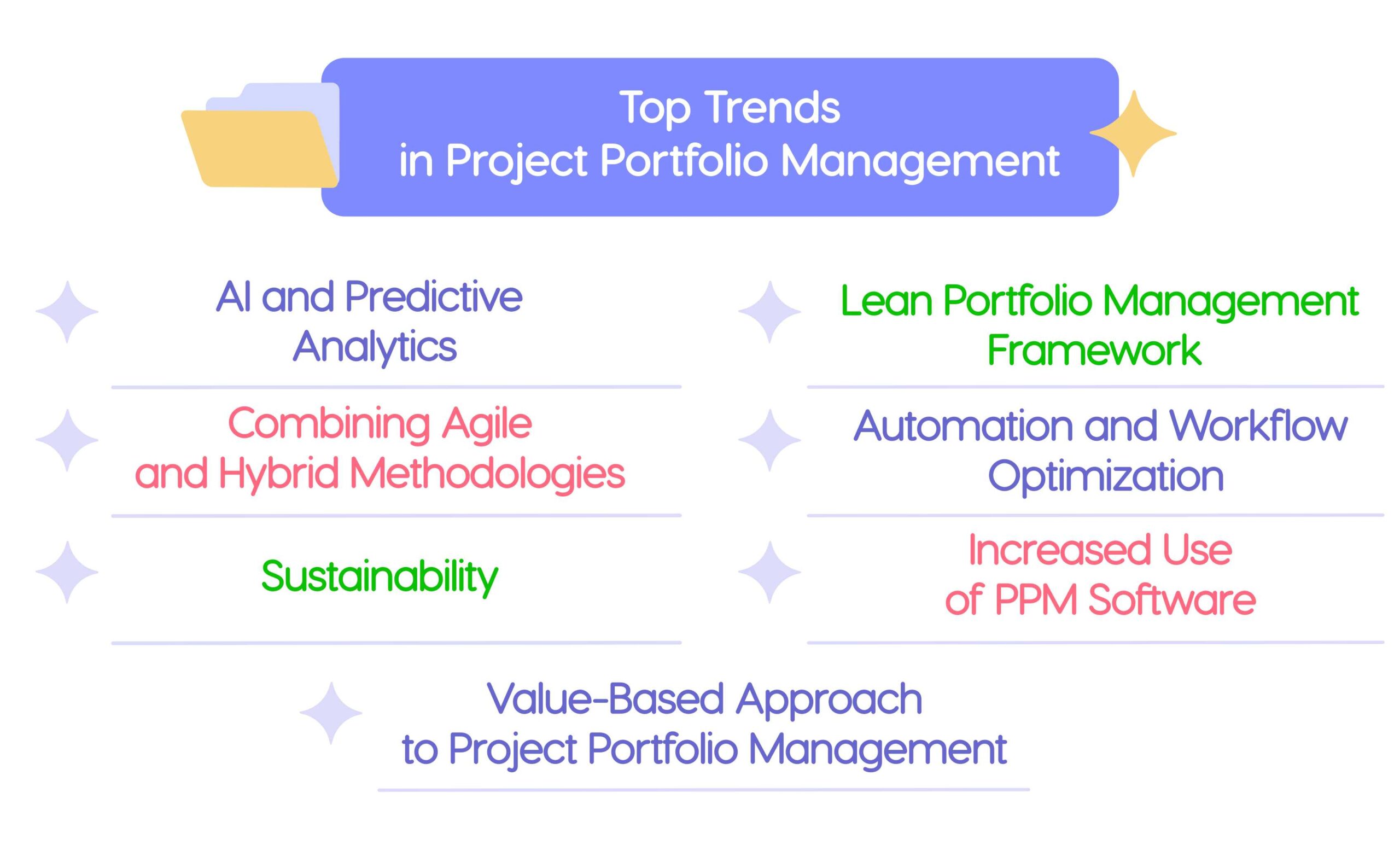
1. AI and Predictive Analytics.
The most rapidly growing trend in project portfolio management is the use of artificial intelligence (AI), generative AI, large language models (LLM), and machine learning (ML). These technologies help companies optimize processes, increase efficiency, and improve decision making. Let’s take a look at some benefits in more detail.
- AI can automate repetitive tasks like filling spreadsheets manually, managing tasks, or making reports, so that managers can dedicate their time to more important tasks.
- ML supports effective PPM risk management by predicting risks, identifying opportunities, and providing data-driven insights for more confident and informed decision-making.
- Predictive analytics can predict bottlenecks in projects so that you can timely prevent them. It also helps in managing resources more effectively and balancing their workloads, and improving their utilization.
The other promising tendencies in AI for project portfolio management are virtual AI assistants and chatbots. To be more detailed:
- Virtual assistants act like experienced helpers for project portfolio managers, detecting bottlenecks and making suggestions about improving the current state of projects.
- Advanced chatbots like ChatGPT, Gemini, and others have already proven their effectiveness in processing data. Someone may say that they are not accurate enough, and it’s true, but they are capable of analyzing and synthesizing data in seconds, which can be extremely helpful day-to-day work. What is more, it is expected that in the next few years, their accuracy will only grow and they will become more and more reliable.
The example of an AI-powered tool for project portfolio management is Epicflow that is equipped with the newest AI features, including forecasting, scenario planning, and a built-in AI project manager that helps manage processes and tasks across the project portfolio. If you want to learn more about Epicflow capabilities, don’t hesitate to contact our experts.
2. Combining Agile and Hybrid Methodologies.
You might agree that for effective project portfolio management, using just one approach like Agile, Scrum, Waterfall across the entire portfolio could not be as effective enough. Adaptive portfolio management frameworks, combining various approaches to managing projects within the same portfolio, can be a better option. Projects become more and more complex and dynamic, so, many organizations prefer to use hybrid approaches to manage a single project, let alone the whole portfolio.
As we know, Agile project management works the best for dynamic projects, like software development, but traditional methods may be better for projects that follow strict regulations, like manufacturing, construction, and so on. That is why hybrid methods have become one of the popular ppm trends.
Read More: How to Blend Agile Principles into Your Methodology
3. Sustainability.
The popularity of sustainable approaches is quite understandable because environmental issues are growing, and people are worried about their future. Many organizations now have made impressive strides in reducing their carbon footprint and waste. But why does it matter for the future of project portfolio management?
Traditionally, project portfolio management was mostly focused on earning revenue, mitigating short-term and long-term project risks, and building strong business strategy to stay competitive over decades. But in recent years, requirements have changed in a more eco-friendly way:
- Some studies show that sustainable projects are often even more profitable than traditional ones. In general, a company’s reputation gets higher when customers see that business promotes sustainability. Therefore, it brings higher outcomes and opens doors for new opportunities.
- Governments are setting stricter sustainability rules, and thus businesses must comply with them in all their projects.
- Customer demand for sustainable approaches is extremely high, and one of the main reasons is that environmental pollution does a lot of harm to nature and people.
But how can businesses contribute to sustainability in project portfolio management? The answer is to implement ESG practices, which stands for Environmental, Social, and Governance factors. Now let’s consider some examples:
- Companies can foster “green” culture. It refers to implementing “green” projects, for example, building Net Zero Energy Buildings (NZEBs) in construction, utilizing green materials, and using clean energy from solar panels or windmills. For the tech industry, it can be creating energy-saving devices or using recyclable packaging.
- Supply chain optimization. Organizations can choose local suppliers instead of shipping equipment and materials via airplanes or trucks. It heavily reduces carbon emissions and supports local production.
- Foster diversity and inclusion. Diversifying teams, ensuring equitable resource allocation, promoting psychological safety, using technology to reduce bias in decision-making.
Read More: 7 Current Trends in Project Management: What to Prepare for?
4. Lean Portfolio Management Framework.
Lean portfolio management approach aligns strategy with execution by applying Lean principles (flow, waste reduction, focus on value) with Agile practices (iterative planning, continuous improvement). It’s becoming one of the major trends in project portfolio management in contrast to rigid portfolio governance, as it’s more adaptive and value-focused. It also involves funding value streams instead of individual projects and prioritization based on value and capacity.
The benefits of lean portfolio management are as follows:
- Faster response to changes;
- Alignment between strategy and execution;
- More efficient resource utilization;
- Portfolio transparency;
- Reducing waste and delivering value.
Most importantly, companies implementing lean portfolio management can deliver the greatest business value compared to those leveraging traditional project portfolio management principles.
5. Automation and Workflow Optimization.
As portfolios grow in size and complexity, organizations more and more often rely on automation to improve decision-making and reduce manual workload. Modern PPM tools with automation capabilities can identify resource conflicts, detect potential risks, perform scenario analysis, and more. This allows portfolio leaders to make faster and more confident decisions based on real-time insights instead of manually created reports with outdated data.
Scenario planning should be given particular attention. AI-driven simulation lets portfolio managers test different scenarios (e.g., resource distribution or prioritization options) and understand their strategic impact before committing. This shifts portfolio management from reactive to proactive, which is more suitable for today’s dynamic business environment and constant changes.
Thus, automation becomes more than just a productivity tool. In addition to all of the above-mentioned benefits, it streamlines processes by letting the work flow from one stage to another smoothly, without bottlenecks and delays, with minimized human errors.
Read More: Portfolio Management and Resource Allocation: What Do They Have in Common?
6. Increased Use of PPM Software.
As we’ve noted above, the complexity of portfolios running in organizations is increasing, which requires reliance on robust PPM software. As a rule, portfolios include concurrent projects, shared resources, and diverse teams. Modern PPM tools provide organizations with real-time insights, automated reporting, scenario modeling, various resource management capabilities, etc. This provides portfolio leaders with required assistance for effective management of complex portfolios and opportunities for maximizing business value.
For example, Epicflow is a platform that unites portfolio and resource management to help organizations track projects, optimize the utilization of shared resources, prioritize projects based on business value and capacity, as well as optimize strategic decision-making. It also has a portfolio optimization functionality, EPO, which enables organizations to maximize value relative to available resource capacity. It’s an interactive AI agent that helps enterprises prioritize initiatives with the highest value potential and direct limited resources to them.
Watch the exclusive presentation of this game-changing functionality: Epicflow Portfolio Optimiser: The New Era of Portfolio Management
7. Value-Based Approach to Project Portfolio Management.
Another promising tendency in PPM is the value-based portfolio management approach. In simple words, it is about orchestrating an organization’s portfolios and programs in a way that delivers and maximizes business value. To be more detailed, this means prioritizing and working on the projects that will create maximum possible value, not just delivering projects on time without cost overruns.
In each specific company, the definition of the value may differ from the others. In some of them, it can be about environmental value (embracing “green” technologies, reducing carbon footprint), financial value (reducing cost spending, increasing ROI), operational value (faster delivery, optimization of processes), customer value (addressing customers’ requests and problems directly), and so on.
Let’s consider the main principles of value-based portfolio management:
- Proactive management.
- Supporting the company’s business objectives.
- Prioritization based on the project’s value.
- Data-driven decision making.
- Considering projects as investments.
- Attention to resource limitations.
Conclusions
Let’s sum up everything said before about trends in project portfolio management:
- Project portfolio management will continue to evolve and embrace new technologies: artificial intelligence, generative AI, automation, virtual assistants, predictive analytics, and so on.
- Hybrid methodologies or combining different approaches to managing projects within one portfolio will continue to be relevant.
- Companies are expected to be increasingly focused on sustainability and eco-friendly approaches, and the future of PPM is to find ways to deliver value to the environment, to society, and to governance (ESGs).
- And last but not least, focusing mostly on the business value instead of just successful project delivery will be a tangible push for a majority of companies to rethink their strategy and create relevant success criteria.
If you’re searching for an effective tool to to support you following trends in project portfolio management, Epicflow can be a great option. Schedule a demo to see which features can drive your business to success.
Frequently Asked Questions
What is the future of project portfolio management?
The future of project portfolio management will be defined by:
- Using technologies like artificial intelligence (AI), machine learning, generative AI, and advanced algorithms.
- Focusing on sustainability and value creation.
- Redefining frameworks and approaches to give preference to more flexible and value-driven ones.
What is modern portfolio management?
Portfolio management today is a process of handling multiple projects at the same time and making them aligned with the objectives of the business. Today, it is moving towards delivering value to the customers while also going digital and sustainable.
What are the latest trends in project portfolio management?
In the upcoming years, PPM trends are defined by diverse tools of automation and AI, the rising popularity of hybrid project management approaches, and a growing trend to value delivery.
What are the best PPM tools in 2025?
Epicflow may become a great solution for enterprises and companies managing large project portfolios. It has a lot of in-built AI features for project, resource, and portfolio management and can be easily integrated with your current PPM tools.
How to prepare for changes in portfolio management?
First of all, to prepare for changes, companies should stay updated regarding current and upcoming trends in PPM. The other important point is selecting a robust portfolio management software equipped with advanced AI-driven functionality. Thirdly, there can be the need for a culture shift within the organization, especially when it comes to value delivery.
How does AI help manage risks in portfolio management?
Here are the examples of portfolio risk management with AI:
- It can identify potential delays or budget overruns;
- It predicts future workload and capacity to let portfolio leaders identify bottlenecks;
- It helps play different scenarios and test the best possible ways to address risks.
How does AI benefit portfolio management?
With the effective integration of AI and generative AI in portfolio management companies gain an edge over competitors by automating routine tasks and decreasing the possibility of errors. It can also make predictions about risks and bottlenecks, and give suggestions on how to solve them.
What is a portfolio in project management?
A “portfolio” is a group of projects that are managed together to ensure achieving a company’s strategic goals.