Portfolio Resource Management: A Complete Guide
 Anna Balyuk
.
Updated
.
Project Portfolio Management
.
31 mins READ
Anna Balyuk
.
Updated
.
Project Portfolio Management
.
31 mins READ

Project portfolio management turns strategy into a set of investments; portfolio resource management determines whether that strategy is actually executable. For PMOs and portfolio leaders managing complex, high-stakes delivery, the central challenge is that multiple projects often compete for the same scarce specialists. In that environment, project portfolio resource management is not about keeping every person busy; it is about directing finite specialist capacity to the work that improves portfolio flow, protects contractual milestones, product launches, operational-readiness commitments, and other critical outcomes.
This guide explains the portfolio resource management process, common portfolio resource management challenges, and how modern project portfolio resource management software can connect capacity decisions with predictable delivery, profitability, and expected cash timing.
Key Takeaways:
- Portfolio resource management ensures that limited resources are allocated across the project portfolio according to capacity, skills, priority, bottleneck impact, and high-stakes delivery commitments - not simply to maximize local utilization.
- Effective portfolio resource management improves throughput by preventing overload, reducing waiting time, and protecting the scarce roles that constrain multiple projects.
- For a Head of PMO or portfolio leader, effective project portfolio and resource management means aligning portfolio priorities with real capacity: which project, milestone, or task should receive the next constrained hour, and what delivery commitment is protected by that decision?
- Release 93 extends this view with Business Value, budget and profitability data, predicted bonus/penalty exposure, and schedule-driven invoice and expected cash forecasts.
- AI-driven portfolio and resource management software can compare resource-constrained scenarios, recommend better portfolio sequences, and increasingly treat AI capacity as a schedulable resource alongside human teams.
What Is Portfolio Resource Management?
Portfolio resource management is the continuous process of balancing project demand against finite resource capacity across a portfolio, then prioritizing and allocating scarce skills so the organization can deliver the highest feasible portfolio value. It combines portfolio resource planning, portfolio capacity planning, demand forecasting, portfolio resource allocation, bottleneck management, scenario modelling, and execution feedback. For PMOs overseeing complex, high-stakes portfolios, resource capacity is not an isolated staffing metric: it determines whether contractual milestones, launches, customer commitments, and other critical outcomes are actually achievable. Mature portfolio and resource management therefore connects resource choices with delivery and economic outcomes instead of optimizing utilization in isolation.
PMI notes that organizations should apply constrained resources to the projects that provide the most value. See Portfolio decisions to maximize strategic benefits.
What Is RPM in Project Management and What Are Its Benefits for Project Management?

Project portfolio and resource management go hand-in-hand and can't be considered apart. In one of our webinars, our researchers concluded that project portfolio management is resource management, which is an undeniable truth. Intelligent resource allocation is the basis of project management, not to speak of complex multi-project environments and project portfolios, where allocating resources to the right tasks and projects becomes a cornerstone of success. Project portfolio resource management involves both managing projects and their resources, with the main goal of delivering the portfolio within the established limits.
Effective project portfolio management, as well as efficient portfolio resource management, provides business leaders and their companies with the following benefits:
- earlier detection of resource overload and bottleneck risk across the portfolio;
- higher portfolio throughput because scarce specialists are protected from conflicting priorities and excessive work in progress;
- more consistent resource allocation because capacity, skills, dependencies, and project value are evaluated together;
- better delivery predictability for PMOs and portfolio leaders because resource conflicts are surfaced before they threaten high-stakes milestones, contractual commitments, launches, or operational-readiness dates;
- more credible portfolio growth decisions because new projects are started only when the shared resource pool - the organization's resource portfolio of critical skills and teams - can absorb the additional demand.
Core Components of Portfolio Resource Management
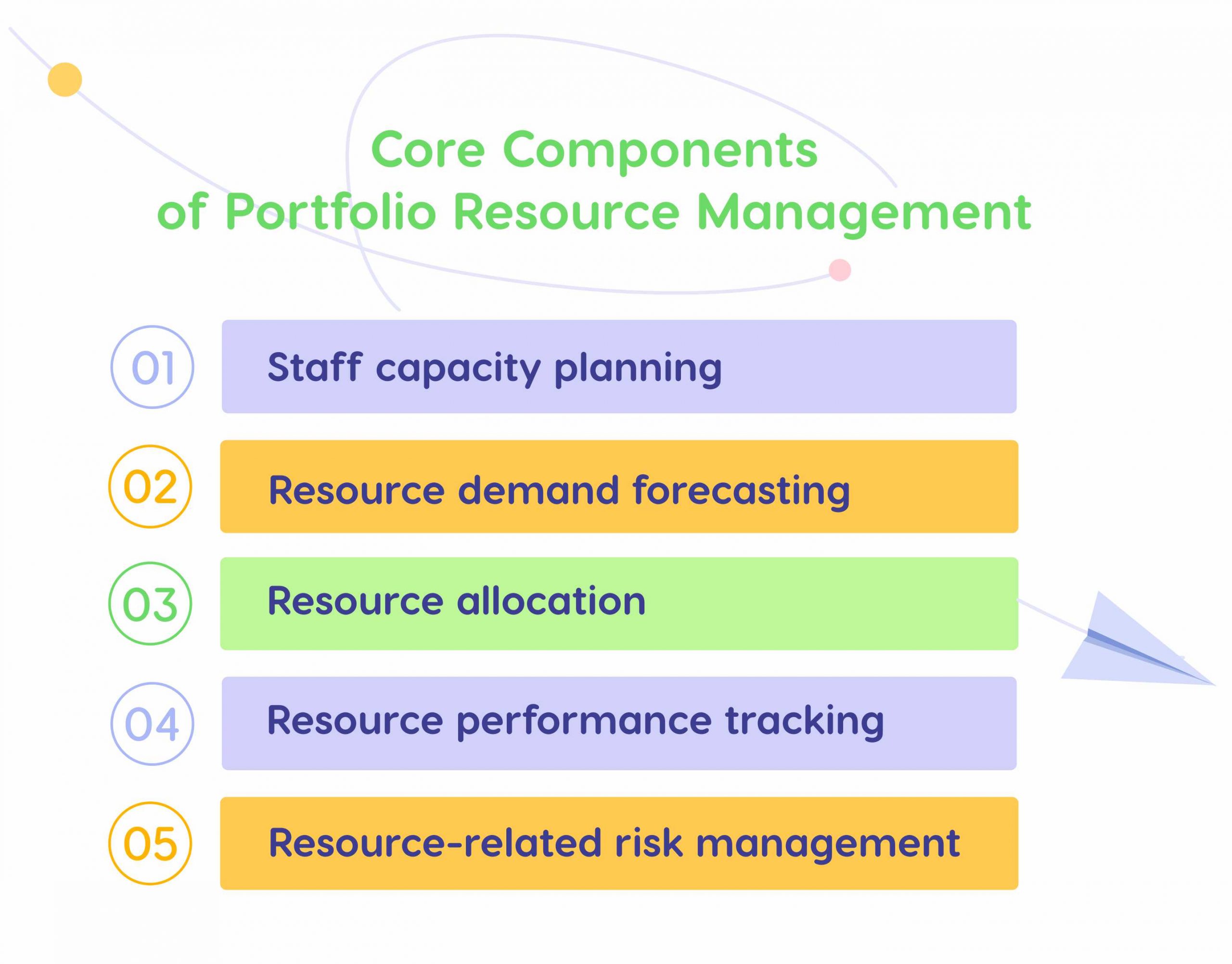
Let's now take a look at the main components of portfolio resource management to understand its nature and find ways to effectively deal with it:
Staff capacity planning
Portfolio resource and capacity planning should measure available capacity by role, skill, team, and time period, not only by total headcount. At the portfolio level, portfolio capacity management asks whether shared specialist capacity is sufficient for the mix and sequence of work the PMO intends to deliver. The purpose is to identify where portfolio demand exceeds the capacity of the shared resource pool and, more importantly, which shortage can become a cross-project bottleneck that threatens a high-stakes commitment.
A useful first diagnostic is: Load ratio = Required hours / Available hours x 100%. For example, 1,200 hours of planned engineering demand against 1,000 available hours produces a 120% load ratio, meaning demand exceeds capacity by 20%. The next portfolio resource management question is not simply 'where do we add people?' but 'which constrained role is actually delaying the most valuable or most consequential work?' This is the practical meaning behind the question what is capacity planning at the portfolio level: comparing time-phased demand with feasible shared capacity before commitments become misses.
Resource demand forecasting
Analyzing new project and task requests is essential to understand the demand and compare it with the available resource capacity to successfully fill in the gap or take measures to increase the capacity.
Resource allocation
Resource allocation is the core of portfolio resource management, but the portfolio perspective changes the decision rule. Resources should be assigned according to priority, competence, availability, task requirements, and the effect of the assignment on the portfolio bottleneck.
A locally urgent task can still be the wrong destination for a scarce specialist if it delays a contractual milestone, product launch, or higher-value project elsewhere. Effective portfolio resource allocation therefore asks which assignment improves total portfolio flow and protects the most important portfolio outcomes, not which project can claim the person first.
Resource performance tracking
Besides traditional project progress monitoring, portfolio managers should constantly track real-time resource performance to make sure resources’ workload is balanced and nobody is overloaded.
Resource-related risk management
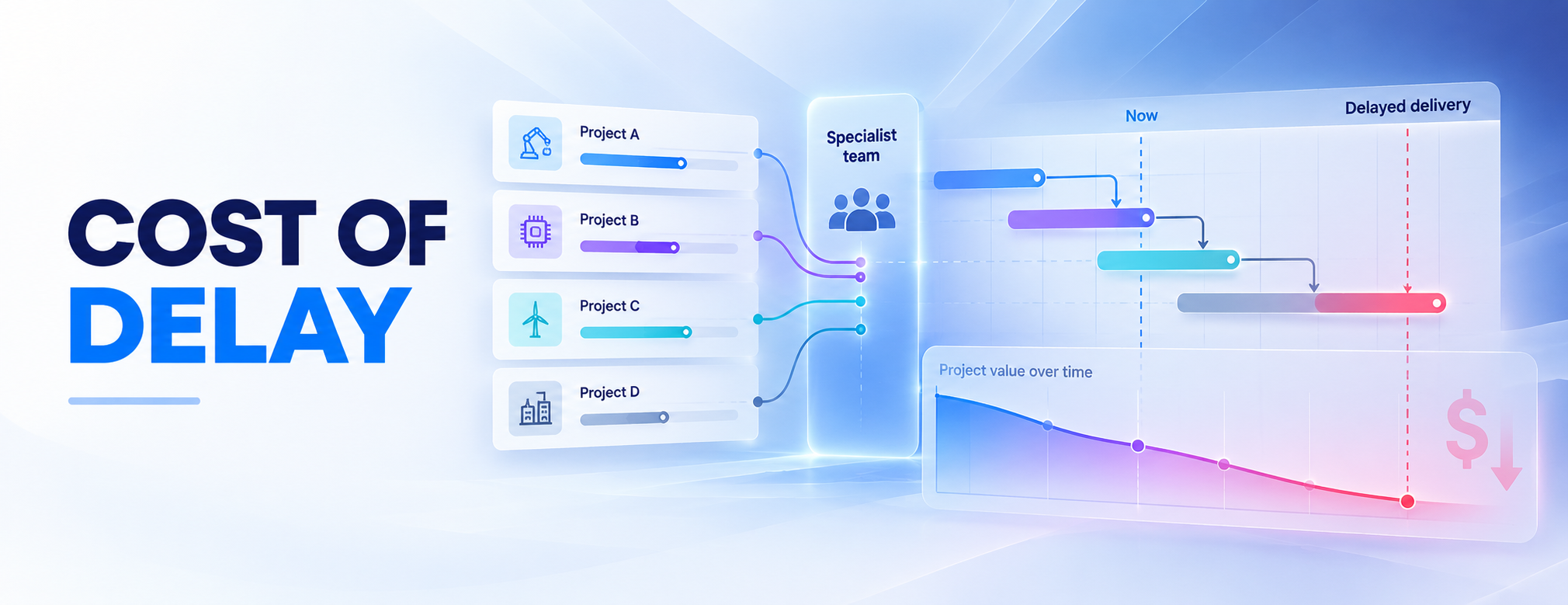
Resource-related risk also has a commercial and executive dimension. If a shared bottleneck pushes a milestone or project finish date, the consequence may be more than schedule variance: it can change a bonus or penalty, move predicted revenue or profit, postpone the date when a milestone becomes invoiceable and cash is expected, or jeopardize a customer or operational commitment
For a PMO or portfolio leader, portfolio resource management is stronger when these consequences are visible before the delay becomes actual.
The Portfolio Resource Management Process (Step-by-Step)
Now, as we've considered the components of portfolio resource management, let's review the steps in portfolio resource management:
- Assessing and measuring the capacity of project resources is the first step in project portfolio resource planning.
- Evaluating the resource demand is an essential step of project portfolio and resource management as it helps build the bridge between available capacity and demand and understand if your resources will be able to cope with the required scope of work.
- Prioritize projects and tasks by business value, high-stakes commitments, and portfolio flow, not by critical path or project urgency alone. In a shared-resource portfolio, priority should reflect which work consumes the constrained resource, what value remains to be earned, which contractual or operational outcome depends on it, and what delay elsewhere the allocation would create. A simple screening heuristic is: constraint value = remaining business value / remaining hours required from the constrained resource. This is not a substitute for full portfolio modelling, but it prevents scarce capacity from being allocated purely by volume or escalation pressure.
- Allocating the right resources to the right tasks at the right time helps have the work done in the most efficient way possible.
- Resource performance and project progress tracking allow you to keep an ear to the ground and timely react to any issues ruining the workflow.
- Optimize the portfolio with scenario modelling. Test alternative project sequences, resource allocations, start dates, and capacity changes against the real shared-resource constraints. Portfolio-level resource optimization should compare not only overload and finish dates, but also the effect on business value, high-stakes delivery commitments, contractual exposure, profitability, and expected cash timing. The selected scenario should then become the schedule teams actually execute, so the PMO's decision, the forecast, and daily work stay connected.
As you can understand, a project portfolio is a set of multiple projects with a shared resource pool, which poses some resource management challenges that are relevant for complex multi-project environments, which we at Epicflow have been dealing with for years. Let's review some of them.
Common Challenges in Portfolio Resource Management
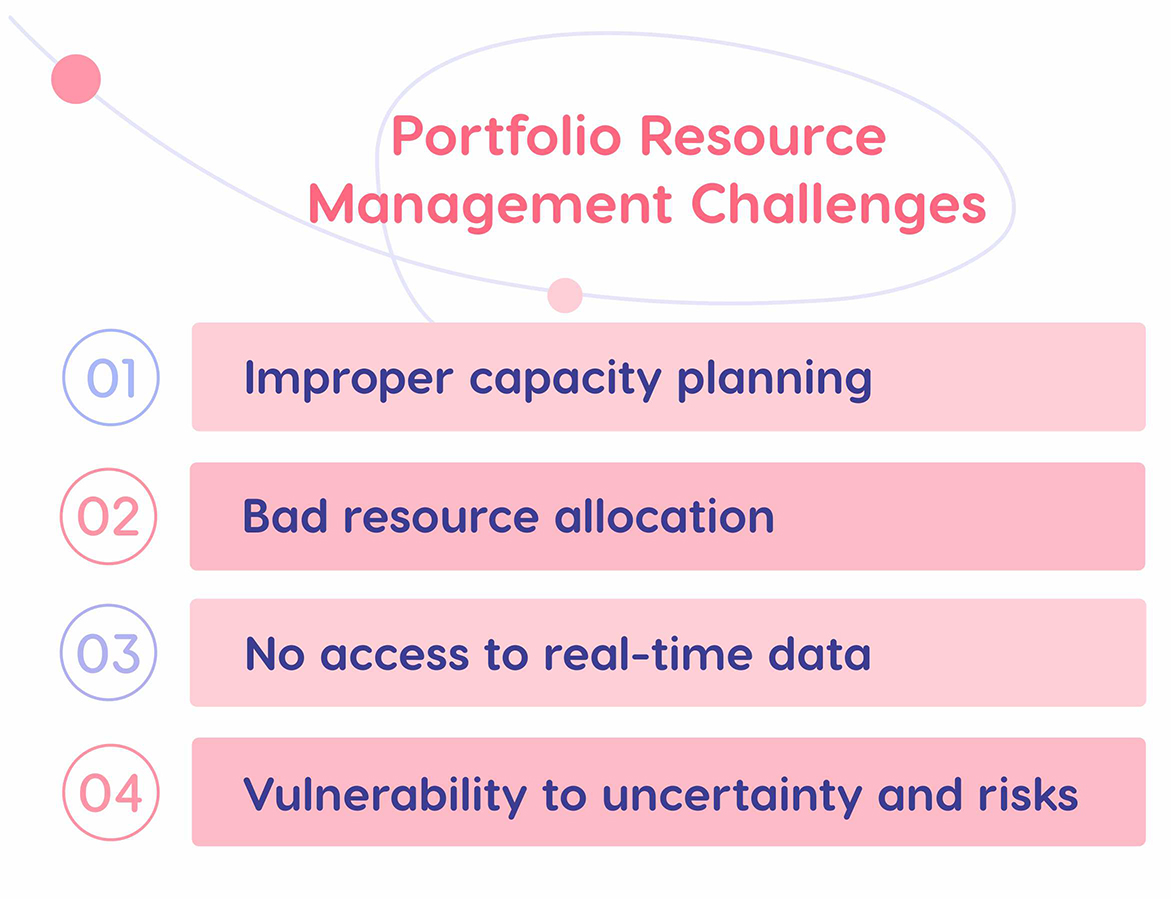
1. Improper capacity planning
One of the biggest project resource management mistakes is making an inaccurate resource capacity plan. It may result in resource gaps between available resources and project demand for resources. In turn, this may lead to over-utilized resources, their overload, and further burnout. Missed due dates and high resource turnover are the frequent consequences. The solution? - The right capacity planning software. It allows for accurate resource forecasting, preventing bottlenecks, and data-driven capacity planning.
Read more: 15 Best Capacity Planning Tools for Your Business
2. Bad resource allocation
One of the biggest resource management challenges is allocating resources improperly, for instance, assigning them to lower-priority projects or allocating resources without regard to their competence and experience levels. This may result in a low quality of the work done, prolonged timelines, overload, and increased waiting times. The results are missed due dates, budgets, and unsatisfied clients. In addition, this wastes capacity that could be directed to projects with higher value potential.
Consider a simplified example. Two projects each need 80 hours from the same scarce systems engineer. Project A protects $400,000 of remaining value; Project B protects $120,000. If dependencies, risk, and strategic commitments are otherwise comparable, allocating the constrained hours to Project A first produces more value from the same scarce capacity. This is the economic layer that portfolio resource management adds to traditional workload balancing.
Read more: 4 Tips on Efficient Resource Allocation in a Multi-Project Environment
3. No access to real-time data
Effective resource management at the portfolio level requires real-time tracking of resource availability and workload to avoid resource management issues, such as bottleneck resources that hamper the workflow and lead to increased waiting times and significant delays, and inability to deliver value. Unfortunately, many companies don't have tools that allow resource managers to track the progress of the entire portfolio, which may result in the issues we mentioned above. Absence of real-time data also complicates making informed data-driven project decisions, which also affects portfolio resource management.
The visibility problem is not solved by another dashboard if schedule, resource, and financial signals still live in separate models. Portfolio resource management needs one operating view in which resource load, project priority, feasible dates, and economic consequences update from the same execution data.
For PMOs, portfolio resource constraint charts are most useful when they show time-phased demand versus capacity by role or skill, expose the constraining groups, and reveal which projects and high-stakes milestones depend on them. That is what allows portfolio leaders to intervene while a bottleneck is still a forecast rather than a missed commitment.
4. Unpreparedness for risks and uncertainty
Uncertainty is a companion of multi-project environments with a shared resource pool. This involves unexpected changes in a project plan or requirements, delays in task execution, unexpected changes in resource availability, and many more. Early detection of these changes, as well as effective mitigation of resource-related risks and dealing with uncertainty, are problematic for many companies due to the absence of the right tools to handle these challenges.
So, what's the solution? Adopting portfolio resource management software can become a lifesaver for large companies running multiple projects with shared resources. Let's see how exactly it can help.
Read more: Top 15 Portfolio Management Tools for Your Business in 2025
Portfolio Resource Management Software as a Key to Effective Portfolio Management

Portfolio resource management software is a tool that helps companies reach their business goals by letting them deliver the planned scope of work and even initiate additional projects with their available resources, therefore, increasing ROI. These tools have everything a portfolio manager needs to plan projects and resources, ensure efficient execution of project tasks, track project success and resource performance, and make informed project management decisions. Let's have a closer look at the top features through the example of Epicflow.
Accurate capacity planning for future projects
Project portfolio resource planning becomes more actionable when future demand is tested against time-phased capacity before new work is released. Epicflow compares planned demand with available capacity, exposes future overload, and helps PMO, portfolio, resource, and project leaders identify the skill groups that can become constraints. Instead of reacting after teams are overloaded, managers can adjust sequencing, staffing, or project start dates while the issue is still forecast and before critical commitments are put at risk.
Automatic project and task prioritization
Epicflow prioritizes projects and tasks and updates priorities as portfolio conditions change. Management can use the Pipeline to see where attention is required, while project teams see the work that should move first. The purpose is not simply to maintain a ranked list: it is to keep scarce capacity focused on the work that protects portfolio flow.
Release 93 makes the Pipeline a stronger intervention view for portfolio resource management. Heads of PMO and portfolio leaders can surface phase-level Business Value, custom KPIs, project budgets and profitability, and actual or predicted bonus/penalty exposure alongside schedule information. New filters also make it easier to isolate resource-assignment context such as Suggested User or Budgeted User, as well as budget, phase, milestone, and remaining/spent/total work. This reduces the distance between seeing a resource problem, understanding which high-stakes commitment is exposed, and acting on it.
Human resource optimization in portfolio management
Epicflow supports human resource optimization by combining capacity, competence, task requirements, and current workload when managers make assignment decisions. The goal is not maximum utilization of every person - that often increases queues and waiting time in multi-project environments - but stable portfolio flow, protection of bottleneck specialists, and better use of scarce skills across competing projects. In practice, portfolio resource optimization tools should help a PMO improve the whole portfolio rather than optimize one team in isolation.
Portfolio resource management is also beginning to include non-human capacity. In Epicflow's AI-resource model, a synthesized AI resource can be represented in the resource pool with capacity and a rate, assigned work in the plan, and kept inside a human-in-the-loop workflow for review. This allows managers to evaluate where AI capacity actually relieves a bottleneck and whether the delivery dates move before committing the work, rather than treating AI adoption as an isolated productivity initiative.
Access to real-time project and resource data
Portfolio resource management software should provide a common operating view of the portfolio rather than a collection of disconnected status reports. In Epicflow, resource load, project priorities, predicted dates, bottleneck signals, and portfolio-level economic data can be evaluated together. This gives PMOs and portfolio leaders a shared basis for portfolio capacity management and delivery decisions from the same live plan that teams are executing.
Risk detection and mitigation
Epicflow supports risk detection and mitigation with What-If Analysis, allowing managers to test the consequences of resource or priority changes in a separate simulation before changing the live portfolio. The strongest portfolio resource management scenarios compare the effect on bottlenecks and delivery dates across all affected projects, especially where the same constrained specialists sit behind multiple high-stakes milestones. This makes scenario analysis a core part of portfolio resource management best practices, not just an occasional planning exercise.
Release 93 adds a direct commercial risk signal: bonus and penalty rules can be linked to projects, and Epicflow can show both actual and predicted bonus/penalty values. If a prediction indicates that a shared resource constraint will push a project beyond a contractual threshold, managers can reallocate capacity before the predicted penalty becomes actual.
Resource-constrained portfolio optimization
Epicflow Portfolio Optimizer (EPO) models portfolio alternatives against real resource constraints and helps management compare different project sequences and allocations. The optimization question is not 'How do we keep all resources busy?' but 'Which feasible use of constrained capacity creates the strongest portfolio outcome?' For PMOs and portfolio leaders, this turns portfolio-level resource optimization into a practical decision discipline for balancing value, delivery risk, and finite specialist capacity.
If a portfolio manager can see that the planned projects can't be delivered within existing time and resource constraints, they can enable Project Staggering. This feature adjusts the project schedule in such a way that lower-priority projects are initiated later, as soon as the required resources cope with the higher-priority ones.
Epicflow also brings an investment lens into prioritization through RRI (Return on Remaining Investment), its implementation of Stephen Devaux's DIPP logic. Conceptually, the ratio compares value still to be earned with investment still to be made, helping leaders avoid letting sunk cost dominate the next resource decision. For more detail, see Epicflow's DIPP-guided resource allocation article and Stephen Devaux's discussion of resource bottlenecks and project profit in Paving the Critical Path.
Connect portfolio resource management to high-stakes delivery, invoice and expected cash timing
Release 93 connects portfolio resource management decisions with both delivery stakes and financial timing. Payments can be linked to milestones and combined with payment terms, so the same resource-constrained schedule that predicts delivery also drives an Invoice Forecast and expected Cash Flow view. If a scarce-resource bottleneck moves a critical contractual milestone by 14 days, the forecasted invoice date - and, subject to the payment term, the expected cash date - moves with it. For a portfolio leader, the resource decision and the commercial consequence are therefore visible in the same chain of cause and effect.
This changes the resource-allocation conversation. A what-if scenario can now answer not only "Will this reduce overload?" or "Will this project finish earlier?" but also "Which invoice, bonus or penalty, predicted profit, or expected cash date changes if we move this capacity?" Epicflow forecasts invoiceable and expected cash timing; it does not replace ERP processes for collections, confirmed receipts, or bank balances.
Conclusion
Portfolio resource management is more than balancing workload across projects. For PMOs and portfolio leaders in complex, high-stakes environments, it is the discipline of deciding how finite specialist capacity should move through the portfolio so the organization can improve flow, protect critical commitments, and deliver the most important work predictably. Strong project portfolio and resource management keeps portfolio priorities grounded in what shared capacity can actually execute.
Modern AI-driven portfolio resource management software can forecast bottlenecks, test resource-constrained scenarios, prioritize work dynamically, and connect resource choices with commercial outcomes. With Release 93, Epicflow extends that operating model from capacity and delivery into Business Value, budget and profitability, predicted bonus/penalty exposure, and schedule-driven invoice and expected cash timing - keeping the PMO's economic decision tied to the plan teams execute.
Frequently Asked Questions
What is portfolio resource management?
Portfolio resource management helps PMOs and portfolio leaders prevent overload, eliminate bottlenecks, and ensure that scarce capacity is directed to the projects and tasks that create the strongest portfolio outcome. It also improves the credibility of delivery and financial forecasts because dates are based on what the shared resource pool can actually execute, especially important when delays threaten contractual milestones, launches, customer commitments, or other high-stakes outcomes.
Why is portfolio resource management important?
Portfolio resource management helps organizations avoid resource overload, eliminate bottlenecks, and ensure that the most valuable projects receive the capacity they need to be delivered successfully.
What problems does portfolio resource management solve?
Portfolio resource management addresses resource shortages, conflicting priorities, hidden bottlenecks, delayed projects, inefficient resource utilization, excessive work in progress, poor cross-project visibility, and economically weak allocation decisions in which scarce capacity is consumed by lower-value work.
The most important portfolio resource capacity challenges usually appear when several projects depend on the same specialist role at the same time and the PMO has to decide which commitment the constrained capacity should protect first.
What is the difference between portfolio resource management and project-level resource management?
Project-level resource management focuses on individual projects, while portfolio resource management looks across all projects to balance capacity, resolve resource conflicts, and maximize overall portfolio value.
What are the main challenges in portfolio resource management?
Improper capacity planning, bad resource allocation, lack of real-time data visibility, and unpreparedness for uncertainty and risks can affect the entire organization and ruin the success of the project portfolio and the whole organization.
Is portfolio resource management relevant for small organizations?
Portfolio resource management is relevant for organizations of any size that run project portfolios with limited resources.
What tools are used for portfolio resource management?
Portfolio resource management requires portfolio management tools with strong resource management capabilities and predictive analytics. These tools will improve portfolio resource visibility, synchronize portfolio and resource management processes, optimize decision making and resource utilization as well as improve portfolio performance.
What are the top portfolio resource management software features?
The top portfolio resource management software features are as follows:
- Time-phased portfolio capacity planning by team, role, and skill
- Competence-aware resource allocation and bottleneck protection
- Real-time project and task prioritization across the portfolio
- Portfolio-level workload, bottleneck, and delivery prediction for PMO and portfolio-leader decisions
- What-if simulations and portfolio-level resource optimization across shared constraints
- Business Value and remaining-investment prioritization signals
- Budget, profitability, bonus/penalty, invoice, and expected cash forecasting connected to the executable schedule
- Human-in-the-loop planning for AI resources where non-human capacity is introduced into the resource pool
Project portfolio resource management software should combine portfolio resource planning, capacity visibility, competence-aware allocation, scenario modelling, portfolio-level resource optimization, and execution feedback. For enterprise PMOs, the software should make it possible to see which constrained roles limit multiple projects, which high-stakes commitments depend on them, and how a change in sequence or allocation affects the rest of the portfolio.
What should project portfolio resource management software support?
A portfolio resource management template can help standardize the minimum inputs needed for an initial review: project priority, required skills, demand by period, available capacity, bottleneck role, milestone or commitment at risk, and the decision required. A portfolio resource planning template is useful for establishing the process, but it should not become a static spreadsheet that separates resource assumptions from the live portfolio schedule.
Do I need a portfolio resource management template?
Portfolio resource management best practices include planning by role and skill over time, limiting work in progress around bottlenecks, prioritizing across the whole portfolio rather than project by project, testing allocation changes with what-if scenarios, and linking capacity decisions to the delivery commitments they protect. The PMO should revisit these decisions continuously as priorities, progress, and available capacity change.
What are portfolio resource management best practices?
Portfolio capacity planning compares time-phased demand from all active and proposed projects with the real availability of shared roles and skills. At the portfolio level, the PMO is not asking whether one project has enough people; it is asking whether the entire mix and sequence of work can be delivered with finite specialist capacity, where the bottlenecks will appear, and which high-stakes commitments will be affected first.