The Ultimate Guide to Program Project Management: Definition, Components, and Best Practices
 Victoria Sokolova
.
June 14, 2026
.
Project Portfolio Management
.
21 mins READ
Victoria Sokolova
.
June 14, 2026
.
Project Portfolio Management
.
21 mins READ
Juggling multiple simultaneous projects is never easy. But what if these projects are interconnected, interdependent, and share the same resources? In this case, this task becomes twice as challenging; without the right approach, there is a high chance that such a project environment will turn into a mess.
Program project management is the right strategy to get a handle on all these projects and their complex interconnections. Read the article to learn all the details about program project management, the difference between project and program management, and how to conduct it effectively.
Key Takeaways:
- Program management is the orchestration of a set of interrelated projects.
- The difference between project vs program management is that project management cares about completing individual projects on time and within budget. Program management focuses on the big picture: the program should deliver value and organizational change.
- The main components of program project management include program planning, project integration, resource management, risk management, budget management, benefits management, and change management.
- Program project management provides organizations with the following benefits: aligning projects with the business strategy, optimizing resource utilization, facilitating value delivery, and ensuring centralized monitoring and control.
- Effective program management requires the following steps: focusing on strategy and benefits realization, ensuring proper stakeholder management, managing dependencies between projects, optimizing resources, and making decisions driven by data.
What Is a Program in Project Management?
To better understand the concept of program management, let’s first figure out the program definition in project management. A program in project management is a set of multiple related projects with a common strategic goal. For example, a digital transformation program will consist of projects reflecting different components of digital transformation, e.g., infrastructure updates, staff training, etc.
This group of projects is managed together, so traditional project management approaches are not enough for their effective orchestration and achieving strategic alignment. This is why we need program management as a separate discipline. Let’s review its characteristics in the next section.
What is Program Project Management?
Program management involves coordinated efforts for orchestrating programs: managing interdependencies, ensuring efficient resource allocation across projects within the program, achieving strategic alignment, and more. In his article “Project or program management?”, M. Becker defines program project management as “the effective implementation of change through multiple projects to realize distinct and measurable benefits for an organization”. [1]
Is program management the same as project management?
Let’s now compare program management vs project management. In contrast to traditional project management, which focuses on successful completion of individual projects, program management doesn’t oversee every single project, but treats a program as a whole. This is the main difference between program management and project management.
You may think that program management is similar to project portfolio management which also involves managing multiple projects and focuses on achieving strategic goals. But let’s consider the detailed difference between all these concepts: project vs program vs portfolio management.
Read more: A Guide to Project Portfolio Management Process: Steps and Flows
What is the difference between project, program, and portfolio management?
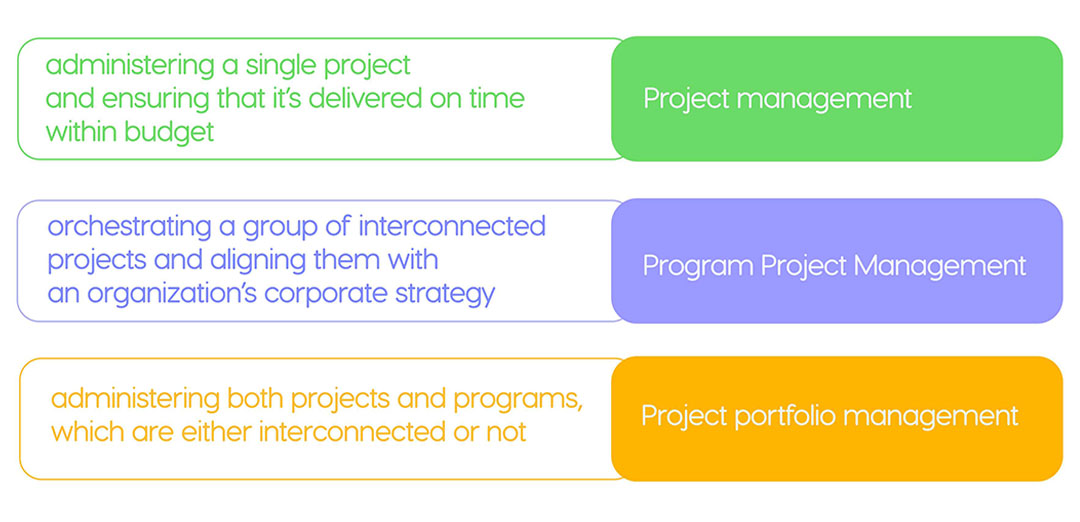
These three approaches are different, but they have one common “measurement unit” – a project.
- Project management deals with administering a single project and ensuring that it’s delivered on time, within budget, and in line with customers’ expectations.
- Project program management involves orchestrating a group of interconnected projects and aligning them with an organization’s corporate strategy.
- Project portfolio management involves administering both projects and programs, which are either interconnected or not, and making sure that they contribute to achieving company-wide goals.
In this article, we are focusing on program project management. So, now, let’s consider its essential components.
What Are the Main Components of Program Project Management?
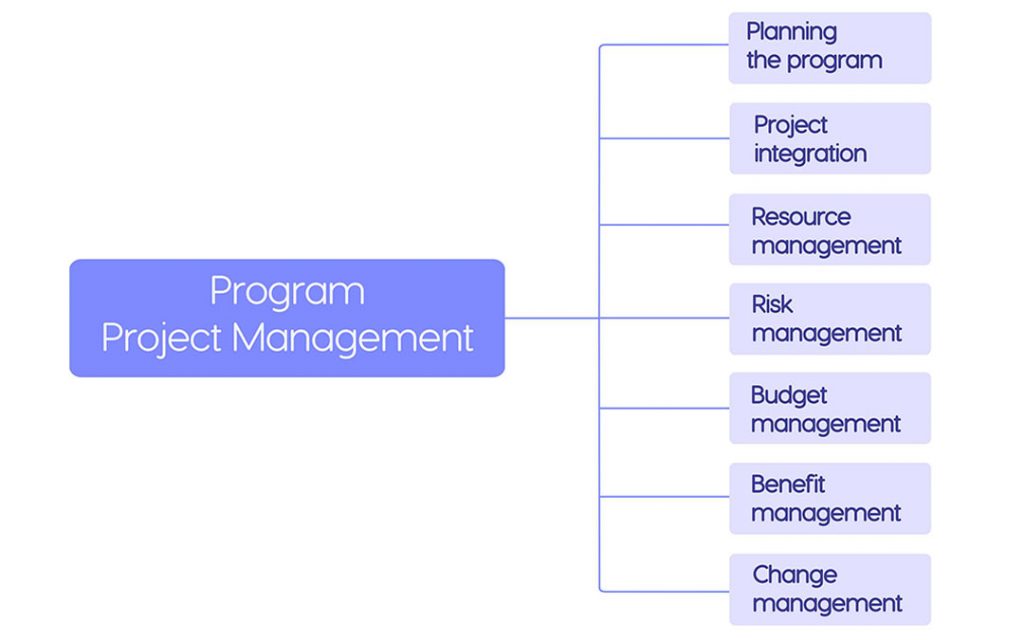
Program project management embraces the following processes.
- Planning the program: This involves developing a high-level plan for achieving the program’s short- and long-term objectives.
- Project integration: Determining relationships and interdependencies between projects within a program.
- Resource management: This involves allocation of different types of resources across projects of the program as well as managing them effectively (planning capacity, managing workloads, tracking performance, etc.).
- Risk management: Due to project interdependencies, risk management gains particular importance; risks within one project can affect others within the program.
- Budget management: Involves allocating financial resources, forecasting budget needs, and tracking its consumption across the entire program.
- Benefit management: This component allows you to measure the value delivered by a program for a business organization.
- Change management: This helps ensure that the changes brought by the program implementation have been successfully adopted by a company.
These components are similar to the main elements of the project management process. But at the same time, they also embrace delivering value and benefits for a business organization.
Apart from value delivery, what are the other benefits of program project management? Read the next section to find the answer.
Why is program management important for your organization?
It helps align projects with the corporate strategy
Program management ensures that you’re not working on a sum of projects and ensure their timely delivery. One of its main goals is making sure that each project within a program and the program itself is connected to the business strategy and contributes to achieving essential business goals.
It optimizes utilization of available resources
As a rule, resources you can allocate to projects are limited, which makes their allocation challenging and increases the risk of bottlenecks. Proper program management ensures intelligent allocation of limited resources across all projects in the program as well as their optimum utilization.
Read more: 4 Tips on Efficient Resource Allocation in a Multi-Project Environment
It facilitates value delivery
As we mentioned earlier, the essential component of project program management is ensuring strategic alignment. This means that for business organizations, program management becomes the driver of strategy execution and achieving their goals.
It ensures centralized monitoring and control
Program management sees the big picture of all projects within a program, which contributes to more effective monitoring and control. For example, you can track projects’ progress, get the idea of potential risks or existing bottlenecks, see which projects require corrective action, etc.
In many cases, program project management is easier said than done. Managing concurrent projects and their shared resources and at the same time connecting them to the company goals may be chaotic. This is why we’d like to provide you with basic recommendations for effective program management. Check out the section below.
Program Project Management Best Practices: 5 Tips
The recommendations below will help you implement program management most effectively and with maximum benefits for your organization.
Tip 1. Focus on strategy and benefits realization.
Programs are not aimed at mere project delivery; their main goal is implementing business strategy and delivering value. This is why you need to make sure from the very beginning that the program you are working on is aligned with organizational strategy. The following steps can be helpful for ensuring strategic alignment:
- Discuss the strategy with senior executives;
- Clarify the strategy to all stakeholders and team members involved in program delivery: everyone should clearly understand “the why” and see the big picture behind everyday work;
- Develop program strategic objectives based on the business strategy.
In addition, program managers should perform benefits realization throughout the whole program execution process. Without that, it will be difficult to ensure that the program will deliver the expected benefits upon completion. Benefits realization requires developing a benefits realization plan, tracking its key indicators, and performing analysis after the program is finished.
Tip 2. Ensure stakeholder engagement.
The success of program project management largely depends on stakeholders’ engagement and support. Otherwise, they may resist some program manager’s ideas or have unrealistic expectations of final outcomes, which won’t do good to the program management process. So, you need to identify the key stakeholders you’re going to collaborate with. Ensure effective communication with all stakeholders depending on their spheres of interest. For example, senior leaders are interested in return on investment. Remembers that team members involved in projects are also stakeholders, so it’s critically important to communicate with them effectively, maintain their engagement, and keep them updated regarding program delivery timelines, scope of work, etc.
Tip 3. Manage dependencies between projects.
In program project management, projects are interdependent. This means that a delay or an issue in one project can affect other projects. In worst-case scenarios, these issues can snowball and have a negative impact on a program as a whole. This is why tracking project health and dependency management as well as risk assessment and management becomes particularly important. How to do that effectively? First, you should identify all existing dependencies and determine their types. Secondly, it’s important to determine what areas of projects will be affected by dependency-related risks. Also, you need to determine the most constrained projects and prioritize them. Finally, assess resource performance metrics regularly to make sure that there aren’t any bottlenecks.
Read more: Dealing With Project Dependencies In a Multi-Project Environment
Tip 4. Work on resource optimization
As we mentioned above, projects within a program share resources from a single pool. So, it’s a good idea to allocate limited resources wisely across projects to ensure their efficient utilization and avoid spending extra costs. How to optimize resources? Use the following steps:
- Resource capacity planning to make sure that there are enough resources to staff projects within the program and avoid resource shortages and unplanned hiring;
- Resource allocation based on employees’ skills, availability, and capacity will contribute to resource efficiency and prevent bottlenecks;
- Tracking resource performance to make sure people cope well with their work and don’t become bottlenecks;
- Take timely measures to resolve bottlenecks – this will contribute to effective resource utilization and smooth flow of all projects within the program.
Read more: Resource Optimization: Key Techniques & Best Practices
5. Make decisions supported by data.
When you manage multiple projects at once, it can be rather difficult to make the right decision. The uncertainty is too high, as you don’t know the consequences of your choices. The other issue is that projects within a program are interrelated, and improper decisions within one project can negatively affect the other ones. This is why you need to rely on data when making decisions. You can use digital tools supporting decision-making, for example, scenario analysis (or “What-if analysis”) as part of program project management software. This decision-making tool will let you test different scenarios to make the most reasonable decision for the project environment.
Finally, implementing these recommendations will be challenging without the assistance of proper software solution. Let’s consider how program management tools can transform the program management process.
Program and Project Management Tools: Epicflow Example
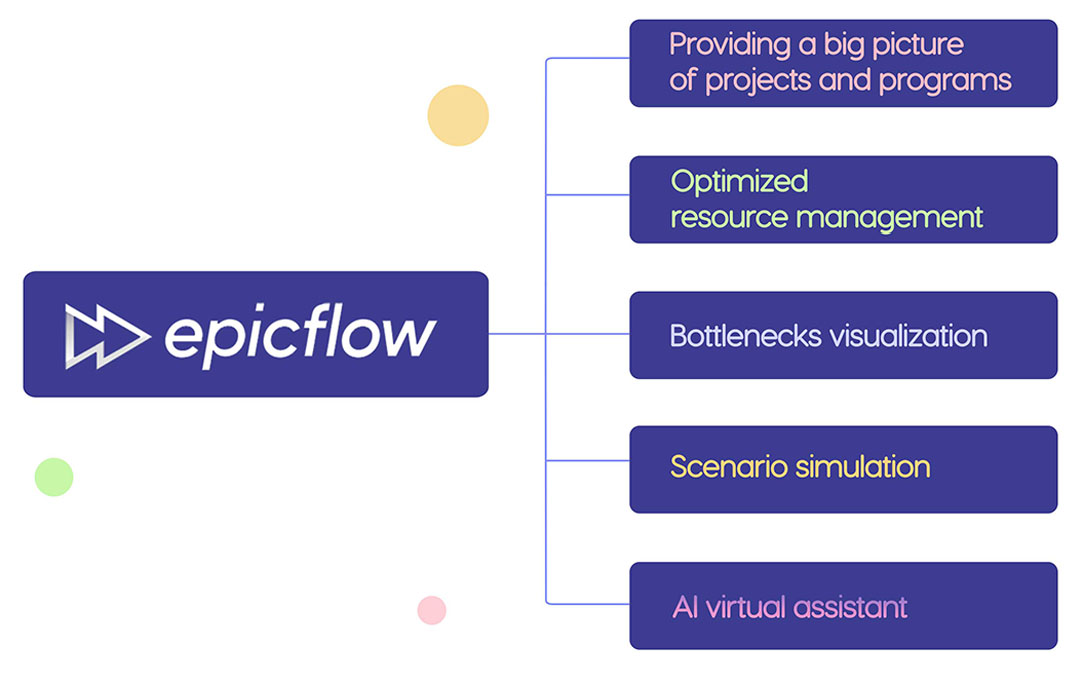
Epicflow is AI-powered multi-project resource management software whose unique capabilities help manage multiple projects, either programs or portfolios, and their shared resources. Its main focus on on achieving resource efficiency across multiple projects and ensuring successful delivery of each project in the multi-project landscape. Here are the key capabilities of Epicflow that work for program project management.
Providing a big picture of projects and programs
Epicflow’s features help you assess the state of the entire program from different viewpoints. For example, you can assess budget consumption or overall health of the project environment at a glance. This comprehensive visibility helps you quickly spot projects that require corrective action and enables effective program monitoring and control.
Optimized resource management
The essential components of resource efficiency across multiple projects are intelligent resource capacity planning and wise resource allocation. Epicflow’s predictive capabilities provide insight into people’s future capacity and workload, which helps plan resources’ capacity most effectively. As for resource allocation, Epicflow’s resource allocation advisor can analyze different parameters (capacity, skills, availability, location, etc.) to suggest a perfectly matching employee to assign to a task.
Bottlenecks visualization
Apart from effective resource management, seamless work across multiple projects is impossible without bottleneck detection and mitigation capabilities. In addition, creating a bottleneck-free project environment is one of Epicflow’s areas of strength: the tool provides capabilities for easy identification of current and future bottlenecks as well as their timely elimination.
Scenario simulation
Making informed decisions is one of the biggest challenges when you manage multiple projects, whether they are within a program or a portfolio. Epicflow can help you overcome it with its What-if analysis feature: it allows you to run different scenarios, analyze their impact on the project environment, and choose the most appropriate scenario.
AI virtual assistant
Epicflow’s virtual assistant Epica is your right hand in managing complex multi-project environments, project teams, and project work. It can help you analyze the state of the project environment, send notifications to the team members, help employees pick the next assignment, warn you of upcoming bottlenecks, and work as a project management knowledge base.
Of course, Epicflow’s functionality isn’t limited to the above-mentioned capabilities. Learn more about its superpower for seamless resource, project, and program management – book a call with our experts.
Final Words
Modern organizations rarely manage a single project at a time. They operate in interconnected ecosystems where projects compete for resources and influence each other’s success. Program project management transforms the coordination of a set of projects into unified effort aimed at delivering strategic value. Managing interrelated projects as a single system helps companies align initiatives with business objectives, manage project interdependencies, and optimize shared resources to ensure that the organization will achieve its goals faster and gain a competitive advantage.
References
- Becker, M. (1999). Project or program management? PM Network, 13(10), 78–79. Retrieved from: https://www.pmi.org/learning/library/project-program-management-3598
Frequently Asked Questions
What is program project management?
Program management in project management is the process of administering programs or sets of interrelated projects. The main purpose of program management is not only to ensure that all projects within a program are delivered successfully, but to guarantee its alignment with organizational goals and delivery of value for an organization.
What is a program in project management?
A program in project management is a set of interrelated projects that serve a specific goal. These projects have shared resources, risks, and benefits
What is an example of program management?
An example of program management can be the implementation of healthcare system improvements. The goal of the program implementation is to improve patient outcomes. This goal can be achieved through delivering these three projects:
- adopting electronic health records,
- implementing telemedicine services,
- ensuring cybersecurity.
What is the difference between program and project management?
The main difference between project vs program management is in the scale of these two approaches. While project management deals with delivering individual projects on time and within budget, program management focuses on managing a set of interrelated projects and ensuring that they deliver the expected value to an organization.
What are common challenges in program project management?
The common program management difficulties include conflicting priorities among projects, resource constraints, misalignment between program goals and organizational strategy, bottlenecks and delays, and inability to achieve expected results.
How do you measure the success of a program?
Program success is measured by achieving the intended business benefits, delivering strategic value, meeting stakeholder expectations, and improving organizational capabilities.
Can a project be a part of multiple programs?
Yes, but it requires careful coordination. The project’s objectives and resources must align with each program’s goals, and the program manager must manage any conflicts that arise.
What tools are commonly used in program management?
In program management, it's reasonable to use program management software like Epicflow, which includes resource management and capacity planning tools, collaboration and reporting features as well as scenario planning, performance analysis, and risk management capabilities.