
Project Portfolio Financial Planning Software | Manage Projects as Investments
Run your whole portfolio as one investment.
Getting the most out of the people your projects compete for has always been Epicflow’s core: bottleneck management across the whole portfolio, on a realistic prediction of what your shared resources can deliver. Epicflow’s financial planning software uses that same prediction to show what a plan is expected to earn before you commit anyone to it. Each piece exists somewhere in the market; the combination exists only in Epicflow. That is why the same people produce more money for your organization.
- Choose where capacity creates more value.
- Fund acceleration where it pays.
- Turn the selected plan into daily execution.
Two projects. One shared constraint.
The same specialist team can work on only one project at a time.

Project A
Plant controls rollout
Project B
Customer acceptance program
 Portfolio bottleneck
Limited capacity.
Portfolio bottleneck
Limited capacity.
Different sequence.
Different result.
Same projects. Same people. Then €30k at the bottleneck.
A first
Completion: A week 6 / B week 12
B first
Completion: B week 6 / A week 12
B first, then accelerate A
Completion: B week 6 / A week 10
One prediction drives both execution and cash timing.
Cash timing follows the same realistic schedule. Earlier cash is not automatically extra profit.
Choose the sequence and interventions.
Realistic delivery schedule for the shared team.
Cash timing aligned to delivery milestones.
The same people produce more money when the portfolio is sequenced around the true bottleneck.
A new opportunity can make the whole portfolio unprofitable
Your next contract looks attractive. The budget is approved, the customer is ready and the project promises a healthy return. But it needs the same specialists your running projects depend on, and that is the dilemma.
Expand capacity, but the specialist you need is the one nobody can hire.
Or delay your golden opportunity, and the customer walks away.
Do neither, and you have bitten off more than you can chew.
Stephen Devaux can.
He calls it the Moneyball game: his method puts a price on time.
For every project, it weighs what the project will still earn against what it will still cost.
According to Devaux, Epicflow is the first in the world to implement his Moneyball game for an entire portfolio.
The business case is not the problem. The bottleneck is. It is a resource constraint: the specialists every project needs at the same time.
Epicflow gets you out of that dilemma
01See what the bottleneck costs you
Before you commit, you see what the whole portfolio would earn if the missing capacity were there.
Know which capacity you lack, when and for which work
Then take targeted action: move specific tasks off the bottleneck, or outsource just that work.
 PLC Programming
Optimize the project sequence when capacity cannot grow
The projects that move are then the ones that cost least to move, and that is not always the new one.
 Project A€120kProject B€250kNew contract€300k
Approving an investment and releasing it into execution are separate decisions. You can support the project without insisting that it starts immediately.
Manage value, time and remaining investment together
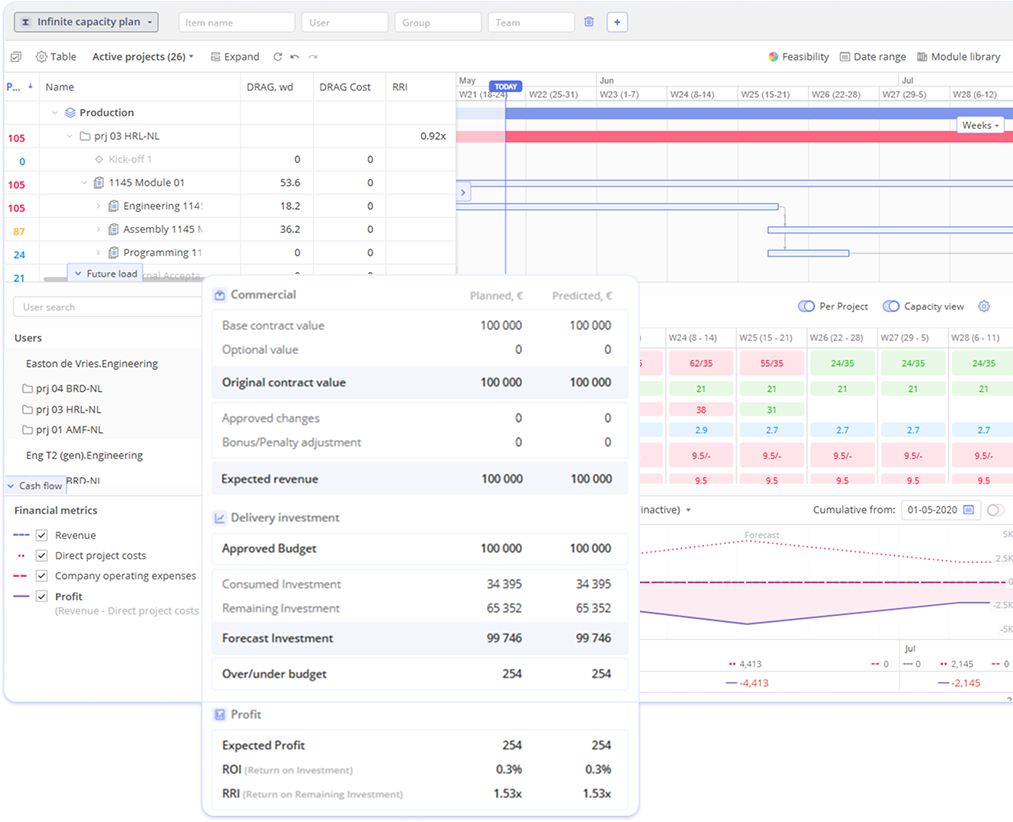
Every project’s investment case rests on three connected questions. Our financial planning software brings the answers together across your portfolio, so you see where it makes or loses money.
What is the project worth?
Identify the outcome worth funding: a customer delivery, a usable capability, an operational improvement or work that enables another investment. Make the benefit assumptions explicit. A business-value score is not automatically a monetary return, and neither is finished work.
When does the money come in?
Consider the delivery date, dependent initiatives and commercial conditions. A late milestone may trigger a penalty, postpone a service launch or shift expected payments. Every delay moves your cash flow. A week costs one project nothing and another its margin. Epicflow’s cash-flow prediction tells you which, before that week is lost.
 03
03What will it still cost?
Take a 1,000-hour project with 100 hours to go and €100,000 to collect on completion. Its ROI over the whole project may look ordinary. But 100 hours stand between you and €100,000: go and get it. That is Devaux’s DIPP. We call it RRI, Return on Remaining Investment: what a project brings in for every euro still to be spent, shown as a multiple. During execution, RRI tells you more than the ROI you used at the start. Epicflow shows both.
The denominator is the current estimate of remaining cost, not the unspent budget
Fund the scope that strengthens the business case
An additional feature can improve a deliverable while weakening the investment. Compare its incremental benefit, the resources required and the effect on delivery timing before deciding whether to include, reshape or defer it. For teams evaluating capital planning software, the test is whether added scope strengthens the investment, not simply whether budget remains.
Devaux’s Value Breakdown Structure connects components of scope with their contribution to value. Include enabling work essential to another project’s outcome, even if it earns no revenue itself. Keep that dependency visible without counting the same benefit twice. In Epicflow, record Business Value at phase level and use What-If Analysis to test the resource and schedule effects of scope changes.


Put a price on time
We translate RRI to the shop floor, so your people work directly on what brings the real money in.
Devaux’s critical path drag is the time a task adds to the project’s duration. Drag cost is what that time costs the project. Both are in PMI’s PMBOK Guide, 8th Edition. A task can carry drag even when it is on schedule, and shortening it helps only as far as the completion date moves.
Drag cost links the project’s value to every task: it shows what a task costs when it holds the project up, and what speeding it up is worth, for example by adding capacity. So the board and the shop floor look at the same money, and every department pulls the same way.
Pay for a better outcome, not for a faster task.
AI finds the most valuable plan. You decide.
Epicflow brings bottleneck management, realistic delivery forecasts and expected financial outcomes together in financial planning & analysis software for project portfolios. RRI for every project, drag cost for every task, cash flow for every milestone. Each piece exists somewhere. Only Epicflow combines them, and puts AI on top to optimize the whole portfolio.
You set the target; the AI optimizes towards it. Maximum profit: the highest return on what you still have to spend. Every mandatory deadline met. Or the best cash flow: AI-driven cash-flow optimization, down to a single payment milestone, because cash flow runs on the same resource-constrained schedule as everything else. Your budget for extra people is part of the target too.
The AI simulates thousands of plans for your whole portfolio, selects the one that hits your target and tells you what it takes: which projects to shift, and where and when to spend your budget on extra people. It shows how much extra profit that investment brings, so every hire becomes a considered investment decision.
We run it for you as PMO as a Service and put the best plan in a What-If Analysis. You see what it does to your portfolio without changing live projects, and you decide whether to adopt it.

The forecast informs the decision.

The chosen plan guides the work.
Progress updates the outlook.
This two-minute video shows it on a sample portfolio: which projects to finish first, which to pause, and when extra people pay for themselves. Nothing about the work changed. The decisions did.
Demo with your own data
Agent as a resource
Back to the dilemma: hire the specialist nobody can find, or move projects and feel the pain elsewhere. The third way: put AI agents at your bottleneck.
Everyone is deploying agents; few can say what they earn. Epicflow can.
01Bottleneck management shows where an agent counts,
drag cost what each hour it frees is worth,
and RRI what that does for every project.
Only Epicflow combines the three.
Free 10% of your bottleneck’s time, with first-pass reviews for example,
and you deliver up to 10% more with the same people.
They are already paid for, so profit rises far more: at a 10% net margin, with materials at 40% of revenue, by 60%.
Agents from the platform you choose join your resource pool: planned like anyone on your team, traceable, and checked by a human.
An agent is not a hire. You build it once; only the checking comes back, so keep that off your bottleneck. Before you invest, we simulate what it earns and what to do.
A second short video shows an agent at work in your resource pool, planned and checked like anyone on your team.

A method you can examine. A product you can see.
Portfolio scheduling experiment: Dutch Ministry of Defence
In an experiment on an initial batch of projects within a $1B+ program, Epicflow’s analysis indicated potential lead-time reductions of more than 30% without increasing headcount. The findings were shared before full implementation and concern delivery performance under a different portfolio schedule.
Read the portfolio scheduling experiment → without increasing headcount
$1B+
without increasing headcount
$1B+
Questions about managing projects as investments
A new customer commitment.
A milestone approaching a penalty threshold.

A request for additional engineers.
An optional feature that could delay the main delivery.
See what a different portfolio decision could change
Bring that decision to the conversation. Explore how Epicflow’s financial planning software can help compare the alternatives, what data the analysis needs and how the selected action would reach the operating plan.
All we need for a demo with your own data
One row per department and one row per project. No detailed plans. A spreadsheet is enough.
| Department | People (FTE) | Average hourly rate |
|---|---|---|
| Mechanical engineering | 12 | €75 |
| Electrical engineering | 8 | €80 |
| Software | 10 | €85 |
| Assembly and test | 16 | €60 |
| Project | Packaging line upgrade |
|---|---|
| Start date | 1 June 2026 |
| Due date | 26 February 2027 |
| Hours to go | Mechanical engineering 320, electrical engineering 240, software 480, assembly and test 900 |
| Contract value | €1,250,000 |
| Bonus per week early | €5,000 |
| Penalty per week late | €12,500 |
From these few numbers, Epicflow predicts when each project will finish, given everything else your departments have on. You see what that date earns or costs, the RRI of every project and where your bottleneck is.