Aerospace Digital Transformation: Technologies, Challenges, and Solutions for 2026
 Victoria Sokolova
.
February 3, 2026
.
Digital Transformation
.
26 mins READ
Victoria Sokolova
.
February 3, 2026
.
Digital Transformation
.
26 mins READ

In today’s changing and uncertain world, aerospace companies are seeking ways to design and develop new products faster and with less cost. Digital transformation in general and digitalization in particular take aerospace operations to a fundamentally new level as well as make it possible to reduce production costs, improve operational efficiency, and keep customers satisfied. So, every company that wants to stay competitive in the market must embrace digital transformation sooner or later.
However, this process often comes with numerous obstacles. In this article, we’ll explore the most significant challenges of aerospace digital transformation and outline the ways to address them. Let’s get started.
Key Takeaways:
- Aerospace digital transformation enables faster product development, lower costs, and greater efficiency across engineering, manufacturing, and other aerospace operations.
- Technologies driving digital transformation in aerospace industry include AI, digital twins, IoT, additive manufacturing, and advanced data analytics.
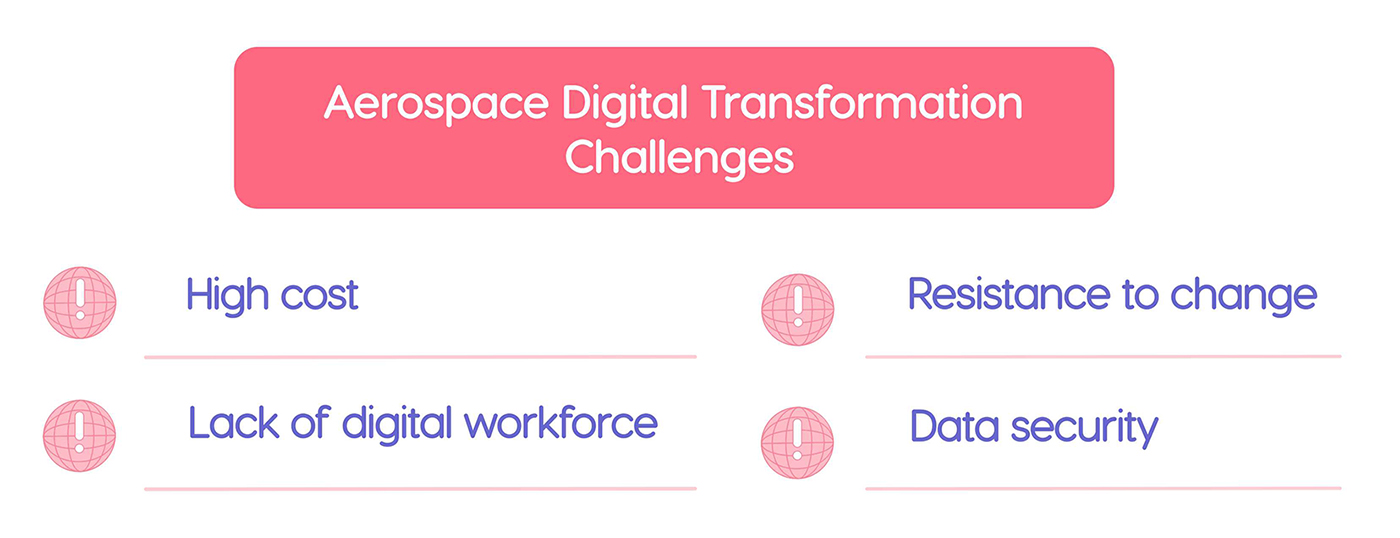
- Challenges of aerospace digital transformation include high costs, workforce shortages, resistance to change, and cybersecurity risks.
What Is Aerospace Digital Transformation?
First off, let’s shed some light on the difference between digitalization and digital transformation as they are still often confused or used interchangeably. Gartner Glossary defines the term digitalization as the use of digital technologies to change a business model and provide new revenue and value-producing opportunities. Digital transformation is a broader term: it implies the rethinking of how an organization uses technology, people, and processes in pursuit of new business models and new revenue streams, driven by changes in customer expectations around products and services.
Aerospace digital transformation is the adoption of digital technologies and data-driven processes in the aerospace industry with the aim of improving efficiency of their processes, increasing safety, optimizing costs, and embracing innovations. It’s not just digitalizing processes, but reimagining the way aerospace companies operate. Aerospace digital transformation embraces aircraft design and engineering, manufacturing, operations and maintenance, fleet management, and aftermarket services.
In this article, we’ll focus on the use of technologies driving digital transformation in aerospace companies and related challenges they have to address.
Why Is Digital Transformation Important for Aerospace Industry?
Aerospace operations involve complex, often time-consuming, and costly processes dealing with myriads of data. Mistakes in these processes come with a high cost, so they should be as optimized as possible, which is achieved thanks to the application of the latest technologies. What are the other benefits of digital transformation aerospace initiatives?
- Faster innovation and product development: Technologies like digital twins, AI, generative design enable rapid prototyping, virtual testing, and design optimization.
- Cost optimization: Optimized processes, predictive maintenance, and optimum resource utilization reduce expenses.
- Improved safety: Real-time monitoring with sensors as well as predictive analytics helps timely detect issues, reduce risks and downtime.
- Improving operational efficiency: Data-driven insights and preventing issues improves processes and optimizes resources.
- Improved decision making: Advanced analytics and integrated systems facilitate faster and more effective operational decisions.
Finally, it gives aerospace organizations a competitive advantage and allows them to meet their customers’ needs to the full.
Technologies Used in Aerospace Digital Transformation

Digital twin
A digital twin is a digital representation of a physical object at a certain moment. Combined with other Industry 4.0 technologies, it allows aerospace engineers to conduct various experiments with the virtual copy of an airplane or a spacecraft, e.g., test design changes and predict performance. As a result, it increases productivity, minimizes risks, improves product quality, and reduces production time. But it’s not only aerospace engineering that benefits from this technology. The other areas are:
- Aircraft operations and maintenance.
- Flight simulation and training.
- Supply chain and production planning.
- Spacecraft and satellite management.
- Fleet management.
Thus, digital twins play a central role in aerospace digital transformation, as it helps companies innovate faster, improve safety, and reduce operational costs.
Digital thread
Digital thread refers to the sharing of product lifecycle data up and down the extended supply chain via a communication framework. It plays a key role in aerospace digital transformation. For example, as for aerospace engineering, it can introduce agile engineering to a company. The technology creates an integrated and open design ecosystem that accelerates product development and tackles the most complex problems of engineering and design and in such a way transforms classical engineering approaches. [2]
In addition, aerospace companies use this technology to transform the following areas:
- Maintenance, repair, and overhaul (MRO) to enable predictive maintenance and faster issues resolution.
- Supply chain management to connect suppliers, manufacturers, and operators.
- Certification and compliance to maintain digital records of regulatory approvals.
- Fleet performance monitoring to optimize aircraft performance.
- Innovation and R&D to support design and testing.
Additive manufacturing (3D printing)
The technology has a huge impact on aerospace engineering and drives aerospace digital transformation in general. In particular, makes it possible to optimize production of some aircraft and rocket parts, as 3D printing requires less raw material and is less time-consuming than traditional manufacturing. In addition, the 3D printed parts are more lightweight, which optimizes fuel consumption.
Artificial intelligence
AI supports digital transformation in aerospace industry by analyzing vast amounts of design, operational, and performance data. Its applications are really wide:
- Design optimization: AI can analyze relevant data to suggest better design, materials, or aerodynamics.
- Predictive maintenance: Monitoring aircraft condition to forecast failure and reduce downtime.
- Flight operations: Optimizing routes, fuel consumption, and decision making for air traffic controllers.
- Supply chain management: Improving demand forecasting and resource allocation.
- Risk management: identifying potential hazards and suggesting ways to prevent them.
- Autonomous systems: Support with AI-driven control and decision making.
These applications demonstrate the potential of AI to transform engineering, design, operations, maintenance, making them more efficient and innovative. Latest developments in agentic AI will take AI applications to the next level, enabling even more autonomous decision making.
Generative design
These technologies are used to develop lightweight and durable components which are a high priority when designing an aircraft. AI combined with generative design allows engineers to examine a variety of design options within a short period of time and come up with the optimum product design. [3]
Beyond component design, generative design plays a key role in aerospace digital transformation, which enables faster innovation, reduces material waste, improves operational efficiency, and lowers costs. It can be integrated with digital twins and advanced simulation technologies to enable virtual testing and refinements before physical prototyping.
Internet of Things
The Internet of Things connects aircraft systems, ground equipment, and maintenance infrastructure. Here’s how this can be used in the context of aerospace digital transformation.
- Predictive maintenance: IoT sensors monitor engine performance and essential parameters to predict failures before they occur.
- Improving operational efficiency: Connected systems can track fuel consumption, flight routes, and component usage.
- Supply chain visibility: IoT devices facilitate real-time tracking of parts and materials to ensure their timely delivery and reduce delays.
- Enhanced safety: Continuous monitoring with sensors can give early warnings to the crew.
- Aircraft design and testing: Diverse sensors and data give insight into possible problems with aircraft/spacecraft parts.
Read more: Driving Digital Transformation in Aerospace & Defense: Recent Technology Trends
To sum up, the above-mentioned technologies improve aerospace operations, supply chain management, aerospace engineering and manufacturing, improve safety, optimize resources and costs.
How Using Digital Tools Transformed Portfolio Management at the Dutch Ministry of Defense
Aerospace digital transformation also involves changing the way aerospace programs and portfolios are executed. In particular, it involves adopting portfolio management tools that will enable faster delivery, informed decision making, optimization of resources and costs, and improving overall performance. This idea is proved by the results of implementing Epicflow PPM software for one of the programs run by the Dutch Ministry of Defense.
A $1B defense program of the Dutch MOD faced major delays despite growing budgets. They partnered with Epicflow to understand the root cause of their issues and test a new approach on a part of their large multi-year program. The main challenges were:
- Huge delays
- Too many projects in execution
- Overloaded teams
- Unclear priorities
- Ineffective capacity planning.
Epicflow helped the MOD identify their main bottleneck that hampered performance – limited resource capacity. By adopting the Epicflow approach, they have achieved remarkable results:
- Lead times reduced by 30%
- Due date performance increased from 24% to 77%.
And what’s most remarkable is that these results were achieved without increasing headcount.
This experiment demonstrates that digital, resource-driven, and data-backed portfolio management can transform complex aerospace and defense programs and help them achieve desired outcomes faster while optimizing costs.
Read more: Why Smarter Delivery Beats Bigger Spend: Experiment at the Dutch Ministry of Defense
However, companies trying to embrace digitalization can face certain problems on this way. Let’s explore the typical aerospace challenges related to digital transformation processes.
Challenges of Aerospace Digital Transformation and Possible Solutions
Challenge 1: High cost
No one doubts that digital transformation is expensive – it requires significant investment in technologies and innovation. First, aerospace companies will require new software, applications, equipment that should be regularly updated and serviced. Also, they will need to hire new employees to implement digital technologies and/or retrain the existing personnel. Finally, it requires investment in cybersecurity risk management to protect the data that becomes attractive for cybercriminals.
Possible solution
There are two things that should be kept in mind. First, digital transformation must be embraced sooner or later by every company – they simply won’t survive on the market without it. Second, it’s an investment into future successful business.
One of the ways to address this challenge is to split the whole digital transformation process into smaller projects, prioritize and implement them based on a company’s business goals and/or the scope of work.
Challenge 2: Lack of digital talent
Digital transformation requires tech-savvy employees who will be able to implement latest technologies in a company’s processes. However, A&D companies continue experiencing talent challenges these days, which inevitably affect the digital transformation process:
- reaching the age of retirement by a significant number of employees;
- the need for reskilling existing engineers and other specialists, which takes a while;
- inability to hire new talent quickly enough due to increased competition for digitally capable workforce.
What should be mentioned separately is the difference between older and younger generations’ approach to engineering. Older technical workers rely more on knowledge acquired through years of on-the-job experience, while young engineers are more tech-savvy but lack real-world problem-solving experience.
These factors create significant roadblocks for aerospace engineering companies’ digitalization.
Possible solutions
The following measures can help aerospace engineering companies build technically capable workforce.
- Facilitating the upskilling and reskilling of the current workforce. For example, this can begin with training people who already have some digital skills but have non-digital roles.
- Establishing partnerships with universities that graduate aerospace engineers as well as with research institutions for reskilling existing employees.
- Finding new approaches to attracting talent: e.g., inspiring and motivating young talent with exciting tech projects (creating supersonic or autonomous aircrafts), increasing leadership involvement in talent management, etc.
- Giving priority to diversity, equity, and inclusion in hiring and talent management. [4; 5]
Challenge 3: Resistance to change
Resistance is a natural human response to any changes; and leadership should be aware of this fact and by no means ignore it. The digital transformation process involves the change of established work routine and may become a serious stress for the existing employees and even be considered by them as a threat. And that’s not without a reason.
- They may fear that digital technologies will replace their work, and the company won’t need them anymore.
- Changes in employees’ work routine always come with uncertainty and corresponding stress: “Will I cope with my new responsibilities?”, “How hard will I have to work?”, etc.
- Change is about leaving people’s comfort zones, and according to the research, less than a third of frontline employees like taking risks and leaving their comfort zones. Therefore, embracing change is psychologically difficult for the majority of workers.
The degree of employees’ resistance will depend on a number of factors: e.g., how long they’ve been working for a company, their age, the scope of changes, the character of communication and relationships between leadership and employees, etc.
Possible solutions
Of course, each company should develop their own solutions to overcome employees’ resistance, but let’s outline some generic rules.
- Explain the benefits of digital transformation for your company and its employees.
- Provide each employee with a detailed explanation of how their work and responsibilities will change as a result of digitalization.
- Facilitate training of employees so that they can acquire necessary knowledge and skills for work in the digitilized environment, which will increase their confidence.
Read more: Change Management Best Practices: Overcoming Pitfalls of Change Implementation
Challenge 4: Data security
Digital transformation involves handling large volumes of data, transmitting it through networks, and increased connectivity, which makes companies vulnerable to cyberattacks. For example, the application of IoT involves active use of digital connections to retrieve data and manage equipment. All other technologies also become a growing source of cyber risks [6]. In addition, phishing and social engineering targeted at ordinary employees can be effective for getting access to sensitive data.
What is secure today, can be not secure tomorrow, which makes it more challenging to protect data against the threats. The consequences of cyberattacks can be really devastating for companies, so, the connected, intelligent, autonomous business needs pervasive cyber resilience.
Possible solutions
Here are some useful tips on improving cybersecurity.
- Take a comprehensive approach to cybersecurity. Cybersecurity involves a variety of solutions – network, application, endpoint, content, cloud and wireless security solutions. Being combined, they create strong protection against next-level threats.
- Communicate with partners and other industry professionals. Companies should be aware of the latest trends and news in the sector as well as share knowledge with each other to maintain proper security level across organizations of the domain.
- Make sure that employees are aware of cyber risks. Training people will enable them to recognize some threats (e.g., suspicious emails) and know how to handle them. Otherwise, they will remain the weakest link in the cybersecurity system.
- Perform “whitehat” security evaluation. A whitehat evaluation simulates hacker’s attack on a website or network; it aims to detect vulnerabilities and weaknesses in them so that a company can protect them properly against “black hat” hackers. [7]
Supporting Digital Transformation in Aerospace Industry with Epicflow
Embracing digital transformation is impossible without adopting aerospace industry solutions for portfolio management, which enable effective management of aerospace projects and programs as well as shared resources. Epicflow offers comprehensive support for aerospace organizations managing project portfolios. Here are some examples:
- End-to-end visibility into projects and programs run by a company.
- Project prioritization based on business value and resource constraints.
- Portfolio optimization enabling achieving maximum business value with resources available.
- Resource management including capacity planning, resource allocation, workload management, and performance analysis.
Epicflow’s capabilities allow aerospace organizations to overcome uncertainty and complexity of aerospace projects and programs, utilize available resources as efficiently as possible, and deliver maximum business value.
For more information on Epicflow’s assistance with aerospace projects and portfolio management, book a consultation with our team.
Read more: A Guide to Aviation Project Management [2026]
Final Words
Aerospace and aviation digital transformation is reshaping the industry by enabling faster product development, cost optimization, more efficient engineering and manufacturing processes. Key technologies such as AI, digital twins, IoT, additive manufacturing, and advanced analytics are driving this transformation and improving data-driven decision making. Despite challenges like high costs, talent shortages, resistance to change, and cybersecurity risks, companies implementing a structured digital transformation strategy can successfully overcome these obstacles and gain competitive advantage in the aerospace sector.
Frequently Asked Questions
What is aerospace digital transformation?
Digital transformation in aerospace and defense involves the adoption of the latest digital technologies across the entire value chain, from design and manufacturing to operations and maintenance.
What are the benefits of digital transformation in aerospace?
The benefits of digital transformation aerospace industry efforts involve faster innovation, cost reduction, improved safety, increasing operational efficiency, promoting sustainability, and improved decision making.
What technologies enable digital transformation in aerospace?
Artificial intelligence, digital twins and digital thread, the Internet of Things, advanced analytics, and additive manufacturing enable digital transformation in aerospace.
What are the challenges of aerospace digital transformation?
Challenges of aerospace digital transformation involve high costs, a lack of digital talent, resistance to change, and data security.
How to implement digital transformation in aerospace successfully?
To embrace digital transformation successfully, aerospace companies should define objectives clearly, prioritize digital transformation initiatives in line with business needs, invest in talent and change management, work on data consistency and cybersecurity.
References
- Profozich, Gregg. (2021).10 Emerging Aerospace Technology Trends You’ll Want to Know About. Retrieved from: https://www.cmtc.com/blog/emerging-aerospace-technologies
- Richardson, Mike. (2021). Digitalising the A&D Industry. Retrieved from: https://www.aero-mag.com/siemens-digital-industries-aerospace-11062021
- Joshi, Naveen, (2019). How AI is Propelling Aerospace Engineering and Development. Retrieved from: https://www.allerin.com/blog/how-ai-is-propelling-aerospace-engineering-and-development
- Athanasakopoulos, G. et al. (2020). Call to Action: How A&D Companies Can Build Workforce of the Future. Retrieved from: https://www.mckinsey.com/industries/aerospace-and-defense/our-insights/call-to-action-how-a-and-d-companies-can-build-the-workforce-of-the-future
- Athanasakopoulos, G. et al. (2021). Seizing the Moment: Talent Challenges and Opportunities in Aerospace and Defense. Retrieved from: https://www.mckinsey.com/industries/aerospace-and-defense/our-insights/seizing-the-moment-talent-challenges-and-opportunities-in-aerospace-and-defense
- Securing the Digital Sky. Cyber Resilience in Aerospace
and Defense. (2019). Retrieved from: https://www.accenture.com/_acnmedia/pdf-103/accenture-securing-digital-sky.pdf - Collasius, Erik. 6 Ways to Improve Defense and Aerospace Cybersecurity. Retrieved from: https://www.jabil.com/blog/defense-and-aerospace-security.html