Product Portfolio Management: What It Is and Why It Matters for Business Leaders
 Anna Balyuk
.
Anna Balyuk
.
 Victoria Sokolova
.
Updated
.
Digital Transformation
.
24 mins READ
Victoria Sokolova
.
Updated
.
Digital Transformation
.
24 mins READ

For growing companies, it’s crucially important to keep track of all their products and make sure they are in demand and meet customers’ needs. A good way to increase profitability is to work on products that will definitely bring revenue and make the right improvements that people are expecting. Product innovation and product portfolio management can make this happen. At the same time, it has some more functions and usually faces a lot of challenges. Read further to learn what we mean.
Key Takeaways:
- Product portfolio management is a strategic approach to managing a company’s set of products to ensure that they support business strategy and deliver value.
- Product portfolio management functions involve selecting, prioritizing, funding, and governing products across their lifestyle.
- Product portfolio management ensures business growth thanks to aligning products with customer demand and market trends, optimizing resource use, improving customer engagement, and maximizing profitability.
- A product portfolio management strategy defines how organizations evaluate, prioritize, and optimize product portfolios.
- The main challenges of product portfolio management involve limited portfolio visibility, competing priorities and running too many projects, resource constraints, poor resource coordination and decision-making as well as changing customer demand.
What Is Product Portfolio Management?
 A product portfolio is a collection of products and/or services that a company creates and offers to customers. The main objective of product portfolio management is to find the most appropriate strategy to gain the desired business outcomes as well as evaluate the success of individual products or services and make corresponding improvements if necessary. Its main focus is customer satisfaction and market changes, by tracking which it is possible to create the products with the biggest value, and therefore, earn more.
Here are some product portfolio management examples of well-known enterprises:
- Boeing manages a portfolio of commercial aircraft (737, 787), defense systems, and space products. Their product portfolio management approach involves balancing long-term defense programs with commercial aircraft development.
- Unilever manages portfolios of food and personal care products (Dove, Knee, Lipton, Axe, etc.). They invest in high growth and sustainable brands and retire products that no longer align with the strategy.
- Coca-Cola’s products involve Sprite, Fanta, Coca-Cola, energy and zero-sugar drinks. Their product portfolio management approach involves diversification of product across categories, introducing healthier alternatives in response to customer demand, and discontinuing low-demand products to stay aligned with evolving consumer preferences.
Let’s consider the benefits of product portfolio management for business success.
Importance of Product Portfolio Management
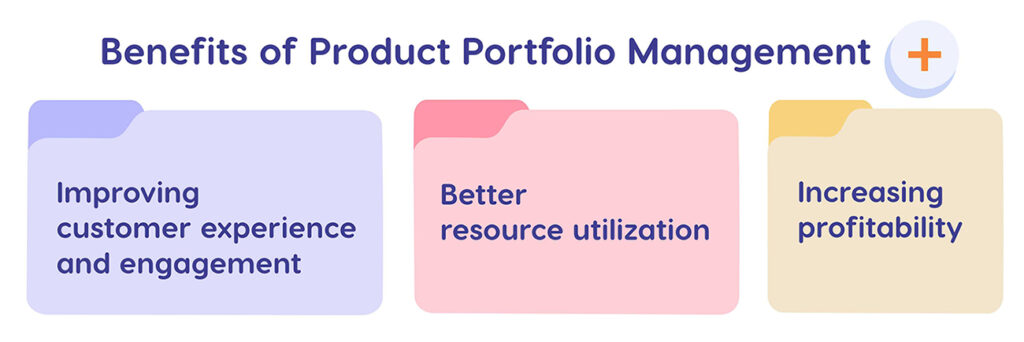
Strategic product portfolio management is essential for any organization, as its efficiency ensures a company's economic growth. The development of effective product portfolio management strategies helps to maximize the value of a product collection and the maximum benefit of its production.
Effective Product Portfolio Management Impacts Customer Experience and Satisfaction
Effective management of product portfolios helps produce only goods and services that are in high demand with its current and potential customers. To let it happen, clients’ feedback is constantly gathered and analyzed. Together with that, the market is under strict and continuous examination to reveal current trends in the domain the company works in. The analysis can show that some company products should be improved, some of them should be changed, and some of them eliminated from the market. By monitoring the market needs and examining competitors’ products and listening to your customer feedback, you can timely react to even slight market changes and people’s needs as soon as they arise. As a result, you can timely update your suite of products to be one of the best in your industry.
Good Product Portfolio Management Contributes to Better Resource Utilization
The analysis of current trends in the market, customers’ requirements, and the current products the company suggests makes it possible to allocate key resources to work on the products that are more valuable to the company. This allows for getting the desired outcomes faster and eliminates the issue of insufficient capacity because your people will work on those projects that are the most important for your business at the moment and won’t be overloaded because of other insignificant tasks.
Product Portfolio Management Implies Customer Engagement to Increase Brand Awareness and Trust
Managing a portfolio of products implies involving customers in one or several stages of the product lifecycle, often before the work on a product has been initiated to increase awareness of the product and make people want it even before its launch.
Properly Managed Product Portfolio Increases Profitability
Profitability is usually associated with an increased income as a result of taking more orders. In other words, it’s indicative of the company’s growth. The revenue must be reasonably invested to be doubled. Efficient portfolio management for new products allows a company to be agile and respond to arising market demands. It results in the acquisition of all necessary information about the company’s products in terms of their performance and success, namely:
- What products are the most popular and bring the best outcomes,
- What products need improvements and which exactly,
- What kind of products are expected to bring profit in the future (based on the given results).
Every product in the portfolio should be evaluated with the help of one of the product success metrics. Product and portfolio management metrics examination allows a company to build a line of products that are in demand, and therefore, increase profitability.
Read more: R&D Portfolio Management Guide: Process, KPIs, Best Practices
Functions of Product Portfolio Management
The main functions of product portfolio management are centered around selection and prioritization of products, their lifecycle management, and performance monitoring. The key functions are as follows.
- Developing ideas into products by combining product innovation and product portfolio management.
- Product selection and prioritization in line with a company’s strategy, market demand, value potential, and risk.
- Budget allocation across products of the portfolio.
- Product lifecycle management: deciding when to launch, enhance, maintain, or retire products.
- Resource allocation and capacity planning for R&D, engineering, marketing, and product teams.
- Performance monitoring and value tracking using different metrics (revenue, profitability, customer satisfaction, strategic impact).
- Decision making to adapt the product portfolio to changing conditions.
Together, these functions ensure that the product portfolio delivers maximum value, is aligned with the business strategy, and available resource capacity.
Now that we know what the main functions of product portfolio management are, we’d like to compare it to project portfolio management as these concepts often get confused.
Product Portfolio Management VS Project Portfolio Management: Main Difference and Common Points
 First off, we have to understand the difference between a project and a product to distinguish between the two concepts.
According to PMI, a project is a temporary arrangement with a defined beginning and end in time and therefore defined scope and resources. The goal of any project is to create a product or service.
A product is a kind of service or goods a company creates and improves in response to customers’ needs with the aim for the company to reach its business objectives and get revenue. As distinct from a project, a product doesn’t have a defined end date and is constantly under development to meet changing market demands.
Project portfolio management implies choosing and delivering the right projects for the organization. The “right” projects are the ones that comply with the company’s business strategy to help reach the goals and deliver value.
Product portfolio management is about choosing and delivering the right products based on the analysis of their performance, market state, and customers’ needs as well as the company’s business objectives.
What Project Portfolio and Product Portfolio Management Have in Common
Despite a great number of differences, there are some things in common:
- the need to create a strategy,
- the need for proper resource management,
- value-based prioritization across all items in the portfolio,
- risk and uncertainty management,
- progress analysis and reporting.
At the same time, it should be kept in mind that product development is project-based, and if a company leverages product portfolio management, it implies that project portfolio management also takes place. Moreover, they have much in common, which makes it possible to use the same solutions to manage them.
Read more: Project vs Program vs Portfolio Management: What’s the Difference?
Product Portfolio Management Strategy

One of the keys to efficient product portfolio management and increasing profitability is creating an effective product portfolio management strategy which involves assessing an organization’s existing and potential products and deciding which ones to develop, sustain, or retire. The goal of developing this strategy is to optimize return on investment by allocating resources to the most promising products as well as mitigating potential risks and maintaining a well-balanced portfolio.
Developing a product portfolio strategy involves the following steps.
- Evaluating the entire suite of products: assessing individual products’ market performance, profitability, alignment with a company’s strategic objectives, and customer satisfaction.
- Determining products’ potential opportunities: performing market research and identifying market opportunities, studying industry trends, and analyzing customers’ needs.
- Aligning products with an organization’s strategic goals: analyzing each product’s potential opportunity to align with a corporate strategy, its growth potential, and profitability.
- Product prioritization: setting priorities with regard to the market condition, customer needs, a product’s revenue potential, and production costs.
- Allocation of resources: determining the budget for individual products, setting timelines, and allocating resources accordingly.
- Monitoring and controlling the entire product portfolio: tracking its performance, analyzing market dynamics, changes in customer demand and their feedback, adjusting the priorities and investments if required.
- Portfolio optimization: determining the most promising combination of products, eliminating bottlenecks, and directing resources to the selected projects.
Value-based portfolio management as a key product portfolio management strategy
Value-based portfolio management should be the foundational strategy for effective product portfolio management. It pimples that product investment decisions are focused on maximizing total portfolio value. Products are evaluated and prioritized based on their expected value, strategic contribution, risks, and resource requirements. This approach enables organizations to allocate limited resources to the products that will deliver the greatest overall impact and sequence or discontinue low-value products.
Implementing this strategy becomes possible with software tools: Epicflow Portfolio Optimizer uses AI to help enterprises select really impactful projects, overcome bottlenecks, and allocate limited resources to the combination of projects with the highest business value potential.
To assess each product of the portfolio objectively, you may require to use product portfolio management models.
Product Portfolio Management Models
When performing product portfolio analysis, organizations tend to use two product portfolio management models: Boston Matrix and McKinsey GE Matrix. Here’s a brief overview of these popular product portfolio management examples.
Boston Matrix (or BCG Matrix) analyzes product performance based on market share and market growth and categorizes them into:
- Stars — high-growth products that are highly competitive on the market;
- Cash cows — low-growth products that are successful and mature with a high market share;
- Question marks — products with a low market share that have potential but may require significant investment;
- Dogs — underperforming products with low market share.
McKinsey GE Matrix is sometimes considered as an improvement to the Boston Matrix. To make the right product decisions, you need to analyze other factors: the level of industry attractiveness and competitive strength. Within these two dimensions, this product portfolio management framework offers companies three strategic actions:
- Invest/grow which is suitable for businesses/products operating in a moderately to highly competitive landscape and demonstrating moderate to high competitive strength;
- Selectivity/earnings (or hold strategy) that is ideal for businesses/products positioned in a low to moderate competitive stance within an appealing industry, or in a highly competitive stance within a less attractive industry;
- Harvest/divest: recommended for those with a weak competitive position, operating in an unattractive industry, or a combination of both factors.
Sometimes, the product portfolio management process doesn’t run as smoothly as expected. Let’s review the most common challenges that product portfolio managers come across in their work.
Product Portfolio Management Challenges
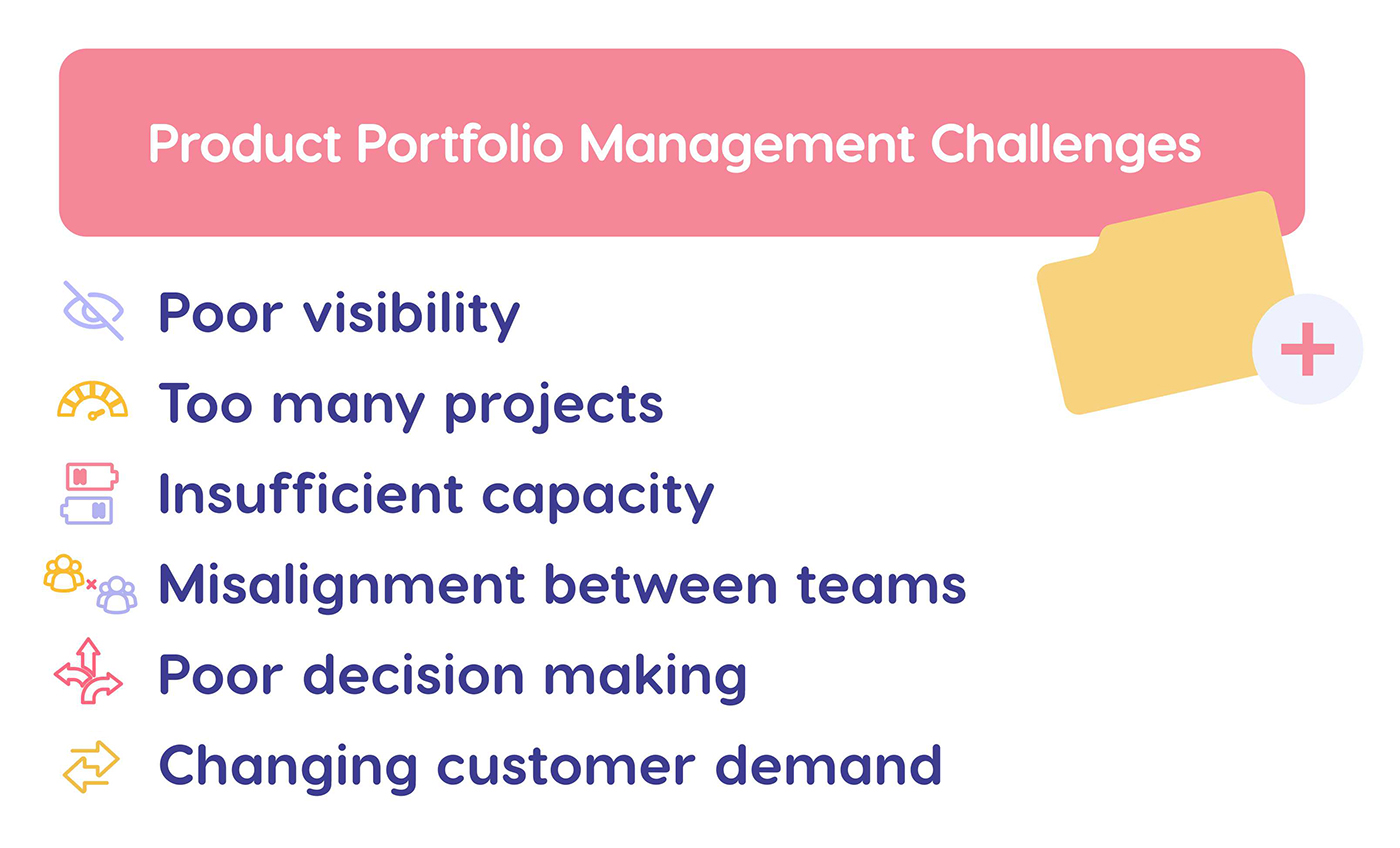
The challenges a product portfolio manager often faces are very similar to those faced by any project manager.
Poor visibility
The absence of transparency in the company makes it difficult to succeed with product portfolio management. All team members and stakeholders must have access to historical and real-time data to be able to timely react to transformations and make reasoned data-driven decisions.
Too many projects within the product portfolio
The companies that run a big product portfolio and an enormous number of projects face the challenge of their prioritization and resource allocation. This can lead to overloaded teams, bottlenecks, and delivery delays, which in turn will negatively affect portfolio performance and a company’s reputation.
Insufficient resource capacity
Insufficient capacity combined with “everything-is-important” mentality leads to overloaded employees not capable of completing all necessary tasks. This is a common problem for organizations that work in a multi-project environment as a result of having a rich product portfolio. Resolving a resource capacity challenge with a resource management solution can help achieve the desired outcomes and quickly grow revenue.
Poor coordination and collaboration between teams
Proper collaboration within and between product teams is crucial and sometimes complicated for a number of reasons: globally distributed teams, different time zones, lack of consistency, absence of a single source of communication, etc.
Ineffective decision making
Poor decision making arises from the complexity of evaluating options without complete or reliable information, especially in environments characterized by uncertainty and risk. When decisions are based on assumptions rather than data across a large number of projects or products, they can lead to potentially harmful impacts on other elements of the portfolio.
Changes in customer demand
Sometimes product portfolio management results in a decision to stop working on a product because it is no longer required in the market. This in turn may lead to team members’ frustration and burnout because of reallocation to another product. Here you need to create the right environment to increase your people’s motivation and implement necessary changes smoothly and efficiently.
Read more: Change Management Best Practices: Overcoming Pitfalls of Change Implementation
The list of challenges is not exhaustive, but the ones mentioned above can be successfully addressed with the help of a software solution. Let’s discuss this in the section below.
Product Portfolio Management Best Practices: Addressing the Challenges with the Product Portfolio Management Software

Gartner experts state that a product portfolio management tool ensures the product strategy’s alignment with both short-term and long-term business goals. A single product PM application can govern multiple product-centric applications with project management capabilities, but it must be harmonized with other applications.
A modern product portfolio management tool should have the following capabilities:
- What-if simulation using predictive analytics providing data-driven insights;
- Demand and capacity planning;
- Resource allocation across multiple projects as product development initiatives;
- Task management;
- Portfolio performance control;
- Reporting;
- Team collaboration;
- Budget management.
A product portfolio management tool provides transparency across all the products or services in the company and therefore assists in better management.
When searching for a reliable product portfolio management tool, we suggest focusing on the following criteria that are similar to the criteria for choosing a resource management solution:
- Functionality: key features;
- Usability: interface, technical support, and availability of a mobile app;
- Architecture: security and integration opportunities;
- Vendor reputation and feedback;
- Cost and terms of use.
Therefore, if you want to grow your company or already have a big enterprise with many products being developed, product portfolio management is a great instrument for it. If you’re interested in the software solution that will allow you to keep track of your portfolios, optimize their performance and resource utilization, don’t hesitate to contact us.
Conclusion
Product portfolio management helps organizations turn strategy into products that customers actually need. It helps them focus on the right mix of products and manage their lifecycles, respond faster to market changes, and use available resources wisely. Portfolio management for new products allows companies to evaluate market opportunities, allocate resources wisely, and reduce risks of failed launches. While challenges like poor visibility, competing priorities, uncertainty and changing customer demand are inevitable, a value-driven approach helps organizations stay competitive and increase profitability.
Frequently Asked Questions
What is a product portfolio?
A product portfolio is a set of products or services offered by a company, which are managed together to deliver value, optimize resources, and achieve strategic goals.
What is product portfolio management?
Portfolio product management is the creation of a collection of the best products an organization produces as part of the company's strategic planning to ensure brilliant business outcomes and satisfied clients.
What is the difference between product and project portfolio management?
Though they sound similar, they have absolutely different purposes. Project portfolio management is focused on the prioritization and timely execution of the portfolio of projects to get the maximum value for the company, while product portfolio management aims to develop a collection of the best projects to maximize ROI and client satisfaction. At the same time, they have much in common: e.g., the need to create a strategy, proper resource management, prioritization of tasks across all items in the portfolio, risk and uncertainty management.
Why do companies need product portfolio management?
Organizations need it to make intelligent strategic decisions about the development and selling of products. Product and portfolio management helps align products with the business strategy, improve ROI, and promptly react to market changes.
What are product portfolio management metrics?
Some product portfolio management metrics include:
- financial metrics (revenue, profitability, ROI),
- customer metrics (customer satisfaction, retention),
- strategic metrics (alignment with business goals, innovation impact),
- operational metrics (time-to-market, capacity utilization).
How can project portfolio management tools be used for product portfolio management?
These tools can be of great help because they provide tools for efficient resource management and allocation, project and task prioritization, uncertainty and risk management, informed decision-making, and real-time progress and performance monitoring and reporting.