Project vs Program vs Portfolio Management: What’s the Difference?
 Victoria Sokolova
.
June 14, 2026
.
Project Management
.
19 mins READ
Victoria Sokolova
.
June 14, 2026
.
Project Management
.
19 mins READ
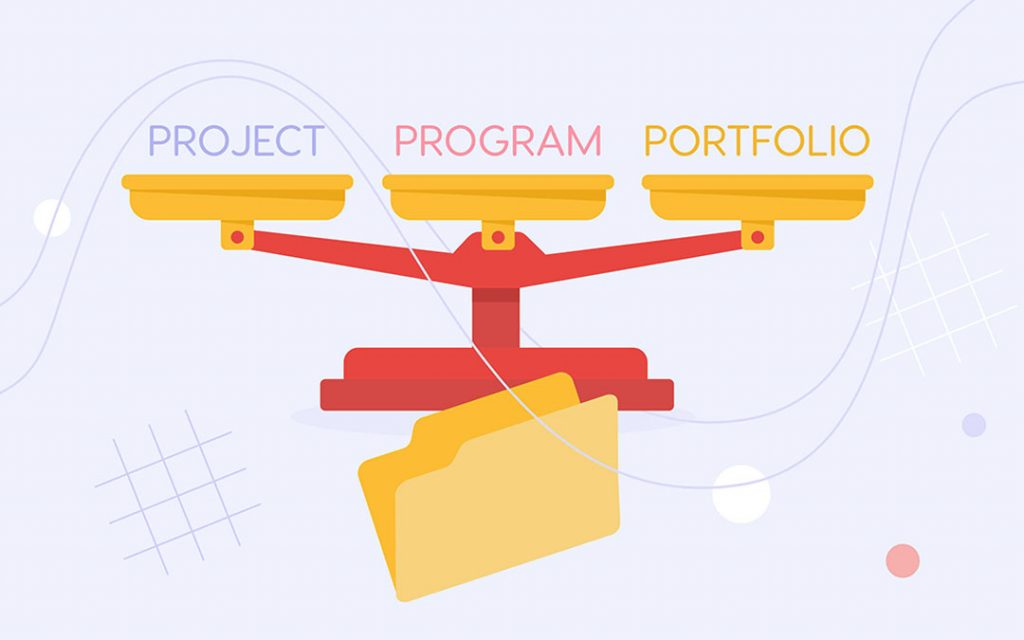
Managing projects can be different: it depends on their number, organizational goals and priorities, and stakeholder requirements. These factors will determine your choice between project, program, and portfolio management, each of which requires different approaches, resources, and tools.
In this guide, we’ll explore the difference between project, program, and portfolio management and roles within them. Read further to decide which discipline is the most suitable for your organization’s needs right now.
Key Takeaways
- Project management = Delivering one product/service/result on time and within budget.
- Program management = Coordinating interrelated projects to achieve a common goal.
- Project portfolio management = Selecting and prioritizing projects to align with strategic objectives.
What Is Project Management?
Project management involves the application of knowledge, skills, techniques, and tools to administer projects. According to PMI definition, a project is a temporary endeavor that aims to deliver a specific output – a product, service, or result. Projects have goals that must be achieved upon their completion. Also, each project has constraints – time, costs, scope, resources, or quality. In other words, there are limits for each project, e.g., the scope of work is usually clearly defined at the beginning of project work and it shouldn’t be exceeded without serious reasons. The same can be said about the timeline.
The key characteristics of a project are:
- Limited timeframe with a clear beginning and end;
- Unique deliverables that should be obtained upon project completion;
- Constraints (limited time, cost, and scope).
So, project management is an art and science of achieving project goals and delivering expected results under conditions of existing constraints.
Examples of project management
Imagine a software development project – a new website for a company. The main goal of this project will be to deliver a properly working website within 3 months. The project will have intermediate deliverables, e.g., creating a website design, software development, uploading the content, testing, and launch. The project will have the following constraints: a budget of $50,000, timeline of 12 weeks, and limited resources. Project management is required to get the required scope of work done on time and within budget as well as in line with stakeholder requirements and quality standards.
What Is Program Management?
Program management is the coordinated orchestration of programs – multiple related projects united by a common strategic objective of an organization. In contrast to focusing on one deliverable like in project management, program management focuses on managing interdependencies within a program and achieving a specific goal that you cannot achieve upon completion of a single project.
Here are the main attributes of program project management:
- Involving multiple interrelated projects;
- Focusing on achieving benefits, not just deliverables.
Examples of program management
As an example, let’s look at a digital transformation program for a retail company. The program may consist of the following projects: developing a new e-commerce platform, implementing a new CRM system, introducing mobile payment solutions, and training staff to use digital tools. The goal of the program is increasing online sales by 40% and improving customer retention. It’s important to note that achieving this goal will be impossible with the above-mentioned individual projects. So, they should be united into a program to ensure achieving the above-mentioned benefits.
What Is Portfolio Management?
Project portfolio management involves the centralized management of all projects and programs run by the organization and ensuring their alignment with a company’s strategic objectives. In contrast to program management that aims to achieve a specific goal, portfolio management focuses on the selection and prioritization of projects and programs depending on their value for a company.
The main characteristics of project portfolio management are the following:
- Strategic focus;
- Embracing all projects and programs;
Dealing with prioritization, resource allocation, and value creation.
Read more: Portfolio Management and Resource Allocation: What Do They Have in Common?
Examples of portfolio management
Let’s imagine project portfolio management in aerospace and defense. As a rule, A&D organizations run multiple complex projects and programs that are costly and long-term. For example, a project portfolio of a defense company may have the following objectives:
- Modernizing legacy systems;
- Maintaining technological leadership;
- Ensuring compliance with international security standards.
At the same time, the list of projects and portfolios they are working on may look like this:
- Developing next-gen fighter aircraft program;
- Cybersecurity enhancement initiative;
- Additive manufacturing for aircraft parts;
- Upgrading legacy aircraft program;
- Environmental compliance projects.
How can a company understand what projects or programs require resources and should be delivered first? This is when they require project portfolio management. It will help this organization set the right priorities across projects and programs, link them to business objectives, and allocate resources to projects/programs with the highest business value. As a result, the defense company will achieve its business objectives and increase profitability.
Project vs Program vs Portfolio Management: What’s the Difference?
In this section, we’d like to summarize the difference between project management vs program management vs portfolio management to avoid any confusion.
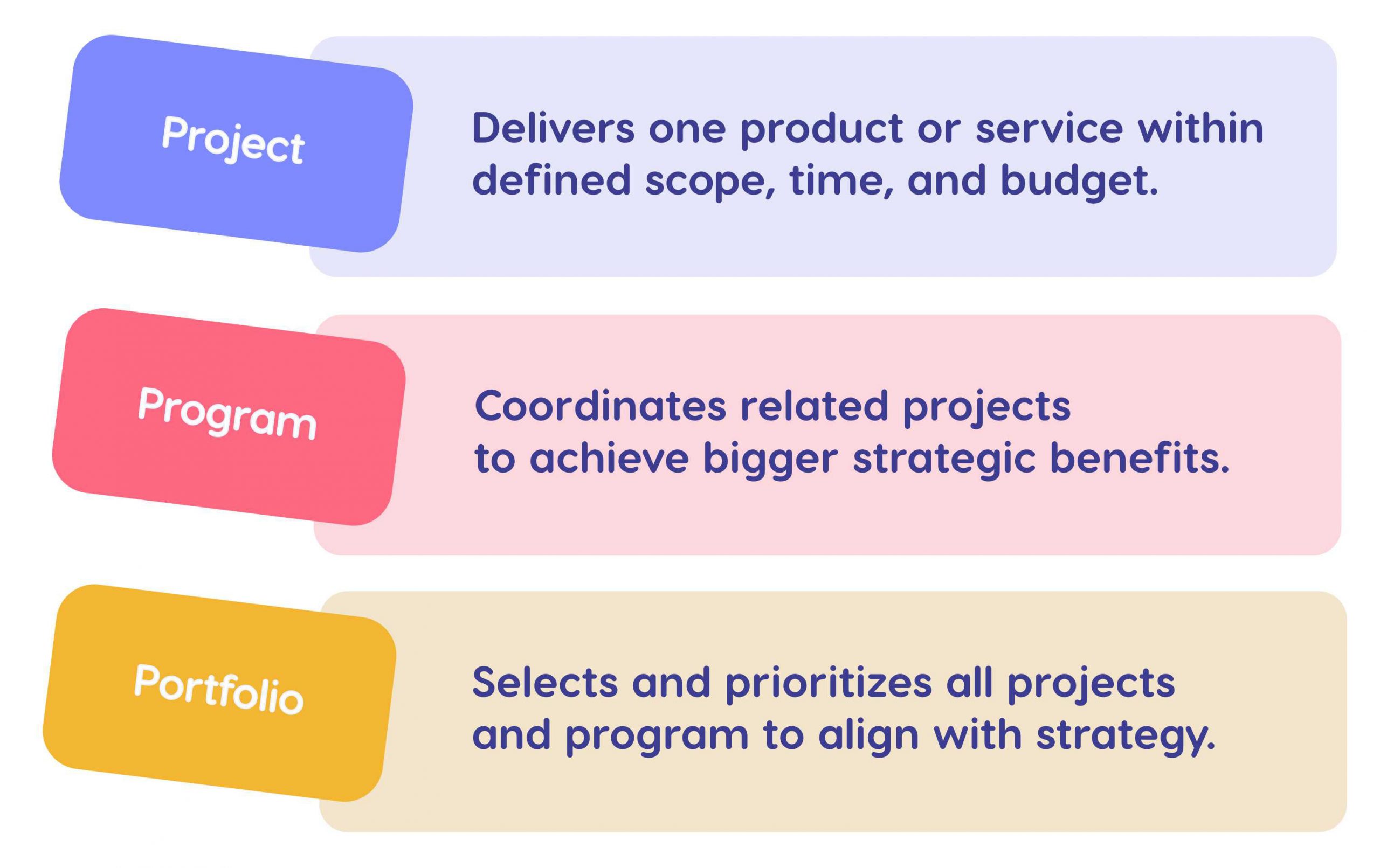
- Project management aims to deliver a single product, service, or result within the defined scope, time, and budget.
- Program management coordinates interrlated projects united by a common goal to achieve strategic objectives that cannot be achieved by executing a single project.
- Project portfolio management is at the highest level; it involves selection and prioritization of projects and programs to achieve their alignment with organizational goals.
Projects deliver outputs, programs deliver outcomes, and portfolios deliver strategy.
Roles and Responsibilities in Project, Program, and Portfolio Management, and How They Interact
The role and responsibilities within portfolio, program and project management differ significantly. Here are their description in more detail.
Project management
Project sponsor: Responsible for funding, approving project scope and changes to it, championing the project at senior level.
Project manager: Responsible for executing, monitoring, and closing the project. Manages scope, schedule, cost, risks, and stakeholders.
Project team: Team members are responsible for executing tasks assigned to them, reporting progress, and completing project deliverables.
Stakeholders: They are responsible for providing requirements, feedback, and approvals.
Functional managers: In matrix organizations, functional managers administer departments and teams whose members are assigned to projects. They ensure resource availability and the required level of expertise.
Program management
Program sponsor
A program sponsor is responsible for approving the funding of a program, addressing cross-program issues, supporting the program, and confirming its successful delivery.
Senior responsible owner (SRO)
SRO has the following responsibilities:
- leading the program to successful completion,
- managing key strategic risks,
- overseeing strategic alignment between the program and organization,
- making decisions by the sponsors.
Program manager
Program managers are responsible for the following things:
- day-to-day program management,
- determining the program governance,
- planning the program and monitoring its progress,
- managing program budget,
- managing interdependencies between projects, resources, documentation as well as stakeholder management,
- aligning the deliverables with the program’s outcomes.
Business change manager
The role of a BCM involves strategic planning and managing the realization of benefits. In particular, they have the following responsibilities:
- Determining the benefits that will contribute to implementing strategic goals,
- Compiling a benefit realization plan,
- Defining and tracking KPI related to benefit realization,
- Consulting a program manager on benefit realization.
Program management office
Members of the program office are responsible for the following activities:
- Determining tools and standards for managing the program,
- Planning and tracking finances,
- Risk management and issue control,
- Managing cross-project interdependencies,
- Establishing quality control standards,
- Developing and implementing communication plans for stakeholders. [1]
Project portfolio management
Executive leadership: Responsible for setting strategic objectives and determining investment criteria.
Portfolio manager: Responsible for evaluating and selecting projects or programs, developing a portfolio strategy and aligning it with organizational goals, balancing risks and benefits, allocating resources and funding, and monitoring performance at a high level.
Portfolio management office: Establishing standards and reporting for decision-making.
Portfolio analyst: Responsible for collecting and analyzing the data on project and program performance, helps with prioritization and resource planning.
What about project managers? Do they participate in all three processes? To some extent, yes. Project management is impossible without the participation of a project manager. Program management includes multiple project managers, for each project within a program, while a program manager’s role is higher. Portfolio management deals with projects/programs’ selection and prioritization, while projects and programs are coordinated by project and program managers.
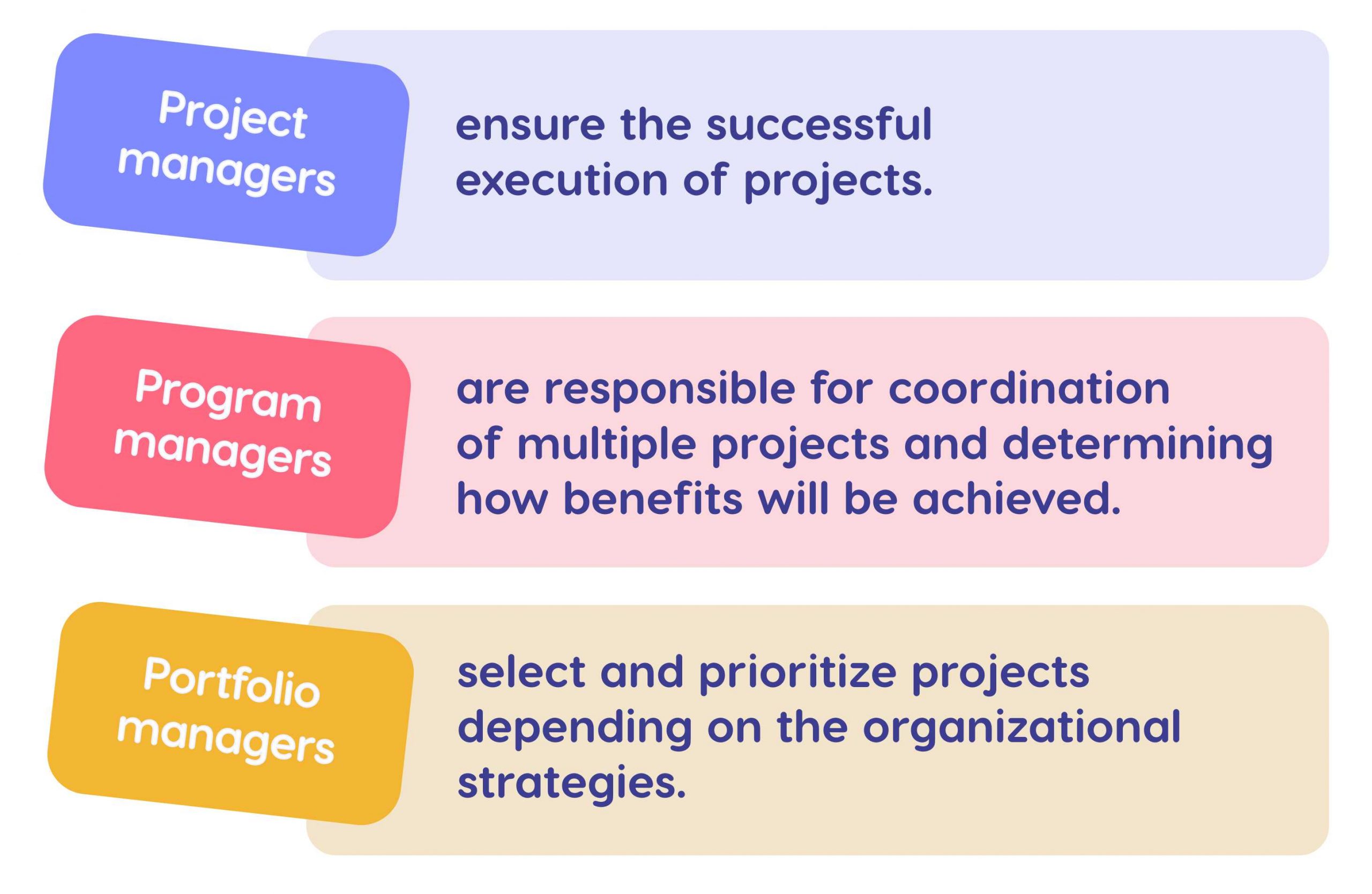
To summarize the difference between portfolio vs program vs project management in roles:
- Project managers ensure the successful execution of projects.
- Program managers are responsible for coordination of multiple projects and determining how benefits will be achieved
- Portfolio managers select and prioritize projects depending on the organizational strategies.
It’s important to note that these roles and responsibilities may differ across organizations. Project managers have the most standardized role, as it’s determined by project management standards like PMI, PRINCE 2, and others. Other roles and responsibilities will differ depending on the organization’s size, maturity, industry, or other factors.
When to Use Project, Program, or Portfolio Management
Here are some quick guidelines on selecting the right discipline.
When to use project management?
Project management should be used when you need to deliver a single project with defined start and finish. The main goal is to produce a specific product, service, or result. It’s focused on scope, time, cost, and quality, which is perfect for individual projects. For example, it can work well for endeavors like launching a new website, developing a product or a feature, or conducting a marketing campaign.
What to use program management?
Use program management when you run multiple related projects that required coordination to achieve common objectives. If your main goal is to deliver benefits and outcomes that cannot be achieved by single project execution, program management can be the right choice. For example, you can use it for digital transformation initiatives, company-wide process improvements, or implementing a new technology platform.
When to use project portfolio management?
Use project portfolio management to decide which projects and programs to invest resources in to meet a company’s strategic objectives. PPM provides a strategic organization-wide view of projects and programs to set the right priorities and allocate resources to the highest-priority projects. For example, you can use project portfolio management to decide which new products to develop and which to cancel or to balance different initiatives across the organization.
No matter which of the disciplines you’re working with, leveraging software tools for program and portfolio management will help you run your projects smoothly and deliver the expected benefits. For example, Epicflow is a project resource management tool that serves multi-project environments with a shared resource pool. It supports project management at all levels while providing robust resource management functionality. With Epicflow, you can achieve smooth workflows, optimal resource utilization across projects, and timely project delivery. What is more, its functionality ensures that projects will deliver value to your organization. Book a call with our specialists, and they will help you find the best solution to address your business needs.
Final Thoughts
Successful organizations do more than manage tasks; they take a purposeful approach that helps them achieve organizational goals. Knowing the right management approach to your initiatives is one of the key factors that ensures reaching desired results. Project management allows you to deliver a single product, service, or result. Program management is required to orchestrate multiple projects that are targeted at achieving a common goal. Project portfolio management serves for the proper selection, prioritization, and management of multiple projects and programs. Thus, project, program, portfolio management are three distinct but interconnected disciplines that help companies align strategy with execution.
For achieving better results, don’t forget to take advantage of project and portfolio management tools – they aim to streamline processes, optimize resources, improve decision-making, and ensure successful project delivery.
References
- Zein, O. (2010). Roles, responsibilities, and skills in program management. Paper presented at PMI® Global Congress 2010—EMEA, Milan, Italy. Newtown Square, PA: Project Management Institute. Retrieved from: https://www.pmi.org/learning/library/roles-responsibilities-skills-program-management-6799
Frequently Asked Questions
What is the difference between project, program, and portfolio management?
Project management focuses on delivering a single product, service, or result within defined constraints. Program management coordinates multiple related projects to achieve expected benefits. Project portfolio management is at a strategic level and involves selection and prioritization of projects and programs in line with organizational goals.
What is the relationship between project, program, and portfolio management?
Project managers report on deliverables and progress to program managers. In turn, they manage interdependencies and track benefits. Program managers provide data to portfolio managers who make strategic decisions regarding funding, priorities, and strategic alignment.
What is the difference between program and portfolio management?
Both disciplines deal with managing multiple projects, however, they aren’t identical. A comparison of program vs portfolio management shows that programs focus on delivering benefits through the completion of multiple related projects, while a portfolio deals with selecting and prioritizing the right projects. Understanding portfolio versus program management is critical for managers who need to distinguish between strategic prioritization and coordination of related projects. Some organizations may use the term “program portfolio management” to denote managing both projects and programs as part of a portfolio. Finally, companies that adopt program & portfolio management practices are more likely to achieve organizational goals, optimize resource allocation, and increase performance.
Can a project exist without being part of a program or portfolio?
Yes, a project can exist on its own, without being involved in a program or a portfolio. This is possible when a company is interested in delivering a single product, service, or result.
Do all programs and portfolios include project managers?
Yes. Programs are collections of projects which have their own project managers. A portfolio embraces projects and programs, which means that project managers participate in the portfolio management processes indirectly.
How to choose between project, program, and portfolio management?
Use project management to work on a single project, program management when you need to coordinate interrelated projects, and project portfolio management when you need to make strategic decisions regarding project selection and prioritization. Examples of project, program, and portfolio management can be found in industries like construction, IT, aerospace and defense whose endeavors range from single product launches to enterprise-wide transformations.