CFO Trends: How Finance Leaders Are Shaping Business Strategy in 2026
 Mykhailo Kulakov
.
June 14, 2026
.
Digital Transformation
.
24 mins READ
Mykhailo Kulakov
.
June 14, 2026
.
Digital Transformation
.
24 mins READ

Chief financial officers are at the forefront of innovation and strategy in many organizations in 2026. The trends that define the CFO role are going to impact organizations as a whole.
Let’s explore what the latest CFO trends in 2026 are, how to implement them in your organization, and what trends are likely to define the rest of the decade.
Key trends:
- Shift of the CFO role from accounting to financial strategy.
- Increased number of priorities that need to be combined.
- Growing requirements for decision-making velocity, including real-time data usage.
- Finance-led smart cost-cutting measures.
- Adoption of AI technology is among the most important CFO technology trends.
- The need to build up tech talent in the CFO finance team.
Why CFO Trends Matter More Than Ever
CFO trends in 2026 are exceptionally important because of the major shift in the role of a CFO. The modern Chief Financial Officer role concerns not only analysis of historical financial data, it has grown into a company growth visionary, an executive leader that shapes company strategy.
CFOs aren’t only focused on internal financials now, but also on the external market forces that can shape a company’s financial performance. They bridge the gap between company vision and many of the external risk factors, leading to improved goal setting and goal getting.
This enhanced scope of responsibilities makes following CFO trends closely important for the future of the company.
Another factor is the increased pace of making decisions. As the last decade showed us, crises and major policy changes can happen fast, and they demand a quick response if an organization doesn’t want to lag behind the competition.
Top CFO Trends Defining 2026
CFOs have faced and overseen a lot of digital transformation in recent years. Let’s explore the major trends that define their role, as outlined by Deloitte 2026 finance trends report[1].
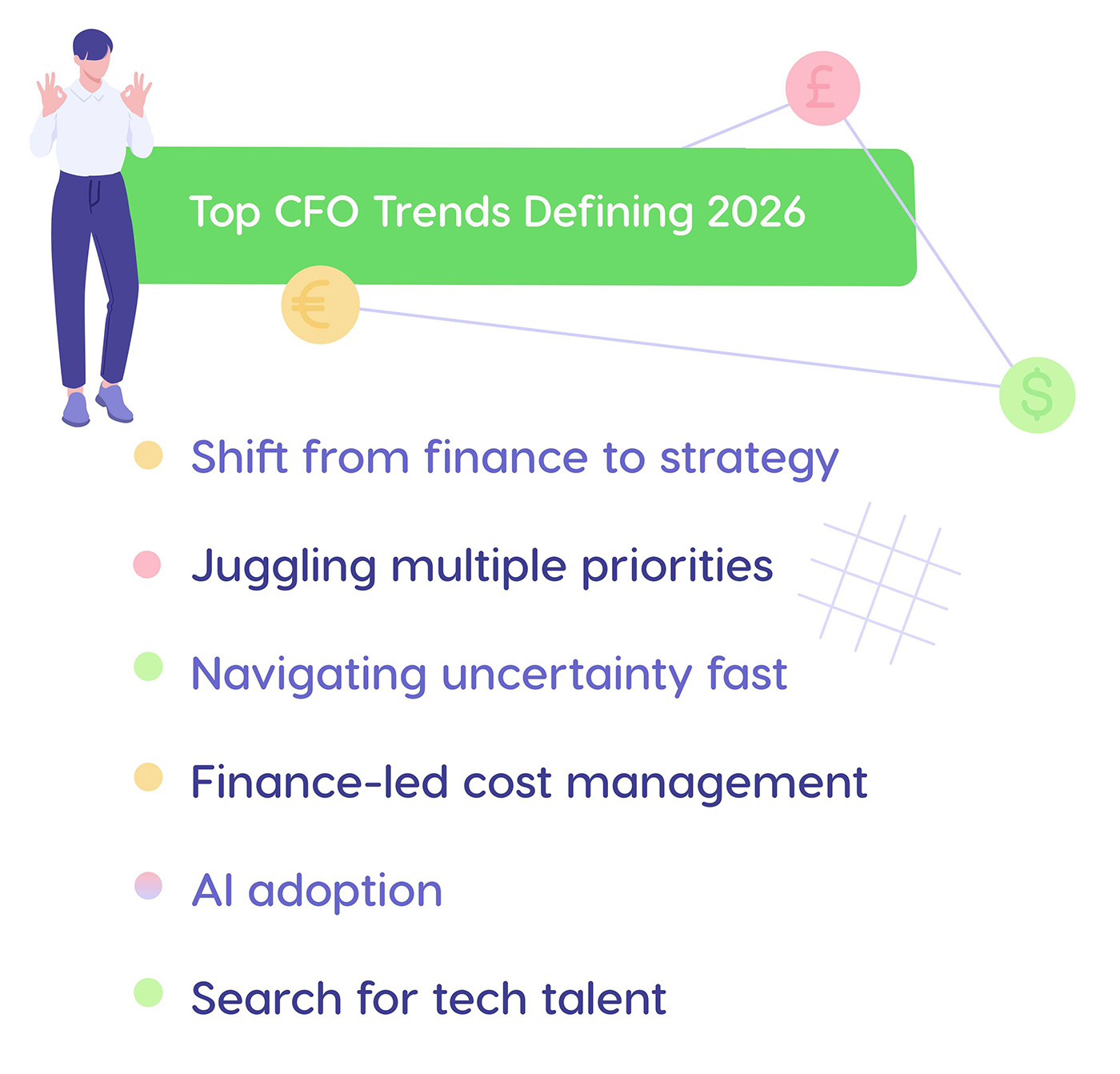
Shift from finance to strategy
The largest continuing trend among financial leadership is the shift from strictly financial analytics to a strategy-shaping role. Job openings for CFO roles demand more skills and experience, especially in risk management and data-driven decision-making.
According to the Deloitte survey, only 1% of finance leaders are not consulted at all concerning strategy decisions, and 57% say they play a leading role in shaping strategy in their organizations.
How to follow this trend
The solution to this growing expectation is twofold. Technology trends for CFO call for an increased focus on automation and advanced analytics. Automation is the key component here because streamlining core responsibilities with technology allows finance leaders to focus their attention on more strategic matters.
Some areas you can automate include:
- Invoice processing.
- ERP integration.
- Bank reconciliation.
- Expense report processing.
Once you can automate those menial time-consuming tasks, you can focus on bringing analytical tools to your organization to implement data-driven change.
Juggling multiple priorities
The Deloitte survey of finance leaders shows that there isn’t a single area of their responsibilities they can prioritize. The top five, with a very small difference in the number of responses, are:
- Planning for external risk factors.
- Adopting new technology.
- Developing new products.
- Optimizing allocation of funds.
- Cost-cutting.
This leads the modern CFO into a situation where they can’t afford to focus on and perfect a single area of business. CFO priorities need to be divided between multiple areas or risk others underperforming.
How to follow this trend
Most CFOs align their work with this trend by using sophisticated scenario planning tools. Implementing machine learning and AI technology lets them combine multiple factors in a single forecasting environment. AI agents and analytical tech let the CFOs shift from juggling multiple priorities to a holistic approach.
Navigating uncertainty fast
Not only are the challenges the modern CFO faces multiple, they are often hard to predict. Internal company risks may also be a part of this problem, but this mostly concerns external risks. As the last couple of years have shown, supply chain disruptions, changes in monetary policy, and economic challenges can arise in a matter of months.
This puts additional pressure on CFOs to perform. Trends for CFOs of the year require them to make accurate, data-backed decisions fast.
How to follow this trend
Apart from implementing AI technology in analytics to predict potential risks, CFOs should change their approach from rigid planning to a more flexible one. Many external risks, like policy change or political unrest that may compromise global supply chains, are almost impossible to predict. Having the flexibility and contingency plans to answer fast can be more influential for successful outcomes than analytics.
Finance-led cost management
As the global economy is slowing down, there’s a constant push to do more with less[2]. Many companies try to achieve this by changing the product lines and automating work that can be automated. In the end, most will have to face the need to run a lean enterprise and investigate workflows for inefficiencies that can be cut to save cost and conserve human capital.
In many organizations, CFOs are at the forefront of this process because they are responsible for cost and expense management.
How to follow this trend
Here, sophisticated analytics software and AI technology can assist CFOs as well. For cost-cutting in terms of company resources in particular, project portfolio management software can create a major positive change. Let’s explore how one such tool, Epicflow, can help an organization optimize resource utilization.
- Use Epicflow dashboard to visualize concurrent projects in your portfolio.
- Use Historical Load Graph to visualize resource utilization across the organization.
- Use scenario planning software to assess the effectiveness of resource allocation options.
- Use Epicflow Portfolio Optimizer to automatically align resource allocation with business value production.
Software like this can help organizations use their resources more effectively and generate more business value with less resources used. Book a call with the Epicflow team to learn about how it can help your businesses achieve smart cost-cutting.
AI adoption
As you may have seen from the previous trends, AI technology is one of the core components of a modern CFO’s toolbelt that can help them implement many of the current trends. Adoption of this technology and its effective usage is one of the most important CFO trends in 2026.
As the Deloitte survey shows, more than half of finance leaders already use AI. For many, though, implementing AI at their organization remains a task they need to handle. Even among AI adopters, ROI and driving practical, measurable value are not always clear.
How to follow this trend
The two main methods of ensuring effective AI adoption in the finance leader role are building organizational trust and integrating AI with legacy systems.
You need to research how AI tools that you’re going to be using for scenario planning and forecasting work to be able to estimate the value they bring. Integrating AI into your existing workflows, be it analytics applications or agentic AI, can work much better than using standalone AI tools.
You do need to have some flexibility and the ability to modify your legacy tech systems to suit faster AI-assisted workflows, though.
Search for tech talent
All the trends above call for technical skills to be added to the CFO team. Deloitte survey shows that 64% of finance leaders believe they need more tech skills in 2026. The leading ones are:
- AI usage.
- Automation.
- Data analytics.
- Tech integration.
- Advanced scenario modelling.
Many of these skills were ranked as being more important than traditional finance skills like regulatory knowledge and cost reduction expertise.
How to follow this trend
There are multiple ways you can add tech talent to your team.
- Train existing professionals.
- Hire new talent.
- Source talent from within the organization.
- Outsource data operations.
- Use AI to cover the skill gaps where possible.
Most companies will have to rely on a mix of these options.
How CFO Trends Are Changing Financial Planning and Forecasting
Financial planning is changing rapidly to align itself with CFO industry trends. These five changes are the most influential.
- Scope. Financial planning and forecasting is shifting from a purely internal process to analytics that include multiple external factors.
- Interconnectedness. Silos are broken down to allow for a more holistic financial planning.
- Velocity. The speed of change is growing, so does the speed of making decisions.
- Real-time data usage. The increased speed requirements push CFOs to implement real-time data analytics.
- AI adoption. Artificial intelligence plays a major role in implementing most CFOs trends.
Challenges CFOs Face When Adopting New Trends
C-level suite roles are rarely easy, and CFO is currently one of the most demanding jobs in that area. Here are the challenges CFOs need to overcome to succeed.
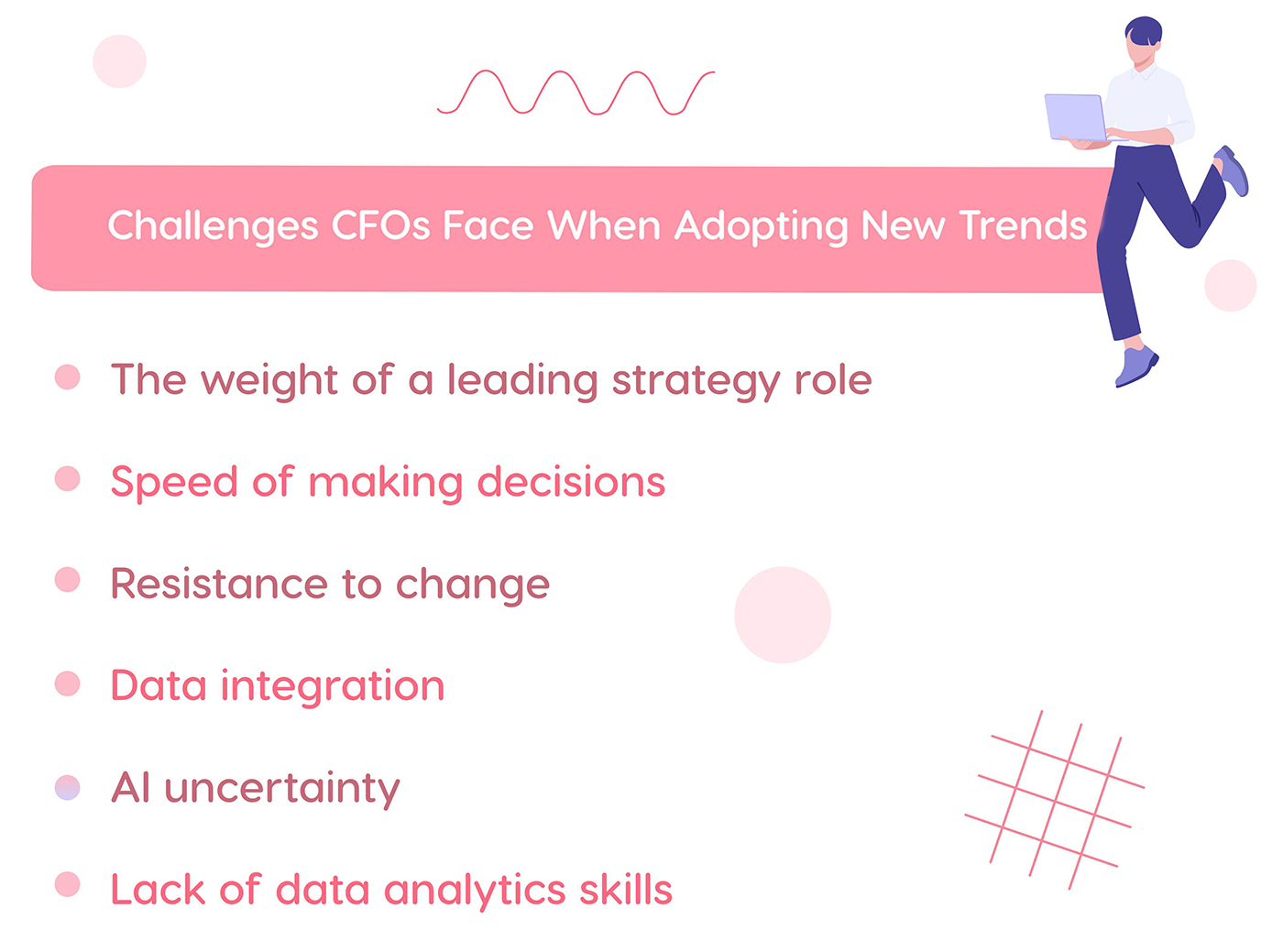
The weight of a leading strategy role
One of the main challenges most CFOs face is the new found weight of their role. Since CFOs are responsible not only for purely financial management but for creating company-wide strategy as well, they need to be even more thorough about their work. This puts additional pressure on finance leaders.
Speed of making decisions
These important financial and strategic decisions have to be taken fast, too. Both external risk factors and new technology that can be used to improve financial workflows tend to appear rather fast in 2026. The pressure to respond to risks in time and find effective ways to adopt new technology before the competition makes a CFOs job harder.
Resistance to change
Despite the need for quick strategic decisions, many organizations remain resistant to changes. This may look like overreliance on old technology and workflows, lack of trust in new technology, or outlook on company strategy that’s not based on data. A CFO’s job is to work with those outdated beliefs in the company and change them to facilitate its transformation.
Data integration
Since a lot of organization’s financial success relies on data analytics, using the right data is a major piece of the puzzle. Companies that operate a disconnected web of data sources will have a harder time arriving at correct insights simply because not all data is being used in the analytics models.
CFOs need to boost digital transformation by ensuring all company data is integrated into a single analytics solution.
AI uncertainty
AI remains a core technology that makes the vast amount of work a modern CFO needs to do possible, but its adoption is lagging behind. According to the Tech Nation 2025 CFO survey, more than half of CFOs believe that AI is going to transform the role in the next 3-5 years, yet only 1% have fully integrated AI into their work[3].
Automation is implemented in larger numbers, 90% of CFOs report automating some part of their workflow. However, the real time savings remain low. 36% report saving under 2 hours per week, and 21% say they haven’t saved any time at all.
The uncertainty of technology implementation, ROI, and time savings delay transformation. CFOs need to work on understanding the new tech stack and justifying the effort spent on its implementation to the governing board and to themselves.
Lack of data analytics skills
Due to high requirements for tech skills that can facilitate the job of a CFO and relatively low previous demands for them, lack of these capabilities in the current financial teams is a major challenge. Without an adequate know-how, implementing, integrating, and using many AI, ML, and automation tools becomes increasingly difficult, if not impossible.
Finding and cultivating the appropriate skillset in the finance team is a challenge CFOs will have to face in 2026.
What the Future Holds: CFO Trends Beyond 2026
We’ve already discussed the main trends that will drive change in CFO functions in 2026. Now, let’s take a look at larger trends that are likely to continue in the current decade. They include both external risk and technological disruptions.
Political tensions disrupting supply chains
Political conflicts have been festering for decades, but most haven’t been a major influence on global economics that CFOs should have been concerned about. In the last five years, the local conflicts became global.
The Houthi blockade that caused the Red Sea crisis, the Russia-Ukraine war and the sanctions that followed have impacted supply chains and economic projections globally. The Stimson Center predicts this trend is not going to stop any time soon.
The current crises in Europe and the Middle East will continue to impact world economics for a long time, and new tensions in Asia Pacific and Latin America can come into play.
CFOs will have to account for that possibility and have contingency plans for supply chain disruptions, whether they affect them directly or through economy-wide increase in costs.
Policy volatility
A changing world, both in terms of disruptive technology and global conflict calls for policy change. This change is often sudden and hard to predict. US trade policy uncertainty index, a measure of how often news outlets discuss uncertainty in US economic policy related to trade, is at an all-time high of 1500-2000 with peaks of up to 4000, as compared to 200-500 back in 2022.
CFOs need to include this factor in their scenario planning. This is extremely difficult as high uncertainty in trade and domestic policy makes it almost impossible to predict what the outlook will be in a year or two. Creating crisis responses for different scenarios is among the few things that can be done to combat these risks.
AI cybersecurity threats
Cybersecurity is as important as ever in 2026 and will remain a major factor in the coming decade. According to Netwrix 2025 Cybersecurity report, 51% of businesses in 2025 had a cybersecurity incident, and 75% of those affected reported financial problems caused by it[4].
On top of the already well-known threats, there’s a growing concern for financial fraud with the use of AI. Artificial intelligence in CFO financial technology trends has reached a point where it’s possible to realistically forge documents, voice recordings, and even run real-time deepfake videos, effectively stealing someone's identity.
This will continue to be in the center of attention, both in terms of general data security practices and in terms of training financial teams to avoid AI invoice fraud.
Data centralization
On a more positive note, data centralization is becoming a new standard for most organizations. Where previously dozens of Excel documents scattered across departments could provide a decent way to stay on top of competition, it’s now not enough.
Investing in scalable data infrastructure solutions that allow analyzing all company data, not only financials is one of the multiple things CFOs will need to implement.
Focus on real-time data
The increased velocity of decision-making and the need to respond to novel risks makes real-time data a necessity in modern finance. Proactive monitoring of financial data streams allows CFOs to:
- Respond to security threats as they appear instead of by the end of the month.
- Spot irregularities and potential bottlenecks before they have the chance to influence a company's financials.
- Add new data to scenario planning and forecasting, leading to a more accurate picture.
Well-trained AI models can do the heavy lifting in this CFO tech trend, flagging potential issues and prompting a responsible person to review them.
Key Takeaways for Finance Leaders
CFOs are the new CEOs, as some experts put it, and that brings in a new set of responsibilities and requirements they have to deal with. CFOs that want to excel in 2026 will have to:
- Be the AI and tech adoption leaders in their companies.
- Build enough tech talent in their teams.
- Automate the core daily tasks to be able to focus on the strategic picture.
- Remove data silos.
- Use advanced predictive analytics for real-time financial forecasting.
References
- Steve Gallucci et al, “Finance Trends 2026: Navigating the expanded scope of finance,” Deloitte Insights, October 06, 2025.
- UNCTAD, “Trade and Development Report 2025: On the brink - trade, finance and the reshaping of the global economy,” December 02, 2025.
- Founders Forum Group, “The Tech CFO Survey 2025,” November 2025.
- Jeff Warren, Dick Schrader, “2025 Cybersecurity Trends Report,” Netwrix, 2025.
CFO Trends FAQs
1. What are the most important CFO trends today?
The most important CFO trends include:
- Change of the CFO role to a more strategic one.
- Increased speed of decision-making.
- The need to cut costs across the organization.
- Introduction of cutting edge technologies.
- Search for tech talent.
2. How is AI changing the role of the CFO?
Artificial intelligence provides the analytical and automation capabilities that allow CFOs to deal with the increased complexity of their role. Properly configured AI software can do the heavy lifting in real-time data analytics and advanced scenario planning.
3. Why are CFOs becoming more strategic?
Partly, this trend is due to the need for finance-led growth strategies and cost-cutting initiatives most organizations implement. Partly due to the possibility of this shift facilitated by AI technology.
4. What are some of the challenges CFOs face in 2026?
CFOs are going to face the difficulties of AI implementation, the necessity of finding or nurturing the tech talent to help it, the increased scope and speed of decision-making in their role, as well as the need to adapt to emerging external risks.
5. What skills will future CFOs need?
CFOs still need a robust skillset in accounting and communication, but the future CFO will have to build tech, predictive analytics, and cybersecurity skillsets as well.
6. Why is finding the right talent one of the biggest challenges CFOs face in 2026?
Data analytics is becoming more and more important in the CFO role, and this drives the need to supplement the team with the right talent. Looking for data analytics talent is also difficult as CFOs will be competing with IT firms for talent.
7. Why is Al adoption a priority for CFOs in 2026?
AI adoption is a priority for CFOs because this technology allows chief financial officers to automate many of routine tasks and improve data analytics capabilities.
8. Why is data analytics a top CFO priority in 2026?
Data analytics is becoming more important for CFOs because their role shifts to a more strategic one, and making decisions on that level requires certainty that can only be obtained through data.