How to Implement Project Portfolio Management (PPM): Steps, Challenges, and Costs Explained
 Mykhailo Kulakov
.
February 26, 2026
.
Project Portfolio Management
.
33 mins READ
Mykhailo Kulakov
.
February 26, 2026
.
Project Portfolio Management
.
33 mins READ
Managing a large portfolio of projects without the right structures and methodologies in your arsenal can be a big challenge. It’s not uncommon to see company resources overloaded, lead times increasing, and overall productivity falling.
PPM is aimed at solving those problems by understanding the resource constraints your company has, prioritizing projects, and focusing your efforts on the projects that matter. In this article, we’ll explore the challenges portfolio managers face, the steps they need to take to implement PPM, and showcase examples of successful implementation.
Key takeaways:
- Project portfolio management can help your business do more with less and ensure that every project is aligned with the business strategy.
- Implementing project portfolio management from the ground up takes a lot of planning to inventorize, prioritize, and allocate resources to projects, and analytics to monitor portfolio performance.
- Portfolio managers may face challenges with managing stakeholder expectations, addressing industry-specific complexity, and obtaining data for portfolio analytics.
- Successful PPM implementation can bring a significant improvement in lead times, project performance, and ROI.
Why Implement PPM?
Implementing a project portfolio management process is a long and difficult task, both in terms of practical execution and in terms of shifting the decision-making mentality. Does it provide a return on investment? Here are the main benefits of implementing PPM.
- Better decision-making. PPM provides a standardized framework for making portfolio management decisions. This improves efficiency, provides visibility into capacity and performance, and speeds up the decision making process.
- Strategic alignment. PPM aligns the portfolio with the company’s strategic vision, which lets it focus its efforts on the projects that support its goals.
- Improved resource utilization. A big part of PPM is analyzing the resource constraints of the portfolio and optimizing it according to the real capabilities of an organization.
- Improved project success rate. A reduced workload quickly results in an increase in productivity, which lets the organization execute more projects.
- Business value optimization. PPM helps organizations maximize business value and do more with less.
PPM is a process that can organize your decision-making processes, prioritize projects in the portfolio with business value in mind, and optimize the portfolio delivery by avoiding delays and bottlenecks. The exact results depend on the organization’s resources and strategic goals, but you can expect an increase in throughput and productivity.
PPM Implementation Costs
The cost of implementing project portfolio management can be broken down into two parts: initial investment and recurring tool costs.
The latter is quite affordable. Epicflow PPM Software starts at €25 per user per month. PPM tool implementation typically is done for free by the vendor.
The initial investment is what makes up the most of PPM implementation costs. It usually includes:
- Consultation services.
- Data infrastructure updates.
- Internal training.
Depending on the vendors you work with, the price of these services can range from $5,000 to over $100,000 for larger organizations.
What Skills Do You Need to Implement PPM
While portfolio management software can handle most of the technical complexities of project portfolio management, PPM leaders need to have a specific set of skills. Here are the most important ones.
Subject Matter Expertise
Despite project portfolio management being mostly centered around management and analytics skills, PMOs also need a good deal of subject matter expertise. Without it, it can be hard to understand the particularities of the processes you’re trying to manage and the difficulties company resources face.
A background in the field is ideal, but not always possible. Nor does it cover every aspect of the work you’re supervising. In most cases, subject matter expertise is obtained by talking to the team leaders and learning from them.
Data Analytics
PPM heavily relies on gathering and analyzing data, so data analytical skills are much needed to make this endeavor successful. Ideally, project portfolio managers should have a considerable knowledge of data analytics, but it can be supplemented.
One option is to hire a dedicated data analyst to the project management office or contract one. Another is using project forecasting software and other analytical tools that take the technical aspects of PPM out of the equation as far as possible.
Soft Skills
Apart from analyzing the portfolio and finding the best possible way to execute it, PPM requires communication with other people in the organization. This includes the teams who are assigned to projects and project managers, but most importantly, the C-level executives, project sponsors, stakeholders, and other members of the governance team.
Creating good-looking projections of an optimized portfolio is just one part of a PMO’s job, the other is convincing everyone this is the right way to go. Understanding people in general and each person on the governance team individually is crucial to ensure your portfolio plans can be realized.
11 Key Steps for Successful PPM Implementation
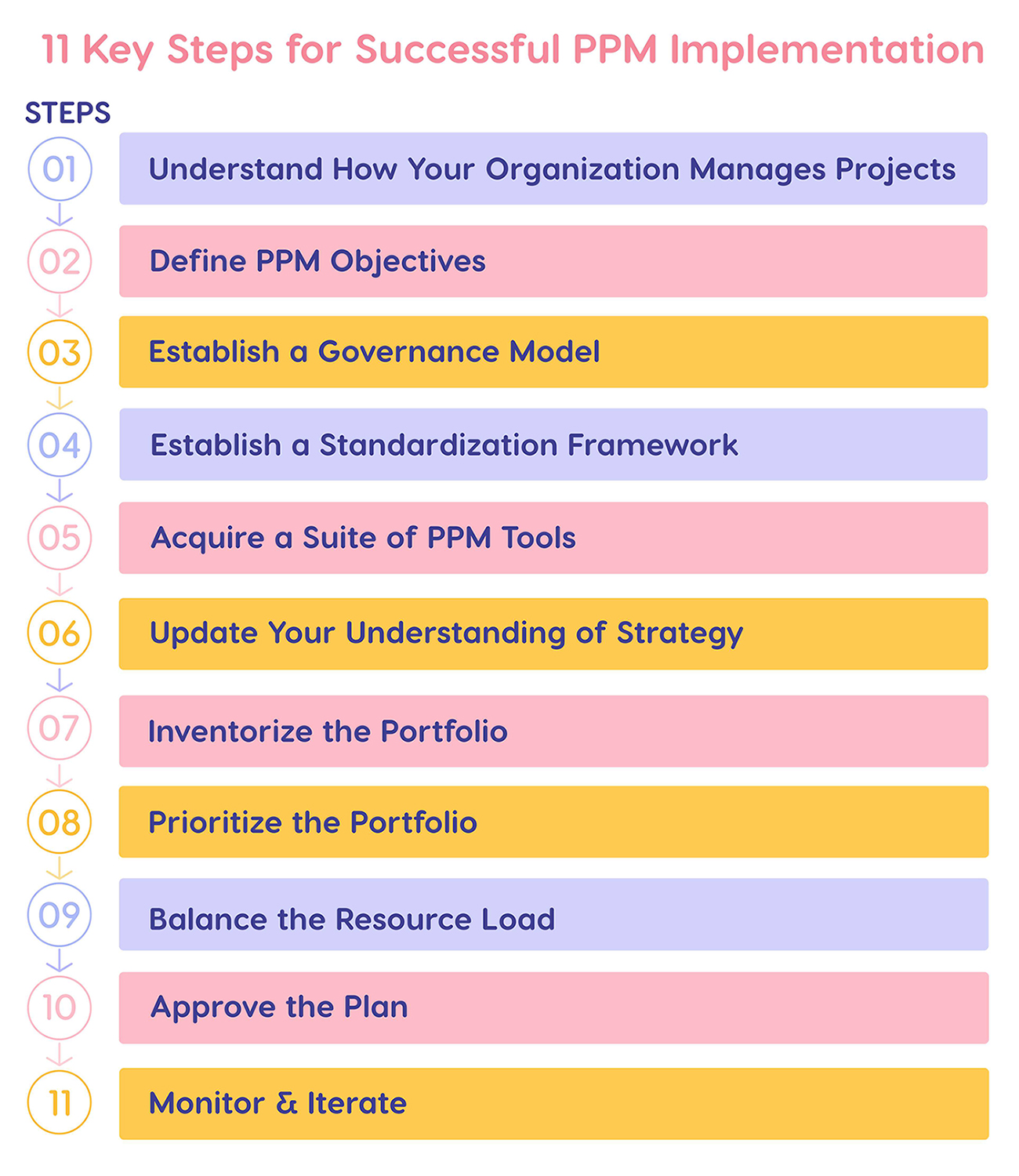
Implementing a PPM strategy takes a lot of planning and analytics, both of how things are at the moment, and of how they should be. Here are the main steps for implementing project portfolio management.
You can use these as your PPM implementation roadmap, or change the steps according to your organization’s needs.
Understand How Your Organization Manages Projects
Supposing you have never implemented the PPM in your organization, the very first step is to understand how portfolio management decisions are made currently. Unlike with Agile methodology, where work is broken down into artificial units, sprints, PPM works with units of work that are extremely common if not universal in all organizations:
- Task: a small unit of work, typically assigned to one person. E.g.: to audit website performance.
- Project: a temporary effort aimed at building something. E.g.: to improve technical website performance across a range of KPIs.
- Program: a group of projects managed together. E.g.: to improve website visibility.
- Portfolio: all programs and projects a company manages.
Even if your organization doesn’t use a specific project selection methodology, there are some methods it uses to decide which projects are in its portfolio. Investigate the following:
- Who decides a new project must start.
- What are the factors they take into consideration
- How do they decide which projects take priority.
- How do they assign personnel to the projects.
- What data is being logged.
- How do they assess project success.
In an average company without established PPM process, you may find a picture akin to this:
- The sales department presents customer requests to the CEO.
- The CEO approves requests based on the price tag.
- They then pass down the project to the team responsible for executing it.
- Team lead does their best to distribute the load and sequence projects.
- No data is gathered on project performance by the CEO.
- The CEO sometimes intervenes and asks to prioritize a project if it’s past the due date.
A process like this is chaotic because the effective portfolio manager, in this case, the CEO, doesn’t have the full picture of what the resource constraints are and how taking on new projects affects the portfolio as a whole.
Define PPM Objectives
With a full understanding of how internal processes work, you can form objectives and goals of implementing PPM. For the example above, this could be:
- Prioritizing projects based on strategic business goals.
- Improving resource utilization.
- Increasing throughput.
Select a set of realistic KPIs. Aim for incremental changes, for instance, decreasing resource overload by 25% and increasing throughput by 10% in three months.
Establish a Governance Model
Create a governance structure for your organization’s portfolio management office. Include people who are responsible for goal-setting and managing the portfolio. Here’s how a minimal governance structure can look like:
- Executive leadership. Defines strategic goals, responsible for risk management, monitors overall performance.
- Portfolio manager. Balances the portfolio, oversees its progress, and makes necessary changes.
- Project sponsors. Define the scope and goals of projects, typically a senior leader at a company.
- Program & portfolio managers. Plan programs and projects, oversee their execution.
In the case of enterprise project portfolio management, PMO will be much larger, with separate teams responsible for financial and strategic planning, risk management, and business analytics.
Establish a Standardization Framework
The next step on the PPM implementation plan is to establish a framework for standardization PPM practices. This makes the process more effective, but also plays a more crucial role. Having strict guidelines on how to make portfolio management decisions doesn’t just help you make decisions, it enhances your understanding of problems in this process.
When something goes wrong, you can always fall back on the defined standard and either find that someone didn’t follow it or that the standard needs to be changed. Without a standardized decision-making process, you simply have no idea what the reason is behind an underperforming portfolio.
Here are a few ideas on what you can standardize:
- A workflow of analyzing portfolio performance.
- A workflow of analyzing project performance.
- Project prioritization criteria.
- People responsible for each step of the portfolio management process.
Acquire a Suite of PPM Tools
Implementing PPM is impossible without a suite of management and analytical tools. Here’s the bare minimum you’ll need.
- A project management tool
- Resource management software.
- A data visualization or BI tool.
Epicflow is a tool with ample functionality for project, resource, and portfolio management that can be integrated with multiple PM and BI tools. Book a call with our team to explore how Epicflow can help you with PPM implementation strategy.
Update Your Understanding of Strategy
A large part of project portfolio management is aligning the portfolio with the company strategy and strategic objectives. To make this process successful, you’ll need to understand the strategy your company has and what strategic goals are currently being pursued.
Read any documentation on strategy the company has and conduct interviews with CXOs if necessary.
If your company doesn’t have a clearly defined strategy, there are two options. You can postpone the PPM implementation process until a strategy planning session is held to make sure the portfolio is optimized with strategy in mind. Alternatively, you can alter the PPM implementation project plan to simply optimize the portfolio for maximizing financial value.
Inventorize the Portfolio
With all the pieces above in place, you can start studying and optimizing the portfolio. Start by taking an inventory of what your portfolio looks like currently. Form an understanding of:
- What projects are in the portfolio currently?
- What projects are planned to be implemented?
- What is the status of active projects?
- What resources does the company have?
- How are they allocated?
Prioritize the Portfolio
The next step is to rank each project according to the strategic value it brings to the company. Here’s how you can do that.
- Develop several criteria for ranking projects. For instance, financial impact, cost reduction, and strategic alignment.
- Assign weights to each criteria in accordance to how important it is for the company.
- Go through the portfolio and rank each project across all criteria.
- Calculate the final score for each project and rank them from highest to lowest.
This list represents which projects have the best potential return on investment. The easiest way to reorganize a portfolio is to discontinue the low-priority projects that don’t fit within the approved budget.
The more advanced option is to run a cost-value analysis and leave the mix of projects that provide the highest business value for the lowest amount of effort.
Balance the Resource Load
Once you’ve decided which projects should remain on the portfolio, allocate resources to them. Use resource capacity planning software to find potential resource overloads or bottlenecks and prevent them.
Generally, you can either assign more resources to a project that overloads the team or reschedule the project.
Approve the Plan
Before you can implement the changes to your portfolio, you’ll need to vet it with the governance board. This might take a bit of soft skills to convince the board to go ahead with your portfolio design, especially if the strategy is not clearly laid out and the board members have slightly different ideas and expectations of how the portfolio should look like.
Monitor & Iterate
After the PPM plan is implemented, monitor how the portfolio performs, and change your approach if it doesn’t bring the expected results. Here are a few PMO KPIs you can track:
- Project success rate.
- Resource utilization.
- Return on investment.
- Budget variance.
- Schedule variance.
- Risk response time.
If these performance metrics are lagging, you should focus on improving resource and schedule optimization.
You should also track financial performance and business value delivery. If these two don’t improve, you should rethink your prioritization criteria.
PPM Implementation Challenges
A process this complex can’t exist without inherent challenges. Here is what you’ll need to overcome to implement PPM in your organization.
Stakeholder Resistance
Project portfolio management relies on CXOs accepting the approach that the data shows to be most productive. If you’re implementing PPM from the ground up, the stakeholder resistance can be even harder. Not only do you need to convince them to discontinue or put on hold projects they believe to be important, you might have to get everyone on board with PPM.
You’ll need to use the findings of your research to convince them along with interpersonal skills. Scenario planning software can help you in this because it can showcase several portfolio scenarios to the stakeholders. Comparing different outcomes can be more illustrative than simply presenting the best one.
Difficulty of Data Collection Standardization
To draw the right conclusions from your portfolio realities, you need to make sure all the right data is being collected. Poor data collection practices will lead to the formation of an incomplete picture of the portfolio, wrong insights, and poor outcomes.
A PPM tool that can act as a centralized source of data for the whole PPM team can be a solution to this problem. If your teams are using Jira, MS Project or other project management software, integrating your PPM tool with it can solve most of these problems. As long as project managers and teams do a good job of reporting the project progress in those tools.
Lack of Data Analytics Skills
A robust data analytics skillset in your PMO team is one of the critical success factors for a PPM implementation. Some PMO teams may face additional challenges due to lack of skills of that sort. Without them, it becomes much harder to create realistic scenarios, analyze portfolio performance data, and make data-driven decisions.
If there’s little or no data analytical skills present in your team, there are a few ways to ensure success:
- Train an existing team member.
- Hire a data analyst.
- Outsource data analytics to a contractor.
Use AI-driven analytical tools to do the heavy lifting.
Project Portfolio Management Implementation Case Study
Let’s explore a few real-world cases of PPM implementation to understand what you can expect in your industry.
PPM in Government Programs
The Dutch Ministry of Defence was facing severe problems with their portfolio. It all stemmed from a lack of prioritization standards. MoD had too many projects simultaneously because the leadership believed every project was equally important. This led to a severe resource overload and loss of productivity.
After understanding and combatting the limiting beliefs, the Ministry of Defence implemented project portfolio management with Epicflow project portfolio management software, and was able to:
- Clearly prioritize projects.
- Find bottlenecks.
- Allocate resources to projects with higher priority.
- Improve the expected due date performance from 24% to 77%.
PPM in Aerospace and Defence Industry
A UK-based A&D company turned to Epicflow for help with the major problems that were plaguing its portfolio. The company was in the growing stage, so a lot more new projects were added. Due to the lack of data for decision-making, decisions on which projects to add to the portfolio were made subjectively. This led to an overloaded resource pool and severe delays in project completion.
The key factors that contributed to an improved productivity were Epicflow aerospace project planning software’s ability to provide portfolio managers with real-time data on project performance and analyze workload. This allowed the A&D management to understand exactly how many projects they were able to take on at the same time and balance the workload across the teams.
The immediate result of implementing PPM was a 10% increase in productivity without hiring any additional resources.
PPM in Telecommunications Industry
KPN, a Dutch telecom company, was suffering from a mismatch between its team’s sales skills and production capacity. The company was able to sell 150 projects to clients, but only delivered 70. This and the lack of standardization in project planning led to delivery time being double what was initially expected and customer satisfaction falling significantly.
After implementing PPM with the help of Epicflow telecom project management software, KPN was able to:
- Unify and standardize project planning approach.
- Update the sales team on company capacity.
- Spot bottlenecks before they became a problem.
- Reduce the number of projects executed at the same time.
- Increase on-time delivery from 18% to 80%.
- Decrease project completion time by 50%.
How to Implement PPM with Epicflow?
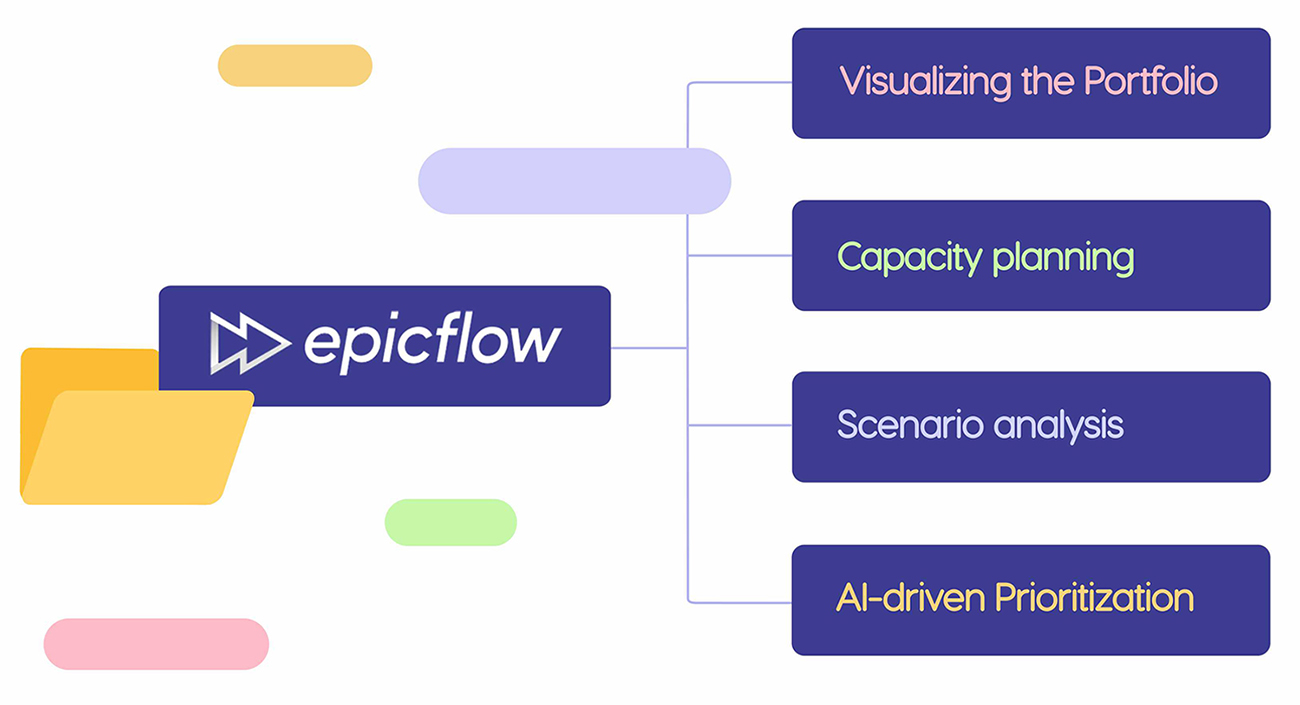
If you want similar results for your organization, you’ll need robust PPM software that can help get everyone in the company on the same page and provide analytical data to the portfolio management governance board. Let’s take a quick look at how Epicflow can do that.
Step 1: Visualizing the Portfolio
Once you get your portfolio data on Epicflow through either integrating your project management tools or adding projects manually, you can have the full overview of the portfolio.
One way to view it is through the Pipeline. This graph visualizes all projects in the portfolio and connections between them. It also shows each project’s state in relation to the due date feasibility.
Another approach is to use a Bubble Graph to visualize the budget consumption across projects and identify projects that have exceeded the allotted budget.
Step 2: Capacity Planning
Analyze your portfolio with capacity planning software to detect bottlenecks and view how you can avoid them by rescheduling projects or allocating more resources to a project that’s causing a delay. Epicflow can show both current and upcoming bottlenecks and helps find proper solutions to prevent or mitigate them.
Step 3: Scenario Analysis
Use What-If analysis to simulate different portfolio scenarios and see how they perform. This can be a great solution for both predicting how management decisions affect portfolio performance and for explaining your PPM implementation approach to the stakeholders.
Step 4: AI-driven Prioritization
Epicflow AI-driven portfolio optimizer can help you to organize your portfolio with the aim of maximizing business value produced per constrained hour. On your end, you need to update business value estimations for each project, and EPO will sort your portfolio with business value optimization in mind.
Step 5: Performance Analysis
Performance Tab in the Dashboard shows overall portfolio performance: the number of projects delivered on time vs with a delay and the number of days delayed.
If you want to learn more about how Epicflow can help your organization, book a call with our team.
Conclusion
Project portfolio management is an approach that has proven itself to optimize both large and small portfolios and let companies focus their constrained resources on the projects that provide the best business value for the budget spent.
Despite its challenging nature, many of its complexities can now be overcome with AI-driven analytics software and advanced PPM tools. Spend the majority of your time on understanding company strategy and priorities, rank the projects in the portfolio with the set of business value criteria you’ve developed, and use PPM software to balance it.
Frequently Asked Questions
Why is implementation of PPM important for organizations?
Project portfolio management is important because it allows organizations to standardize decision-making processes, get a better understanding of the resources available to them, and through a series of management decisions optimize the business value your organization can bring in with the resources at its disposal.
What are the common challenges faced during PPM implementation?
The most common challenges organizations are faced with are stakeholder resistance, lack of data analytics skills, and a lack of data collection standards.
How long does it take to implement PPM?
Depending on the size of your organization and the scope of PPM, implementation can take between 3 and 6 months.
What are the costs associated with PPM implementation?
The cost of PPM implementation can vary greatly depending on how you want to go about it. The basic cost of PPM tools can be quite small. Epicflow pricing, for instance, starts at 25 EUR per user per month. It’s the other costs that make PPM a tough endeavour. Consulting and data infrastructure creation fees can reach $100,000 depending on the subcontractors you choose.
Which PPM tools are best for small businesses?
Epicflow is the ultimate PPM tool for both small and large businesses because of its fair pricing, wide range of analytical capabilities, and low entry barrier.
How can organizations measure the success of their PPM implementation?
To understand whether your PPM efforts are successful, you’ll need to measure portfolio management metrics like lead time and schedule variance as well as financial metrics like project ROI and business value.