Project Risk Management: Importance, Challenging Issues, Recommendations
 Victoria Sokolova
.
March 16, 2026
.
Project Management
.
28 mins READ
Victoria Sokolova
.
March 16, 2026
.
Project Management
.
28 mins READ
Risk is often perceived as a potential hazard or something that should be better avoided. However, we all know that the road to success is fraught with risk, as it’s often associated with new opportunities that lead to better results. The process of managing projects is always accompanied by uncertainty and risks. While uncertainty is something unmanageable and not so easily taken under control, risk management is one of the necessary components of successful work on a project. So, why is risk management important? What challenges is it associated with, and how can they be addressed? We’re going to dwell upon these issues in this article.
Key takeaways:
- Project risk management is a process of identifying and managing project-related risks.
- Its importance lies in the ability to predict and mitigate risks before they pose a threat.
- To do this, you’ll need to create and document a way to estimate risks and risk response strategies based on your company’s capabilities.
What Is Project Risk Management?
According to PMI, a risk is an uncertain event or condition that, if it occurs, has a positive or negative effect on a project’s objectives. Project risks usually refer to a project’s scope, budget, time, resources, technology, or any unpredicted situations that nobody’s insured against. What is also worth our attention here, is that risk is associated with uncertainty, but its outcomes can be predicted and taken into account in case this anticipated situation occurs. What cannot be avoided, should be managed to reduce the negative impact of unfavorable events. This fact highlights the importance of purposeful project risk management.
As stated in the PMBOK Guide, “Project risk management includes the processes of conducting risk management planning, identification, analysis, response planning, and controlling risk on a project. The objectives of project risk management are to increase the likelihood and impact of positive events, and decrease the likelihood and impact of negative events in the project.”
The main steps of the risk management process
The risk management process embraces several stages.
1. Risk identification.
To identify possible threats to a project, you can communicate with stakeholders and team members as well as analyze previous experience. All the risk factors you’ve identified should be documented in the risk register, a document outlining all possible project risks as well as their priority, impact, owners, and other essential information.
Read more: Creating a Risk Register: All You Need to Know
2. Risk analysis.
You should analyze every risk you’ve identified in terms of risk event probability and impact. You can also consult stakeholders and team members for more precise and effective analysis.
3. Risk prioritization.
Now that you know the probability and severity of project risks, you should rank them accordingly. The risks that have the highest probability and the most severe impact on the project flow will become the highest-priority ones and should be given particular attention.
4. Risk monitoring.
You should assign risk owners to the risks you’ve identified. This person will be responsible for monitoring risk triggers, reporting them, or taking action. Remember that risk monitoring is a proactive and regular process.
5. Responding to risks.
Finally, if a risk-bearing event occurs, you should respond to it properly. A risk management plan created at the stage of project planning as well as a risk register will help you respond to the risk properly.
The next subsection presents the different ways to react to arising risks.
Types Of Risk Responses
Managing risks doesn’t mean that all the risks will be avoided; a risk response strategy involves a variety of actions.
- Avoiding risks: This approach involves actions that minimize the exposure to risks to avoid their negative consequences.
- Transferring risks: This implies that the other organizations (e.g., an insurance company) will deal with the risk.
- Mitigating risks: This involves taking actions to minimize the negative impact of a risk.
- Accepting risks: This type of risk response is applied when the consequences of risks aren’t that severe compared to the costs and effort required for risk mitigation.
- Escalating risks: This approach involves engaging leadership to deal with a risk.
Now that the essence and steps of the risk treatment process are clear, it’s time to review its benefits.
Why Is Risk Management Important in Project Management?
The importance of risk management cannot be overestimated: it is crucial for minimizing threats, identifying opportunities, and facilitating successful project delivery. Here are the advantages of project risk management in more detail.
Planning for risks
Effective risk management helps you detect potential threats and opportunities in a project early on. As a result, the team can prepare responses to risk-bearing situations to mitigate the consequences of the negative ones. For example, if a piece of necessary equipment goes out of service, it will be much less harmful to a project in case responses to technology risks have been planned beforehand. Also, using project risk management software makes it possible to seize the opportunities offered by positive risks and improve project outcomes.
Improving project performance
Detecting and addressing risk-bearing situations that can negatively impact the project (its budget, timeline, or quality) contribute to better predictability of project outcomes as well as better overall performance.
Timely detection of problems arising in project flow
As a rule, the risk management process involves assigning risks to the team members responsible for monitoring the workflow and detecting threats. This helps the project participants not to miss any issues that can derail the workflow as well as take timely measures to mitigate their negative consequences.
Benefits for future projects
The experience of managing risks in a current project can be taken into account for further projects. The project team should document lessons learned and use these insights in managing future projects and in such a way improve their risk management practices.
Comprehensive overview of the whole project
The development of a risk management plan requires identifying the project’s strong and weak points as well as potential opportunities and threats.
Now that the importance of risk management in project management is clear, let’s review the most common risk management issues.
How to Manage Project Risk: Tips and Best Practices
Now that you’re familiar with the steps of the project risk management process and possible risk responses, let’s look at several factors that influence successful project risk management.
Understanding your current risk profile
The first thing that is crucial for the process as a whole is forming a correct understanding of the current risk profiles in each project. That can be more or less difficult depending on your decision making methods.
Using the wrong methods or using methods in a wrong way can lead to a distorted understanding of risks and to taking wrong actions. Most mistakes tend to happen because of lack of objectivity in the risk evaluation process.
Here is how you can do that:
- Use risk matrices or scoring models to reduce subjectivity.
- Invite the subject matter experts to risk evaluation meetings.
- Use historical performance data to improve understanding of risk event probability.
- Use a value risk matrix to weigh risks against potential benefits.
Defining criteria for risk responses
PMOs have a finite number of actions that can be taken to mitigate risk. The problem lies in choosing the action appropriate to the risk factors at hand. There are no universals here, and each organization should decide what to do based on:
- Its resource pool size.
- The skills available in the resource pool.
- Its risk mitigation strategy.
- Its portfolio and risks on the portfolio level.
Best practices in this area are:
- Companies with large and complex portfolios can accept more risky projects.
- Smaller companies with lower risk tolerance should reduce project risks as much as possible.
- Use scenario planning software to confirm the impact on the portfolio risk level.
- Define possible risk responses.
- Standardize the decision-making process that goes into applying them.
Monitoring
Monitoring portfolio performance and making changes to the risk management procedures is a major part of risk management. Here are the best practices for conducting it:
- On a larger time scale, between 3 and 6 months, monitor risk event occurrence.
- If you see that risks occur more often than expected, reevaluate your risk assessment techniques.
- Note which risk containment methods tend to work best.
Standardization & documentation
The final tip for project risk management is to document every finding and standardize the way you do things. To standardize your approach, create a risk management plan, a document that outlines every step of the process and every decision-making path. You should include:
- Who should be present for risk assessment meetings.
- Which criteria should be used to determine risk.
- What risk assessment methodology should be used.
- What responses to risks should be taken.
If you continuously see performance other than you’ve expected, you can always fall back on the standards and change them to fix the issue. Documenting all the findings on risk factors evaluation and risk management techniques allows you to know what works and what doesn’t to later change your approach.
Examples of Risks & Risk Management Strategies
Let’s take a look at three most widespread types of business risks and risk management strategies you can implement to manage them.
Budget overrun
A common problem many companies face is that a project goes beyond the allotted budget over time. This can hurt your portfolio because increased budget decreases ROI of the project and can delay other projects due to resource overload.
This can be caused by several factors:
- Incorrect initial estimations of the budget.
- Improperly managed changes and scope creep.
- Incorrectly allocated skilled resources.
- Project delays.
Risk management strategy
To fix these, you’ll have to understand what the problem was and do one of the following:
- Make changes to your budget estimation process to make it more accurate.
- Forecast bottlenecks and eliminate them.
- Create contingency plans and consider adding time and capacity buffers.
- Perform budget monitoring activities regularly.
Strained capacity
Another typical risk is strained resource capacity. When companies don’t have a clear way of understanding their real capacity constraints and project priority, they tend to start too many projects. This quickly leads to resource overload and overall productivity suffers.
Risk management strategy
The right thing to do here is to use resource capacity planning software to analyze your resource capacity and do portfolio prioritization to understand which projects are the most valuable to the company. Then, you can easily make decisions on what projects you can postpone to ensure better productivity.
Read more: A Comprehensive Guide to Prioritization In Multi-Project Management
Scope creep
Perhaps one of the most common project risks is project scope creep. When the planning is poor or when the project scope is not well defined, it tends to take on more and more features and details, which will inevitably steer it off its course.
Risk management strategy
To combat project scope creep, you need to either strictly define its scope and stick to it or hold meetings to define the new timeline and budget every time the scope changes. Also, you need to manage changing requirements and approve changes only after thorough analysis of their impact on the project’s scope, timeline, and budget.
Read more: Changing Requirements in Project Management: How to Stay on Track
Challenges in Project Risk Management and Ways to Address Them

Like any other project management practice, the process of risk management can be accompanied by challenges, too.
Difficult to identify project risks
It can be challenging to predict all possible risk-bearing situations that can impact the project flow, especially when you deal with complex long-term projects with a lot of moving parts or with a multi-project environment with a shared resource pool.
Possible solution
When performing risk analysis, you can analyze previous experience and communicate with team members who have worked on similar projects or are familiar with these risk areas. You can also use project management software with predictive analytics; you’ll be able to run scenarios and a project’s weak points.
Unengaged leadership
Sometimes, project managers may stumble over stakeholders’ or senior management’s unwillingness to manage project risks, as they are too optimistic about the process of project implementation and/or don’t consider it as something really important and worth time and effort. For example, a team member has reported that an unfavorable situation occurred, but no actions have been taken on the part of leadership or those who make important decisions.
Possible solution
Communicate with stakeholders and explain the importance and benefits of managing risks; present different scenarios to illustrate what the consequences of neglecting the risk management process are.
Considering a risk management plan as a formality
The other sort of issues arise when a risk management plan has been developed just to tick the box, but the risk management process itself is not being implemented.
Possible solution
Assign employees who’ll be responsible for dealing with risks: monitoring them, reporting, and responding. Use project management software with predictive analytics to select optimum ways of responding to arising risks and make sure that everyone responsible is familiar with these risk responses.
Managing risks in a multi-project environment
Obviously, working on multiple projects is much more difficult than managing a single project, so risk management process in this case becomes much more challenging and requires prioritization of projects and corresponding risks.
Possible solution
Risk management in a multi-project environment should be given special attention, as problems in one of the projects can affect the others in the environment. Again, you can leverage PM software suitable for multi-project management and capable of conducting scenario analysis to help you identify risks across the whole project environment and find ways to respond to them.
Jump into the next section to find out more opportunities for effective risk management provided by a robust project management software.
Overcoming Project Risk Management Challenges: How Epicflow Can Help
As we’ve noted before, a software solution can contribute to much more effective risk management — it will be definitely useful to keep control over a project’s timeline, budget, scope, and resources, as well as to detect/predict bottlenecks that can ruin the flow.
Let’s review the example of Epicflow, multi-project resource management software, and how its capabilities assist in managing risks.
Monitor the state of all your projects
Regular monitoring and control are essential for effective risk management. In Epicflow’s Pipeline, you get a clear overview of the whole project environment. Projects are marked with colors depending on their feasibility, so you have no chance to miss those that are at risk. Also, you can track the feasibility of project milestones, which allows you to timely respond to arising issues.
Forecast resource bottlenecks
Epicflow helps you minimize resource-related risks — its Future Load Graph demonstrates how loaded your resources will be and how much capacity they are going to have in the future based on their involvement in projects. In such a way, you can forecast and prevent resource bottlenecks and their negative consequences.
Detect potential risks and plan responses to them
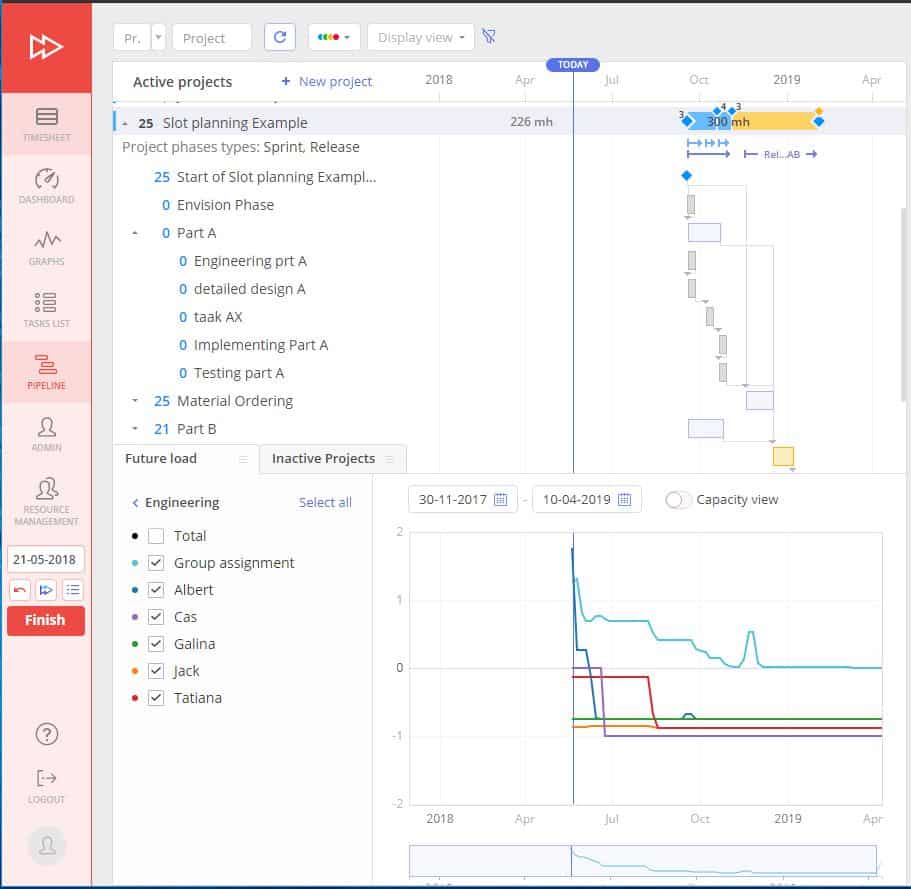
Once a potential risk has been identified, you have an opportunity to try various scenarios of responding to it (e.g., move due dates, reassign resources, add or remove projects and/or resources). Epicflow’s What-If Analysis feature will show you the future consequences of changes you make, so it becomes much easier to make decisions regarding risk responses.
Get early warnings of potential issues in the workflow
Epicflow’s AI virtual assistant Epica analyzes the state of the project environment and gives notice of threats arising in the workflow (e.g., overloaded resource groups or teams that can cause further issues in the portfolio), refers you to corresponding graphs for detailed analysis as well as advise how to address them.
Thus, knowing the ways to cope with the challenges of implementing project risk management as well as applying reliable software tools will give you the upper hand in managing external and internal risks to a project, and, as an additional benefit, will make you more confident as to its flow and outcomes.
Have you ever had any challenges when implementing risk management? How did you handle them? Share your experience with us.
If you want to learn more about how Epicflow can help your business, book a call with our team.
Conclusion
Project risk management is an integral part of portfolio management. It allows project managers to understand what risks are associated with the project and mitigate them before they pose a real threat. This process is also important for the portfolio as a whole as portfolio managers will use risk data from the process to analyze the portfolio-level risks.
Standardize your approach, monitor its performance, and use portfolio management tools to simulate risk management scenarios.
Frequently Asked Questions
1. What is risk management in project management?
Risk management is a part of the project management process that involves evaluating, assessing, and dealing with risks that arise during project execution.
2. What are the 5 stages of risk management?
The five stages of the risk management process are: identification, analysis, evaluation, risk response, and monitoring.
3. What are the four types of risk in project management?
The risks you’ll typically face within a project can be categorized into financial risks, technical risks, operational risks, and external risks.
4. What is a project risk management plan?
Risk management plan is a document that standardizes the risk management process and decision-making within it.
5. How can a risk management plan keep a project on track?
Risk management is an important part of project and portfolio management because it allows PMOs to be proactive in managing risks and avoid bottlenecks before they happen.
6. When should I use project risk management?
Risk management should be an ongoing process that happens for each project. Do an initial risk assessment before starting it, reassess risks in the process of executing a project, and check how your initial assessment compares with real outcomes of the project at its end.