What Is Critical Chain Project Management: A Modern Approach to Optimizing Resources and Overcoming Bottlenecks
 Victoria Sokolova
.
Updated
.
Project Management
.
18 mins READ
Victoria Sokolova
.
Updated
.
Project Management
.
18 mins READ
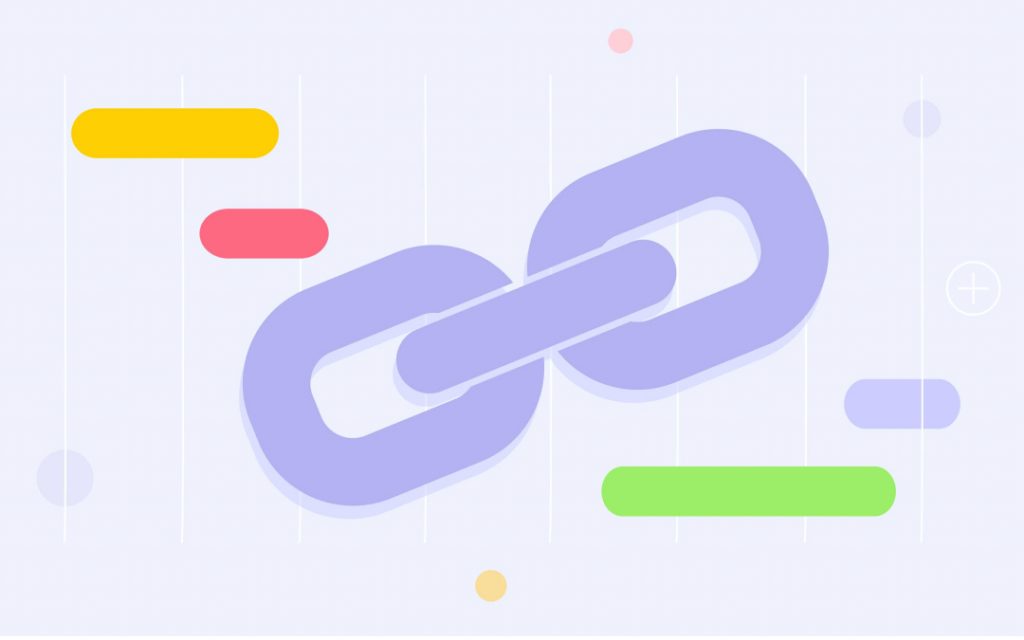
Traditional project management methods are often insufficient for the present-day uncertain and resource-constrained project management landscape. This is where critical chain project management comes into play. In contrast to other methodologies, this project management tool helps optimize resource utilization, reduce bottlenecks, and address uncertainties.
The article explores the essence of CCPM methodology, outlines its benefits and stages, and provides insight into the capabilities of project management software based on CCPM principles.
Key Takeaways:
- Critical chain project management (CCPM) is an approach to scheduling and managing projects, which identifies the critical chain (the sequence of tasks considering resource constraints), accounts for resource availability, and uses buffer management to handle uncertainty.
- CCPM makes it possible to complete projects faster and prevent project delays, increases chances for successful project delivery, optimizes resource utilization, and is suitable for multi-project management.
- The critical chain project management process involves the following stages: identifying the critical path, detecting resource constraints, developing a project schedule, adding buffers, and regularly monitoring the buffer consumption.
- Critical chain project management software helps project managers with buffer management, project scheduling, managing conflicting priorities, resource allocation, comprehensive project monitoring, and informed decision-making.
Defining the Basics: What Is Critical Chain Project Management?
Critical Chain project management (CCPM) is a project management method that focuses on managing resource constraints and uncertainty to improve project delivery. Following the critical chain project management definition, it is an indispensable framework for minimizing the risks of time and budget overruns. The method is based on the idea of critical chain – the longest sequence of dependent tasks under current resource constraints. It determines the shortest possible duration under real conditions.
Initially, this framework was based on the theory of constraints, which views organizations as systems where their weakest element can negatively impact overall outcomes. Over time, this method has evolved into a practical approach for addressing the challenges related to resource constraints and task estimation. In contrast to other existing methodologies (e.g., Critical Path), the Critical Chain, as a new approach to project management, considers the scarcity of available resources to identify the critical set of tasks and the timeline needed for project completion. As a result, the CCPM method helps managers avoid bottlenecks, which distinguishes it from traditional approaches
Critical Path vs Critical Chain: How is the Critical Path viewed in Critical Chain project management?
Critical Chain Project Management is built upon the foundation of the Critical Path method, but extends it to address its key limitations. The Critical Path method outlines the longest path of dependent tasks that dictates the minimum project duration under unlimited resource availability. CCPM optimizes this model: it identifies the critical chain and adds buffers and considers resource limitations, thereby avoiding disruptions caused by constraints.
| Aspect | Critical Path Method | Critical Chain Project Management |
| Focus | Task dependencies | Task dependencies and resource constraints |
| Resource Consideration | Unlimited resource availability | Limited resource availability, shared resources between projects |
| Handling Uncertainty | Added to individual tasks | Protecting project from uncertainty by adding buffers |
| Project Scheduling | Often optimistic | Realistic and execution-focused |
Core Components of the Critical Chain Method
The reason why previously developed methodologies failed to deliver the desired results is their theoretical limitations that implied an unlimited number of resources in addition to a static environment. In contrast, the CCPM method addresses these limitations by focusing on resource constraints.
The Critical Chain
This is a sequence of dependent tasks that determines the overall project duration, taking into account task dependencies and resource availability. In contrast to the critical path, the critical chain reflects real execution conditions and highlights tasks that must be carefully managed to ensure timely project completion.
The Feeding Chain
Feeding chains are sequences of tasks that are not part of the critical chain but are connected to it. Delays in these chains can impact the critical chain, which means that they should be properly managed to maintain overall project flow.
Buffers
Buffers create a room for manoeuver in case of unexpected changes affecting project and task execution. They are reserves used to protect the project schedule from uncertainty. There can be the following buffer types in critical chain project management:
- Project buffers: placed at the end of the critical chain to protect the entire project’s completion date from delays.
- Feeding buffers: added to the points where feeding chains connect to the critical chain to protect the latter from delays.
- Resource buffers: placed before critical chain tasks that require key or constrained resources to prevent delays caused by resource unavailability.
Read more: 7 Current Trends in Project Management [2026]: What to Prepare for?
What Are Critical Chain Project Management Principles?
Critical Chain project management principles are aimed at managing uncertainty, resource constraints, and project flow for faster and more successful project delivery. Rather than focusing on individual task completion, the critical chain focuses on the entire project flow. Here are the key principles of the critical chain project management approach.
1. Focusing on bottlenecks.
According to CCPM methodology, every project system has a limiting factor or a bottleneck that is usually an overloaded resource. CCPM aims to center work around constraints and eliminate bottlenecks to improve project flow.
2. Scheduling projects around resource availability.
In contrast to critical path planning assuming unlimited resources, CCPM creates project plans and schedules based on available capacity of limited resources. This allows for realistic task sequencing and more predictable project delivery.
3. Managing uncertainty.
To mitigate the negative impact of uncertainties, this project management approach involves protecting projects with buffers. Rather than adding safety time to each task, CCPM implies adding buffers to the project’s due date and important milestones. These include not only time buffers but also resource buffers.
4. Eliminating multitasking.
Multitasking can be harmful for the project flow, as they reduce team members’ productivity and increase lead times. CCPM facilitates focusing on one highest-priority task at a time and reducing the amount of work in progress (WIP).
5. Using buffer management for control.
Instead of tracking every task deadline, CCPM focuses on monitoring buffer consumption. If they are consumed too quickly, there’s a risk of project delay; if buffers are stable, the project is on track.
6. Reducing the effects of Student syndrome and Parkinson’s law.
Student syndrome implies starting the task as close to the deadline as possible, while Parkinson’s law means expanding the work to fill all the available time. Both issues reduce productivity, and CCPM aims to address them.
These principles have become the basis for the functionality of Epicflow, AI-powered multi-project resource management software that ensures successful delivery of multiple parallel projects under conditions of change, uncertainty, and resource constraints. Contact us to learn how its features can optimize project delivery in your organizations.
Now, let’s consider the significance of critical chain methodology for seamless project management.
What Are the Benefits of Critical Chain Project Management?
1. Preventing project delays.
Uncertainties and risks can disrupt the task completion, which can undermine the project’s success. Buffers, in turn, are designed to prevent delays by adding time and resources: effective buffer planning can boost performance and reduce the project’s duration.
2. Improved delivery rates.
You can significantly improve the delivery rates by prioritizing focus on the project flow. By eliminating multitasking and task padding, team members can focus on the highest-priority tasks within the Critical Chain, be more productive, and complete their work even earlier. The absence of task buffers provides an opportunity to complete the project even earlier.
3. The opportunity to take on more projects.
The adoption of the Critical Chain method in project management enhances the ability to reduce lead times and complete more projects within a given timeframe. This approach combines buffers, resource synchronization, and project staggering to achieve this outcome. It also means that project managers can improve overall throughput across projects.
4. More efficient resource utilization.
Thanks to eliminating task buffers and multitasking as well as accounting for resource constraints, CCPM contributes to more efficient utilization of available resources. They are more productive and less stressed by multitasking and overload, which also contributes to their efficiency and engagement.
Read more: Intaking More Projects in Aerospace and Defense: How Resource Management Solution Can Help
Now that the essence and importance of this project management methodology are clear, let’s consider the process itself.
Main Stages of the Critical Chain Project Management Process
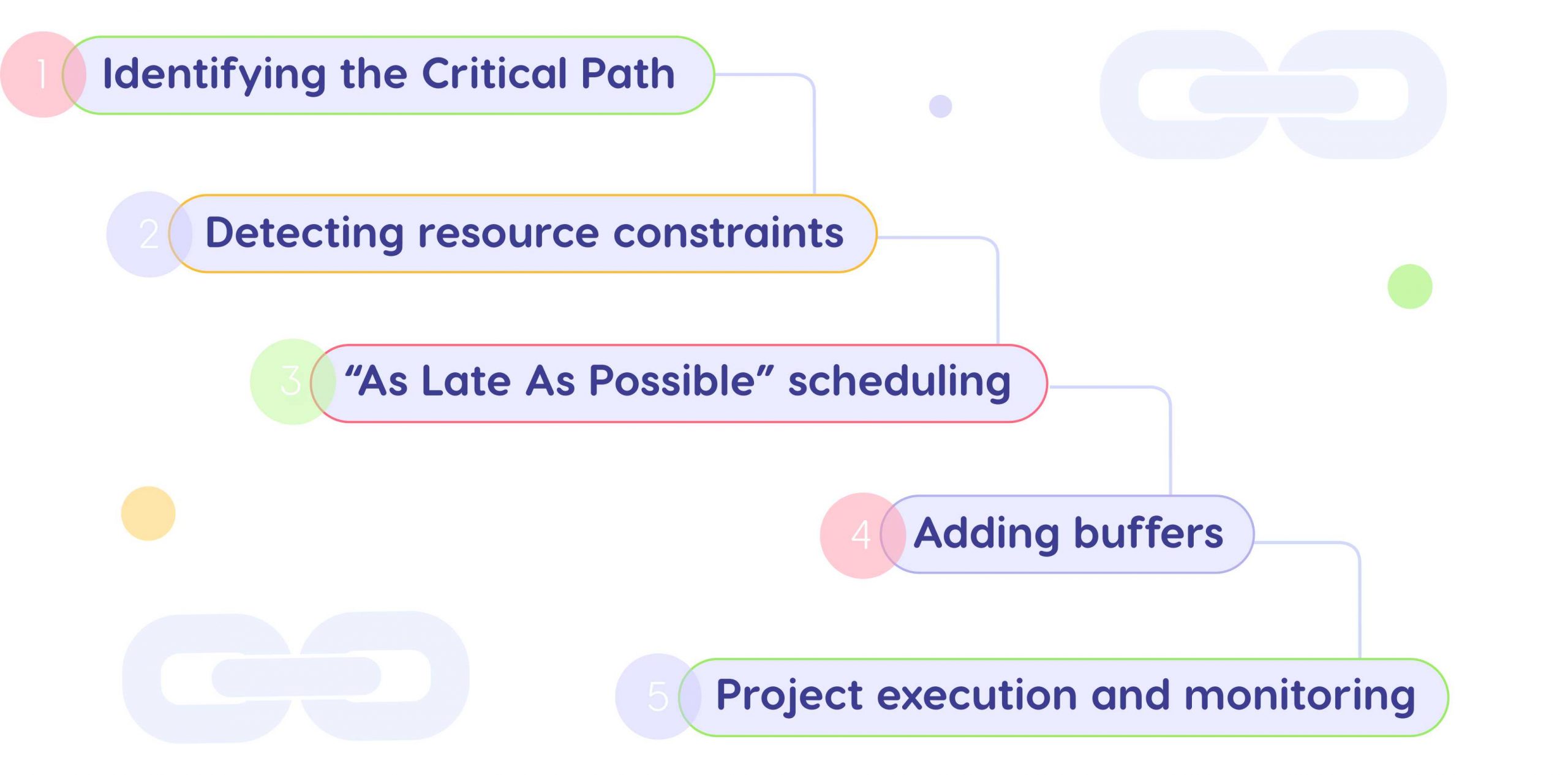
1. Identifying the Critical Chain.
The Critical Chain method in project management starts with critical chain identification to plan the next stages. It is comparable to creating the foundation of the entire project, which outlines the interdependent tasks that set up the core of the future processes. Therefore, the first step is to consider the most important tasks in addition to the longest to complete.
2. Detecting resource constraints.
Identifying resource constraints is a necessary component of creating the Critical Chain. Project management critical chain involves considering all possible constraints for every task (the number of people assigned to tasks, materials or equipment, and workspace).
3. “As Late As Possible” scheduling.
This step requires scheduling tasks backward from the due date through each task, starting on the latest possible start date. This approach differs from starting a new task as early as possible. This type of scheduling prevents multitasking with its negative consequences.
4. Adding buffers.
Based on the drafted Critical Chain, project managers should add the necessary buffers in addition to feeding chains. Risk assessment is also necessary to determine the necessary amount of buffer: higher risks require a bigger buffer to avoid disruptions.
5. Project execution and monitoring.
It’s important to focus on one task at a time to avoid multitasking. Project monitoring should be based on buffer consumption using Fever Charts. Buffer consumption will provide you with insight into the project's health and help you identify issues early on.
Read more: The Evolution of Project Monitoring: Critical Chain Fever Chart Re-Imagined
Critical chain project management software helps project managers to plan and schedule projects, allocate resources, and track progress in real-time. Let’s consider their role in more detail.
Reasons to Acquire Critical Chain Project Management Software
Critical Chain Project Management (CCPM) software provides an opportunity to reap the benefits of the critical chain approach to project management: it simplifies its implementation by automating some processes and providing real-time insights. Here are the other benefits provided by CCPM software.
- Automated buffer management: As a rule, CCPM has graphs or charts (e.g., Fever Chart) that help project managers visualize buffer consumption and assess project health at a glance.
- Optimized resource allocation and management: CCPM software monitors resource availability and capacity, which helps avoid resource bottlenecks and project delays caused by a lack of required resources.
- Improved decision-making: CCPM tools provide various real-time data, dashboards, reports, and forecasts, which help managers make better decisions.
- Comprehensive visibility into project processes: PM software provides project managers with a big picture of the state of the whole project environment, project progress, resource performance, etc.
An example of multi-project critical chain project management software is Epicflow. It simplifies complex multi-project and resource management by smart prioritization based on buffer consumption, intelligent resource allocation, comprehensive buffer management, and overall control of the project environment, and AI-powered informed decision-making. Contact us to learn more about Epicflow and its contribution to implementing critical chain method and improving project and resource performance.
Read more: AI in Project Management: Is the Future Already Here?
Frequently Asked Questions
What is the critical chain project management?
Critical chain project management is the technique that prioritizes resource availability and buffer management as critical components of successful project completion. According to this approach, projects are scheduled based on resource availability, and buffers are added to overcome uncertainty and the consequences of unexpected changes.
What is a critical chain?
A critical chain is the longest sequence of dependent tasks that determine the project duration.
What is the difference between CPM and CCPM?
Critical chain method in project management is an advanced version of the Critical Path method. CPM focuses on creating the longest path of tasks in a project, which determines its shortest possible duration. In addition to the critical path, CCPM takes resource availability into account and applies buffer management. This approach is more effective, especially when working in multi-project environments with limited resource availability.
What are the benefits of CCPM?
The benefits of the CCPM approach include preventing project delays, improved project performance, more intelligent resource utilization, and the opportunity to implement more projects.
What are critical chain project management advantages and disadvantages?
The benefits of the CCPM approach include preventing project delays, improved project performance, more intelligent resource utilization, and the opportunity to implement more projects. At the same time, switching to this method requires cultural change in companies, which can be often met with resistance. Also, it required accurate data and may seem complex compared to traditional methods.
What are critical chain project management buffer types?
Three buffer types include project buffers, feeding buffers, and resource buffers
What is the critical chain project management example?
A software team is working on a project with three main tasks: design, development, and testing. In a traditional schedule, each task includes extra time for safety, which can cause delays, especially driven by Student syndrome and Parkinson’s law. Also, without understanding the critical tasks required for project completion, the team members can switch between assignments, which reduces productivity. CCPM will adjust the schedule in line with resource availability, identify the critical chain, remove extra buffers from tasks, and add a project buffer to the end date of the project. As a result, the team will complete the project faster and with fewer surprises.