New Technology Trends in Aerospace and Defense Industry [2026]
 Victoria Sokolova
.
December 29, 2025
.
Digital Transformation
.
38 mins READ
Victoria Sokolova
.
December 29, 2025
.
Digital Transformation
.
38 mins READ
![Epicflow – New Technology Trends in Aerospace and Defense Industry [2026]](https://www.epicflow.com/wp-content/uploads/2022/04/New-Technology-Trends-in-Aerospace-and-Defense-Industry_1-1024x640.jpg)
In 2026, the aerospace and defense industry is projected to grow and progress: the air travel demand has already returned to the pre-pandemic level, while geopolitical tensions cause increased defense spending in a great number of countries. [1]
How can aerospace and defense organizations respond to increasing demand under conditions of present-day uncertainty and change? One of the solutions is the application of emerging technologies that allow A&D companies to dramatically transform the way they work and deliver value to their customers.
According to the Aerospace Industries Association’s Vision for 2050 [2], some of the key technology and innovation trends in aerospace and defense industry will be:
– the rise of automation and artificial intelligence,
– wide application of augmented and virtual reality,
– the rise of Industry 4.0 (e.g., additive manufacturing and digitization).
Here’s an overview of technology trends that will be driving digital transformation in aerospace and defense in 2026.
Key Takeaways:
- The A&D industry trends won’t change drastically in the coming years; the domain continues its digital transformation and adoption of innovative technologies in 2026.
- Artificial intelligence and agentic AI will play a growing role in decision making, automation, and operational efficiency.
- Additive manufacturing and immersive technologies will enhance production, training, and mission planning.
- Organizations will continue decarbonization efforts.
- Robotics, increased connectivity, and blockchain will optimize supply chains, improve situational awareness, and improve overall efficiency.
Defense Industry Digital Transformation: Technology Trends
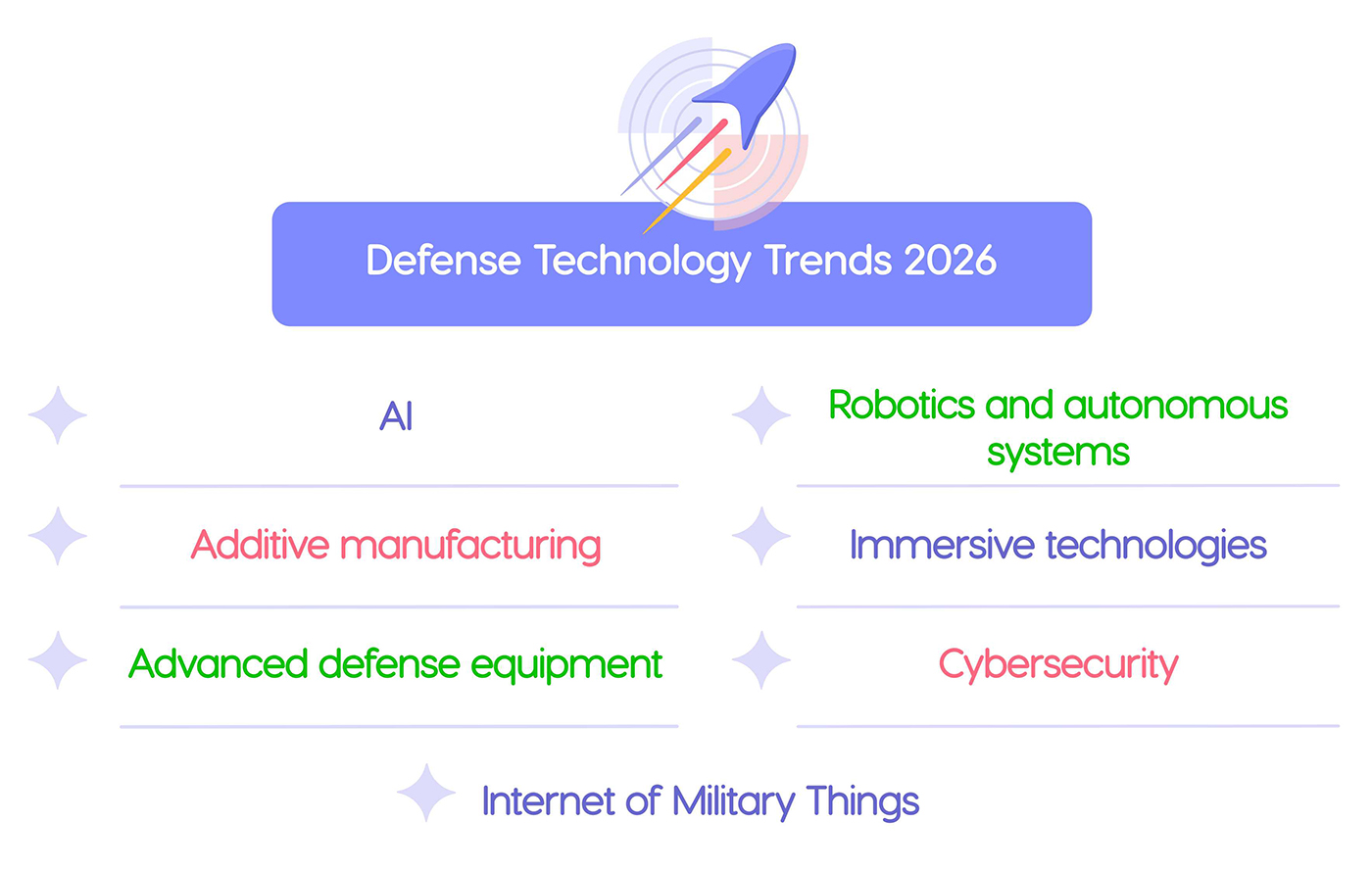
1. Artificial Intelligence.
AI is gaining momentum in the aerospace and defense industry, and its potential suggests that areas of its successful application will grow. AI is used in the defense sector for training the military, creating advanced weapons, surveillance purposes, and providing cybersecurity. Here is an overview of current AI applications in more detail:
- AI-powered autonomous weapons and vehicle systems—crewless vehicles and submarines are already employed by the military, but replacing soldiers on the battlefield is still far from widespread implementation;
- Transforming command and control systems by performing real-time data analysis and enabling informed decision-making;
- Predictive maintenance providing the ability to forecast equipment failure;
- Detecting and mitigating cyber threats thanks to analyzing network traffic, detecting vulnerabilities, and timely responding to cyber attacks;
- Training military personnel using AI-driven simulations and virtual environments;
- Intelligence and surveillance—thanks to AI’s ability to process large amounts of data, the military can increase situational awareness;
- Supporting decision-making.
Therefore, artificial intelligence has a major role in the future of the defense industry thanks to transforming military operations and increasing their effectiveness and efficiency.
In 2026, AI will be positioned as a foundational capability for decision making, command and control, and mission planning. In particular, this was stated by the US Department of Defense. The focus of AI adoption in defense will be on agentic AI, which is gaining traction across industries these days. Defense companies are no exception. Agentic AI enables quick and autonomous decision making, better coordination between multiple domains, reduces the risk of human errors, which is crucial for high-stakes missions. As stated by Deloitte, defense organizations will work on adopting AI agents and integrating agentic AI with legacy systems for achieving seamless interoperability. Currently, most organizations are still at the early adoption stages. But in the years ahead, the benefits of agentic AI will prompt companies to move to its full-scale deployment rather than executing pilot projects.
Read more: AI in Project Management: Is the Future Already Here?
2. Additive Manufacturing.
The defense sector benefits a lot from employing additive manufacturing, leveraging it for the following purposes.
- Replacing obsolete vehicle/military aircraft parts with 3D printed ones: This is especially relevant for Air Forces that follow the example of Boeing and Airbus and have necessary parts 3D printed instead of the ones manufactured in a traditional way—it’s much faster and more cost-saving to print these necessary parts.
- Building various structures, from bridges to shelters: The technology can not only enable faster design but also speed up all building processes and make them much less labor-consuming.
- Reducing the weight of defense equipment: 3D-printed parts and components are more lightweight, require less material than the ones traditionally manufactured, and are less costly.
Therefore, additive manufacturing is and will be actively used by the military to quickly create a variety of things they require—from “printing” vehicle parts to building necessary structures. The technology will also contribute to overcoming supply chain issues thanks to deploying on-site 3D printers.
In 2026, additive manufacturing will continue to play its critical role in the defense sector. The main shift is from prototyping to full-scale production of critical components. According to the statistics, the global additive manufacturing market in defense is growing and is projected to expand significantly by 2033, which is explained by the need for streamlining production processes, military fleet modernization, and the aim to achieve supply chain resiliency. Additive manufacturing processes are expected to be more standardized, focused on lightweight and durable materials, and integrated into the digital thread.
3. Advanced Defense Equipment.
With the rapid development of digital technologies, defense equipment is becoming more and more sophisticated, which includes the use of directed energy and hypersonic weapons, space militarization, and more. In addition, in response to the demand to achieve net-zero emissions, the defense sector is looking for ways to employ electric propulsion and greener alternatives to traditional fuels to reduce their carbon footprint. Finally, the progress in biotech and nanotechnology research has made it possible to create self-healing armor which becomes a game-changer for soldier protection. [3]
4. Internet of Military Things.
The Internet of Military Things is the other game-changer for military operations. Being an interconnected network of devices, technologies, and the internet, it facilitates increased automation, improves decision-making, and secures real-time data-sharing. IoMT implies that sensing and computing devices are worn by soldiers or embedded in equipment for collecting a variety of data. Therefore, tanks, ships, drones, soldiers, and operating bases are connected in a network, which improves situational awareness and field understanding and facilitates faster and more effective decision-making. Future developments and applications of IoMT are expected to involve the integration of sensors, vehicles, robots, and weapons.
In 2026, the Internet of Military Things will continue to be the enabler of situational awareness, decision support, and effective coordination at the battlefield. Analysts expect the IoMT market to grow significantly throughout by 2031 at a CAGR of 10.6%.
Read more: Aircraft Engineering: How to Manage Aviation Projects?
5. Robotics & Autonomous Systems.
Robotics and autonomous systems have huge potential for the defense sector, as they make it possible to take military conflicts to the next level, mainly thanks to increasing situational awareness and reducing soldiers’ physical and cognitive workload. Being used both on land and sea, they facilitate freedom of maneuver and at the same time reduce risks faced by soldiers. For example, robots and autonomous systems can assist in landmine clearance, explosive ordnance disposal, search rescue operations, or undersea navigation and surveillance. In particular, robotic tanks are already being used on Ukrainian frontlines to transport ammunition, supplies, and evacuate injured soldiers.
In 2026, robotics and autonomous systems are expected to become integral components of military operations, which is, among other things, explained by increased popularity of AI agents. The technology makes them more adaptable and increases their level of autonomy: they can not just execute instructions but assess changing conditions and make recommendations regarding further action. So, in the years ahead we’ll see the further evolution of robotics and autonomous systems in defense applied for combat, surveillance, and logistics. By 2033, the defense robotics market is expected to grow at a CAGR of 7.3%.
Increased use of drones
Leveraging drones in military operations is worth giving particular attention to. Their effectiveness has been proven in recent military conflicts, particularly in Ukraine. Drones travel long distances and can be used for surveillance purposes, to hit specific areas, or to suppress air attacks. However, the main reason for their extensive use is their low cost and effectiveness. Their production is cheaper than the production of other weapons. At the same time, they cripple the enemy seriously. [4] The use of drones will continue to accelerate in 2026, as recent conflicts have demonstrated their effectiveness.
6. Immersive Technologies.
The main advantage of leveraging immersive technologies (augmented and virtual reality) is that the military can apply them for equipment, flight, and weapons training. When used for training soldiers, VR and AR provide safer training environments, terrain diversity and customization, better access to mission rehearsals as well as enhanced spatial awareness. AR can also be used for training fighter pilots, as it simulates threats that a pilot has to fight with. Immersive technologies make soldiers more effective, e.g., wearable glasses can provide them with a variety of data for more effective decision-making. Finally, immersive technologies can help with more effective mission planning by providing 3D terrain maps and simulated environments.
In 2026, we expect even wider adoption of immersive technologies and market growth. New immersive systems combine AR/VR with AI to create a dynamic, adaptive, and realistic training environment. Also, military forces across countries are investing in Live, Virtual, and Constructive (LVC) training environments that connect real hardware, virtual simulations, and AI-controlled opposite forces. Finally, immersive technologies will be used to rehearse operations in 3D spaces before their actual execution to increase their effectiveness, improve coordination, and reduce risks. [10]
7. Achieving Cyber Security.
Cybersecurity remains one of the biggest concerns and sustained trends for the defense sector, as it’s often vulnerable to cyber-attacks that have become more frequent in recent years. As defense organizations adopt advanced technologies, the need for cybersecurity becomes more and more urgent, as they store and share large amounts of data. So, the defense sector is expected to use digital technologies and advanced detection systems to protect sensitive data, identify potential cyber threats, and mitigate them before they cause damage. However, in addition to protecting from cyber attacks, the military are working on developing offensive cyber warfare including malware, ransomware, and phishing attacks. [3]
What is the outlook for 2026? There’s no doubt that this trend will remain relevant in the years ahead and the investments in cybersecurity will continue to grow, which is supported by the Military Cybersecurity Market Overview. Artificial intelligence will affect offensive and defensive cybersecurity efforts, e.g., AI-enabled attacks will become more sophisticated, while AI will be able to timely detect threats and help organizations mitigate them more effectively. Increased use of cloud and IoT devices for military operations will increase risks, so defense companies will continue their efforts to monitor potential threats and protect their operations from attacks.
Read more: Aerospace & Defense Industry: Project Management Challenges and Ways to Address Them
Let’s now review what trends will be relevant for the aerospace sector next year.
Current Trends in Aerospace Industry Remaining in 2026
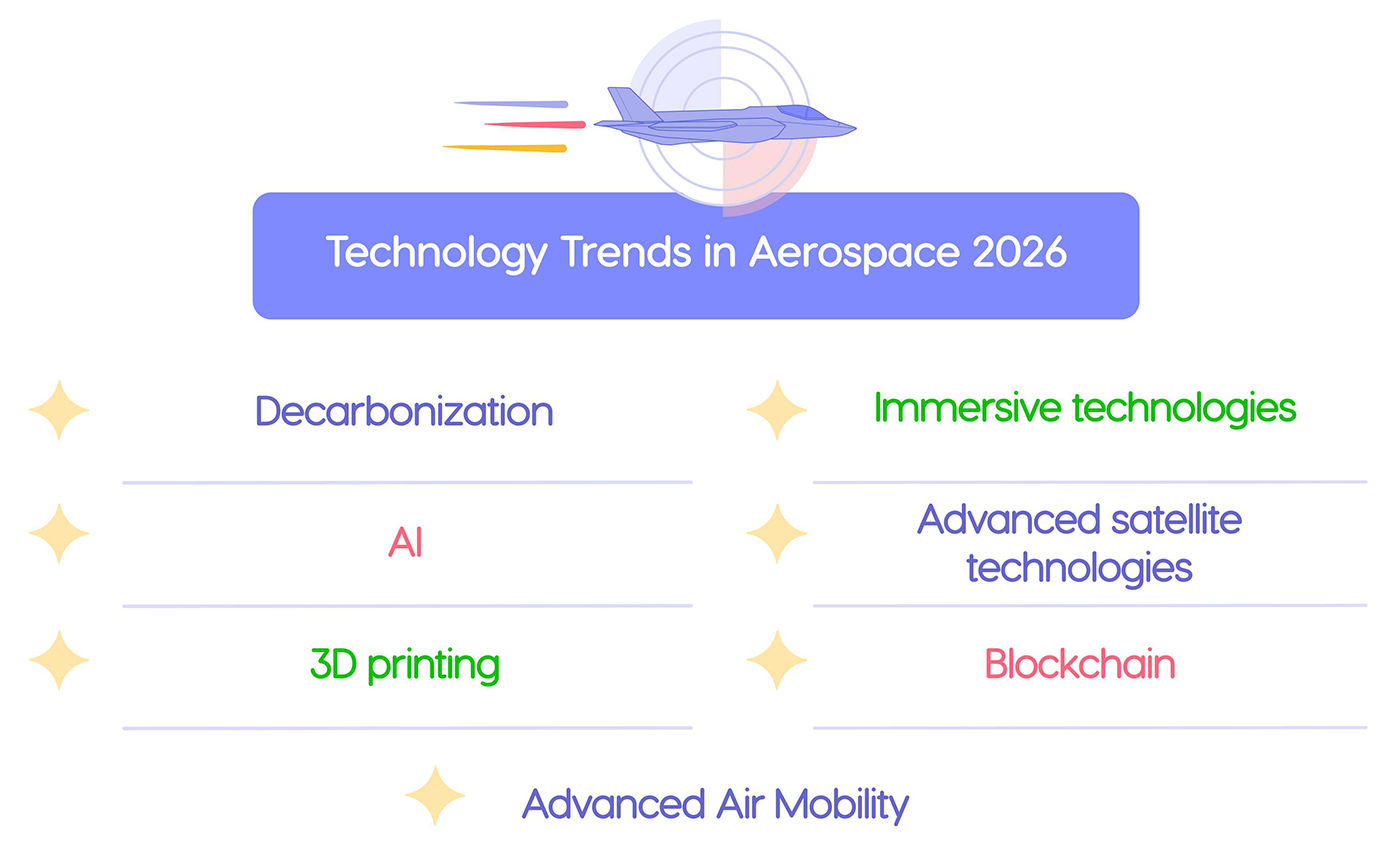
The aerospace trends listed below aren’t new to the industry; most require much time to be implemented, so they are here to stay for several more years or even decades. Also, as technologies become more and more sophisticated, their application in the industry becomes more diverse. Let’s take a look at the most essential emerging technologies in aerospace.
1. Facilitating Decarbonization.
This is one of the most challenging aerospace industry trends. Following the adoption of various initiatives aimed at reducing the negative effect of carbon emissions on climate change (e.g. the European Green Deal [5]), decarbonization is a trend that is here to stay for at least a couple of decades. Despite progress in minimizing Scope 1 and 2 emissions, reducing Scope 3 emissions (produced by the manufactured product, e.g. an aircraft during flight) is more challenging as long as they are more difficult to control. So, aerospace companies will continue their decarbonization journey in 2026.
By now, there has been some visible progress in reducing emissions and decarbonization efforts. For example, Airbus reports that they have already reduced Scope 3 emissions by 31% since 2015, while GKN Aerospace are planning to reduce emissions by 25% by 2030.
Nevertheless, companies are expected to continue their efforts and leverage recent developments in aerospace engineering and innovation technologies as well as focus on technological and operational improvements to address the sustainability challenge. This can be achieved by means of:
- utilization of advanced technologies (e.g., digital twins, smart factory, digital threads) to improve aircraft design and engineering and achieve fuel efficiency;
- selection of sustainable alternative fuels, e.g., sustainable aviation fuels or SAFs;
- new propulsion technologies (electric, hydrogen, hybrid);
- combining smart technologies and green energy (the factory of the future);
- aerospace supply chain reconfiguration and streamlining shipping and distribution.
2. Artificial Intelligence.
The use of artificial intelligence in aerospace and defense is growing—it’s one of the most prominent trends in aerospace. The technology allows aerospace organizations to transform their manufacturing processes, improve safety, and optimize customer service and system management. What is more, AI is capable of solving complex problems more quickly than humans, it facilitates effective decision-making, and eliminates human errors. The aerospace sector leverages artificial intelligence for air traffic management, manufacturing, training pilots, and fuel consumption optimization.
An example of an Aerospace AI startup is Beacon AI which employs deep learning algorithms to enhance the safety of private and commercial flights. The pilot works with an AI assistant during the flight, which minimizes human errors and improves overall operational efficiency. [6]
In 2026, the aerospace sector will take advantage of agentic AI, which will help them with predictive maintenance, flight planning and optimization, threat detection, achieving supply chain resilience, and decision making.
3. 3D Printing.
Additive manufacturing (AM) or 3D printing is the process of creating three-dimensional objects from digital 3D or CAD modes, which implies adding materials layer by layer until the required object is ready. Currently, the aerospace and defense industry is among the largest users of additive manufacturing technology: it’s applied to create rocket bodies, build rocket engines, optimize astronaut uniforms, accelerate commercial aircraft production, etc.
The main advantage of additive manufacturing for the aerospace sector is that it improves manufacturing efficiency (thanks to rapid prototype development) and makes it possible to produce more lightweight components for aircraft, spacecraft, and satellites. This is especially relevant in the context of post-pandemic production ramp-ups in the aerospace realm; the technology makes it possible to reduce production costs, optimize fuel consumption, and generally gives aerospace manufacturers a competitive advantage.
Though additive manufacturing is not a new aerospace technology, its market will grow in the years ahead. Similarly to the defense sectors, Aerospace 3D Printing Market Forecast shows that the most prominent tendencies in the use of 3D printing are:
- The use of metal additive manufacturing
- The shift to mainstream production
- On-demand manufacturing
- Focus on creating lightweight parts.
4. Advanced Air Mobility.
Advanced Air Mobility (or aerial mobility) is a revolutionary approach to urban mobility that involves leveraging flying cars and cargo drones with electric vertical takeoff and landing (eVTOL). This is a relatively new technology in aerospace, which has been actively developing in recent years. Some organizations have already completed the research and development stages and are testing their vehicles.
2024 was going to be remarkable for advanced air mobility: the company Volocopter which has already developed three types of aircraft suitable for Urban Air Mobility was planning to launch commercial flights and provide an all-electric air mobility service for the Olympic Games in Paris. However, the certification delays made the showcase during the Olympics impossible, and the first Volocopter flight was conducted later, in August. 2026 will be marked by further developments in this latest aerospace technology, with more companies involved. [7] For example, in UAE, they are actively building air mobility corridors, vertiports, and regulatory frameworks to support air mobility services; air taxi rollout is planned in Dubai for 2026. In the upcoming years, we will finally see at least early deployments of eVTOL and other AAM services.
5. Immersive Technologies.
Immersive technologies (virtual and augmented reality) make it possible to see real-world objects overlaid with digital data. They are widely applied in the aerospace sector for the following purposes:
- Modernization of aerospace manufacturing: The technologies improve manufacturing accuracy, significantly reduce downtime, and improve manufacturing efficiency.
- Aerospace employee training: For example, pilots can improve their proficiency during AR-assisted training, while would-be pilots learn more effectively on virtual reality simulators.
- Aircraft maintenance and repair: Applying AR and VR will streamline and significantly improve the process of aircraft inspection and maintenance.
In 2026, immersive technologies in aerospace will continue their development and strong market growth as well as will be increasingly impacted by integration of artificial intelligence.
5. Advanced Satellite Technology.
The application of satellites is gaining momentum and is expected to grow in 2026 and beyond. This is explained by the reduction of prices for satellite launches and the increased demand for geospatial intelligence and satellite imagery. Also, the extensive use of the Internet of Things and the need for global connectivity promotes the active development of satellite technologies.
According to the research, some of most prominent satellite technology trends are going to be the following ones:
- Satellite miniaturization: small satellites are replacing the large ones and related infrastructure; they are positioned in LEO and used for Earth observation and remote sensing;
- Applications of satellite IoT;
- Advanced ground systems that are capable of monitoring satellite constellations without human intervention;
- Spacecraft propulsion that allows satellites to travel deep into space and perform complex maneuvers;
- Leveraging sustainable propulsion systems in satellite production;
- Very High Throughput Satellites (VHTS) that transmit data at the speed of several hundreds of gigabytes or even terabytes per second. [8]
6. Blockchain.
One of the major aerospace and defense industry trends and ongoing challenges is achieving resilience of complex supply chains—it’s a critical component enabling manufacturers’ competitiveness and minimizing their risks and financial losses. This is where blockchain can assist: this mechanism enables transparent information sharing with high-level data security and network resiliency. Therefore, aerospace manufacturers can enhance visibility into supply chains and in such a way mitigate related risks and improve supply chain efficiency.
In 2026, the adoption of blockchain will be expanding. For example, the Asia-Pacific region is increasingly investing in the technology for aerospace manufacturing and supply chain visibility. Also, the applications of the technology will go beyond supply chains and involve secure data sharing, certification histories, and cross-enterprise collaboration. [11]
These were the most common trends in the aerospace industry related to the application of technological advancements; they are going to have the biggest impact on its development next year and in the near future and help companies effectively address aerospace challenges.
Read more: Successful Project Delivery in Aerospace and Defense: Success Criteria
Aerospace and Defense Market: Overview

The global A&D market is projected to experience steady growth in 2026, driven by digital transformation, increased defense spending, supply chain resiliency, and a recovery in commercial aviation. Here are some other factors that will shape the A&D market in 2026:
- Technology innovations;
- Sustainability requirements and ESG;
- Digitalization and Industry 4.0;
- Growing focus on space;
- Addressing persisting workforce challenges.
Here is a brief overview of defense and aerospace market trends.
Regional market dynamics
- North America remains the largest and the most technologically developed region.
- Asia-Pacific continues to lead growth fueled by defense modernization and expanding low-cost carrier networks.
- Middle Eastern companies are expected to increase their investments in aviation infrastructure and military capabilities.
- Europe and North America will focus on NATO-aligned defense upgrades and sustainable aviation innovations.
Addressing supply chain challenges
Companies are addressing supply chain vulnerabilities through reshoring, dual-sourcing, and adopting advanced tracking systems driven by AI and predictive analytics and blockchain. Raw material shortages, such as titanium and rare earths, remain critical concerns for manufacturers.
Investment trends
A&D companies are expected to invest mostly in R&D in hypersonics, AI and agentic AI, electric propulsion, unmanned systems, cybersecurity, smart materials, and immersive training technologies.
Emerging markets
South Korea, Turkey, and Brazil are expected to take steps in the A&D sector, contributing to global supply chains and forming partnerships for co-production and technology transfers.
Commercial aviation trends
- Continued fleet modernization and adoption of hybrid and electric aircraft.
- Expansion of Urban Air Mobility and eVTOL deployments.
- Increased reliance on digitalization, predictive maintenance, and operational efficiency.
Project management trends in A&D companies
The upcoming year will be marked by balancing innovation, sustainability, and addressing internal and external challenges. The most prominent tendencies in aerospace and defense project management are as follows:
- Applying hybrid project management methodologies;
- Leveraging innovative technologies;
- Increased focus on risk management and cybersecurity;
- Focus on business value;
- Addressing workforce shortages;
- Cost and time optimization.
Epicflow is aerospace and defense project management software trusted by A&D organizations as well as some Western European ministries of defense. The tool helps them optimize portfolio performance and deliver more value with available resources thanks to value-based prioritization, focusing on resource constraints, and optimizing decision making. If you have questions regarding portfolio and resource management in A&D organizations, don’t hesitate to contact our experts — they have considerable experience in consulting A&D companies and will be glad to help you.
Read our A&D client’s success story: Unlocking a Defense Company’s Potential to Complete More Projects
Conclusion: The Future of the Defense & Aerospace Industry
The aerospace & defense domain continues its digital transformation and active adoption of innovative technologies. In 2026, recent technological advancements will continue to shape the aerospace and defense industry landscape. Among the notable developments that will impact aerospace and defense trends next year are artificial intelligence and agentic AI, additive manufacturing, and immersive technologies. Also, aerospace & defense organizations will continue their decarbonization efforts supported by technological developments, improve defense equipment and satellite technologies, as well as take advantage of robotics, increased connectivity, and blockchain.
In addition, project-based organizations in the A&D industry are increasingly relying on diverse project management tools. For example, portfolio management tools help these organizations keep strategic alignment when they implement diverse innovations and technologies and maintain visibility into multiple projects. PMO software is the right solution to maintain standardization across multiple projects and teams. Finally, efficient resource management is impossible without project resource management software as well as capacity planning software that helps utilize organizational resources most effectively and ensures robust project planning and staffing. This trend will remain in the industry for years ahead.
Frequently Asked Questions
What are the key aerospace and defense technology trends in 2026?
Key aerospace and defense innovations will include the application of artificial intelligence and agentic AI, immersive technologies, additive manufacturing, cybersecurity solutions, blockchain, IoT, and robotics. What is more, next year will be marked by further sustainability efforts, space exploration, and developments in aerial mobility.
How will AI be utilized in the aerospace and defense sector?
AI is the key aerospace and defense technology. It will play a transformative role in several areas:
- Transforming military operations and increasing their efficiency;
- Predictive maintenance in both aerospace and defense sectors;
- Enhancing cybersecurity by predicting threats;
- Operational optimization for commercial aviation;
- Optimizing decision making.
What sustainability efforts will A&D companies implement in 2026?
Sustainability is one of the main drivers of innovations in aerospace and defense. Companies take the following actions to meet the sustainability requirements:
- Using green fuels, e.g., sustainable aviation fuels and hydrogen.
- Leveraging lightweight materials and optimizing design to make aircraft more energy-efficient;
- Implementing green manufacturing practices to reduce waste and minimize carbon footprint.
How technology is used in defense?
AI is used for training the military, creating advanced weapons, surveillance purposes, and providing cybersecurity. Additive manufacturing is used to quickly create various things for the military—from “printing” vehicle parts to building necessary structures. The Internet of Military Things facilitates increased automation, improves decision-making, and secures real-time data-sharing. Robotics and autonomous systems make it possible to increase situational awareness and reduce soldiers’ physical and cognitive workload. The immersive technologies (augmented and virtual reality) can be applied for equipment, flight, and weapons training.
What are the emerging trends and technologies in aerospace sector?
In 2026, the aerospace landscape will be marked with further sustainability efforts, developments in advanced air mobility, the adoption of AI, 3D printing, and immersive technologies as well as the increased application of satellites.
What are the advancements in aerospace engineering?
Advancements in aerospace engineering involve accelerating innovation across aircraft design, defense systems, and space technologies to drive efficiency, resilience, and sustainability in the industry.
References
- 2025 Aerospace and Defense Industry Outlook. Deloitte. Retrieved from: https://www2.deloitte.com/us/en/insights/industry/aerospace-defense/aerospace-and-defense-industry-outlook.html
- What’s Next for Aerospace and Defense. A Vision for 2050. AIA. Retrieved from: https://www.aia-aerospace.org/wp-content/uploads/Whats-Next-for-Aerospace-and-Defense.pdf
- Top 10 Military Technology Trends and Innovations for 2025. StartUs Insights. Retrieved from: https://www.startus-insights.com/innovators-guide/top-10-military-technology-trends-2022/#Advanced-Defense-Equipment
- 7 Top Military Technology Trends (2024&2025). Retrieved from: https://explodingtopics.com/blog/military-technology-trends
- The European Green Deal. Retrieved from: https://commission.europa.eu/strategy-and-policy/priorities-2019-2024/european-green-deal_en
- Top 8 Aerospace Trends & Innovations in 2025. StartUs Insights. Retrieved from: https://www.startus-insights.com/innovators-guide/aerospace-trends/#sustainability
- Volocopter Conducts First eVTOL Flight at the Palace of Versailles. Retrieved from: https://www.volocopter.com/en/newsroom/vc-flight-versailles-palace
- Explore the Top 10 Satellite Industry Trends in 2025. StartUs Insights. Retrieved from: https://www.startus-insights.com/innovators-guide/satellite-trends-innovation/
- Improving 2025 Outlook for Global Aerospace and Defence Due to Strong Demand. Fitch Ratings. Retrieved from: https://www.fitchratings.com/research/corporate-finance/improving-2025-outlook-for-global-aerospace-defence-due-to-strong-demand-06-12-2024#:~:text=Increased%20demand%20and%20easing%20supply,airlines%20replacing%20or%20expanding%20capacity
- 2026 Simulation Trends in the Defense Industry: Why Choose Simulators Over Real Vehicles? (2025). Retrieved from: https://www.skyart.com/blog/airline-industry-trends/2026-simulation-trends-in-the-defense-industry-why-choose-simulators-over-real-vehicles
- Blockchain Technology in Aerospace Market Overview. Retrieved from: https://www.wiseguyreports.com/reports/blockchain-technology-in-aerospace-market