Program Management Framework: Key Components, Benefits, and Best Practices
 Victoria Sokolova
.
October 2, 2025
.
Project Portfolio Management
.
28 mins READ
Victoria Sokolova
.
October 2, 2025
.
Project Portfolio Management
.
28 mins READ

Program management can be challenging – you have to coordinate complex interdependencies, manage shared resources, meet deadlines, and at the same time ensure value delivery. To address these challenges, a great number of companies look for ways to streamline and standardize these processes and optimize the program management process.
Program management frameworks help business organizations plan and execute their programs, which can simplify complex program management and increase its effectiveness.
In this article, we’ll consider the following aspects of program management frameworks:
- What is a framework in program management, and what are its essential components?
- The benefits of adopting a program management framework.
- Challenges of implementing the frameworks, and how to make their adoption maximally effective.
Read further to discover how a program management framework can transform the way your organization delivers programs.
What Is a Program Management Framework?
A program management framework is a model that determines how a business organization plans, executes, and controls programs, i.e., sets of multiple interrelated projects united by a common strategic goal. This framework defines standards, processes, structures, and best practices required for effective program management. In simple terms, it answers the question: How to manage programs successfully?
Program management framework vs. project management framework
The main difference between these two frameworks is in their scope.
- Project management frameworks deal with single projects that have clearly defined scope, budget, and timeline. Their main purpose is to ensure the successful delivery of a project.
- A program management framework facilitates successful program management. It helps coordinate multiple interrelated projects throughout the whole program lifecycle and ensures their alignment with the business strategy and a company’s long-term goals.
Therefore, program management frameworks are essential for defining the standards for program management and achieving expected results.
Let’s now consider some typical elements of program management frameworks.
What Are the Core Components of a Program Management Framework?

Strategy alignment
Strategy alignment ensures that every project within the program directly contributes to achieving a company’s strategic goals. In particular, it unites a program’s goals with the company’s mission and strategy, provides criteria for project selection and prioritization, and helps senior management make informed decisions regarding program management (allocating resources, funding, problem-solving in case of bottlenecks, etc.). Without this component, it will be difficult to ensure that a program will deliver outputs that will drive the organization towards achieving its goals.
Benefits management
This component focuses on delivering value. It helps companies in the following ways:
- Identifying potential benefits a program can achieve;
- Connecting potential benefits with projects within a program;
- Tracking benefits realization throughout the program lifecycle;
- Providing reporting for executives.
Implementing benefits management will ensure that the execution of a program will justify the investment, and the company implementing it will achieve the expected benefits.
Stakeholder engagement
Stakeholder engagement is indispensable for managing expectations and effective communication among everyone involved in program execution. What are the other benefits of this component?
- Analyzing stakeholder interests and requirements;
- Contributing to trust-based relationships between stakeholders;
- Reducing resistance;
- Involving stakeholders in the decision-making process.
Program governance
Governance determines the decision-making procedure and accountability. In particular, it clarifies roles and responsibilities across the program team; establishes approval procedures for budgets, resource allocation, making changes, etc., and ensures compliance with organizational standards. These factors prevent scope creep and ensure transparency of all program management processes.
Life cycle management
Lifecycle management provides a structure for implementing the program from start to finish. For example, it defines the stages of a program and potential decision points as well as determines tools and templates to use at different phases.
The components may vary across frameworks, but usually these five components form the backbone of a program management framework.
Why Following a Program Management Framework is Important?
The right program management provides organizations with the following benefits.
Strategic alignment
A program management framework ensures that all projects within a program support the organization’s strategic goals. Thanks to applying these frameworks, the management can set the right priorities across projects, allocate resources and budget to the most valuable ones, and decline projects that don’t contribute to achieving strategic goals.
Standardization
Without standardization, different projects may use different methodologies, templates, or siloed reports. This will create confusion and reduce work efficiency. In contrast, program management framework standardizes program management, in particular, planning, monitoring, and control as well as contributes to consistency of the program management processes.
More effective resource management
As a rule, resources you can allocate to projects are limited, so wise resource management is the key to their efficient utilization and delivering projects on time. A program management framework helps companies allocate and manage resources across projects more effectively. This also prevents overload, reduces bottlenecks, and increases productivity.
Improved stakeholder communication
For effective program management, it’s critically important for all stakeholders to be on the same page. Program management frameworks provide standardized reporting and a single source of truth for all stakeholders, which in turn improves cross-department collaboration.
Value delivery
Every program is an investment, and business organizations expect to achieve appropriate ROI. Program management frameworks focus on benefits management from defining the expected outcomes to tracking their achievement.
To cut it short, a program management framework turns a collection of projects into a well-coordinated and value-driven program that helps organizations deliver tangible outcomes.
Now, it’s time to review the most common program management framework examples.
3 Popular Program Management Frameworks
1. PMI’s Standard for Program Management.
This is a large program management framework developed by the Project Management Institute. Its core components include Benefits Management, Program Governance, and Stakeholder Management. The framework is principle-based and aims to help organizations enhance their program management processes for different types and sizes of programs and, what is most important, align program outcomes with the organizational strategy.
The benefit of this framework is that it’s standardized by the PMI and aligns with other PMI standards and practices. However, companies may require other materials and more guidance to implement this framework effectively.
2. Mastering Successful Programs (MSP).
The MSP framework is widely used in the UK and globally. It helps organizations achieve transformational change through program management. It’s based on three elements – principles (values that a program follows), themes (specific program management areas), and processes (program lifecycle activities).
This framework provides detailed guidance for program management and is mostly suitable for public sector programs or large-scale change. But at the same time, applying MSP may require additional training and change management.
3. HERMES.
HERMES an all-in-one framework for project and program management developed by the Swiss government. It’s highly adaptable and can be used for a wide range of project environments and project management methodologies, including traditional, hybrid, and Agile. It’s also suitable for various areas and industries, from change implementation programs to information technology. The framework clearly defines roles and responsibilities within the program management process and puts emphasis on governance, planning, financial management, and managing interdependencies.
HERMES is good for government and public sector programs, but it may not be sufficient enough for the commercial sector or government programs outside Switzerland.
When implementing a program management framework, you may face some challenges that will prevent you from achieving expected outcomes. Let’s consider these challenges in more detail.
Challenges of Adopting a Program Management Framework
It’s better to know and be prepared for possible challenges in advance. So here are the most common difficulties you can come across.
1. Getting executives’ support.
Adopting a program management framework may be considered as redundant effort and investment. If the executives don’t realize the benefits that a company achieves upon implementing a framework, they will be less likely to support this endeavor. In turn, without their support, it will be difficult to ensure cross-departmental cooperation and consistent work on the program execution.
What to do about that?
You should present the framework as a tool for achieving business outcomes. To be more persuasive, you can communicate success stories of companies that have already implemented these frameworks, and provide stakeholders with precise numbers showcasing the benefits of this initiative.
2. Resistance to change.
Most changes implemented within an organization face resistance. And program management framework adoption is no exception. “We’ve always done it this way, so why should we change something?” is a common way of thinking of people resisting to changes. Without corrective action, resistance to change can undermine the effectiveness of any framework.
What to do about that?
Communication is the key. You should clarify the importance of framework adoption, what benefits each program participant will achieve, and how their everyday work will change. Also, conduct training and workshops to make project leaders and project team members more confident and less resistant.
3. Framework complexity.
Some frameworks are rather comprehensive (e.g., PMI’s or MSP), so adopting each of their components at once may be overwhelming for the staff. In turn, this will slow down program management processes and may lead to delays. Also, excessive complexity will cause more intense resistance.
What to do about that?
You can tailor the selected framework to your organization’s specificity and implement it stepwise – adopting the most essential components first. Some projects and teams may require unique approaches, and this fact shouldn’t be ignored.
4. A lack of required skills and knowledge.
Program management requires different knowledge and skills from traditional project management. Some program activities can be new for the team members, program leaders, or PMO staff. Without additional training, they may find it difficult to master new ways of working required by a program management framework.
What to do about that?
First things first, you should make sure that people involved in program management processes undergo the required training within a chosen framework. Second, it’s a good idea to facilitate collaboration between less experienced staff members with more experienced ones or mentors/consultants. Finally, you can keep reference materials in place and encourage people to use them whenever necessary.
5. Mismatch with organizational culture.
Program management frameworks are rather rigid structures, which may contradict the values of some organizations. For example, sometimes, organizations prioritize flexibility, informality, and are prone to making ad-hoc decisions. It may be challenging for them to put themselves in a structured framework.
What to do about that?
Before choosing a framework, you should analyze its elements and required processes, and assess these factors from your organizational culture’ perspective. The other solution can be stepwise implementation of the program management framework and refusing the elements that will rather cause difficulties and resistance in your company than generate value.
In addition to overcoming possible challenges, you should also know some best practices that will make the adoption of the new framework smooth. Let’s consider some recommendations in the section below.
Best Practices for Effective Adoption of a Program Management Framework
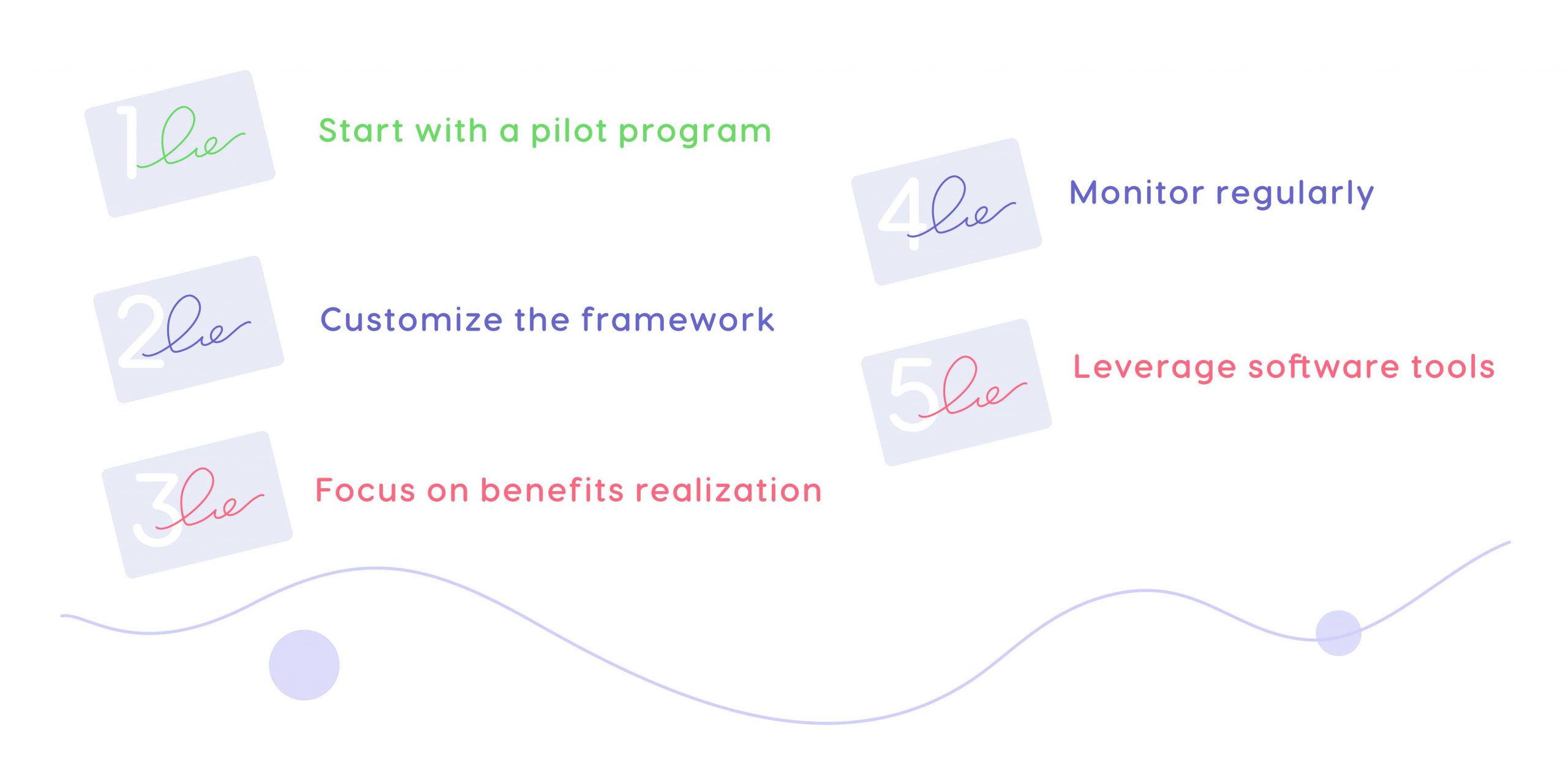
Implementing a program management framework requires processes and tools as well as organizational culture adaptation. The steps below will help your organization undergo this transition seamlessly and achieve desired outcomes.
Tip 1. Start with a pilot program.
It’s better not to jump off the deep end and adopt the framework for all programs across the organization at once. This approach can be risky, overwhelming for the staff, cause resistance and fail to deliver the expected results. Instead, you can choose one or two pilot programs and test the framework before scaling it to the rest of the projects and programs.
Tip 2. Customize the framework.
Every organization has its unique corporate culture, project management maturity level, industry specificity, and other unique characteristics. This means that there cannot be a one-size-fits-all solution in terms of choosing the right project management framework, and you should customize the existing solution for your organization’s purposes. For example, you can keep the core principles of the framework, but adapt terminology, roles, and decision-making process.
Tip 3. Focus on benefits realization.
It’s important not to reduce the framework to mere box-ticking, but keep focus on the value it brings to the program management process and the organization in general. You should link each component of the program management framework to the measurable benefits. Track benefits realization regularly and adjust priorities according to the outcomes.
Tip 4. Monitor regularly.
Business organizations don’t remain in the same condition – they change constantly. And the framework should adjust to these changes. This is why it’s important to conduct periodic assessments to make sure that it still fits your organization’s specificity and can bring the expected benefits.
Tip 5. Leverage software tools.
Program management frameworks require accurate data and optimization of key program management processes. Also, informed decision-making is an indispensable component of successful program management framework implementation. Use program management software to centralize data, automate processes, perform risk assessment and mitigation, and ensure visibility and data-driven decision-making. Let’s dwell upon using PM tools in more detail in the next section.
Tools Supporting Program Management Frameworks: What Epicflow Offers for Program Management

Managing programs and implementing program management frameworks is more effective when you use specific tools. In a nutshell, they provide visibility into all processes, projects, and resources, enable informed decision-making, and facilitate fruitful delivery of every project within a program. As an example, let’s consider Epicflow, an AI-driven multi-project resource management solution that perfectly complements program management frameworks. Here are its capabilities for program management in more detail.
1. Powerful resource management across programs.
Resource management is one of Epicflow’s superpowers. And here’s why:
- The tool enables intelligent resource allocation across all projects within a program based on employees’ skills, capacity, availability, and other attributes. In addition, it can provide you with resource allocation suggestions and quickly find the right person to assign to a task.
- The other essential resource management functionality is AI-powered capacity planning that helps program management plan projects, workloads as well as forecast and prevent bottlenecks.
- Epicflow provides opportunities for team performance analysis, which is indispensable for timely detection of existing bottlenecks and inefficiencies before they cause troubles for the whole project environment. This is especially essential for program management with interdependencies between projects.
2. Risk and bottleneck identification.
As we mentioned earlier, projects have interdependencies within a program, which means that you should avoid botteleсks by all means. Why? Because only one bottleneck can cause snowballing delays that affect the progress of the entire project environment. Epicflow can forecast bottlenecks with its capacity planning tool as well as identify the existing ones with the help of its Historical Load Graph.
3. Comprehensive visibility and control.
Want to know the state of your projects in terms of milestone feasibility? You’re welcome to the Epicflow’s Pipeline that will show you how healthy your project environment is. Need to find the right employee for a task quickly? Epicflow will select the right person just in seconds. Moreover, you can control budget consumption to make sure that you won’t go beyond the determined budget frames. Therefore, Epicflow provides the big picture so that program managers could control processes and resources within programs.
4. Decision support.
Making project management decisions in a multi-project environment without knowing their consequences for other projects is like taking a wild guess and winning. But the price for making a mistake is too high when you manage programs or portfolios. Epicflow reduces this uncertainty – its What-if analysis feature allows you to test different scenarios before making a decision. You can change different parameters, run scenarios, discuss them with project stakeholders and the team, and implement the best one.
The list of capabilities supporting effective program management goes on. You can contact our experts to learn more details on Epicflow’s contribution to seamless management of projects within a program and achieving the expected business goals.
Conclusions
It’s time to draw some conclusions. When implemented right, a program management framework will be more than a set of processes. It has the potential to connect a company’s strategy with program execution and its outcomes. At the same time, selecting and adopting the framework effectively may require some effort, e.g., initial analysis, framework customization, focusing on benefits realization as well as leveraging portfolio management tools with functions supporting program management. But it’s definitely worth the effort – it gives your company a chance to deliver strategy faster and with greater benefits.
Frequently Asked Questions
What is program management framework?
A program management framework is a structured model of processes, tools, and practices that help organizations plan, execute, and control program management processes. They facilitate consistency, optimum resource utilization, and contribute to achieving benefits and strategic goals.
What is the difference between a program management framework and program management?
Program management is a discipline and a process of managing multiple interrelated projects. In contrast, a program management framework is an approach to managing programs. The variety of a program management framework demonstrates different approaches to the program management process. To cut it short: program management is what you do, and a program management framework is how to do it.
What are the core components of a program management framework?
Program management frameworks differ from each other. However, their components usually include the following ones: strategy alignment, benefits management, stakeholder engagement, governance structures, and lifecycle management.
Why do organizations need a program management framework?
Program management frameworks ensure strategic alignment and consistency, optimize resource utilization, contribute to stakeholder engagement and value delivery.
What are the biggest challenges in adopting a program management framework?
The most common challenges of adopting a program and project management framework involve a lack of executives’ support, employees’ resistance to change, the complexity of the framework and its mismatch with the organizational culture, and a lack of required skills and knowledge.
What are some popular program management frameworks?
The examples of popular program management frameworks include PMI’s Standard for Program Management, Mastering Successful Programmes (MSP), and Switzerland’s HERMES framework.
What are some best practices for successful adoption of a program management framework?
The steps listed below will make it possible to adopt a program management framework seamlessly and effectively:
- Starting with a pilot program;
- Customizing the framework depending on your organization’s specificity;
- Focusing on benefits realization;
- Monitoring the progress and results regularly;
- Leveraging software tools supporting program management.