The Job of a Resource Manager: Role and Responsibilities
 Victoria Sokolova
.
January 12, 2026
.
Resource Management
.
22 mins READ
Victoria Sokolova
.
January 12, 2026
.
Resource Management
.
22 mins READ

Are you thinking of hiring a resource manager but would like to learn more about the ways they could contribute to your projects? Or maybe you’re thinking of becoming a resource manager but not sure if it’s the right choice for you?
The job of a resource manager can be less common as a project manager’s, but just the same important: apart from allocating the right resources to the right tasks at the right time, a competent resource manager’s efforts can improve the overall project flow, keep employees’ load balanced and prevent them from burnout, overcome resource shortages, and ensure that all the projects running in a company are staffed with perfectly matching employees.
Read further to get a comprehensive idea of this job position and how resource managers can assist with successful delivery of your projects.
Key Takeaways:
- Resource managers support project managers with planning, allocating, and optimizing resources across projects.
- Some of the responsibilities of a resource manager include resource allocation, capacity planning and forecasting future resource needs, monitoring and adjusting resource utilization, and managing resource conflicts.
- A resource manager should have managerial skills, understand the fundamentals of project and human resource management, have analytical and data skills, and be able to work with software (resource management or capacity planning tools).
- Resource management software supports resource managers in performing their day-to-day resource management tasks and addressing typical challenges like resource conflicts, bottlenecks, limited visibility, balancing capacity across multiple projects.
A Resource Manager: Job Description
Let’s begin with a resource manager definition. A resource manager is the one who helps project managers with planning, allocating, and optimizing resources across projects; determines an organization’s demand for resources and ensures there’s enough capacity to meet staffing needs of projects; assigns employees to a project’s tasks; and participates in hiring new employees. Also, resource managers can support project prioritization decisions by providing insight into resources’ available capacity.
Resource managers are usually required in fast-growing companies or mid-sized and large organizations with shared resources, distributed teams, and an increasing number of projects.
Now that you understand what a resource manager is, it’s time to review what they do in organizations. The role of a resource manager and their scope of responsibilities differ across companies. However, having reviewed job descriptions for a resource manager’s position on LinkedIn Jobs and employment web sites (Glassdoor, ZipRecruiter, Totaljobs, SimplyHired), we’ve come up with the following summary.
Responsibilities of a Resource Manager
Resource manager responsibilities typically include the following ones.
- Assigning available employees to projects in accordance with their skillsets, previous experience, and availability.
- Monitoring day-to-day project activities and corresponding resourcing.
- Capacity planning, i.e. making sure that a company’s resources have capacity to work on upcoming projects.
- Forecasting the need for extra employees to staff projects.
- Monitoring and managing employees’ workload, utilization, and overtime hours.
- Managing resource conflicts.
- Overcoming resource shortages by means of resource management techniques, reallocating resources, assigning more staff, etc; informing senior management of any issues related to inability to meet clients’ needs due to resourcing.
- Providing project managers with support when it comes to resource management issues or improving resource management processes.
- Knowing all the current and upcoming projects run in an organization and business development activities and being able to plan resourcing accordingly.
- Collaborating with the HR department regarding staff training, compensation and benefit planning, payroll administration, and hiring new staff for projects.
- Being familiar with labor laws as well as resource management trends.
- Documenting processes (e.g. weekly utilization report, etc.).
In simple words, resource manager roles and responsibilities come down to assigning the right resources to the right projects at the right time to ensure successful delivery of projects.
Read more: Portfolio Management and Resource Allocation: What Do They Have in Common?
And now, let’s consider professional and personal qualities a resource manager should possess.
Requirements to a Resource Manager
A resource manager mostly deals with people, projects, and related processes, so it’s important for them to understand project management, business processes, and talent management. Their soft skills are no less important: they should be good at communication, interpersonal interaction, and have good strategic thinking.
Education
- A resource manager should have a Bachelor’s degree in human resource management, business, management, or a similar field.
- Taking a project management certification course or similar resource management courses (e.g., Resource Management Certified Professional (RMCP) by Resource Management Institute) will be a big advantage.
Experience
- Previous experience as a project/resource/HR manager or in the related industry is optional but advantageous.
- Working in a multi-project or portfolio management environment can be a plus, especially for a senior-level resource manager.
Skills and competences
- Proficiency in human resource and project management,
- Ability to use technology (analytics tools, resource management software, capacity planning tools),
- Data-driven mindset,
- Knowledge of applicable labor laws,
- Ability to prioritize and manage multiple tasks efficiently,
- Critical thinking, analytical and forecasting skills,
- Change management skills and adaptability,
- Conflict-resolution and problem-solving skills,
- Flexibility and good decision-making skills,
- Managerial and time-management skills,
- Interpersonal interaction skills (effective communication, negotiation, collaboration, the ability to be diplomatic and stand one’s ground).
Read more: Becoming a Successful Project Manager: 5 Tips to Achieve Professional Goals and Objectives
Resource Management Roles
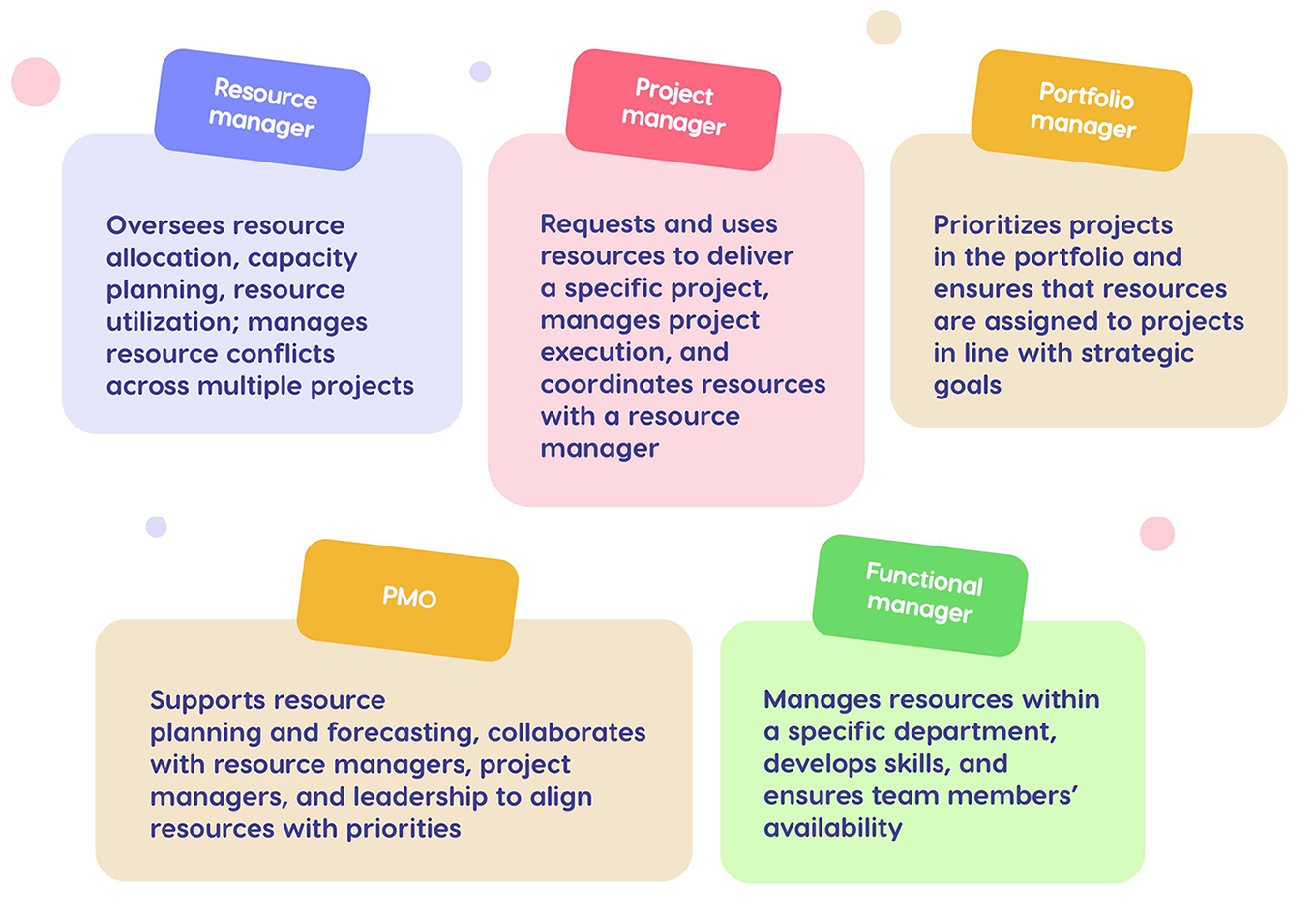
In modern organizations, managing resources becomes more and more complex and requires several management lines. Let’s take a quick look at the diversity of resource management roles.
- Resource manager: Oversees resource allocation, capacity planning, resource utilization; manages resource conflicts across multiple projects.
- Project manager: Requests and uses resources to deliver a specific project, manages project execution, and coordinates resources with a resource manager.
- Portfolio manager: Prioritizes projects in the portfolio and ensures that resources are assigned to projects in line with strategic goals.
- PMO (Project Management Office): Supports resource planning and forecasting, collaborates with resource managers, project managers, and leadership to align resources with priorities.
- Functional manager: Manages resources within a specific department, develops skills, and ensures team members’ availability.
Each of these roles has its own contribution in the resource management and process and project execution, but all of them ensure that resources are used efficiently and projects are delivered successfully across the organization.
Sometimes, there is a misconception concerning the roles of a project manager, a resource manager, and a human resource manager. So, in the next section, we’ll consider how these job positions differ from each other.
What Are the Differences Between a Resource Manager vs Project Manager vs HR Manager?
Look at the table below with a brief description of these jobs to understand the difference between them better.
| Criteria | Resource Manager | Project Manager | HR Manager |
| Operation area | The whole organization | A project or multiple projects | The whole organization |
| Deals with | Resource planning and allocation, ensuring optimal utilization of a company’s resources, managing employees’ skills, supporting PMs in terms of resourcing | Project planning and scheduling; estimation of project scope, budget, and time; risk management; stakeholder management | All employee-related issues (recruitment, training, engagement, compensation and benefits, etc.) |
| Goal | Ensuring the projects have enough resources to be delivered | Delivering projects on time and within budget | Managing a company’s workforce |
Thus, the main difference between these three job positions is that a resource manager deals with employees (and sometimes equipment and facilities) as resources for projects, a project manager is responsible for delivering projects on time and budget, and a human resources manager interacts with employees as the whole organization’s workforce. Notably, a resource manager collaborates with both project managers and human resource managers.
Read more: How to Start a Career in Project Management: Answers to FAQ
As we’ve mentioned earlier, a candidate applying for a resource manager’s position should be able to work with technology tools including resource management software. Why is this software necessary and how does it help? Let’s figure it out.
How Resource Management Tools Assist Resource Managers

A resourcing manager comes across various challenges in their work:
- a lack of skilled resources,
- ineffective resource utilization,
- resource bottlenecks;
- resource conflicts,
- lack of project resource visibility,
- making under-informed decisions on project resourcing,
- managing resources in a large organization and distributed teams.
To address these challenges successfully, it’s a good idea to utilize resource management software solutions: they aim to automate routine processes of a resource manager’s work (e.g. creating schedules, compiling reports, etc.), help with monitoring the team’s workload and progress, and even assist in making important decisions.
What should be mentioned separately is managing resources in a multi-project environment that is fundamentally complex and challenging due to the shared resource pool, overlapping due dates, and dependencies between projects and tasks. Let’s consider some major resource management challenges of a multi-project environment and how a resource management tool can help to cope with them.
As an example, we’ll describe the features of Epicflow – a project resource management tool that has been developed specifically to meet the needs of a multi-project environment. Epicflow was founded by the researchers who’ve been investigating the complexity of a multi-project environment for many years. In addition, it has powerful resource management functionality, which makes it a perfect solution for overcoming a multi-project environment’s pain points, including resource management challenges.
Addressing challenge #1: Overloaded employees.
Working in a multi-project environment, employees usually have a significant number of tasks piling up in their to-do lists, which can easily lead to their overload. Without effective project prioritization and insufficient awareness of capacity constraints, the risk of overload is extremely high, which is, unfortunately, a common situation in large organizations.
Epicflow’s solutions
- Prioritization of projects and tasks: due to its prioritization capabilities, the Epicflow system analyzes existing constraints and automatically prioritizes tasks from all the projects of a multi-project environment. So every employee will focus on the most important assignments and avoid bad multitasking, overload, and their negative consequences. The list of prioritized tasks available to both a resource manager and every team member is presented in the Task List.
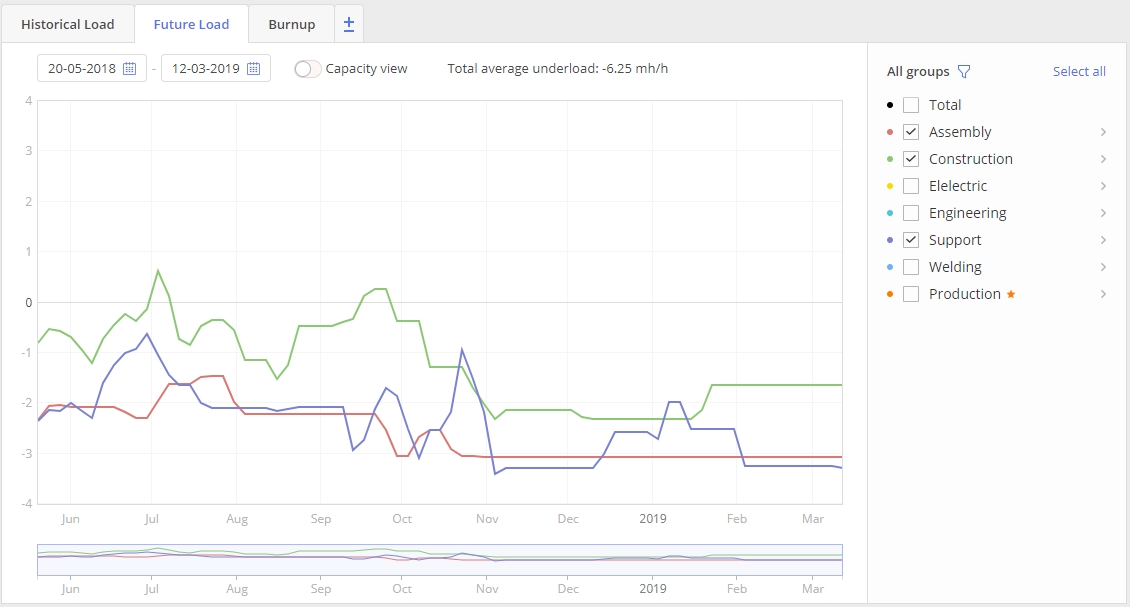
- Upfront overload prevention: Epicflow’s capacity planning tool shows employees’ workload in the future depending on their current tasks. Analyzing this graph, a resource manager can allocate resources in such a way that the team members won’t be overloaded.
Addressing challenge #2: Resource shortages.
First, it’s a typical challenge of fast-growing companies, where the number of projects is increasing, while hiring new employees takes more time. Secondly, due to shared resources, an employee or a resource group can be required for several projects at the same time, and assigning them to the highest priority projects will make them unavailable for the other ones.
Epicflow’s solution: Competence Management
Epicflow’s Competence Management functionality provides a resource manager with necessary information on team members’ skills, their level, capacity, and other attributes like location or previous experience. This makes the selection of required resources fast and effective, which is especially relevant for large organizations. Besides, this feature makes it easier for a resource manager to deal with siloed and distributed teams, and improves visibility of the resource allocation process. There’s also a resource allocation advisor that suggests a candidate to assign to a task.
Read more: How to Handle the Issue of Slow Recruitment with Resource Management Techniques
Addressing challenge #3: Resource conflicts.
Allocating resources when some of them are required for multiple projects simultaneously is a challenging task. Conflicting priorities, limited capacity, and overlapping project timelines often lead to overallocated employees, bottlenecks and delays, and reduced productivity.
Epicflow’s solutions
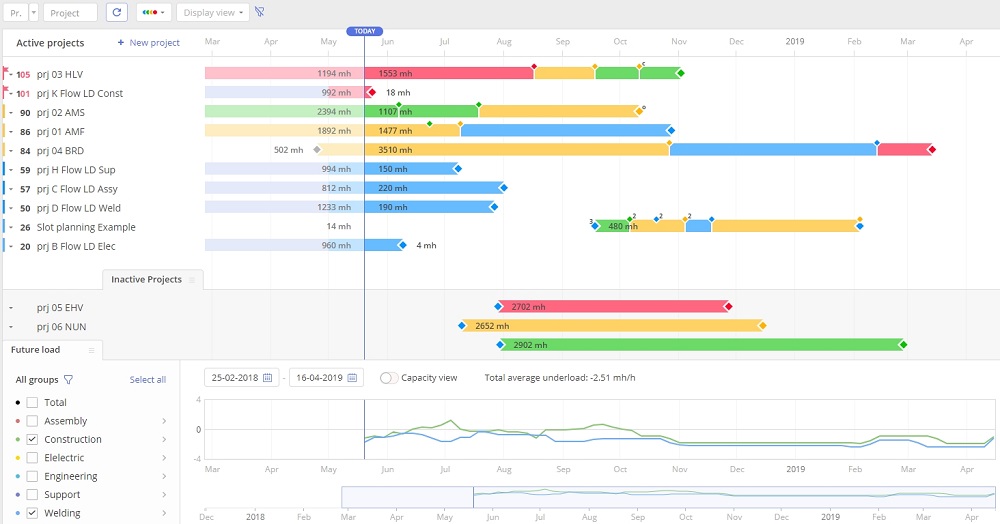
- Epicflow is designed for streamlining work in multi-project environments with a shared resource pool. This is why it eliminates the possibility of assigning the same employee to conflicting tasks. Being assigned to a task or a project, the resource is marked as unavailable in the system.
- Previously mentioned Competence Management also works like a resource allocation advisor, suggesting a resource who has required skills and capacity for completing a task.
- To make informed resource allocation decisions, a resource manager can perform scenario analysis that is available with the What-If Analysis feature: it allows you to change various parameters and see how they will affect the project outcomes and in such a way to come up with the most reasonable decisions to make the best of the available resources.
Read more: Resource Management Best Practices: 7 Tips to Consider
Addressing challenge #4. Limited visibility.
Resource managers often face limited visibility into essential data required for proper resource allocation and management: resource capacity, availability, and competencies. Without this data, it also becomes challenging to plan ahead, forecast demand, and make informed resource management decisions.
Epicflow’s solution
Epicflow provides end-to-end visibility into the entire resource pool with all necessary attributes and helps a resource manager quickly find required resources to assign to projects and tasks. In addition, its scenario analysis feature helps find an optimum resource distribution scenario, which assists in resource planning, allocation, and addressing bottlenecks.
If you’d like to explore the ways Epicflow can improve resource management processes in your organization, you can contact us and book a demo.
Conclusion
Resource managers play a key role in aligning people, skills, and capacity with project needs across multiple initiatives. They support project managers with resource planning, allocation, and conflict resolution to ensure efficient project execution.
To succeed, resource managers need strong managerial and analytical skills, a good understanding of project and human resource management, and the ability to work with resource management tools. Resource management software is essential for improving visibility, balancing capacity, and addressing resource management challenges effectively.
Frequently Asked Questions
What is a resource manager?
A resource manager plans, allocates, and optimizes resources across projects to ensure that teams have the right capacity and skills to meet project demand. They also help prevent resource conflicts and balance workloads as well as resolve bottlenecks to ensure seamless work on multiple projects.
What are the main responsibilities of a resource manager?
Resource manager roles and responsibilities include resource allocation, capacity planning, forecasting future resource needs, monitoring utilization, managing resource conflicts, and supporting project managers with resourcing decisions.
How does a resource manager differ from a project manager?
A project manager focuses on delivering a specific project on time and within budget, while a resource manager oversees shared resources across multiple projects to ensure their optimal utilization.
What skills does a resource manager need?
Key resource management skills include analytical thinking, prioritization, forecasting, communication, conflict resolution, and proficiency with resource management or capacity planning software.
When does an organization need a resource manager?
Organizations need a resource manager when they manage multiple concurrent projects, share resources across them, have resource conflicts, and face difficulties when balancing limited capacity with increasing demand.