10 PMO KPIs: Essential Metrics to Drive Project Portfolio Performance
 Victoria Sokolova
.
Updated
.
Project Management
.
22 mins READ
Victoria Sokolova
.
Updated
.
Project Management
.
22 mins READ
As business and project management become more and more complex, the requirements for PMOs also evolve. They should demonstrate their value to an organization. But how can you measure this value and evaluate the effectiveness of PMO work? What are scalable metrics in a PMO? Our article will help you figure them out.
Read further to learn more about KPIs for PMO, their importance, and how to track KPIs effectively.
What Are PMO KPIs?
PMO KPIs or Key Performance Indicators are values that help you assess PMO performance and effectiveness of its work. In particular, these indicators show how a PMO ensures strategic alignment, utilizes available resources and budget, whether or not it delivers the expected value to an organization, etc. There are dozens of different KPIs, but their choice depends on the goals of an organization, challenges it’s facing, projects it’s running, etc.
Why Track PMO KPIs?
Like with any other organizational units, companies need to understand whether their PMOs work effectively. This is the main reason for regular tracking of PMO KPIs. In addition to that, using PMO metrics provides a chance to assess the effectiveness of the project management processes running in a company. Let’s consider some more benefits of tracking these key performance indicators.
- Assessing the value delivered by a PMO: Using KPIs will demonstrate how a PMO contributes to successful project delivery, strategic alignment, effective resource utilization, etc.
- Detecting inefficiencies: Some KPIs help detect some inefficiencies in the project management processes, which in turn provides an opportunity to eliminate them and improve the situation.
- Tracking project performance: There are KPIs that show project performance, whether they are delivered on time, within budget, and comply with customers’ expectations.
- Supporting decision-making: KPIs provide valuable data that can be further used for making informed decisions regarding project prioritization, resource allocation, risk management, etc.
- Providing stakeholders with actionable insights: Using KPIs, you can create reports or dashboards that will provide stakeholders with clear evidence of current progress or possible challenges, which will contribute to more trust-based relationships with them.
Now that you understand “the why” of leveraging PMO KPIs, it’s time to discover how to choose the most appropriate indicators for assessing your PMO.
How to Select Relevant KPIs for Project Management Office: Key Factors to Consider
Ok, you’ve decided to use KPIs for assessing your PMO’s work. Now, you need to choose the ones that will be the most relevant for your organization. Choosing the right PMO metrics to track is critical for evaluating performance effectiveness and demonstrating the value of the project management office. Let’s consider some recommendations that will help you select the required metrics.
- Goals: Determine your organization’s business objectives and align the selected KPIs with them.
- Alignment: Make sure that the KPIs correspond to your organization’s strategic goals.
- Data accuracy: Choose KPIs for which you can collect accurate data.
- PMO maturity: Take into account the level of PMO maturity; in a newly formed PMO, the indicators to analyze will be different from a mature PMO.
- Simplicity: The PMO KPIs you’ll analyze should be simple and measurable; overly complex metrics can make your assessment less effective.
And now, we’ve come to the most important part of the article. Jump into the next section to discover the PMO KPI examples you can select for analysis.
Read more: A Quick Guide to Essential Project Management Metrics
10 Essential PMO KPIs to Track in 2025
1. Project success rate.
Project success means its delivery on time, within budget, within the defined scope, in line with customer expectations, and meeting the expected quality standards. In fact, these criteria may vary in different organizations for different projects. Project success rate helps assess the percentage of projects that were delivered successfully. To calculate this indicator, you can use the formula:

Using this metric, you can decide how successfully your PMO delivers projects and identify possible issues, or compare project performance over time.
2. Resource utilization.
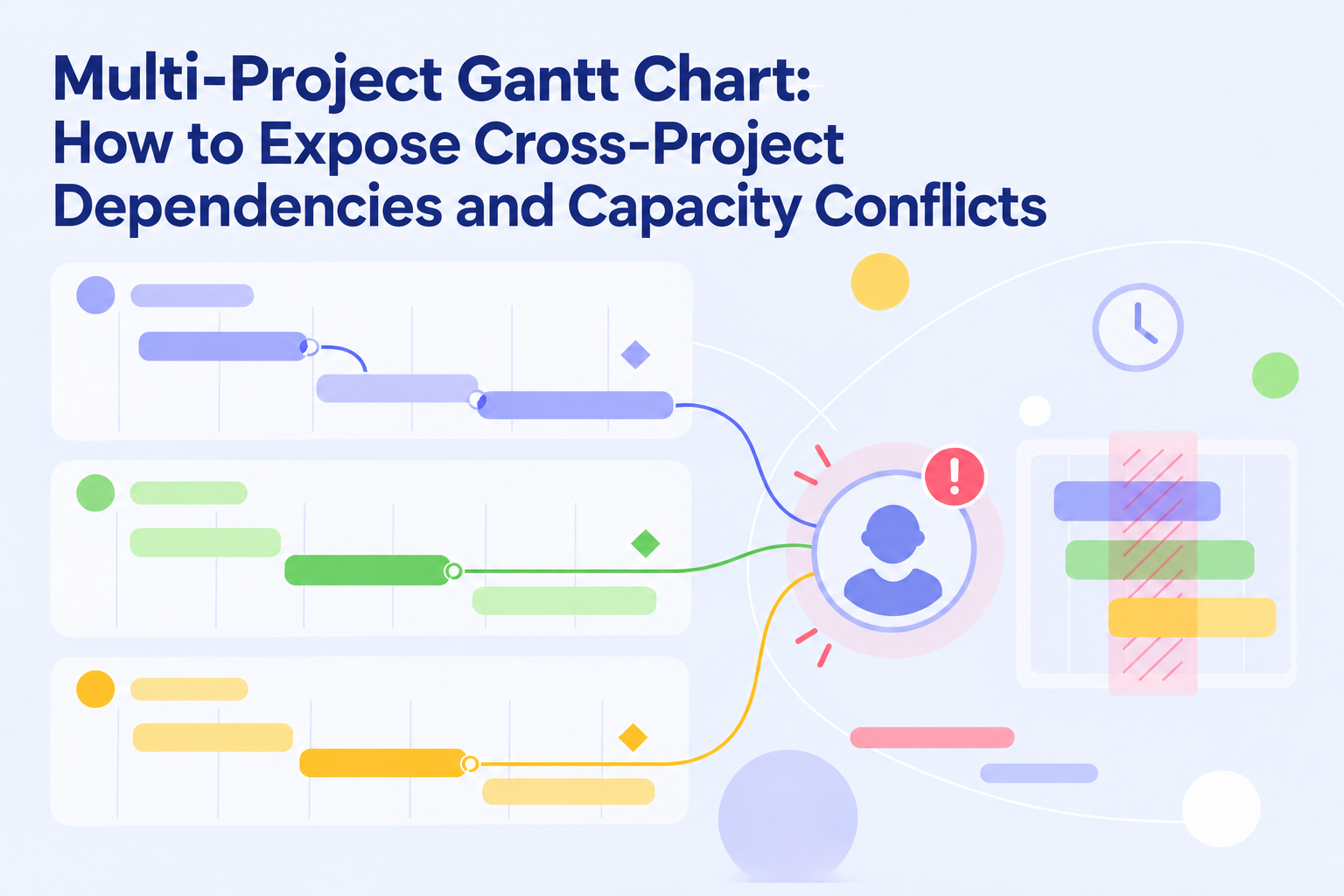
Resource utilization is one of the most important PMO metrics, especially when resources are shared by multiple projects. Efficient resource distribution and utilization eliminate the possibility of bottlenecks, which in turn reduces the risk of delays and cost overruns. Tracking resource utilization is critical for the following reasons:
- It increases team members’ efficiency;
- It reduces unnecessary expenditures;
- It keeps employees engaged and productive;
- It makes it possible to deliver more without increasing the headcount.
Overall utilization tracking is the key to resource efficiency and improved project outcomes.
3. Return on investment (ROI).
ROI shows the value generated by projects implemented by a project management office. ROI shows the difference between the costs invested in projects and the value gained upon their completion. It’s calculated with the following formula:

Why is it important for PMOs to track ROI? First, it helps determine project success in business terms – whether the project execution was worth the effort. Secondly, it supports strategic decision-making, e.g., stakeholders can determine which projects were worth the effort. Also, ROI can demonstrate the effectiveness of PMO’s work. Finally, it contributes to more effective resource utilization: e.g., you can determine what projects are expected to generate most value and assign limited resources to the highest-priority projects.
4. Budget variance.
This is a common and essential indicator used by project management offices. It shows the difference between the planned project budget and its actual costs. Obviously, the lower the difference, the better. Keeping track of this KPI will help you assess the effectiveness of your PMO’s budget management efforts and improve the effectiveness of financial control. If the variance is high, it indicates the need for corrective measures and more thorough control of project costs.
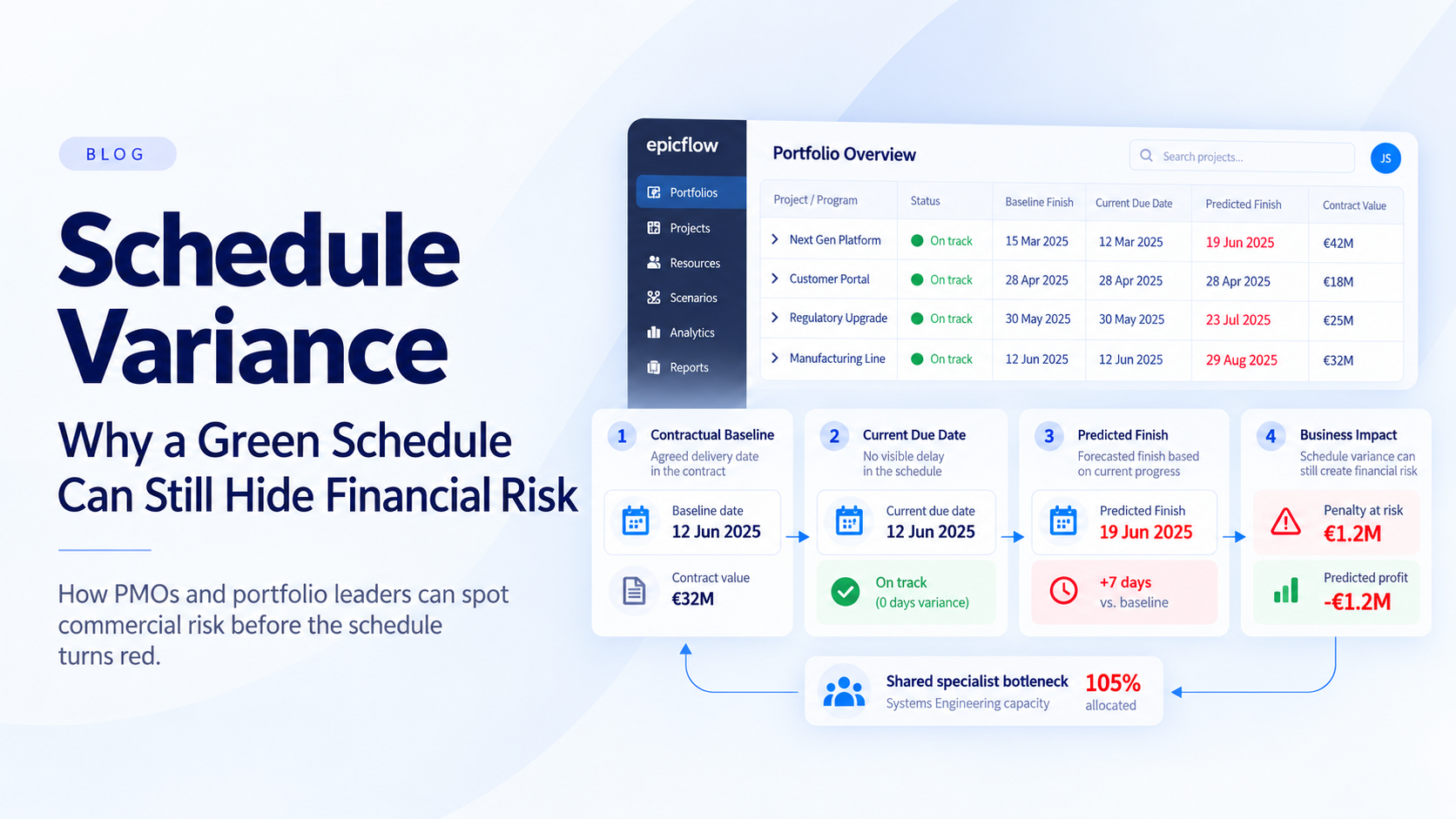
5. Schedule variance.
As the name suggests, this PMO KPI shows whether a project is ahead of or behind the approved schedule. You can calculate it with the following formula:
SV (Schedule Variance) = EV (Earned Value) – PV (Planned Value),
where Planned Value is the amount of work to be completed by a certain point in the schedule, and earned value indicates how much work has been actually completed.
This indicator helps PMOs assess projects’ progress and identify potential delays.
6. Strategic alignment KPIs.
This is one of the most essential KPI. It indicates how projects managed by a PMO contribute to organizational strategy execution. It shows that a PMO is not just focused on successful project delivery, but on completing the right projects for a company. For example, you can calculate the percentage of projects aligned with the strategy.
7. Benefits realization.
This metric helps organizations assess how a PMO delivers the expected benefits. It’s not enough to deliver projects on time and within budget; these projects should deliver benefits for an organization, e.g., increasing revenue or customer satisfaction, improving process efficiency, etc. To assess PMO benefits realization, organizations can track the percentage of projects that achieve the planned benefits, compare planned vs. actually achieved benefits, the number of benefits implemented within the given time, etc. Why is this metric important? It allows you to detect areas for improvement and contribute to achieving the intended by projects run by a PMO.
8. Risk response time.
This metric indicates a PMO’s flexibility and effectiveness in responding to and managing risks in projects. It can be calculated both for individual risks and on average across multiple projects. To calculate risk response time, you need to know the date of risk identification, the date of responding to it, risk type, and its severity (if needed). The shorter risk response time, the better. Long risk response time may indicate not only poor risk management, but also bottlenecks in decision-making.
9. Customer satisfaction and quality.
In addition to delivering value to an organization, project outcomes should of high quality, meet customers’ demand, and contribute to their satisfaction. This is also an indicator of PMO effectiveness: if customers are happy with what they have got, it demonstrates the ability of a PMO to govern project effectively. These metrics are obtained by conducting customers’ surveys and gathering stakeholder feedback.
10. PMO maturity.
And here comes the last PMO indicator in our overview, PMO maturity. It shows the level of PMO development and standardization. As a rule, it’s assessed and analyzed using specific PMO maturity models (PMO maturity cube, P3M3, etc.) that show different levels of PMO development. Evaluating PMO maturity helps organizations understand how this organizational unit performs compared to best practices, identify areas for improvement, and determine PMO’s actual role within an organization.
Examining the above-mentioned PMO KPI examples for measuring success and performance criteria will help organizations select their own metrics depending on their needs.
However, this list of PMO KPIs isn’t exhaustive. In the next section, we’d like to review the specific indicators to assess portfolio management efforts.
Project Portfolio Management Metrics: Supplementing PMO KPIs
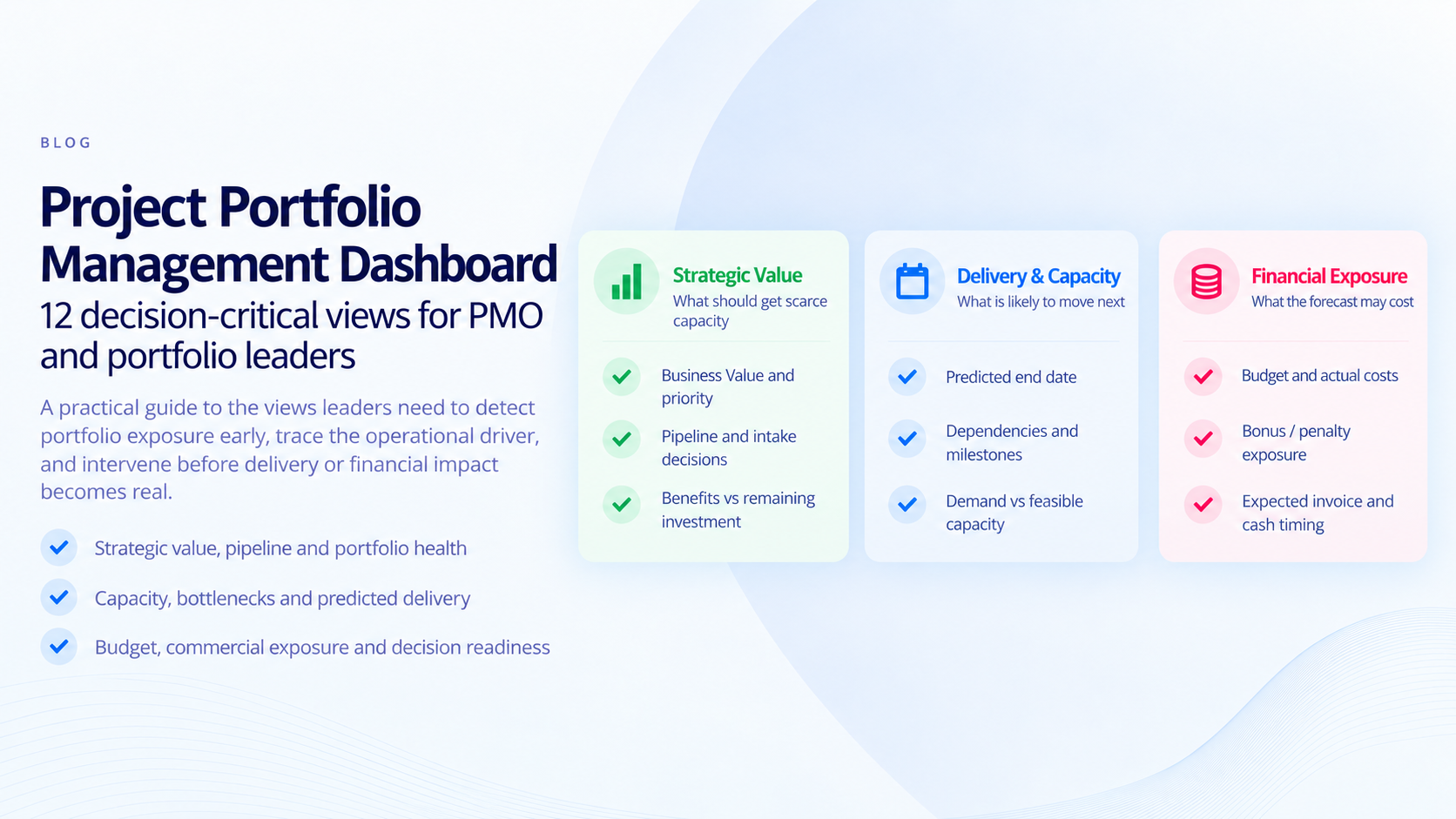
PMO KPIs mostly focus on tracking the execution of projects and programs and related aspects such as budget consumption, resource utilization, etc. Strategic aspects of PMOs’ work are evaluated for enterprise PMOs. In this case, PMO metrics will include ROI, strategic alignment KPIs, and benefits realization.
In other cases, PMO KPIs can be supplemented by project portfolio management KPIs that provide you with insight into the effectiveness of strategy execution and the value delivered by project portfolios.
We can group project portfolio management metrics used by PMOs into the following categories: financial, execution, operational efficiency, business value metrics. Let’s consider them with examples.
Financial metrics
These indicators show whether the project portfolio delivers the expected ROIs and delivers the expected financial value. The examples of financial PPM metrics include:
- Return on investment (ROI);
- Total cost of ownership;
- Benefit-cost ratio;
- Budget utilization.
Execution metrics
PPM execution metrics demonstrate the success of project delivery within the portfolio. Also, they help track performance, identify bottlenecks, and ensure that projects are on the right track.
Here are some examples of execution metrics:
- Milestone achievement rate;
- Project throughput;
- Issue resolution time;
- Project health index.
Tracking execution metrics also aims to minimize risks and make sure that projects within the portfolio don’t go off the rails.
Operational efficiency
In contrast to execution metrics that evaluate the performance of projects within the portfolio, operational efficiency metrics deal with the portfolio as a whole. In particular, these metrics assess how portfolio-level activities and resources are managed by an organization, help identify bottlenecks, and provide opportunities for improvements. What are the examples of these metrics?
- Resource utilization rate (portfolio level);
- Project ramp-up time;
- Project approval cycle time;
- Portfolio cycle time
Read more: How to Improve Operational Efficiency in Project-Based Organizations
Business value metrics
These indicators aim to evaluate how PPM process delivers value for an organization and aligns with its business goals. They don’t take into account delivering projects on time and within budget but show what outcomes these project deliver. As examples of business value metrics, we can mention the following ones:
- Strategic alignment score;
- Business value realization;
- Innovation index;
- Portfolio value.
Thus, KPIs for portfolio management will help you assess the state of your project portfolio from multiple perspectives, from process efficiency to the value it delivers to a business organization.
Now that you have several lists of KPIs, let’s consider how to use them for effective PMO assessment.
How to Track PMO KPIs Effectively?
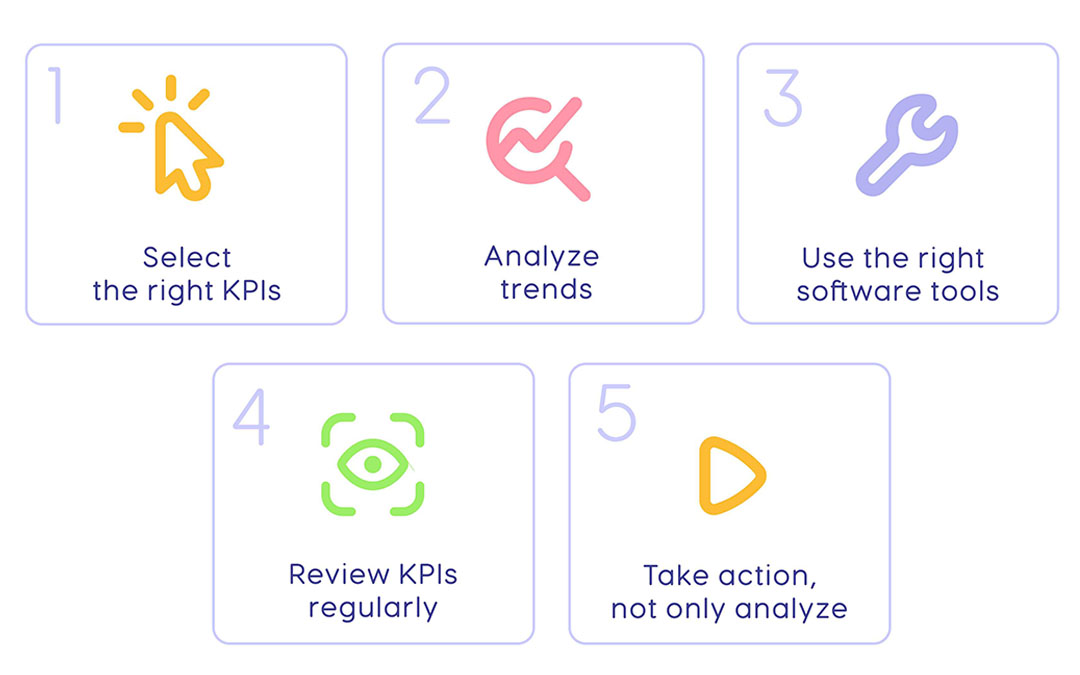
Effective tracking of PMO KPIs is more than just calculating formulas. It requires a structured approach, the use of specific tools, and stakeholders’ involvement. Here are some recommendations for actionable KPI tracking for project management offices.
Tip 1. Select the right KPIs.
As we stated earlier, among a great number of key performance indicators used by PMOs, you should select the ones that correspond to your specific needs as well as strategic and operational goals. They also should be measurable, understandable to stakeholders, and backed up with data.
Tip 2. Analyze trends.
It’s important to look beyond the numbers and identify trends and changes in the indicators you’re dealing with. These trends will help you make forecasts for future or adjustments of some current project or resource management processes.
Tip 3. Use the right software tools.
Leveraging PMO software will provide diverse opportunities for tracking KPIs for a PMO. For example, they give insight into resource utilization, budget consumption, project health, etc. In addition, these tools can visualize the data on dashboards, which makes tracking KPIs much easier. Finally, PMO software with predictive capabilities can make forecasts and analyze scenarios, which is really helpful for KPI analysis and further decision-making.
Tip 4. Review KPIs regularly.
It’s a good idea to establish the time intervals for KPI analysis and reporting, e.g., weekly, monthly, etc. Additionally, the dynamic project environment requires reviewing the existing KPIs and making adjustments to your tracking strategy, if required.
Tip 5. Take action, not only analyze.
Reviewing KPIs and making no adjustments makes no sense. KPIs should serve as grounds for making decisions on further actions, for example, reallocating resources, shifting priorities, optimizing processes, accepting risks, etc.
Tracking PMO Performance Metrics with Epicflow
It’s not a secret that PMOs use specific PMO software tools that provide them with a variety of insights and opportunities for streamlining their work and making decisions. Let’s see what indicators you can track using Epicflow, a multi-project resource management tool for PMOs.
1. Resource performance.
Wise resource management across multiple projects is Epicflow’s superpower. This is why it provides capabilities for tracking resource performance, which is the basis for the whole project environment’s health. Its Historical Load Graph will provide you with insights into resource output in relation to their capacity. This helps identify bottlenecks and assess the efficiency of shared resources.
2. Project environment’s health.
You can assess the state of the entire multi-project environment at a glance. Epicflow marks projects with colors depending on their state, so you can always see the big picture of the project portfolio’s health without performing complex operations.
3. Forecasted due date performance.
Epicflow can forecast the outcomes of your portfolio management efforts. For example, you can track how many projects are expected to be delivered on time vs with a delay, compare the projected number of days delayed with earlier delivery dates, assess the proportion of projects that are in red and in green, etc. This allows you to track portfolio performance from different angles and predict outcomes you can achieve.
4. Budget consumption.
Epicflow provides you with real-time insights into budget consumption. You can compare the budget planned vs. spent. Also, Epicflow can be integrated with other systems tracking financial performance, which enables multi-faceted control of financial metrics.
Final words
In conclusion, tracking PMO metrics is important for assessing and demonstrating the value of this organizational unit for a company. You can evaluate its performance, standardization, resource management, project delivery, strategic alignment, and other areas of its activities. You can use PMO tools or other software solutions that monitor various project, resource, and portfolio parameters and visualize them, e.g., provide PMO KPI dashboards. Effective tracking of PMO metrics and KPIs becomes grounds for reasonable decision making and ensuring that a project management office delivers the expected value to a company.
Frequently Asked Questions
What is PMO KPI?
PMO KPIs refer to key performance indicators used by project management offices. They show how effectively they support project delivery, ensure strategic alignment, optimize resources, and what value they deliver to an organization.
What are portfolio management KPIs?
Portfolio management KPIs are used to evaluate the performance, efficiency, and strategic alignment of a project portfolio. For example, companies can track financial, execution, business value, and operational efficiency metrics.
How to track PMO KPIs?
To track PMO KPIs effectively, you should first af all select the right KPIs for analysis, depending on your organization’s needs and areas you’re planning to evaluate. When analyzing the indicators, you need to identify trends, not just look at the numbers. It’s no less important to review the KPIs regularly and take action if required. Specific PMO software will help you analyze PMO KPIs efficiently.
What are examples of PMO KPIs?
Some PMO KPIs examples include project success rate, resource utilization, return on investment, benefits realization, PMO maturity, risk response time, and others.