PMO Implementation: 8 Steps to Set Up a Successful PMO
 Victoria Sokolova
.
June 14, 2026
.
Project Portfolio Management
.
27 mins READ
Victoria Sokolova
.
June 14, 2026
.
Project Portfolio Management
.
27 mins READ

The role of a project management office (PMO) in organizations is evolving now: it can become a strategic partner that drives organizational performance, improves decision-making, and ensures wise distribution of resources across projects. But achieving this kind of impact depends, to a great extent, on the right approach to PMO implementation: defining the purpose of PMO, selecting the right PMO type, establishing goals you’re planning to achieve, selecting PMO tools, etc. In addition, you should be aware of potential challenges you may encounter in the PMO setup process, from resistance to change to a lack of executives’ support.
To help you build a PMO that will deliver a measurable impact for your organization, this guide will provide you with everything you need to know, from implementation steps to best practices for long-term effective functioning.
Read further to gain a full understanding of how to set the right track for your PMO from the very beginning.
Key Takeaways:
- PMO implementation involves planning, determining the type and structure, role and responsibilities, approaches and tools for a PMO.
- There are three types of PMOs: supportive, controlling, and directive.
- The first step in PMO setup is assessing the current state of project management processes in the organization.
- PMOs provide PM processes’ oversight, optimize resources across projects, optimize decision-making, and improve project performance.
- The main challenges of building a PMO involve resistance to change, a lack of stakeholders’ support, a lack of resources, and sustaining value.
What Is PMO Implementation?
Project management office implementation is the process of setting up a project or portfolio management office in your organization. It involves planning, determining the structure, roles and responsibilities, approaches and tools to be used, and their adoption across the organization. Building a PMO from the ground up starts with assessing the current state of project management processes in your organization, identifying challenges and areas for improvement, and coming up with the main purpose of the would-be PMO. Then, you need to gain the executive’s sponsorship, determine the structure of this organizational unit, assign roles and responsibilities, and determine what tools will be used.
Types of PMOs and Their Role in PMO Implementation
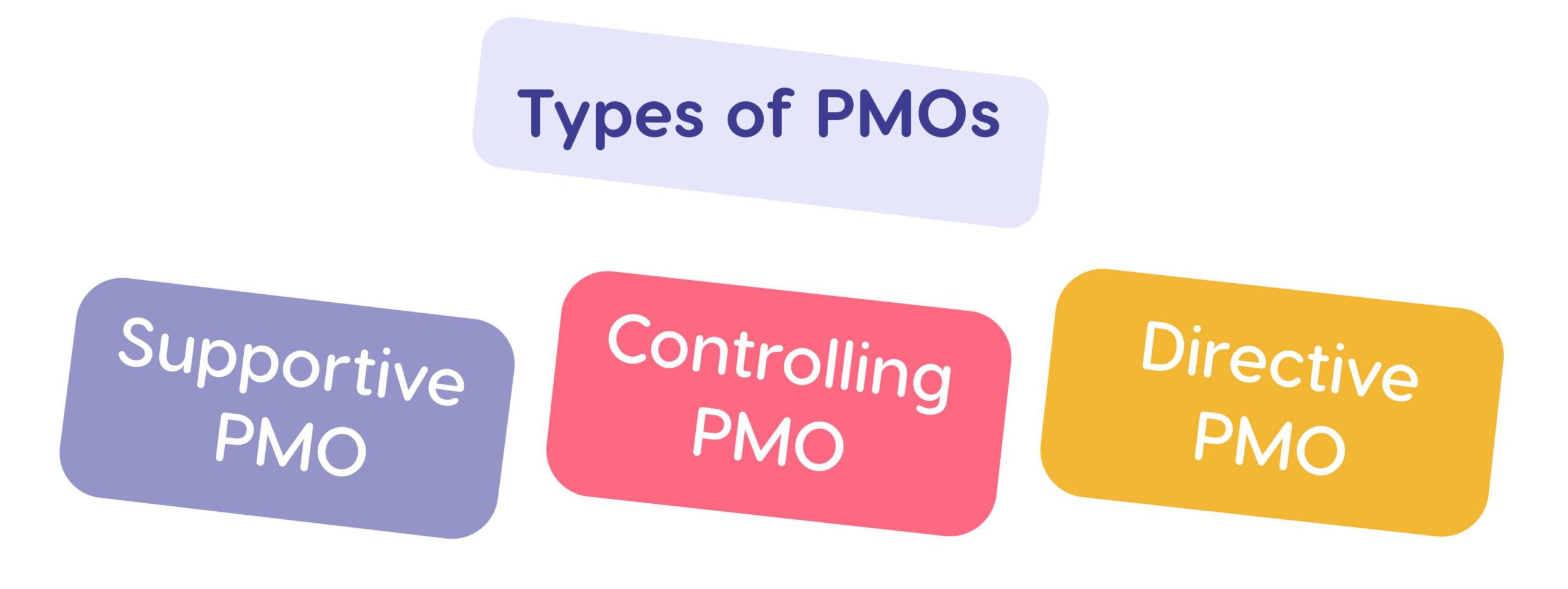
Before we answer the question how to start a PMO, let’s take a look at different types of this organizational unit. There are three main types of a project management office: supportive, controlling, and directive. All of them have different roles and levels of control, which will affect the implementation of a PMO. Let’s consider them in more detail.
Supportive PMO
Supportive PMOs provide guidance, templates, training, share best practices and knowledge, without changing the existing practices. As their role is mostly supportive, they have a low level of control, which means that it’s up to project managers to decide whether to adopt their recommendations.
When is it suitable to implement this kind of PMO? There are two options: in organizations new to project management so that they can test this format. The second variant is implementing a supportive PMO for companies with a high level of autonomy and project management maturity, which mostly need support.
Controlling PMO
You can establish PMO of this type to bring structure and enforce compliance with standards, methodologies, frameworks, and reporting requirements. They have a moderate level of control, which means that the project manager must follow certain processes and templates and adopt recommended tools.
A controlling PMO is suitable for organizations whose major issue is inconsistency of project management processes. Also, it may be required by companies looking for better governance and oversight.
Directive PMO
Directive PMOs have direct control over projects. They assign project managers, make resource decisions, and sometimes even run projects, which reduces flexibility for individual project managers. As you may guess from the name, they have a high level of control, and project managers report directly to the PMO. It’s advisable to implement a directive PMO in large organizations running complex high-risk projects or in companies where senior management wants maximum control and alignment with strategic goals.
Read more: PMO Maturity Models and Assessment: A Complete Guide
Why Do Organizations Need a PMO?
Organizations establish project management offices to manage their projects more effectively, ensure their alignment with organizational goals, optimize resource utilization, and ensure consistency across multiple projects. As a rule, PMOs exist in organizations in which multiple projects are managed by different departments. Let’s consider the detailed benefits organizations get from PMO’s work.
Standardization of project management processes
Without standardization, project managers may use different PM approaches, tools, and methods, which will lead to reduced efficiency and confusion. In contrast, PMOs provide all departments of an organization with common templates and standardized processes to ensure consistency across all projects.
Optimizing resource allocations
When managing multiple projects, it can be difficult to allocate resources evenly across multiple projects. Oftentimes, they can become overloaded or idle, which reduces their efficiency. So, one of the tasks of a PMO is to monitor resource allocation and ensure that the right people are available when needed.
Improving visibility and reporting
Project management offices provide diverse tools for comprehensive monitoring of projects’ vital signs, their progress, resource utilization, project and resource performance, etc. For these purposes, they use dashboards, KPIs, reports, and other tools that help them report to stakeholders and keep their finger on the pulse of the project environment’s state.
Facilitating strategic alignment
PMO helps to ensure that every project running in a company contributes to achieving its strategic objectives. This also helps companies avoid wasting time and effort on projects that will generate low value.
Improving project success rates
The State of PMO Report claims that high-performing PMOs show 59% improvement in the number of projects delivered on time compared to organizations with less mature PMO functions. Project management offices provide project oversight, optimize resource allocations, help manage risks, which in turn facilitates successful project delivery.
Value delivery
The role of a PMO is constantly evolving with time. Recently, more and more project management experts emphasize the need for shifting the PMO role from standardization and controlling to facilitating value delivery by an organization. Though the definition of value can be different across organizations (every company defines value differently), a PMO can become a powerful enabler of value creation.
In the next section, we’re going to analyze how to set up a successful PMO.
How to Set Up a Project Management Office (PMO): 8 Steps
The following steps outline how to set up a PMO. Despite the fact that this process will differ across organizations, you can rely on these steps as a basis of the process.
Step 1. Assessing the current state of an organization.
Before establishing a PMO, you need to understand how your organization manages projects currently. With this in mind, you should evaluate its current project management maturity as well as tools and processes used in the project management process. It’s also reasonable to identify the key challenges your organization faces when managing projects, e.g., poor prioritization, resource management challenges, inability to deliver projects on time, etc.
Step 2. Determining the would-be PMO’s purpose and objectives.
Organizations exploring how to establish a PMO should clarify the purpose it will serve. So, based on the above-mentioned analysis, you can determine the main goals of a project management office’s work, e.g., what problems it will solve and what value it will bring to the organization (improving visibility, process standardization, etc.). You can create a business case for a PMO in the same way you create one for projects; it will help you get senior stakeholders’ and executives’ buy-in. This will also define the type of a PMO – supportive, controlling, or directive.
Step 3. Gaining executives’ support.
Fruitful work of PMO will be impossible without support of senior executives. So, before proceeding with other steps of the project management office setup, make sure that your initiative will be supported. You need to create a persuasive case for PMO implementation – show the executives how a project management office can help achieve a company’s business goals, and what value it will bring. Focus on concrete outcomes, e.g., cost optimization, preventing project failures, increasing profitability.
Step 4. Determine the structure and governance of the would-be PMO.
At this stage, you should determine the place of a PMO in the organization’s structure. For example, it can be an enterprise PMO (EPMO), which will be responsible for overseeing all projects and programs within the organization, or a departmental PMO that will focus on managing projects within a business unit or department. Also, you need to determine the roles and responsibilities within a project management office: a PMO head, project and program managers, analysts, and methodology specialists. Finally, at this stage, you determine the governance model: whether a PMO will have decision-making authority and what reporting hierarchy will be.
Step 5. Develop PMO methodologies and tools.
One of the main purposes of a PMO is establishing standards, methodologies, and tools used throughout the organization or a department. This is why it’s essential to select them at the beginning to ensure consistency at once. Also, you should adopt PMO software that will provide you with end-to-end visibility, resource management functionality, dashboards for performance tracking, forecasting tools, etc. Finally, this stage involves determining KPI and PMO metrics, e.g., the percentage of projects delivered on time vs with a delay, resource utilization, value realization, etc.
Step 6. Create the PMO team.
The roles within a PMO will be different in organizations, depending on their size and the scale of a PMO itself (a project management office within an organizational unit will differ from the enterprise-wide PMO). Possible roles include a PMO director, program and project managers, project analysts, change control analysts, administrative staff, etc. When building the PMO team, you can hire external specialists or assign internal employees, provided that they’ve undergone specific training.
Step 7. Test the PMO implementation.
Before launching the PMO organization-wide or for all projects, it’s a good idea to test how it will work for a limited number of projects. You can monitor its performance, collect data on possible improvements, and gather feedback from managers and the team. This will help you take all specific nuances into account, which will make the real PMO implementation more successful.
Step 8. Monitor performance after organization-wide rollout.
It’s essential to keep track of PM performance regularly, relying on the criteria important for your organization or established KPI. Also, monitor value delivery so that the role of a PMO wouldn’t come down to formal box-ticking. Otherwise, this department will be perceived as overhead.
These were the main steps of establishing a PMO – a practical roadmap that will guide you to a high-performing and value-oriented project management office.
To sum up, here’s a PMO setup checklist:
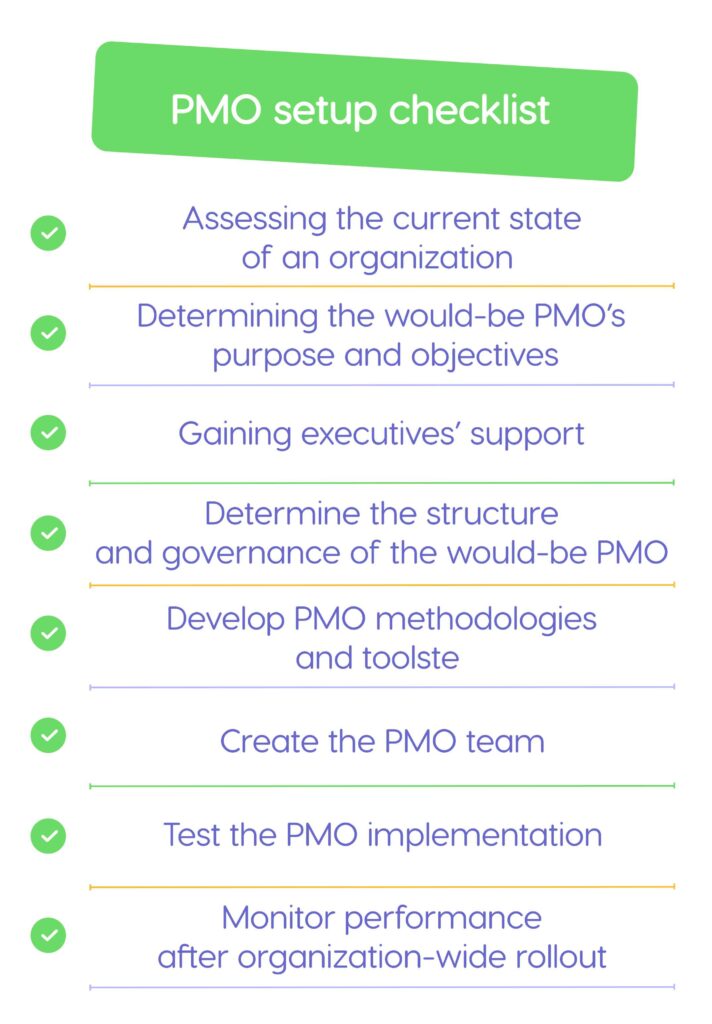
The process of PMO implementation can be accompanied with challenges. Let’s consider the most common of them.
Key Challenges in Establishing a PMO
1. A lack of executives’ support.
Despite the fact that senior leaders’ support is one of the main prerequisites for effective PMO work, in some organizations, it can be difficult to achieve. It can be caused by poor understanding of PMO business value and considering it a formal organizational unit. Poor communication and inability to explain PMO value are the other reasons why executives may not support PMO. Without strong support from the executives, PMO lacks authority, required funding, and is seen as an administrative layer rather than a value-driving organizational department.
2. Unclear purpose and strategy.
Sometimes, PMOs start without clearly defined purpose and scope, trying to manage all at once, from project delivery to portfolio strategy. This results in struggling to deliver measurable value to an organization, which in turn diminishes PMO authority in an organization. As a result, PMOs lack both executives’ support and lose authority among project teams.
3. Resistance to change.
Resistance to change can be explained by a couple of factors. First, teams can perceive the PMO as a bureaucratic organizational unit. In fact, in a great number of companies it has really become a formal and bureaucratic department. Secondly, establishing a PMO is a change, which will be naturally met with resistance. For example, some employees or teams can perceive it as a threat to their traditional ways of working, which can become a roadblock in the interaction between them and the PMO. Finally, resistance to change can be explained by uncertainty: when teams don’t understand how their work will change, how they will cooperate with the PMO, and what value it will bring to the organization.
Read more: Change Management Best Practices: Overcoming Pitfalls of Change Implementation
4. A lack of skilled resources.
One of the most common barriers to successful PMO implementation is a lack of skilled personnel able to execute PMO functions effectively. This can happen when a company assigns existing employees without providing them with required training. Leadership often doesn't want to increase headcount, so this approach to PMO staffing is rather common. This leads to reduced effectiveness and value of a PMO in an organization as well as poor project performance and resource utilization.
5. Bureaucratic processes.
One of the main goals of a PMO is to add structure and governance to project management processes across the organization. But very often, this structure and standardization turns into bureaucracy. This happens when this organizational unit focuses more on processes’ formality, documentation, approvals, one-size-fits-all approach, and doesn't pay enough attention to the value delivered by a PMO. This bureaucracy can result in endless approvals, slowing down work on projects, and poor quality of final outcomes.
6. Maintaining value for the organization.
Sustaining value over time can become a real challenge for a PMO. Unfortunately, many PMOs lose their relevance with time. Portfolio management experts emphasize the need for existing PMOs to evolve from formal organizational units to value-generating ones. Newly established PMOs should take these observations into account to maintain their relevance for the organization: effectively cooperate with executives, participate in decision making, and, most importantly, improve project performance.
Now, it’s time to review some recommendations that will help you overcome the challenges of PMO implementation and contribute to its effective functioning.
Best Practices for a Successful PMO Implementation
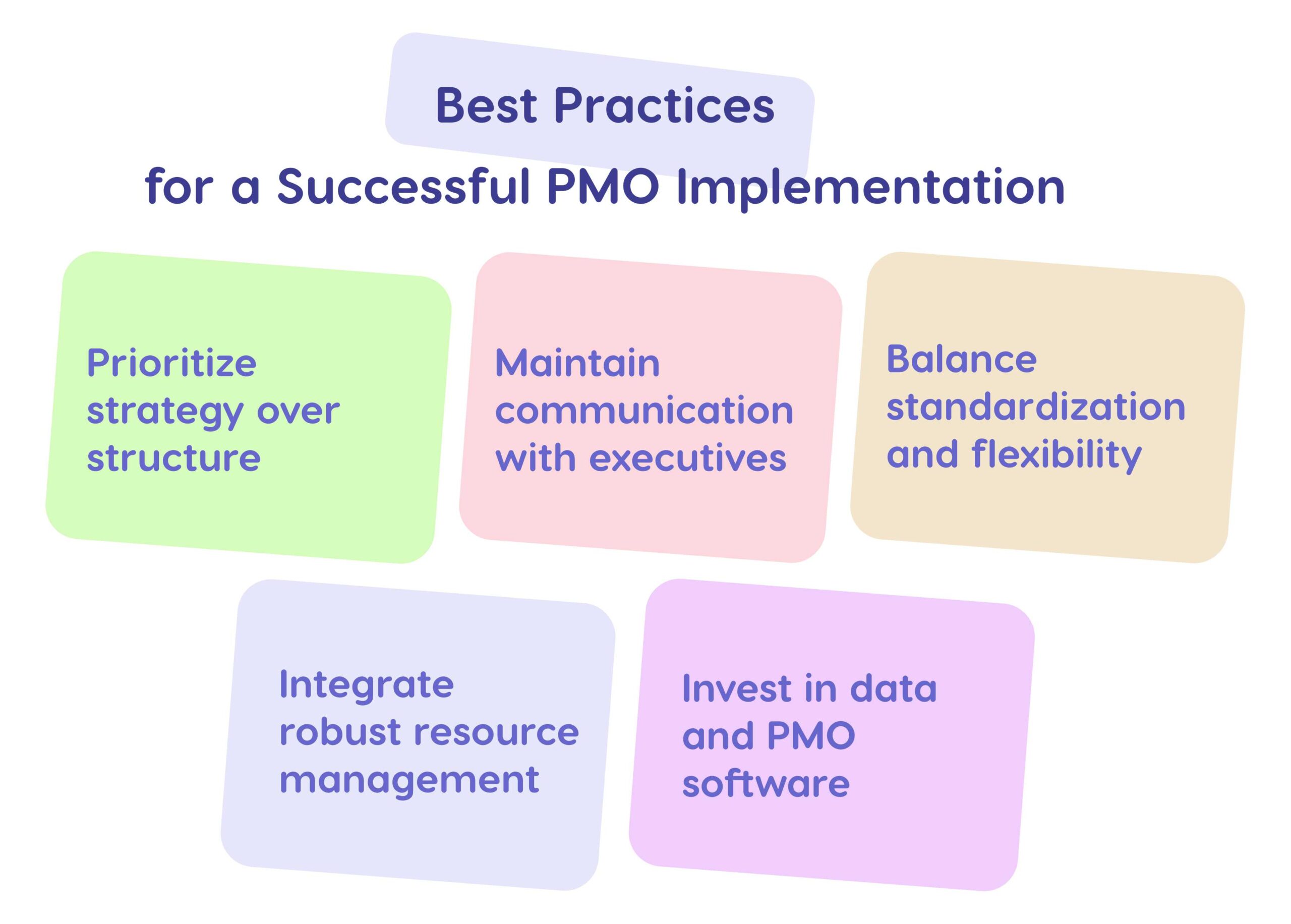
1. Prioritize strategy over structure.
Currently, we can observe the changing role of a PMO. Despite the fact that in many organizations it still exists as a controlling organizational unit, the shift towards value is inevitable to maintain PMO’s relevance. This means that before setting up a PMO, you should make sure that the would-be PMO will be aligned with your organization’s goals. For this, it’s important to tie PMO’s objectives to a company’s strategic goals and avoid implementing a generic PMO without taking into account organizational needs, goals, industry specifics, and project management maturity.
2. Maintain communication with executives.
Senior leaders’ support of a PMO is critically important for its successful functioning. First, you should find out their expectations of PMO work and what outcomes they are expecting to achieve. Second, keep them regularly updated: provide them with reports and regular updates. Third, it’s important to communicate value constantly: share the business impact of PMO functioning, e.g., saving costs, increasing sales, etc.
3. Balance standardization and flexibility.
We know that one of the main functions of a PMO in a company is establishing standards. It ensures consistency and is a must for projects with standardized workflows. But given the dynamic nature of current project environments, too much standardization can lead to rigidity and the inability to effectively address occurring changes and challenges. So, the right solution will be balancing standardization with flexibility.
4. Integrate robust resource management.
Giving proper attention to resource management can significantly increase project performance and the effectiveness of PMO’s work. To ensure effective resource management, PMOs should align available resources with project priorities, which will ensure that there are enough of them for the most important initiatives. Also, it’s critically important to track resource performance and utilization across projects; this will allow you to timely detect inefficiencies, prevent bottlenecks and bigger issues.
5. Invest in data and PMO software.
PMO software can become the PMO members’ reliable assistant in overseeing project management processes, managing resources, and ensuring value delivery. Here are some essential capabilities of PMO software:
- Providing visibility into all projects with their statuses, milestones, priorities, and deadlines.
- Keeping data on a company’s human and material resources: capacity, availability, competences, previous experience, location, etc.
- Advanced resource management capabilities: resource capacity planning, resource allocation, workload management, performance analysis.
- Forecasting bottlenecks and finding ways to eliminate them.
- Scenario analysis for informed decision-making.
- Providing AI-driven insights for portfolio optimization.
- Reporting.
All of the listed capabilities are available in Epicflow, AI-powered multi-project resource management tool perfectly suitable for diverse activities of a project management office. It provides PMO members with the necessary insights and capabilities for seamless work and value creation. Contact us to learn how Epicflow can empower your PMO to become the driver of high performance and achieving strategic goals.
Conclusion
When done right, starting a PMO can become a strategic investment that can significantly improve how organizations plan, executive, and deliver projects. To set up a PMO and ensure its effective work, it’s important to be aware of possible challenges you may face: resistance to change, too much bureaucracy, a lack of resources, and insufficient support of senior management. The success of a PMO also depends on its ability to deliver measurable value, adapt to evolving business needs, and support strategy execution.
Frequently Asked Questions
1. What is PMO implementation?
Setting up a PMO is the process of establishing a project management office in your organization. It includes planning, determining the structure of a PMO, assigning roles and responsibilities, developing approaches and tools to be used and their adoption across the organization.
3. How long does it take to build a PMO?
The timeline can vary from several months to a year. This depends on the number of factors: PMO type (supportive PMO takes less time compared to enterprise PMO), the maturity of current project management practices, organizational culture, size and complexity of projects and portfolios. Finally, creating a high-performing PMO is a rather ongoing process that requires continuous analysis and enhancements.
4. How to implement a PMO into your organization?
Knowing how to build a PMO means understanding the people, processes, and tools required to support it. Setting up a PMO from scratch involves the following steps:
- Assessing the current state of an organization.
- Determining PMO’s purpose and objectives.
- Gaining executives’ support.
- Determining the PMO’s structure and governance.
- Developing PMO methodologies and tools.
- Creating the PMO team.
- Testing the PMO implementation.
- Monitoring performance after organization-wide rollout.
5. What makes PMO implementation fail?
There can be the following causes of PMO failure: unclear purpose and objectives, a lack of executives’ support, poor change management, too much bureaucracy, a lack of measurable value of PMO work, and poor alignment with organizational strategy.
6. What makes a PMO successful in the long run?
Success of a PMO depends mostly on its ability to deliver value to an organization. In turn, this is achieved by ensuring transparency, executive support, clear roles and responsibilities, process efficiency, effective resource management, and demonstrating impact in the organization.
7. What are the main challenges of PMO implementation?
The main challenges of setting up a PMO include unclear PMO goals, resistance to change, a lack of executive sponsorship, shortages of skilled resources, too much bureaucracy, and inability to deliver value.
8. Should every organization implement a PMO?
No. PMOs are most effective for organizations running multiple concurrent projects, dealing with resource constraints, and those that require standardization and centralized oversight of project management processes.
9. How to create a PMO implementation plan?
A PMO implementation plan defines the structure, processes, timeline, responsibilities, and success criteria to set up a PMO from scratch. The PMO implementation plan example may include PMO charter, current state assessment, gap analysis, PMO structure and governance model, methodology and process framework, tools, team structure, PMO implementation roadmap, and KPIs.