

Project-driven cash flow forecasting for organizations that share specialists across projects
Cash Flow Forecasting Software Built Around Your Projects
Epicflow cash flow forecasting software puts every expected payment on the milestone that earns it, then dates that milestone from a schedule built around the people you actually have. Add your payment terms and you see what becomes invoiceable when, when cash is expected, and when the portfolio covers what the organization costs. Slip a milestone two weeks and watch break-even move.
Expected invoices and cash, derived from the schedule. Your ERP keeps the bank balance.


Why project cash flow forecasts drift from delivery reality
$400,000
Your cash forecast says the $400,000 commissioning milestone pays in June. That forecast is only as good as the date under it.
-
Three projects need the same two commissioning engineers in May, and only one can have them first.
The other two wait. Their acceptance slips, their invoices slip, and their cash slips with them, while payroll keeps running.
-
Add up each project's payment plan and the total quietly assumes every project gets its people when it needs them.
In a shared-resource portfolio, that never happens. A set of projects that looks cash-positive one by one can turn negative once they compete for the same team.
-
Finance usually learns this at month end, when the receipt does not arrive.
The PMO could have seen it weeks earlier, in the queue at the commissioning team.
The question is which commitment should move, and what that costs the rest of the portfolio. That takes the delivery plan and the payment schedule on one timeline.
What is project-driven cash flow forecasting?
Cash flow forecasting software estimates future inflows and outflows so a business can plan.
-
Starts from financial data
Most cash forecasting software starts from financial data: open invoices, orders, budgets and plan figures that someone maintains every cycle. And in many project tools, the "cash curve" is scheduled cost with a new label: no payments, no payment dates.
-
Starts from the work
Project-driven cash flow forecasting starts from the work. Epicflow predicts when each payment milestone can realistically be reached under your shared resource constraints, makes the payment invoiceable on that date, and applies your payment terms to give the expected cash date. The schedule is the forecast. When delivery moves, the forecast recalculates. Nobody re-types it.
Built for project-based organizations with shared resources
Epicflow fits when four conditions hold:
-

Payments are tied to delivery milestones
-

Several projects compete for the same specialists
-

Payment terms are known
-

Management can change priorities or move people
That describes
- Aerospace and defense programs
- Engineer-to-order manufacturers
- EPC contractors
- Machine builders
- Engineering services firms
- Telecom rollouts
Finance owns the expected payment timeline. The PMO and operations control the work that sets it. Epicflow gives both the same forecast, so the conversation moves from "why is the cash late" to "which move brings it back".
For bank balances, collections or reconciliation, pair it with cash flow software built for treasury.
How Epicflow cash flow forecasting software works
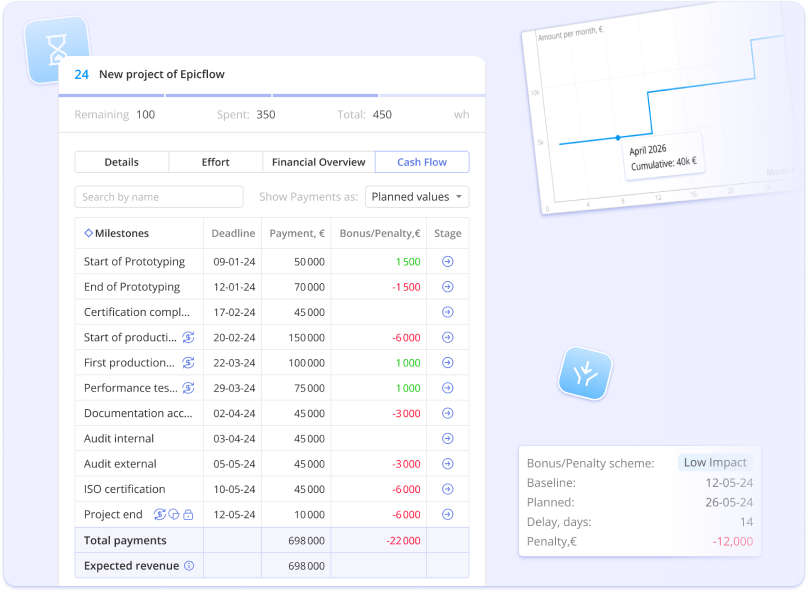
Each payment sits on a milestone in the project plan: a fixed amount, a percentage of contract value, or the remaining amount of the contract. Recurring monthly payments, such as service or after-care fees, start from a milestone. If the contract carries a bonus or penalty scheme, the predicted bonus or penalty lands on the milestone that pays.
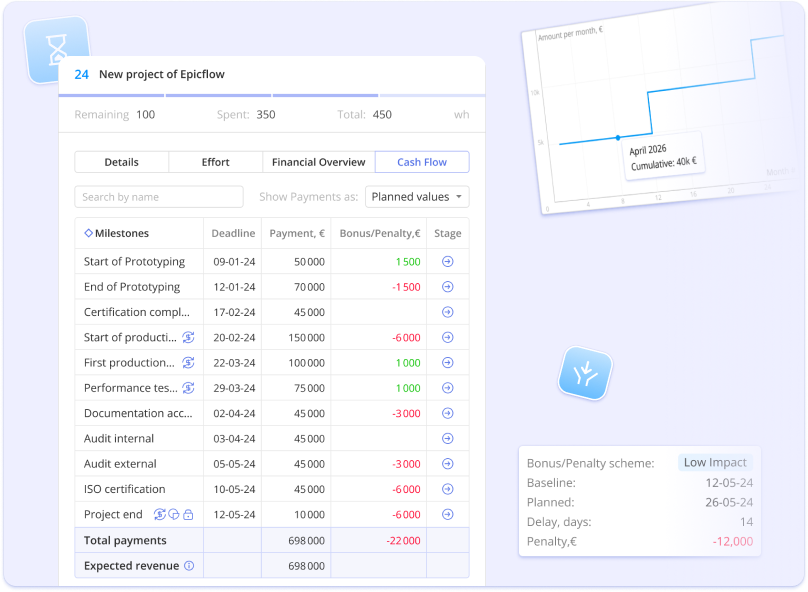
Epicflow predicts milestone dates from the work itself: effort, dependencies, progress, priorities, and the availability and skills of people shared across every project. The date is calculated, not promised, and it changes the moment its inputs do.
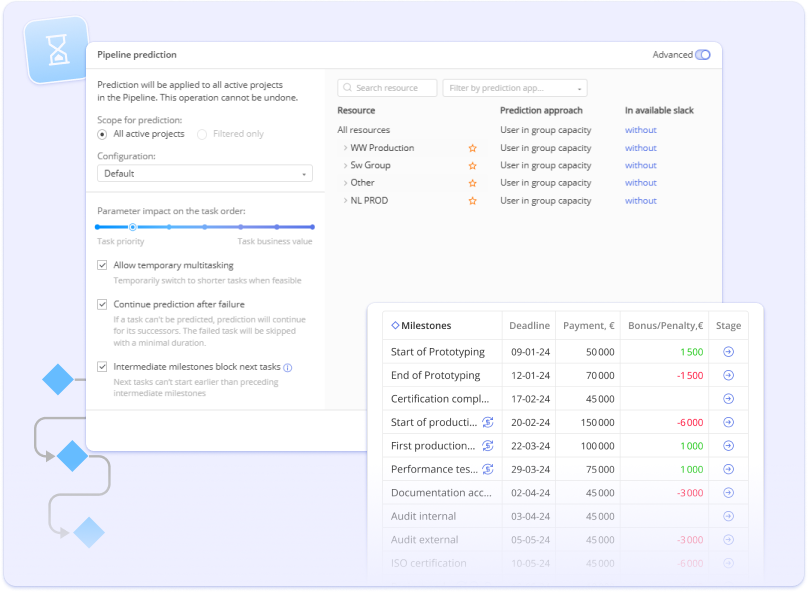
Switch between two bases. Invoice places each payment on its predicted milestone date. Cash adds your payment terms, set for the company and adjustable per project or project group. Every payment shows whether it is ready to invoice.
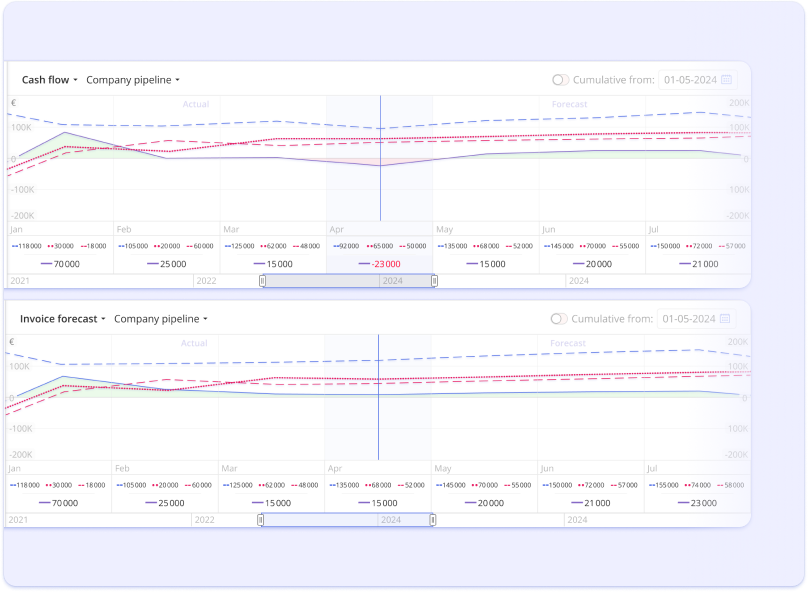
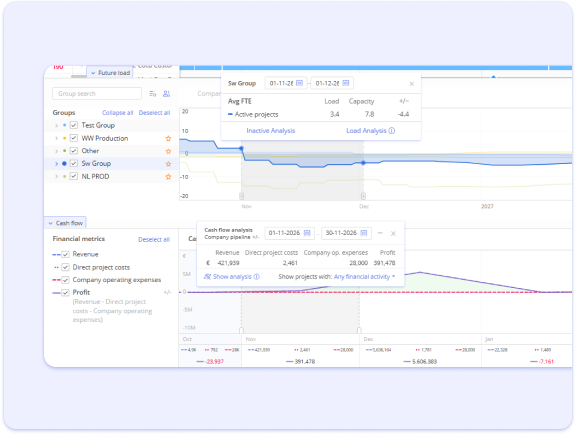
Each project shows its own milestones, payments, bonus or penalty and invoice stage. The portfolio view shows revenue, direct project costs, and the cost of capacity and overhead over time. Nothing is spread across projects. A project carries only its own money, and the cost of the organization stands as one line at portfolio level.
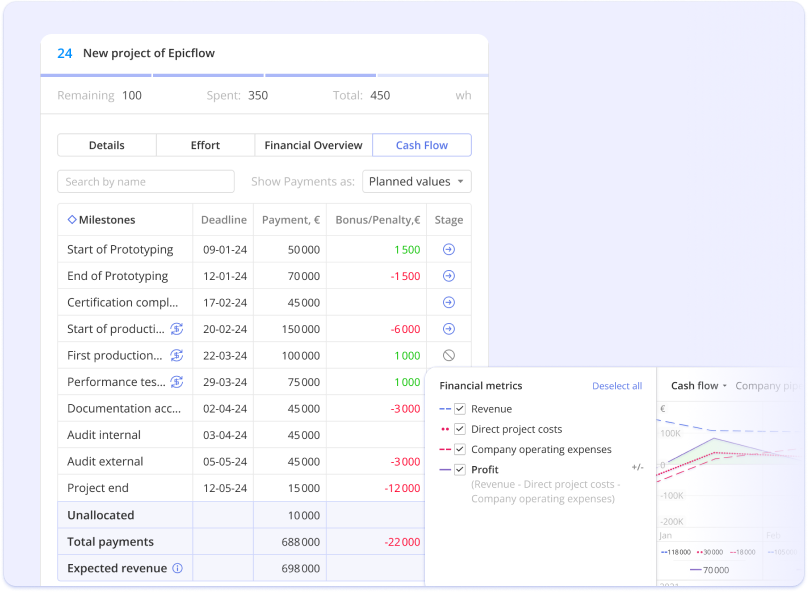
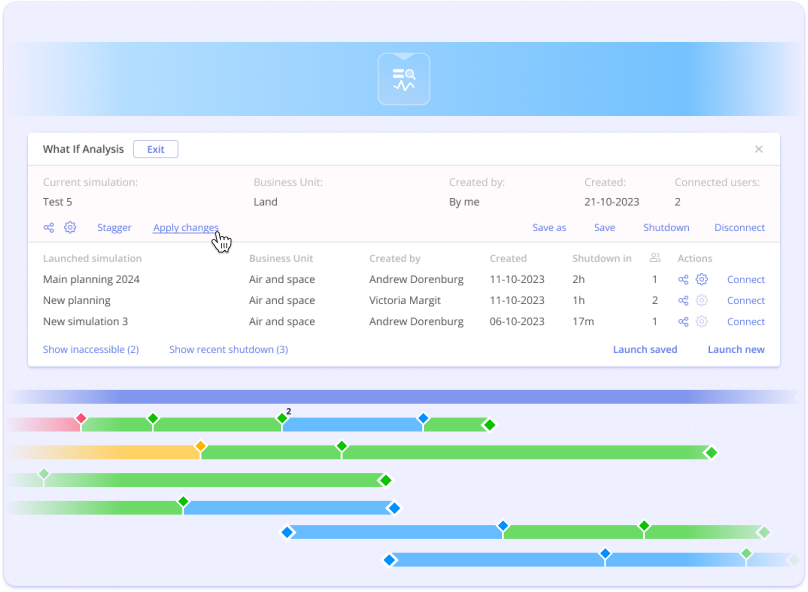
Model a different sequence or a reassigned specialist in What If analysis, or let the Epicflow Portfolio Optimizer propose alternatives under your capacity constraints. In What If analysis, compare expected cash, milestone by milestone and month by month, against the current plan, and see which other projects pay for the change. Management chooses.
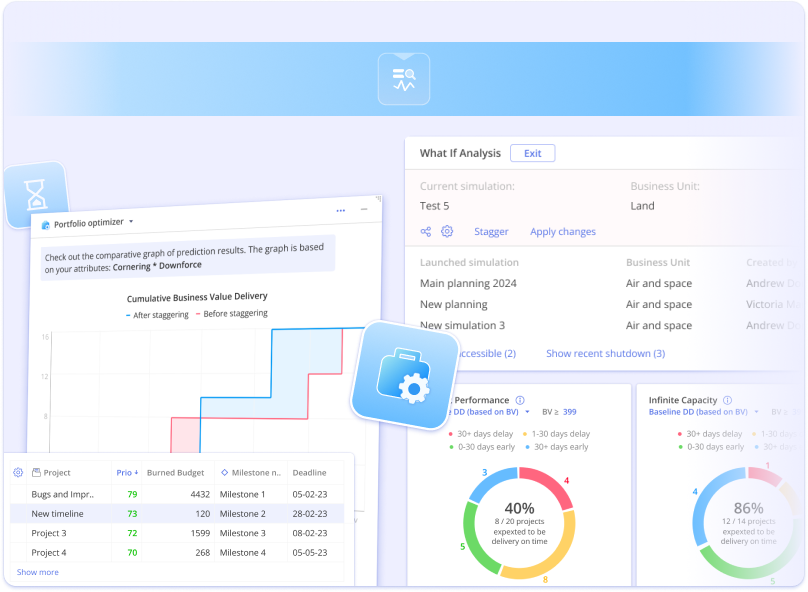
Apply the chosen plan and the cash flow forecast follows the new dates. As progress is reported, it keeps following the work. There is no monthly spreadsheet to rebuild.
See payment timing and capacity on the same timeline
Planners already read Epicflow's future load graph: demand against the capacity you have. The cash flow view reads the same way. In the load graph, the reference line is capacity. In the cash flow view, it is what that capacity costs each month. Above the line, the portfolio earns more than the organization costs. Below it, it does not. Hours and dollars, one picture.
What you can inspect, and the decision each answers:
-
The milestone that pays.
When parallel work competes for a scarce team, you see which task releases an invoice.
What should the team work on first?
-
Invoice and cash dates, separately.
The invoice basis is your leading indicator, one payment term earlier.
Where will cash be tight next quarter?
-
Project and portfolio views.
One project's own money, or everything against the cost of the organization.
Is this a project problem or a portfolio problem?
-
Break-even that moves with the schedule.
Idle capacity shows up ahead of time, as months below the line.
Do we act now or accept the slip?
What happens to expected cash when a milestone slips?
Illustrative example with an assumed 30-calendar-day payment term, invoicing on readiness.
-
Milestone payment
$50,000
-
Expected cash date
May 31 → June 14
-
Change in expected timing
14 days later
| Parameter | Baseline | Delayed |
|---|---|---|
| Milestone payment | $50,000 | $50,000 |
| Forecast milestone completion and invoice readiness | May 1, 2027 | May 15, 2027 |
| Assumed payment term | 30 calendar days | 30 calendar days |
| Expected cash date | May 31, 2027 | June 14, 2027 |
| Change in expected timing | Baseline | 14 days later |
A $50,000 milestone is forecast to be ready for invoicing on May 1. With a 30-day term, cash is expected on May 31. A shared specialist is needed on another project first, and readiness moves to May 15. The expected cash date moves to June 14. The payment is still $50,000. Nothing is lost; it arrives two weeks later, and the team's salaries for those two weeks are already spent.
Before choosing a fix, look at the constrained work behind the date. The cheapest fix is often in another project.
Test portfolio decisions before you commit
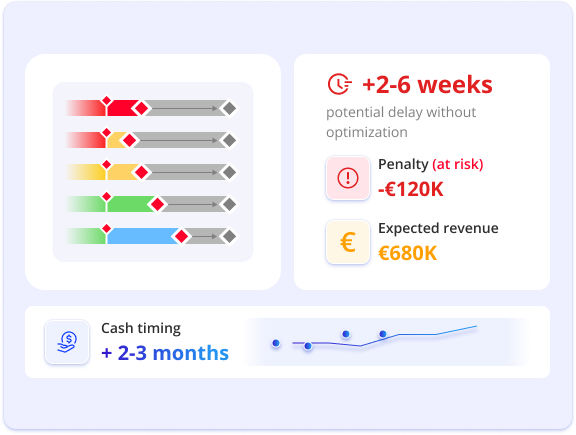
When a paying milestone is at risk, three moves are worth testing:
-
Change the sequence
-
Move a scarce specialist
-
Start fewer projects at once so the running ones finish sooner
Each has a price somewhere else, and What If analysis shows it in expected cash before anyone moves.
Manage your projects as investments. Make every portfolio decision a financial one.
Take two projects sharing one specialist, both on 30-day terms. Project A has a $50,000 milestone, Project B an $80,000 one.
-
Today A goes first
$50,000 is expected in May and $80,000 in June.
-
Swap the order
B's $80,000 arrives in May while A's $50,000 moves to June.
$30,000
May improves by $30,000. The total stays $130,000. That is timing, not extra profit. Whether the swap is right depends on A's delivery commitment, its penalty clause and the other projects that need the same person.
When two projects compete for the same scarce hour, the one that brings cash in sooner can deserve it, even at equal total profit. And once the overload is gone, speed becomes a choice: concentrate people on your most valuable project and its cash arrives earlier, bonus included. Used as cash flow planning software, Epicflow lets you test portfolio scenarios or have the Epicflow Portfolio Optimizer propose sequences. Management picks the trade-off.
Prioritize the remaining investment
Cash timing answers when. A second question answers whether: is finishing this project still worth what is left to spend on it? Epicflow compares what a project still has to earn with what it still needs, so the next scarce hour goes where the rest of the spend buys the most. Money already spent does not decide it. If you want the technical names: the product calls this figure RRI, Return on Remaining Investment, and the price it puts on each week of delay is what Stephen Devaux called drag cost.
Which cash flow forecasting approach fits your business?
| Criterion | Spreadsheet model | Accounting or treasury forecast | Epicflow project-driven forecast |
|---|---|---|---|
| Source of dates | Analyst-maintained dates | Financial data and plan items | Predicted milestone dates from the portfolio schedule, plus payment terms |
| When shared capacity changes | Someone revises dates and formulas | Depends on which operational data is connected | The schedule recalculates and expected payments move with it |
| Far end of the forecast | Maintained by hand | Plan items re-entered each cycle | Computed from the predicted schedule |
| Planning alternatives | Depend on model upkeep | Financial scenarios | Sequence and staffing alternatives, with their cash consequence |
| Main question answered | Can we keep this model reliable? | What does financial data imply for liquidity? | Which delivery decision brings expected cash forward, and at whose expense? |
| Actual receipts | Imported by hand | Part of the finance workflow | Stay in accounting, ERP or treasury |
Spreadsheets and financial platforms can include project drivers, and many forecast years ahead. The difference is the source and behavior of the dates: a maintained plan, or a computed consequence of the schedule that re-forecasts when reality moves. Most finance forecasting takes a feed from projects. Epicflow works on the decisions that create that feed.
Five checks for any cash flow forecasting tools you evaluate:
- What makes a payment invoiceable
- Whether shared capacity sets delivery dates
- Which payment assumptions are visible
- How a scenario affects other commitments
- How the chosen alternative gets back into execution
A cash flow forecast software demo that cannot show all five is answering a different question.
What data drives the forecast and what remains in your ERP?
-
What data drives the forecast
The forecast runs on data your project organization already keeps: project and milestone plans, effort estimates and dependencies, people's availability and skills, progress, payment values and payment terms. On the cost side, it uses people's monthly cost and direct costs such as materials, visible only to users with financial permissions.
-
What remains in your ERP
Finance will recognize the logic. It is a contribution view: revenue minus direct costs per project, with the cost of capacity and overhead held at portfolio level instead of spread by rates. Your ERP keeps the ledger, invoicing, collections, reconciliation and confirmed receipts. Epicflow books nothing. It is the steering view on top of the schedule.
Product scope, pricing, and availability
| Field | Epicflow |
|---|---|
| Best fit | Project portfolios with shared specialists and milestone-linked payments |
| Forecast basis | Predicted milestone dates under resource constraints, plus payment terms |
| Views | Project and portfolio cash flow; Invoice or Cash basis |
| Payment types | Fixed amount, percentage of contract value, remaining amount, recurring monthly; bonus or penalty on the paying milestone |
| Cost side | Monthly cost of people as one portfolio line; direct costs such as materials; nothing spread across projects |
| Horizon | Monthly, across your full planning horizon |
| Scenarios | What If analysis, with expected cash per alternative; Epicflow Portfolio Optimizer proposes sequences |
| Works alongside | Your ERP, accounting and treasury systems |
| Pricing | Platform plans on the Epicflow pricing page |
Evidence behind the planning engine
A cash forecast built on schedule dates is only as good as those dates. Epicflow's date engine has a measured track record: KPN raised due-date performance from 18% to 80% with Epicflow's planning approach. Dates that hold are payments that arrive when the forecast says.
-

due-date performance
Start with your portfolio and payment milestones
See how your delivery plan changes expected cash
Bring a milestone-based project example. We will show how your capacity, milestone dates and payment terms set expected payment timing, and what one portfolio alternative would move.
Start with one project whose payments depend on milestones and whose team is shared with other work. Add its payments and terms, compare the forecast with what Finance expects, then test one realistic alternative and see what it moves elsewhere. Bring a representative milestone and payment rule to the demo.
Cash flow forecasting software FAQs
What is cash flow forecasting software?
Cash flow forecasting software, sometimes called cash flow projection software, estimates future inflows and outflows to support planning. Epicflow takes the project-driven route: expected payment timing follows predicted milestone dates, calculated from the portfolio schedule and the people available, plus your payment terms.
How does Epicflow forecast project cash flow?
Payments sit on milestones. The schedule predicts when each milestone can be reached under shared resource constraints. The invoice basis shows when a payment becomes invoiceable; the cash basis adds payment terms.
Does Epicflow track bank receipts or replace accounting software?
No. It forecasts invoiceable value and expected cash. Collections, reconciliation and confirmed receipts stay in your accounting, ERP or treasury system.
What happens to the forecast when a milestone is delayed?
When progress, priorities or capacity move a milestone, its payment moves with it, including any bonus or penalty the delay triggers. Review the whole portfolio: the fix for one late payment often delays another.
Can I compare a resource or priority decision before committing?
Yes. In What If analysis, compare a different sequence or staffing choice against the current plan and see expected cash per milestone and per month, plus which other projects move.
What does AI do in this workflow?
The Epicflow Portfolio Optimizer proposes portfolio sequences under your capacity constraints and shows their consequences. It proposes; your management team decides.
Why does cash flow forecasting in project management need resource data?
In a shared-resource portfolio, the date a milestone is reached depends on who is free to do the work. A forecast that ignores the queue at a scarce team puts payments on dates the team cannot meet.
How should a project business choose a cash flow forecasting tool?
Check where payment dates come from, how shared capacity is handled, which assumptions are visible, how scenarios affect other commitments and how decisions return to execution. For bank balances or collections, add a cash flow forecasting solution built for treasury.