Engineering Capacity Planning for Hardware and R&D Teams
 Victoria Sokolova
.
Published
.
Project Portfolio Management
.
27 mins READ
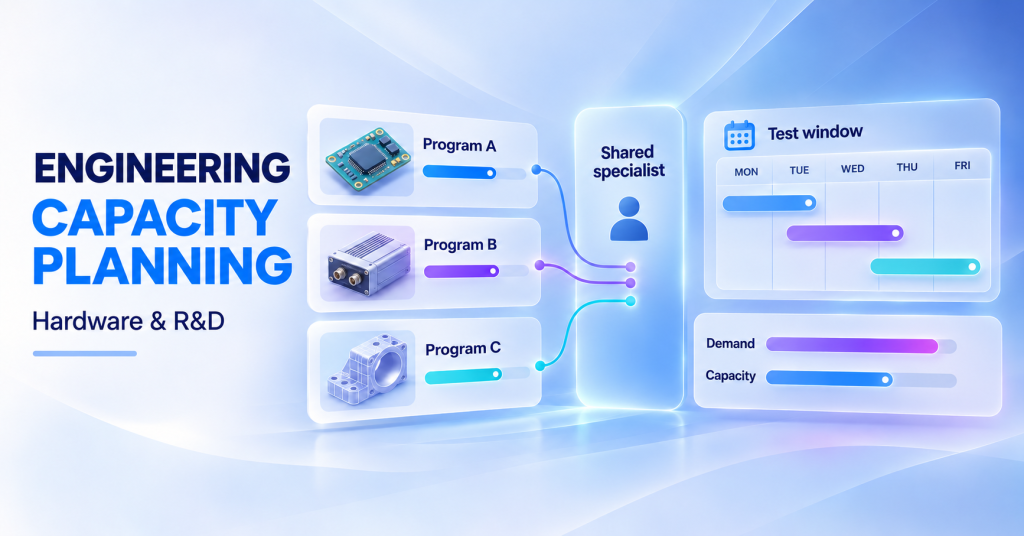
Three concurrent hardware programs can show a green, fully resourced status on an executive headcount dashboard and still be heading for the same bottleneck. The roster looks sufficient, but all three depend on the same RF design specialist or the same external qualification window.
Engineering capacity planning is the practice of mapping forecast project demand against actual net availability by specific competency and time window. Rather than relying on aggregate utilization, this process exposes skill gaps and external constraints well before delivery commitments are finalized.
This guide provides engineering capacity planning best practices to help hardware and R&D leaders capture true portfolio demand, evaluate availability across tight skill sets and physical test calendars, test response scenarios, and decide what to sequence or adjust before signing off on new commitments.
What engineering capacity planning means for hardware and R&D teams
In hardware development, engineering capacity planning has two boundaries that generic definitions skip. It covers more than headcount, and it does not cover the factory floor.
Project engineering capacity is not factory production capacity.
Separate project engineering capacity from shop-floor manufacturing operations. This planning framework focuses entirely on the availability of engineering personnel, specialized skills, and development workflows across concurrent initiatives. Machine run-rates, factory floor scheduling, production line balancing, material availability, and Manufacturing Resource Planning (MRP/ERP/MES) are distinct operational disciplines handled by separate systems and teams. Confusing engineering problem-solving with assembly-line throughput produces commitments the team cannot meet.
Capacity includes more than headcount.
A simple headcount roster cannot tell you whether a hardware portfolio is executable. True hardware development capacity covers non-fungible competencies, cross-functional engineering squads, dedicated test benches, internal laboratories, external certification and regulatory audit slots, and supplier or contract manufacturer (CM) turnaround times. Not all of these live inside a project management calendar: environmental chambers and third-party test agencies follow their own booking rules and owners. Capacity planning for engineering teams requires mapping human skill availability alongside these external time constraints to build an honest forecast.
Why hardware engineering capacity plans fail
Hardware capacity plans fail when leadership treats engineering work as generic and interchangeable. The four failure modes below show where that assumption breaks.
Skills are not interchangeable.
A common failure mode is assuming that any engineer within a broad discipline can execute any task. A hardware team cannot simply assign an embedded systems engineer to solve an optical transceiver layout problem or reassign a mechanical packaging lead to structural thermal analysis. If a project requires a rare qualification, that work must be assigned to that specific competency, not absorbed into an aggregate "hardware engineering" pool.
Shared equipment and external slots sit outside the project plan.
Engineering schedules fail when physical assets and outside services are omitted from capacity calculations. Environmental stress chambers and hardware-in-the-loop (HIL) simulators represent fixed physical limits. Slots at third-party testing labs or certification agencies are hard constraints controlled by outside calendar owners. If those assets are booked or unavailable, human engineering hours stall, regardless of staff availability.
Changes shift demand across several projects.
In hardware programs, changes rarely stay isolated. An engineering change order (ECO) or an extended design review on Program A pulls specialists away from Program B. The delay cascades into adjacent milestones and can push programs past pre-reserved external testing windows that are hard to rebook.
A static plan treats tentative work as committed or ignores it.
Capacity forecasting struggles when organizations fail to separate project certainty tiers. Static planning either includes every early concept as a committed drain on specialist capacity or ignores tentative projects entirely until they suddenly materialize. Engineering teams must clearly delineate approved, likely, and exploratory demand using organizational inclusion thresholds rather than relying on arbitrary percentage probabilities.
What to map before you forecast capacity
Collect four inputs before you run any portfolio-wide calculation. The seven-step process below shows how to use them.
Project demand by phase, skill and time bucket.
For every work package, capture the required competency, an effort range (low, likely, high), the execution window, dependencies and a confidence score. Weekly or monthly buckets reveal demand peaks that quarterly estimates hide.
Net capacity, not roster size.
Record available hours per competency after leave, overhead, support duties and work already underway, never gross headcount. State any contingency or productivity factor as a team-specific assumption. Step 4 below shows the calculation.
Non-person constraints.
List the shared test equipment, simulation clusters, environmental chambers, third-party lab slots and contract manufacturer windows that limit throughput. Give each one a named calendar owner and a last-verified date.
One register for planning assumptions.
Write down the decision horizon, the update cadence, the unit of measure (engineering hours or person-weeks), the confidence threshold a tentative project needs to enter the baseline, and the owner of every estimate. One shared set of rules keeps the engineering capacity planning baseline consistent and avoids false precision.
Read More: Resource Capacity Planning: What, Why, and How
A seven-step engineering capacity planning process
Effective capacity planning in a hardware portfolio comes down to seven steps, run before new commitments are locked in.
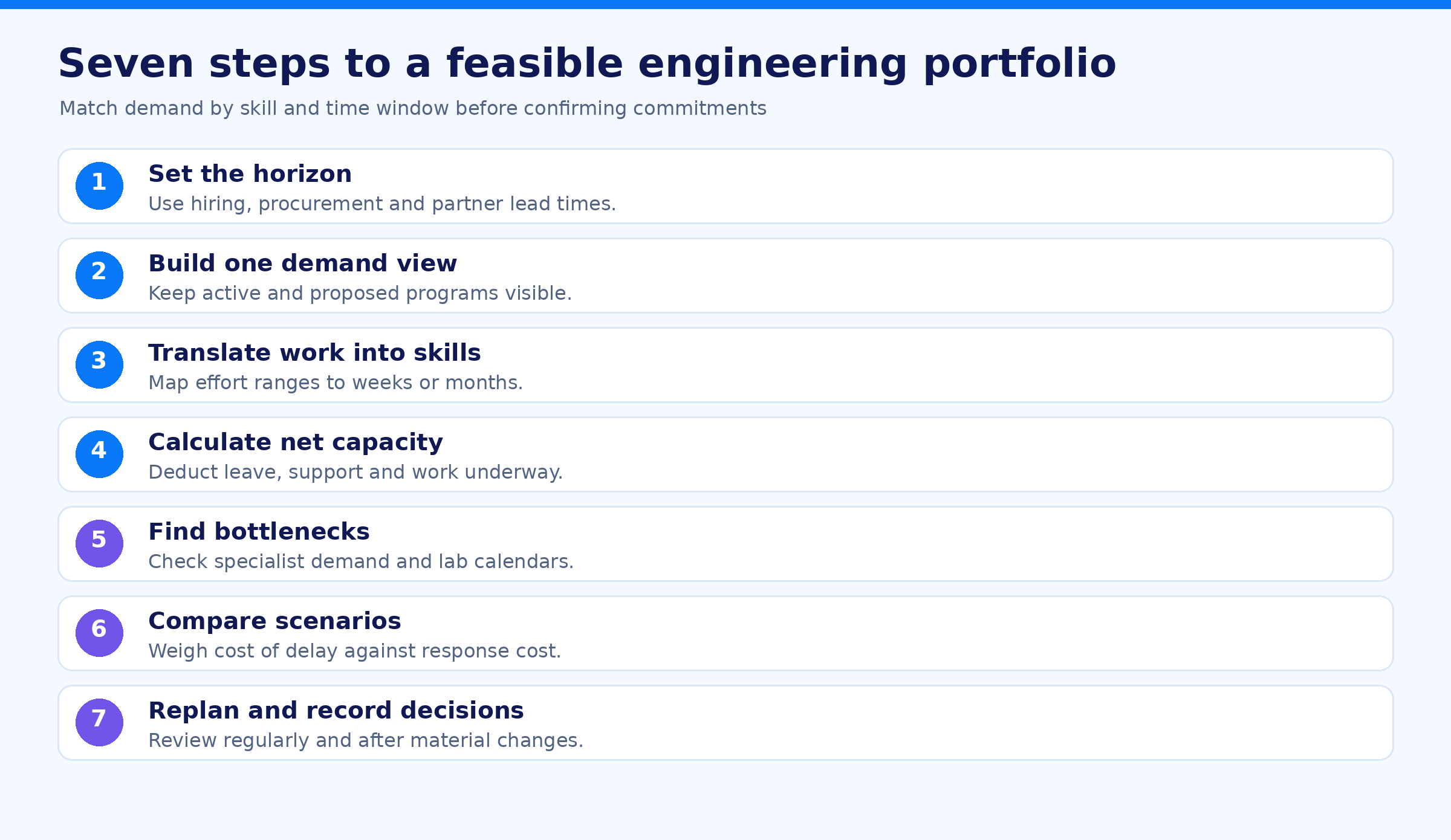
1. Set the decision horizon.
The resource planning horizon must align directly with the lead times of the decisions leadership needs to make. If procuring long-lead components or recruiting a specialized optical engineer takes four to six months, a rolling six-week tactical horizon is insufficient. Conversely, attempting to plan granular engineering activities three years into the future produces false precision, as estimation accuracy degrades sharply over time.
Hardware engineering teams operate on very different cadences: an engineer-to-order (ETO) industrial equipment builder may need a rolling 12-to-18-month view, while a consumer hardware startup iterating through rapid prototypes may work on a 3-to-6-month window. Do not impose one engineering capacity planning horizon on every team. Let the lead time to add staff or shift external partners set the horizon.
2. Build one portfolio demand view.
Assemble all hardware programs into a single demand view. This portfolio view must capture active, approved initiatives alongside proposed pipeline projects, tracking their current phases, stage-gate milestones, cross-project dependencies, and probability or confidence scores.
Keep each program visible instead of blending demand into one effort curve. When a delivery date shifts or an engineering change order lands, you can then see exactly which shared teams it hits.
3. Translate work into skill demand.
Break project work packages down into specific engineering competencies, such as power electronics layout, firmware security architecture or thermal stress modeling. Map each need to a time bucket, such as a specific week or month.
For each competency, define:
- The estimated effort required in the target period.
- The specific work packages that rely on scarce competencies.
- A range estimate (low, likely, high) for exploratory or high-uncertainty phases.
Effort ranges show where technical uncertainty can cause demand spikes, so leadership can manage high-risk deliverables before dates are locked.
4. Calculate realistic net capacity.
Calculate net capacity for each competency pool. Gross capacity (staff multiplied by forty hours a week) is a theoretical number that does not reflect real output.
To calculate net capacity accurately:
- Start with nominal calendar availability for the planning period.
- Deduct planned leave, company holidays, and known absences.
- Subtract non-project allocations, including operational maintenance, customer escalations, administrative duties, and ongoing sustaining engineering.
- Account for pre-existing task commitments already underway.
State all underlying assumptions and data sources explicitly. Avoid a blanket utilization target, such as mandating that all engineering groups operate at 90% or 100% capacity. Sustainable targets vary by discipline, and loading specialized teams to the maximum removes the buffer they need to absorb routine friction and rework.
5. Find the bottleneck and the time window.
Overlay translated skill demand onto realistic net capacity across each time bucket. Evaluate each specialized competency individually; a quarterly portfolio load that shows an average utilization of 80% can easily hide a two-week period where demand for an antenna design expert reaches 250%.
Cross-check human capacity bottlenecks against non-person constraints. Align skill demand curves with the reservation calendars of internal testing chambers, simulation hardware and pre-booked external certification windows. Then rank the conflicts by cost of delay: the bottleneck that matters most is the one where each week of waiting costs the portfolio the most.
6. Compare response scenarios.
When projected capacity demand exceeds net capacity within a given window, evaluate alternative capacity planning strategies. Run structured trade-off analyses to compare viable responses:
- Resequencing. Shifting non-critical tasks or delaying non-dependent work packages to spread demand.
- Scope modification. Deferring secondary features to a subsequent hardware revision or phase.
- Phase concurrency. Overlapping development phases where risk is acceptable to compress timelines.
- Capacity adjustments. Onboarding verified contractor capacity, leveraging specialized design partners, or utilizing cross-trained internal staff.
- Asset rescheduling. Swapping internal lab slots or securing alternate certification testing windows.
Each scenario carries trade-offs in cost, technical debt, product quality, regulatory compliance and contractual milestones. Put them in one unit: the cost of delay of the work that moves against the cost of the response, such as contractor fees or revenue lost to cut scope. Present the options with those figures. The decision to change commitments, budgets or schedules rests with the portfolio and project owners.
7. Replan on a cadence and after a material change.
Engineering capacity planning is an active operational process rather than a static quarterly event. Maintain accuracy by establishing a routine review cadence, supplemented by event-driven replanning whenever material changes occur.
Establish triggers that require an immediate update to the capacity plan:
- Formal stage-gate approvals or phase exits.
- Significant engineering change orders (ECOs).
- Critical path schedule slippages.
- Introduction of new project commitments to the portfolio.
- Shifting availability of third-party test facilities or supplier lead times.
Give every estimate, skill roster and external asset calendar a named owner, and keep a versioned decision log. Recording why the plan changed makes the next forecast better.
Read More: Cost of Delay: How to Calculate It and Prioritize Projects
A worked example: one specialist, three simultaneous projects
The figures below are hypothetical and only illustrate the method. They are not a case study or an Epicflow result.
| Project | Window | Demand for rare skill | Cost of delay per week | Note |
|---|---|---|---|---|
| Program A | Weeks 5-8 | 2 specialist-weeks | $30,000 | Qualification work in an agreed external test window. The next free slot opens 10 weeks later. |
| Program B | Weeks 5-8 | 2 specialist-weeks | $45,000 | Prototype change that gates a customer pilot. |
| Program C | Weeks 5-8 | 2 specialist-weeks | $5,000 | Internal design review and sign-off. |
| Available | Weeks 5-8 | 2 specialist-weeks | n/a | One specialist; 2 weeks remain after known fixed work. |
In this scenario, demand reaches 6 specialist-weeks against 2 specialist-weeks of net capacity, a deficit of 4 specialist-weeks inside a four-week window.
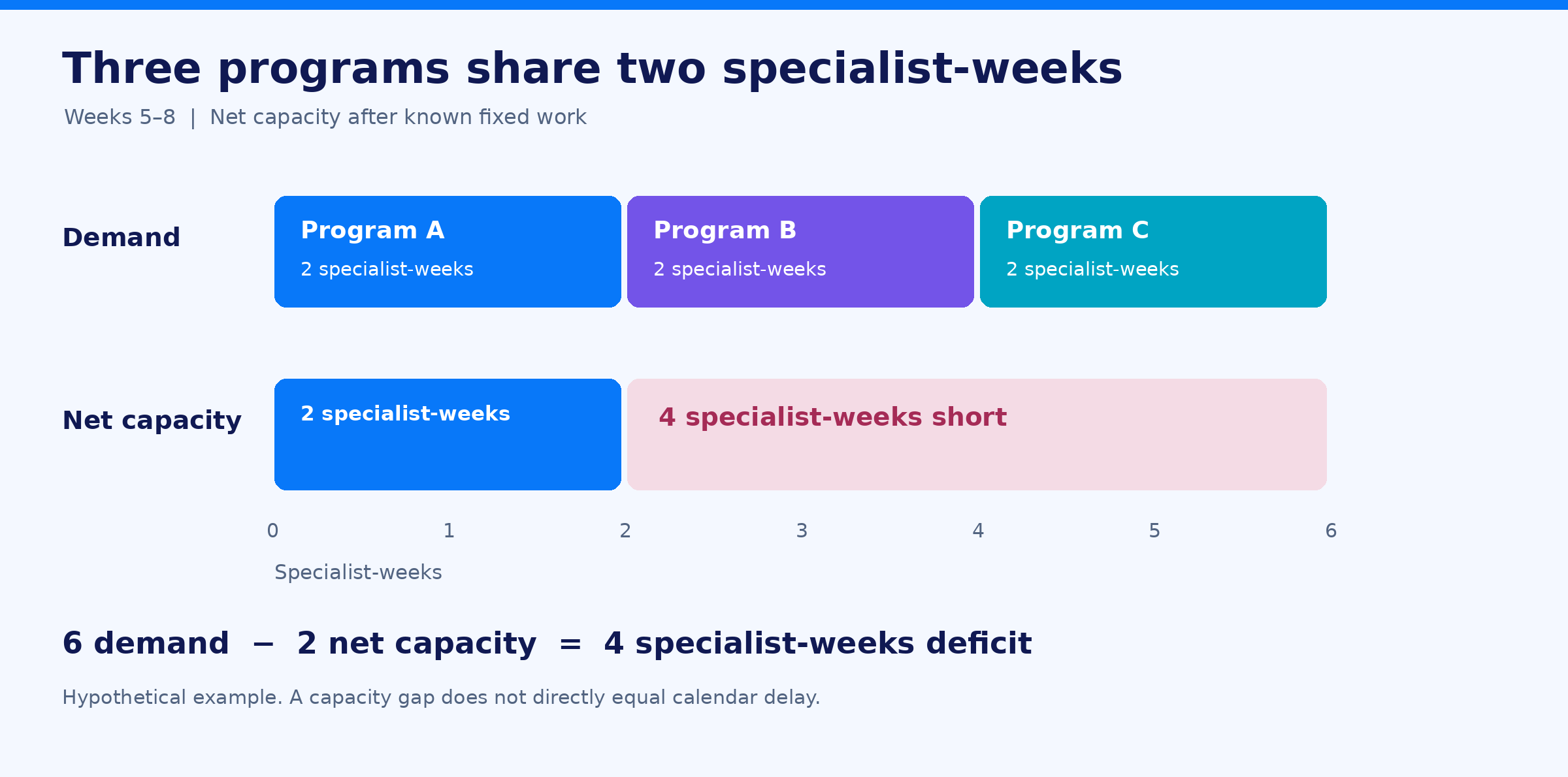
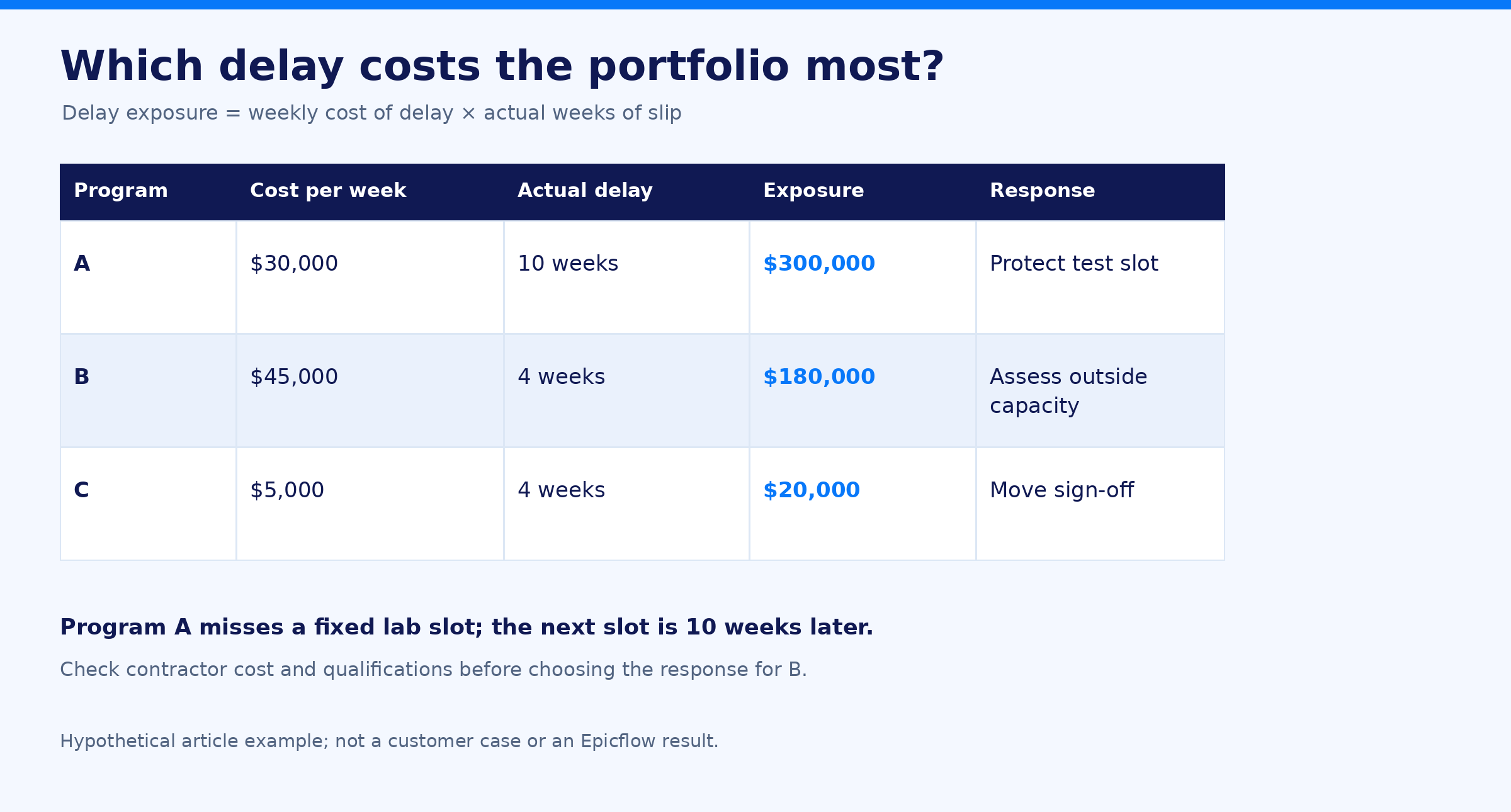
Headcount alone cannot tell you which program should get the specialist. Cost of delay can. Multiply each program's weekly cost of delay by how long its delay would really last:
- Program A. Missing the window does not cost one week. The next lab slot opens ten weeks later, so the slip costs about $300,000.
- Program B. A four-week wait costs about $180,000.
- Program C. Moving the sign-off by four weeks costs about $20,000.
The specialist's time is worth the most on Program A. Program B's delay is expensive enough to justify paying for outside capacity. Program C is the cheapest delay, so it moves. Ranked by who asked first or who escalates loudest, the specialist could just as easily have gone to Program C.
A gap of 4 specialist-weeks does not automatically mean a four-week delay. To close it, leadership and the engineering team can combine several options:
- Stagger and resequence. Give the specialist to Program A's qualification work to protect its fixed slot, and move Program C's sign-off, the cheapest delay, to a later bucket.
- Reduce or redistribute work. Descope non-essential parts of Program B's prototype change and hand non-specialist preparation tasks to other team members.
- Add qualified capacity. Bring in a cross-trained internal engineer or an accredited external contractor for Program B, where a week of delay costs more than a week of extra capacity.
- Renegotiate commitments. Adjust internal milestones before work starts, not after the schedule has already slipped.
Because Program A depends on an agreed external testing window, treat that slot as fixed. Verify availability directly with the lab owner before you change the sequence.
Choose tools that match the constraint you need to manage
Match the system to the operational constraint you need to govern. Teams that chase long feature lists or all-in-one suites tend to blur the line between human skill availability and physical production. The result is heavy administrative overhead and capacity forecasts that miss bottlenecks until after commitments are made. If you are shortlisting vendors, this side-by-side comparison covers the main options.
Hardware organizations use four classes of systems, each for a different layer of delivery:
- Portfolio and project capacity systems. These systems aggregate skill demand and human availability across concurrent projects and flag specialist bottlenecks before new commitments are made.
- Product Lifecycle Management (PLM). These tools serve as the authoritative record for product configurations and engineering change orders (ECOs).
- Dedicated lab and asset scheduling systems. Manage maintenance cycles and test bench availability for physical rigs and environmental chambers.
- Enterprise Resource Planning (ERP) and Manufacturing Execution Systems (MES): Control production execution, shop-floor machinery, procurement cycles, and material supply chains.
These systems must exchange data, but no single platform owns every operational layer. Forcing machine scheduling into a project tool, or using an ERP system to balance specialized engineering workloads, creates administrative drag and distorts capacity data.
If your main constraint is engineering-team capacity and specialist availability across concurrent hardware and R&D programs (not shop-floor line scheduling), see how Epicflow plans engineering capacity across programs.
The platform turns finite specialist capacity into a feasible portfolio plan, connecting shared-resource bottlenecks directly to milestone dates and commercial exposure before deadlines slip. However, operational boundaries remain essential: software orchestrating human engineering capacity does not automatically book third-party certification bodies, reserve physical test rigs, or replace shop-floor execution in ERP or MES systems.
Three programs, one specialist, one four-week window: which delay costs you the most? Build your own demo to see what a week of delay costs each program competing for your scarcest engineers.
How to measure whether the plan is useful
A capacity plan is useful when it changes decisions before commitments, not when it reports on them afterwards. Track these leading indicators:
- Pre-commitment review coverage. This is the percentage of new hardware projects or engineering commitments where translated skill demand and net capacity were formally validated prior to confirming delivery dates.
- Early bottleneck identification rate. The number and proportion of resource or asset constraints identified well in advance of a milestone collision, logged alongside the exact detection lead time.
- Rolling forecast error. Variance between forecast demand and actual effort across defined skill and time buckets. Define a standardized internal formula (absolute percentage error over a rolling 60- or 90-day window, for instance) and evaluate performance against comparable prior periods.
- Replanning latency. The total turnaround time elapsed from a material trigger (engineering change order or supplier delay) to a fully re-baselined capacity view and a documented management decision.
- Cost of delay avoided. The estimated cost of delay of the conflicts resolved before commitment: weekly cost of delay multiplied by the weeks of slip avoided. It ties the planning process to money and shows which decisions paid off.
Avoid using a single organization-wide utilization rate as a core performance indicator, and do not treat the planning system as a mandate to load staff more heavily. Maximum loading removes the slack teams need to absorb support work and unexpected rework.
Read More: Engineering Project Management: The Essential Guide
Frequently asked questions
What is engineering capacity planning?
Engineering capacity planning is the practice of forecasting project work across specific engineering skills and calendar time buckets, then comparing that demand against actual net workforce capacity. It identifies skill shortages and timing bottlenecks across concurrent hardware initiatives before delivery commitments are finalized, without addressing factory equipment or assembly operations.
How is engineering capacity planning different from production capacity planning?
Engineering capacity planning focuses on specialized human competencies and technical milestones across concurrent development projects. Production capacity planning governs shop-floor machinery, raw materials, assembly lines, and factory output rates. Complex manufacturers run both disciplines in parallel through distinct, but still linked operational workflows.
What data do hardware and R&D teams need for capacity planning?
Hardware and R&D teams require project work breakdown structures by phase, estimated effort mapped to specific competencies, target time windows, and estimate confidence levels. They also need net human availability (reflecting operational deductions), task dependencies, and verified availability dates from the named owners of lab and external supplier calendars.
How do you plan for shared test equipment or certification windows?
Model physical test rigs and external certification slots as distinct non-person constraints on separate calendars. Each asset calendar requires a designated operational owner and a verified booking date. Never treat provisional or tentative facility availability as a guaranteed slot when committing to project milestone dates.
How often should an engineering capacity plan be updated?
Maintain a regular rolling review cadence, supplemented by event-driven updates whenever material project changes occur. Immediate replanning triggers include scope adjustments, engineering change orders (ECOs), critical path schedule slips, new project commitments, or shifts in external supplier and testing dates. The ideal cadence matches organizational decision lead times.
Can a project capacity planning system schedule factory machines or test labs?
Not automatically. Multi-project planning systems manage engineering skills and work packages, not physical assets. Factory line execution belongs in ERP and MES systems, and dedicated lab booking systems manage equipment reservations. Check what each vendor actually supports and set clear system boundaries instead of expecting one platform to manage both people and machines.