
AI Project Portfolio Management Software
for Resource-Constrained Enterprises
Put AI Where Portfolio Value Gets Stuck
Epicflow is AI value-optimized portfolio management software that helps resource-constrained enterprises to deliver more strategic value and increase portfolio profitability without increasing headcount.
It puts scarce expertise where it creates the most portfolio value, using AI to expose bottlenecks, sequence work by value per constrained hour, and protect throughput and profit before delays materialize.




Value-optimized. Constraint-aware. Human-in-the-loop.
PMOs, portfolio leaders, resource managers, and finance leaders use Epicflow to expose hidden constraints, prioritize work by business value and resource constraints, predict the delivery and commercial impact of delay, and add governed AI capacity where bottlenecks block flow.
- Sequence project by business value relative to constrained capacity, not deadlines, seniority, or stakeholder pressure
- Predict bottlenecks before they put delivery and commercial commitments at risk
- Stress-test portfolio decisions against finite capacity before changing the live portfolio
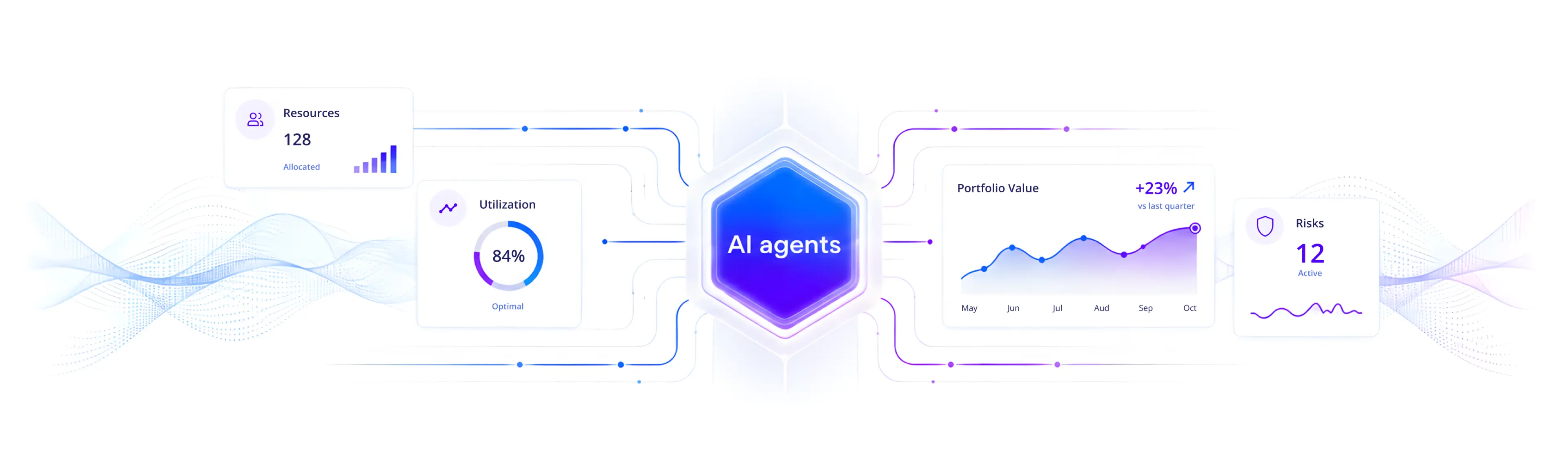
- Add AI Agents as controlled capacity relief for repeatable bottleneck work
-

Enterprise Security
All the information entered to Epicflow is encrypted and guarded within our secured networks. Any personal and project-related data is visible only for the company that owns it.
-
Custom Integrations
We can develop a custom integration with a software of your choice and move your projects to a modern environment where you can use all of our features.
-
Flexible permissions
Full control over all the data in the system - you can grant or hide project details for any project team member depending on their role and level involvement in the company.


Where Epicflow Is Different
Epicflow is a constraint-first portfolio orchestration platform that acts as AI portfolio manager for shared-resource enterprises. It brings together finite-capacity modeling, economic prioritization, scenario testing, commercial-impact forecasting, and governed AI resources.
- Portfolio-aware — sees all projects competing for finite specialist capacity
- Constraint-first — predicts where flow will break and what the delay may cost
- Agentic — adds governed AI resources to relieve selected bottleneck work
The Epicflow flow logic
-
1
Identify the constraint: Detect overloaded specialists, teams, approval processes, and dependencies across the full portfolio, then show which commitments are exposed.
-
2
Protect the constraint: Reduce multitasking, protect scarce capacity, and prevent low-value work from consuming critical resources.
-
3
Synchronize around the constraint: Sequence projects and tasks around the real capacity of the bottleneck, not around arbitrary deadlines or stakeholder pressure.
-
4
Elevate the constraint: Reallocate capacity or add governed AI resources to selected repeatable work where bottlenecks are blocking delivery.
-
5
Repeat and re-optimize: Monitor shifting constraints, test alternatives, and update the portfolio sequence before delivery and commercial impact materialize.
Security standards
-

ISO 27001 Certified
Third-party-audited information security management — the internationally recognized standard your procurement and IT teams require
-

GDPR Compliant
Full EU data protection compliance with data processing agreements and EU data residency — essential for European manufacturing operations
-

Role-Based Access Control
Site-level, team-level, and project-level permissions. Control exactly who sees which projects, resources, and production data across every plant and department
-

Data Guard
Cloud software — but your production data, engineering specs, and supplier information never leave your own infrastructure. The answer to the #1 reason manufacturers hesitate to move off legacy systems


Trusted in mission-critical environments
-

Dutch Ministry of Defense
Approved and actively used in Dutch MOD mission-critical operations — setting the bar for security and reliability that manufacturing environments can count on
-

British MOD pen-test standard
Penetration-tested to UK Ministry of Defence standards — giving manufacturers in the British defence supply chain a vendor they can put in front of any security review
-

JOSCAR registered
Listed on the Joint Supply Chain Accreditation Register — the recognized compliance standard for aerospace and defence supply chains, accepted by major manufacturers and prime contractors alike

AI Project Portfolio Management Software Built for Mission-Critical, Resource-Constrained Environments

Predict Bottlenecks and Commercial Impact Before Delivery Slips
See overload forming - and the commitments it threatens - while there is still time to act.
Forecast resource demand, workload, output, and bottlenecks across your entire shared-resource portfolio with Epicflow’s Future Load Graph and bottleneck analysis engine. AI for resource forecasting identifies who will be overloaded, which projects are competing for that capacity, when the pressure will peak, and what the options can protect delivery. Where commercial data is configured, leaders can also see predicted bonus, penalty, revenue, or profit exposure before the delay becomes actual.
Applying Epicflow’s AI for risk detection in PPM allows you to turn future overload into a managed constraint: reprioritize earlier, protect critical capacity, and intervene before schedule risk becomes a missed commitment or profit erosion.

Rank Project by Economic Return on Scarce Capacity
Direct scarce capacity to the work that creates the greatest portfolio return.
Use AI-driven project selection and prioritization to sequence initiatives by value per constrained hour, not by arbitrary deadlines or stakeholder pressure.
Epicflow’s AI portfolio optimization engine calculates the strategic return of each initiative under your real capacity constraints and re-ranks the portfolio accordingly. The result is a capacity-feasible sequence of projects that maximizes throughput, strategic value, and portfolio profitability.

Test Delivery and Financial Trade-Offs Before You Commit
Make portfolio decisions in capacity-tested simulation.
Run what-if scenarios in a safe mode that mirrors your real portfolio environment. Shift start dates, add new projects, move milestones, rebalance resource allocations and see the downstream impact across every project before any change touches the live portfolio.
Epicflow’s What-if analysis tests scenarios against finite capacity and shows their potential impact on throughput, delivery confidence, and, where configured, bonus, penalty, revenue, or profit. Leaders can choose the option that best protects value before committing.
Elevate Bottlenecks
with Governed AI Resources
Put AI capacity where your portfolio is constrained.
Generic AI agents help teams write, summarize, and coordinate. Epicflow AI models for portfolio management do something more valuable for enterprise portfolios: they become controlled, assignable capacity inside the project flow.
Use three tests to decide where AI capacity belongs: other work is waiting on it; the delay has a meaningful business cost; and an AI agent can complete it to an approvable standard.
Suitable work can include project initiation, document review, schedule adaptation, task preparation, and structured handoffs.
Epicflow AI Agents are not generic AI teammates.
They are governed AI capacity for portfolio bottlenecks.
- Model AI as a resource with capacity, a cost rate, dates, and dependencies
- Prioritize its work against the real portfolio queue and forecast the delivery effect
- Offload repeatable bottleneck work from scarce experts
- Keep execution governed with human-in-the-loop review and traceable handoffs

Result: Less bottleneck pressure, shorter queues, faster portfolio flow, and measurable delivery impact.
Why Portfolio-Aware AI Creates
More Enterprise Value
Most work-management AI optimizes local productivity. Epicflow’s portfolio management with AI becomes economic leverage across the portfolio, protecting constraints and increasing portfolio value.
Portfolio intelligence means optimizing across the entire shared-resource system: which projects consume the most constrained capacity, which deliver the most strategic return per hour, and what every priority decision costs the rest of the portfolio, and where intervention protects the most delivery value and profit.
| Generic work management AI | Epicflow AI for portfolio management |
|---|---|
| Works at the task layer | Works at the portfolio system layer |
| Automates updates and summaries | Models finite capacity, constraints, and economic trade-offs |
| Helps teams move faster locally | Helps the whole portfolio finish higher-value work sooner |
| Adds AI activity | Adds governed AI capacity where bottlenecks block delivery |
| Makes work faster | Optimizes portfolio value, throughput, and profitability |
From Connected Data to Confident Action: AI PPM Implementation Roadmap
-

Connect Your Portfolio Context
Bring in project and resource data into Epicflow through integrations with Jira, MS Project, Oracle Primavera, or custom systems. The AI works from the real operating conditions of your enterprise, including shared resources, active initiatives, dependencies, and capacity constraints, not from isolated prompts or disconnected task lists.
-
Model the Impact
Epicflow maps constraints, forecasts load, identifies the highest-value work, and shows the consequences of each scenario under finite capacity. The AI reveals where the portfolio is under pressure, which decisions would relieve that, and what each option costs in throughput and delivery confidence.
-

Act with Confidence
Approve the best scenario, assign people and AI agents to the right work, and let notifications, handoffs, and automated execution keep delivery moving with every decision backed by a tested capacity model, not a spreadsheet estimate.


AI Portfolio Management
in Practice: Where It Pays Off
-

Aerospace and Defense
Used by QinetiQ and aligned with JOSCAR supplier standards.
Aerospace and defense programs compete for the same scarce engineering and certification specialists, creating hidden bottlenecks across concurrent delivery streams. Epicflow AI portfolio management software forecasts demand against that finite supply, identifies which programs are at risk from the same bottleneck, and sequences work to protect throughput and program integrity.
-
Manufacturing and Engineering-to-Order
Custom product development, design reviews, and sign-off gates all queue behind the same engineers, creating hidden delays across manufacturing projects. When a new project joins the portfolio, its impact on every other delivery timeline is immediate and often invisible until the delay has already occurred. AI portfolio optimization models that impact before the commitment is made.
-
Telecoms and Infrastructure Delivery
Bottlenecks in network planning, permitting, or civil engineering expertise cascade across multiple concurrent rollout programs. AI-driven resource forecasting identifies where specialist demand in telecom projects will exceed supply before field operations are affected, enabling resequencing while delivery windows are still open.
-
Pharma and Life Sciences
Shared laboratory capacity, regulatory review windows, and clinical trial specialists cannot be easily augmented. Epicflow models demand against shared resources across the full development portfolio, giving program managers in the pharma industry a forward view of which pipeline projects are at risk before the delay becomes irreversible.


What Changes When AI PPM Software Sees the Whole Portfolio
PMI research indicates that AI delivers the greatest impact when applied to planning, resource allocation, and decision-making across projects, rather than only at the task execution level.
Organizations that move from task-level AI to portfolio-aware AI report the same pattern:
- Fewer emergency reprioritizations
- Shorter lead times
- Strategic decisions that deliver expected outcomes even as portfolio conditions change
“Once we started looking at the portfolio as one interconnected system, it became clear why projects were slipping and how to fix it without adding more resources.”
-

Up to 20–30%
improvement in on-time delivery performance
-

More output
The ability to deliver more work with the same resources.
-

Reduction in lead times
Significant reduction in lead times through improved sequencing and bottleneck management


See What Your Hidden Bottleneck Is Costing You
In one tailored session, we will show you where your portfolio constraints are, what they are doing to throughput and commercial commitments, and which sequencing or capacity decisions can protect more value without increasing headcount.
Best scheduled before your next portfolio review, planning cycle, or resource reallocation meeting.
Frequently Asked Questions About AI Project Portfolio Management Software
What is AI in project portfolio management?
AI in project portfolio management refers to the use of machine learning, predictive analytics, and AI agents to support portfolio-level decision making across multiple concurrent projects. It helps organizations evaluate project priorities, compose a capacity-feasible portfolio, distribute shared resources, identify bottlenecks, and test portfolio decisions before committing. Unlike task-level AI, it addresses the sequencing, economic trade-offs, and finite-capacity logic that determine whether the portfolio delivers strategic value.
What are AI portfolio management tools?
AI portfolio management tools are platforms that apply AI to portfolio-level decisions rather than individual task execution. The market is divided into three categories. AI-powered strategic portfolio management platforms such as Planview, Clarity, and Planisware add AI layers to established SPM tools. Work-management platforms such as Jira, monday, and Smartsheet extend their task-level AI upward toward portfolio dashboards and reporting. Constraint-aware portfolio orchestration platforms such as Epicflow are purpose-built to model shared-resource capacity and optimize sequencing, delivery flow and performance across the full portfolio.
What are the benefits of AI in portfolio management?
AI in portfolio management enables leaders to direct scarce capacity to the highest-value work; predict bottlenecks and the delivery or commercial impact of delay; stress-test trade-offs before changing live plans; and extend bottleneck capacity with governed AI resources. The result is a more capacity-feasible portfolio that protects throughput, strategic value, and profitability.
What is the best AI project portfolio management software for enterprises with shared resources?
The best fit depends on whether the organization needs task-level AI assistance or portfolio-level AI decision-making. Many AI portfolio management tools focus on improving execution within individual projects. However, shared-resource enterprises, where the same specialists serve multiple concurrent projects and bottlenecks migrate across the portfolio, require constraint-aware portfolio orchestration platforms like Epicflow. Its AI sequences work by value per constrained hour, predicts resource bottlenecks, and tests decisions before they are committed, and adds governed AI capacity where repeatable work blocks flow.
How is AI used in portfolio management?
Here are five AI use cases in portfolio management:
- prioritizing initiatives by value and available capacity;
- forecasting resource demand and identifying future bottlenecks;
- simulating what-if scenarios to test decision impact before committing;
- automating project initiation by converting requirements into structured plans;
- acting as assignable AI capacity through agents that handle repeatable tasks with human oversight.
What are the risks and limitations of using AI in portfolio management?
AI in portfolio management depends on the portfolio data it works from. Inaccurate inputs can lead to misleading recommendations or suboptimal prioritization. Gartner has noted that over 40% of agentic AI projects are expected to be cancelled or restructured by 2027 without appropriate human-in-the-loop governance. In Epicflow, which provides AI governance for PMOs, every AI recommendation has reasoning and requires human approval before affecting the live portfolio.
How is AI portfolio management different from AI work management?
AI work management speeds up task execution within a project. AI portfolio management software decides which projects to run, in what order, and at what cost to the rest of the system. The project illusion – green dashboards hiding portfolio underperformance – exists because work-management AI optimizes locally, while shared-resource enterprises require AI portfolio optimization software with constraints to work on the level of the entire portfolio.
Does Epicflow's AI integrate with existing PPM stack (Jira, MS Project, Oracle Primavera)?
Yes. Epicflow integrates with Jira, Microsoft Project, Oracle Primavera, and a range of other systems. It is designed to layer on top of the tools your teams already use, not replace them. Project data flows in from existing systems, and Epicflow portfolio optimization software adds the portfolio-level finite-capacity model and AI decision layer on top. This allows organizations to retain their current toolchain while adding AI-driven decision support across the full portfolio.
How are Epicflow AI Agents different from AI assistants?
Epicflow AI Agents are modeled as resources inside the portfolio rather than used only as chatbots or writing assistants. They can be assigned capacity, a cost rate, dates, dependencies, and a human review step; prioritized against the portfolio queue; and used for structured, repeatable bottleneck work. Their value is measured by the effect on portfolio flow and delivery, not by the amount of AI activity generated.
Can Epicflow AI Agents replace human resources?
No. Epicflow AI Agents are not designed to replace human expertise or decision-making. They are designed to protect and extend scarce human capacity in environments where the same specialists are shared across multiple concurrent projects. This means reducing the load of repeatable, structured, or administrative work that often consumes bottleneck resources. Humans remain responsible for approvals, prioritization, and any decisions that require judgment, accountability, or strategic context.
What types of work can AI Agents support?
Epicflow AI Agents are best suited for structured, repeatable work that creates unnecessary load on constrained teams. This typically includes:
- project initiation and setup based on predefined templates
- structured planning and task breakdown generation
- document review and preparation of standardized outputs
- schedule updates and adaptation based on defined rules
- coordination tasks such as handoffs, notifications, and status preparation
Are Epicflow’s agents prebuilt or custom?
Epicflow can support prebuilt agents for common workflows and custom agents for client-specific processes, constraints, and governance rules. In both cases, AI Agents operate under defined rules and remain fully integrated into portfolio governance, ensuring consistency, traceability, and human oversight.