PMO Manager Roles and Responsibilities: From Governance to Strategic Value Delivery
 Victoria Sokolova
.
February 18, 2026
.
Project Portfolio Management
.
24 mins READ
Victoria Sokolova
.
February 18, 2026
.
Project Portfolio Management
.
24 mins READ

This growing complexity highlights the importance of project management office (PMO) in general and a PMO manager role in particular. These professionals design frameworks that guide every project, transforming chaos into structured roadmap to organizational success.
In this article, we’ll explore who a PMO manager is, what makes their role vital for companies, how to become a PMO manager, or what skills you should pay attention to while hiring such specialists.
Key takeaways:
- A PMO manager leads the project management office (PMO).
- PMO managers are required by organizations managing multiple projects and programs in resource-constrained environments.
- Key responsibilities of a PMO manager include establishing governance and standards, performance monitoring and reporting, ensuring strategic alignment and correct prioritization, engaging stakeholders as well as managing resources, costs, and risks across multiple projects.
- Strategic thinking, communication and leadership capabilities, decision-making skills, analytical and data-driven mindset, and the experience in working in multi-project resource-constrained environments are the capabilities of a good PMO manager.
Who Is a PMO Manager?
A PMO manager is a leader of the project management office whose primary goal is ensuring the PMO acts as a strategic driver to the company’s success. They are responsible for project alignment with business strategy, establishing effective frameworks, and continuous improvement across the whole environment. In recent years, the role of PMOs is shifting from administrative to more value-oriented. This means that the role of a PMO manager should also evolve: they should be not only administrators but also strategic partners for executives in driving business value.
PMO Manager vs Project Manager
Long story short, a project manager focuses on day-to-day execution of a specific project, while a PMO manager’s role is to set standards for the entire portfolio of projects and programs and permanently monitor alignment with the company’s goals. The PMO manager supports project managers with working standards and strong governance, providing tools and methodologies required for successful project delivery.
| Project manager | PMO manager | |
| Focus | Individual project | Entire portfolio or program |
| Goal | On-time and on-budget project delivery | Strategic alignment and governance |
| Responsibilities | Project planning, execution, monitoring | Frameworks, reporting, resource management coordination |
| Scope | A single project | Departmental or organization-wide |
Read more: Project vs Program vs Portfolio Management: What’s the Difference?
What Organizations Require a PMO Manager?
A PMO manager is a critical professional for multi-project organizations that need strategic planning, prioritization, resource coordination, and transparent reporting. These needs are common in the following types of organizations:
- Aerospace and defense organizations represent one of the most complex project environments with extreme project complexity, limited resources, strict regulatory compliance, high risks, and data security requirements.
- IT and software development projects often have multiple teams working across different projects and with different technologies.
- Construction and engineering companies deal with projects with tight budgets, strict safety standards, and evolving regulations.
- Pharmaceutical organizations are under constant pressure of faster project and product delivery and need to comply with strict and often evolving regulatory requirements.
- Financial companies manage high-risk projects and programs that involve regulatory compliance and deal with sensitive data.
- Telecommunications companies deal with large-scale infrastructure projects with shared teams and significant investments.
- Manufacturing projects are vulnerable because of supply chain disruptions, resource constraints, and pressure to implement innovations.
- Government organizations and their public initiatives often involve a great number of stakeholders and face the need to build strong relationships and open communication between them for ensuring success.
All these organizations require intelligent governance and coordination, value-driven prioritization, proper resource allocation and their efficient utilization, effective risk management, and coordination between stakeholders. This creates the need for a dedicated organizational unit that will guide these projects to successful completion under complex conditions and constraints. PMOs and PMO managers become indispensable in this context to establish proper coordination, overcome project complexity, address challenges, and optimize resources and costs.
Read more: PMO Implementation: 8 Steps to Set Up a Successful PMO
Key Responsibilities of a PMO Manager
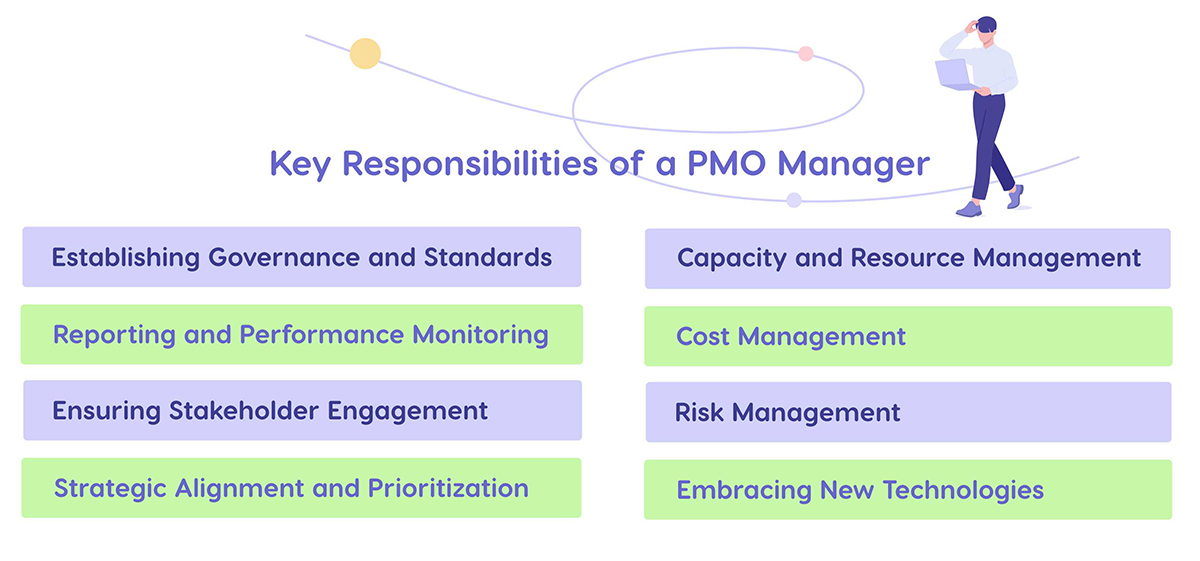
1. Establishing Governance and Standards.
A PMO manager role involves defining how projects are initiated, planned, and executed across the organizations. In particular, this includes selecting and adjusting project management methodologies (Agile, Scrum, Waterfall, PRINCE2, hybrid, and so on) that will be the most appropriate for different projects of the portfolio. This role also includes maintaining these standards and monitoring adherence to them.
Such an approach allows companies to implement structure into the project execution process, reduce ambiguity, and prevent chaos that can arise in complex multi-project environments.
2. Reporting and Performance Monitoring.
PMO managers should establish standardized processes for reporting and decision-making as well as provide tools to track progress of all ongoing projects and programs within the portfolio. Therefore, at this point the main responsibilities of PMO managers are:
- Tracking performance of each project, ideally with PMO tools.
- Providing guidance for project managers based on performance insights.
- Analyzing overall productivity and KPIs using analytical tools.
In this case, a dashboard that gathers real-time data about performance of projects across the portfolio, becomes a helpful hand, creating a single source of truth and making reporting easier.
3. Ensuring Stakeholder Engagement.
PMO managers are responsible for building transparent and open communication between stakeholders and teams. The main challenge here is to collect requirements and expectations from stakeholders and ensure that they are aligned with project execution and organizational constraints. Poor stakeholder engagement is often the main cause of misaligned priorities, changing requirements, and unrealistic expectations. This means that PMO managers should ensure smooth communication across all levels of the organization and active stakeholder involvement.
4. Strategic Alignment and Prioritization.
PMO managers must ensure that all projects in the portfolio support strategic objectives of the company. They review project proposals and prioritize them according to their expected business value, current business strategy, and organizational constraints.
Manual prioritization often becomes overwhelming in large multi-project environments. Prioritization decisions often depend on a large number of factors like strategic fit, budget availability, timing, resource requirements, and projected value. To ensure accurate prioritization decisions, PMO leaders can use tools which automatically prioritize projects based on defined criteria and real-time portfolio situation.
5. Capacity and Resource Management.
The key constraint that most organizations face is limited resource capacity. Resource scarcity along with their ineffective utilization hamper performance and prevent business organizations from achieving desired outcomes. PMO managers are responsible for ensuring proper project staffing and efficient utilization of available resources, which is achieved by:
- Ensuring effective resource and capacity planning to prevent overbooking, bottlenecks, and underutilization.
- Coordinating resource allocation based on skills, availability, and capacity, and priorities..
- Leveraging resource management and capacity planning tools to gain visibility into workloads, forecast the demand, and support data-driven resource allocation decisions.
6. Cost Management.
Effectively forecasting and managing costs across projects and portfolios is considered to be one of the most challenging problems. According to the 2025 PMO Outlook Report, 38% of organizations report cost forecasting and control as a major challenge. Cost management in this context involves forecasting future spendings, tracking current costs, and financial reporting. The PMO’s role here is to:
- Establish standardized financial governance and reporting across projects and programs.
- Monitor cost performance.
- Support informed investment decisions.
- Reduce the likelihood of cost overruns.
Thus, PMO members contribute to optimizing costs and ensuring their efficient distribution across projects.
Read more: 8 Tips on Reducing Project Costs
To learn how Epicflow PMO tool can help your organization not only cut down on cost spending but noticeably improve portfolio performance and business results, book a call with our experts.
7. Risk Management.
PMO risk management focuses on identifying, assessing, and mitigating risks at the portfolio level, rather than individual projects. It takes into account cross-project dependencies, shared resource constraints, and strategic objectives as well as the impact of risks on the entire portfolio of projects.
In this context, the role of a PMO manager comes down to:
- Consolidating risks across projects.
- Managing cross-project and resource risks.
- Running simulation to forecast risks or find ways to mitigate them.
- Integrating risks into prioritization decisions.
- Supporting project managers in managing individual project risks.
To manage risks effectively in complex environments, PMO managers should rely on scenario modeling and scenario planning software which allows them to see the immediate impact of possible decisions. They can explore scenarios like delaying a project or reallocating resources and understand their potential impact on other projects’ timelines, shared resources, and overall outcomes.
8. Embracing New Technologies.
Modern PMO managers play a key role in the adoption of advanced project and portfolio management software, e.g., PPM systems enhanced with data-analystics and predictive capabilities. These tools are critically important to ensure effective work of PMO managers: they improve visibility and control of the whole project environment, optimize resources and costs, and improve decision making.
How can PMO managers contribute to adopting PPM software?
- Testing new tools and approaches.
- Supporting training and change management.
Read more: Top 4 Challenges for a Project Management Office (PMO) and Ways to Address Them
Requirements for a Project Management Office Manager Position
To succeed as a PMO manager, specialists typically need the following skills and experience:
- Education: Bachelor’s or master’s degree in business administration, management, or a related field.
- Certifications: widely recognized certifications such as Project Management Professional (PMP), PgMP (Program Management Professional), PfMP (Portfolio Management Professional), PRINCE2, or any other PMO associated certifications.
- Experience: 5-10 years of experience in project management; proven experience in portfolio, program management, or portfolio operations; experience in working in multi-project and resource-constrained environments.
- Essential competencies: Strategic thinking, strong communication and leadership capabilities, governance and decision-making skills, analytical and data-driven mindset, resource management competences, change management and adaptability.
As we mentioned earlier, intelligent PMO software can become the right hand for PMO managers, helping them with their key responsibilities, providing data-driven analytics, and supporting decision making. Let’s consider this software’s core capabilities through the example of Epicflow in the section below.
Effective Project Management Office Software: Epicflow Solution
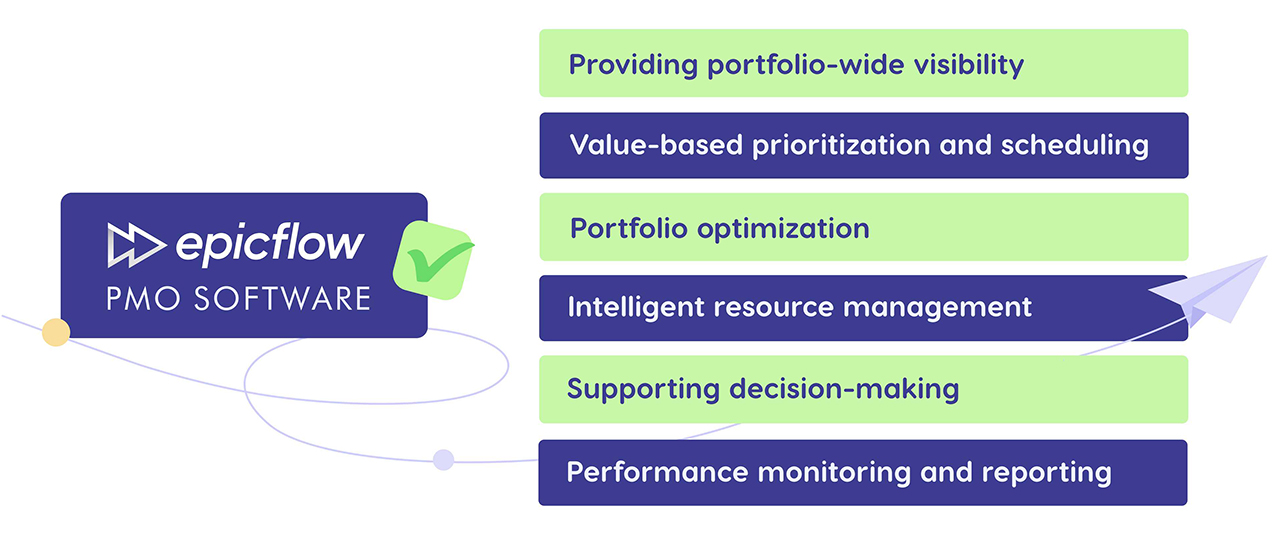
Epicflow portfolio and resource management software is an effective all-in-one solution for PMO managers. It has been designed specifically for managing complex multi-project environments where limited resources are shared by numerous projects. This is why it has strong resource management capabilities, supports decision making, provides end-to-end resource and portfolio visibility, which perfectly address the needs of PMO managers’ daily work.
Here are some examples of how Epicflow helps PMO managers.
1. Providing portfolio-wide visibility.
Epicflow provides PMO managers with a real-time view of all ongoing projects and their statuses, which helps monitor progress, detect risks, and make informed decisions. Its dashboard and visualization tools become a single source for truth for performance and resource data.
2. Value-based prioritization and scheduling.
Epicflow automatically prioritizes projects of the portfolio based on their business values. What is more, upon detecting that resource constraints will prevent projects from timely delivery, it can suggest rescheduling lower-priority projects to complete more valuable ones on time.
3. Portfolio optimization.
Epicflow Portfolio Optimizer uses AI to find optimum portfolio composition that will generate maximum business value with current resource constraints a company is facing. This becomes possible thanks to capacity forecasting, scenario simulation, and value-based prioritization.
4. Intelligent resource management.
Epiclow’s functionality is based on the idea that resource efficiency is the key to seamless project execution and timely delivery. This is why it’s equipped with advanced resource management capabilities that are a must for effective PMO and portfolio management:
- Resource capacity planning;
- Resource allocation based on skills, availability, and capacity.
- Workload balancing.
- Performance analysis.
These capabilities help organizations reduce bottlenecks, optimize the utilization of available resources, and minimize lead times.
5. Supporting decision-making.
Epicflow’s What-if scenario planning tool that allows PMOs to simulate different scenarios. Before making strategic decisions, PMO managers can test potential changes and see probable outcomes and consequences. For example, it allows managers to explore different resource distribution options and portfolio composition, predict operational risks and project feasibility, and helps find optimum risk mitigation strategies. You can run these simulations in the safe sandbox environment, compare them, and discuss with colleagues before committing.
6. Performance monitoring and reporting.
Epicflow enables performance analysis on different levels: project, resource, and portfolio. It has dashboards and graphs that help PMO managers gain real-time performance insights as well as analyze forecasts and historical data. They can use these insights to create reports or generate them automatically in the system.
In addition to these powerful capabilities, Epicflow has virtual assistant Epica that supports Epicflow users and enables most efficient interaction with the system: automating administrative tasks, warning of upcoming bottlenecks, and explaining how to use the tool effectively.
Schedule a call with our experts to learn more about Epicflow capabilities and how they benefit PMO managers’ work.
Conclusion
A PMO manager plays a critical role in helping organizations establish, maintain, and improve project management standards and practices. This role isn’t necessary for every organization, but it’s critical for large enterprises that run multiple projects simultaneously with a shared resource pool.
PMO managers’ responsibilities involve setting corporate project management standards, controlling project and program execution, facilitating risk and resource management, engaging stakeholders, and making decisions. To achieve better outcomes and automate some tasks PMO managers rely on portfolio and resource management tools that provide them with comprehensive visibility, support decision making, and optimize resource utilization.
Frequently Asked Questions
Who is a PMO manager?
How does a PMO manager differ from a project manager?
What does a PMO manager do?
How to become a PMO manager?
What is the role of a PMO manager?
What makes a good PMO manager?
Is PMO manager a good job?