Project Management in Renewable Energy: Strategies, Challenges, and Future Trends
 Victoria Sokolova
.
February 26, 2026
.
Project Management
.
29 mins READ
Victoria Sokolova
.
February 26, 2026
.
Project Management
.
29 mins READ

Today, you can hear about renewable energy from every corner of the Internet, and it’s no wonder why. Society grows, people become more conscious about environmental problems, as well as their impact on nature and human health. As the latest research indicates, renewable sources of energy are going to meet about 95% of growing electricity demand by 2027. It makes this industry extremely competitive on the one hand, but extremely promising on the other.
In this article, we’ll discuss what a renewable energy project is, what makes managing them uniquely challenging, and learn the best strategies for efficient renewable energy project management.
Key Takeaways:
- Renewable energy projects are initiatives that use replenishable natural resources to produce electricity. It can be, e.g., solar farms, windmills, hydroelectric stations, etc.
- Project management in the renewable energy sector helps to coordinate various teams responsible for software development, infrastructure installation, testing and monitoring, and other processes.
- Project management brings more consistency and efficiency to renewable energy projects by mitigating risks, utilizing limited resources efficiently, and facilitating a consistent workflow.
What Are Renewable Energy Projects?
Renewable energy projects are initiatives that aim to generate clean energy from free natural resources such as wind, sunlight, water, etc. They are gaining more and more traction due to the growing threat of global warming, high levels of air pollution, and increasing energy challenges that the world is facing now.
From the HealthData article, we can notice that:
- Air pollution led to roughly 8.1 million deaths in 2021.
- Air pollution is now the second leading cause of death.
- It causes heart disease, lung cancer, diabetes, etc.
At the same time, solar panels and wind farms are clean sources of energy that replace fossil fuels such as coal, natural gas, and oil. It makes them immeasurably valuable when it comes to addressing environmental issues because they don’t emit any harmful greenhouse gases and lower overall carbon emissions. In simple terms, they are the keepers of our sustainable future. That’s why there’s such a high demand for these projects in the market.
What Is Project Management in Renewable Energy?
Imagine a field full of solar panels. Have you ever wondered why they are installed on this particular field and not 30 kilometers away? You can be sure that it’s not a coincidence but the result of analysis and strategic planning – key factors of effective project management.
Project management in the renewable energy industry is critical for delivering these complex initiatives successfully by ensuring productive collaboration of different teams, from electrical engineers to software developers, handling all activities across the project portfolio, and completing the project on time and within the budget. An effective renewable energy project manager fosters clear communication between stakeholders and provides a full picture of ongoing processes while mitigating risks for successful project delivery.
Easier said than done, right? Let’s take a closer look at how it works in practice.
Project Lifecycle in Renewable Energy Projects
Renewable energy project lifecycle may include lot of different phases but for effective project management we’ve highlighted 4 the most widely used ones.
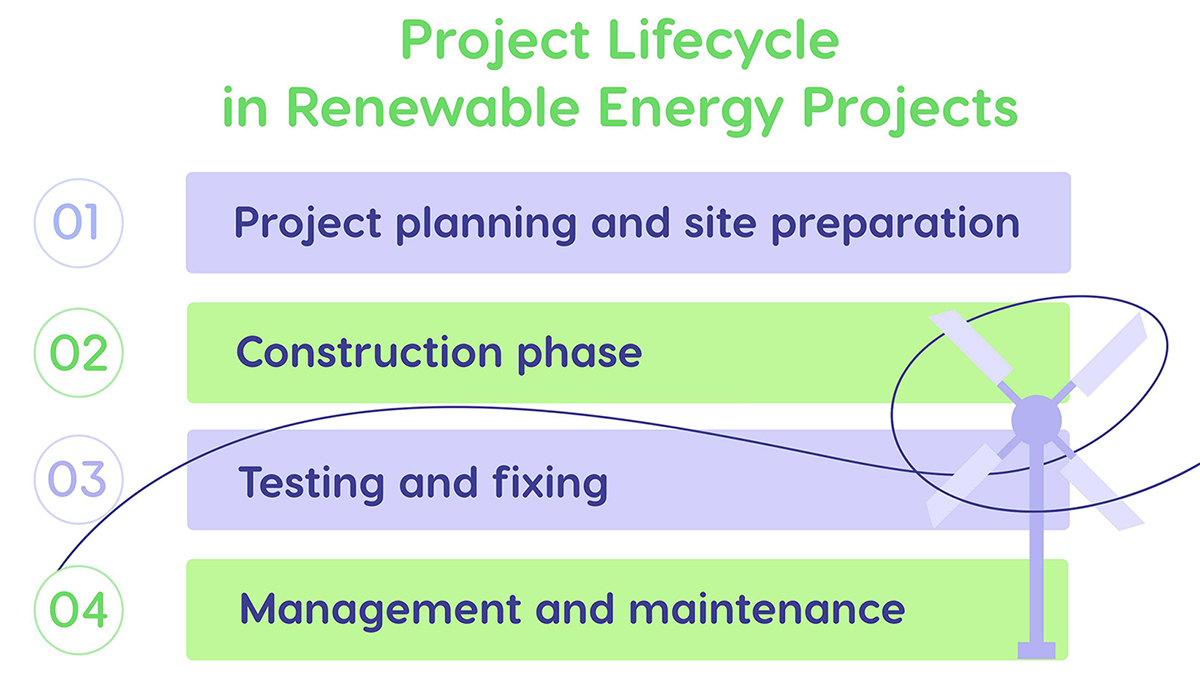
1. Project planning and site preparation.
The first stage is initial planning, where teams and project managers:
- Select a site.
- Define available natural resources there, for example, the level of solar radiation, wind speed, or water flow.
- Check environmental and social impact.
- Make necessary inspections of land.
- Align the initiative with business goals and regulations.
2. Construction phase.
Once everything mentioned above is completed, we can move to the construction stage. There, managers and teams:
- Prepare the construction site for work.
- Install all necessary infrastructure and equipment.
- Monitor the quality of work during each step.
- Create regular progress reports to track project status.
- Ensure that all activities follow safety standards.
3. Testing and fixing.
The third stage is about testing and fixing appeared issues to finalize the process. At this stage, managers and execution teams:
- Test performance to ensure everything works correctly.
- Identify and fix all malfunctions.
- Ensure connection between all system parts.
- Make final inspections and optimize processes if needed.
4. Management and maintenance.
This last stage is about continuous improvement and monitoring. To perform this effectively, managers should:
- Monitor the system’s performance regularly.
- Create the schedule of maintenance and updates.
- Apply the latest trends and technologies to stay efficient.
- Provide software updates and introduce new features.
- Ensure that the system stays competitive and maintains high performance.
Projects in renewable energy are complex by their nature: they are costly, risky, require regulatory compliance, and involve a number of complex interrelated processes. So, let’s take a look at possible challenges you may face when managing projects in this field.
Unique Challenges of Renewable Energy Project Management

According to the research, we can highlight 4 main challenges of renewable energy project management.
1. Stakeholder alignment issues.
The diversity of interests among various stakeholders may be an extremely challenging task. Investors care most about ROI, local community members prioritize environmental control, and executive teams worry about budgets and delivery schedules. This variety requires effective negotiating skills to align business strategy with the development process and ensure successful collaboration.
Read more: How to Manage Competing Priorities: 5 Effective Strategies and 5 Tips to Prevent Them
2. Cost overruns in projects.
Going over the budget is a significant problem not only in project management in renewable energy projects but in the construction industry overall. It often happens because of poor planning at the beginning, inefficient utilization of available resources, and poor risk management. In addition, one can explain it by the enormous complexity of such projects. Even one mistake can have unforeseen consequences, exacerbating risks and negative consequences. Experienced managers perform budgeting and minimize financial risks by using AI-powered forecasting software which timely detects bottlenecks and risks, helps control costs, and address issues intelligently.
3. Navigating regulatory compliance.
Adherence to the regulatory requirements and regulations is critical for project management in renewable energy, as they affect everything from environmental protection aspects to safety standards and the way that the project is operated. The renewable energy project manager must always stay up to date with local and national regulations, ensuring strict compliance with them as well as proactive communication with stakeholders and clear reporting. It is crucial for preventing penalties and delays caused by non-compliance.
4. Managing long project lifecycles.
Such projects can last many years or even decades. During this time, projects may face problems like:
- Short innovation cycles.
- Complexity of supply chain management.
- A lack of certified professionals.
- High stakes and high uncertainty.
To prevent these challenges, managers should develop a strategy based on data-driven insights, proactive risk and resource management. This will help prevent problems in advance, delivering the most value with less waste.
Project management software like Epicflow can help you prevent and overcome these challenges. It provides a set of advanced tools, from managing multiple projects and resources to advanced scenario planning and a virtual AI project manager assistant. Don’t hesitate to schedule a call with our experts to learn more about Epicflow capabilities for overcoming the complexity and uncertainty of renewable energy projects.
Best Strategies in Managing Renewable Energy Projects
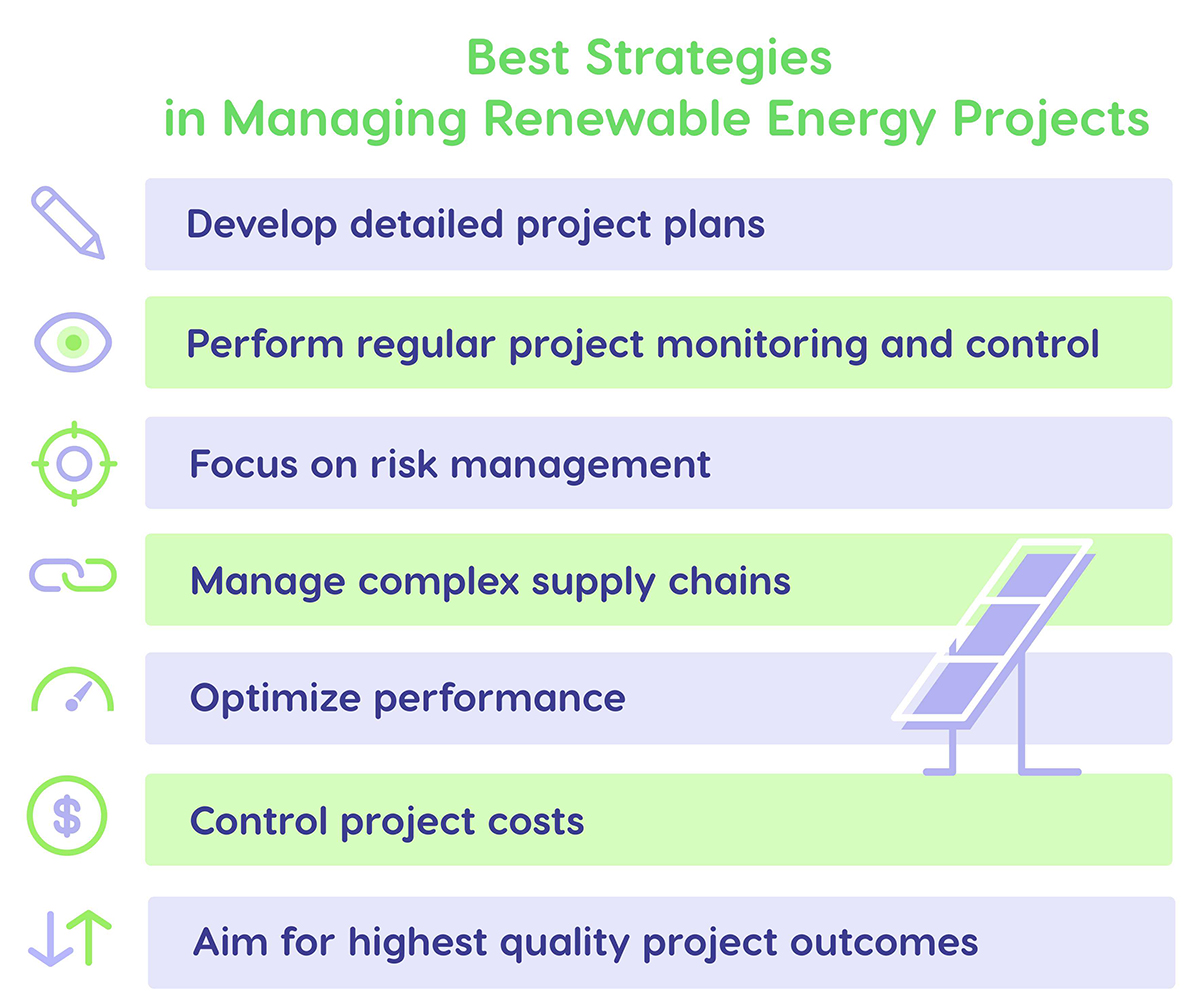
When we are already familiar with the most widespread challenges, let’s define the best strategies for project management in renewable energy. According to the above-mentioned research, the top strategies are as follows.
1. Develop detailed project plans.
Planning complex renewable energy projects should be as detailed as possible, taking all possible contingencies and uncertainties into account. Planning resources required for project completion is no less essential. It will help companies determine all resources and costs required for project completion and plan for possible risks. At the same time, planning these projects should include some buffers to protect them against uncertainties and keep them on track.
2. Perform regular project monitoring and control.
Continuous monitoring and control are vital for such complex and long-term projects as renewable energy ones that depend on various external factors, e.g., climatic conditions or multiple vendors spread across the world. Small deviations can expand into major problems that reduce profitability or delay energy generation, while constant oversight supports taking timely actions to overcome emerging problems.
Moreover, tools like Gantt charts, critical path analysis, and earned value management help energy project managers keep track of project progress and spot bottlenecks. To be aware of the state of the project environment and project performance, project managers can use analytical dashboards that provide an overview of all information about project statuses, priorities, budgets, and milestones.
3. Focus on risk management.
Proper risk management is the cornerstone of successful management of renewable energy initiatives. It’s important to create detailed risks management plans and develop strategies to mitigate negative risks and properly respond to opportunities.
Leveraging risk management software can greatly increase the effectiveness of handing risks in renewable energy projects. For example, its forecasting capabilities help predict potential bottlenecks before they escalate. In addition, tools equipped with scenario simulation allow you to test different scenarios and find out the best possible ways to mitigate risks and resolve bottlenecks.
Read more: PMO Risk Management: Best Practices for Project Success
4. Manage complex supply chains.
Managing supply chains refers to the coordination of all processes, like searching for vendors, transporting, manufacturing, and delivering the components and materials needed for the project. It may be the most vulnerable part of the project execution and the most vital at the same time. However, it can be also challenging: it depends on multiple vendors from different countries, logistics challenges, and strict regulations.
To mitigate these risks, renewable energy project manager should:
- Build strong relationships with suppliers.
- Diversify suppliers. It increases complexity, but prevents significant disruptions in project workflows.
- Implement reliable inventory management systems.
5. Optimize performance.
In complex sectors like renewable energy, improving operational efficiency and performance is a must. It allows organizations reduce operational costs, ensure efficient utilization of available resources, increase ROI, and comply with regulations and standards. What can you do to optimize performance?
- Automate processes wherever possible. Automation assists teams in freeing resources for more important tasks, minimizing the likelihood of mistakes made by humans and increasing the quality of output.
- Optimize resources: Analyze resource performance and utilization to spot bottlenecks and inefficiencies and eliminate them. Allocate resources based on their skills, capacity, and availability to ensure high productivity.
- Leverage data and advanced analytics: This will help you optimize decision-making, analyze scenarios, and make forecasts for more streamlined workflows and increased efficiency of processes.
- Set the right priorities: Prioritizing projects and tasks helps companies focus their effort and direct limited resources to the most important work for the moment and deliver it on time.
Read more: How to Prioritize Projects: Methods, Criteria & Matrix (A Complete Guide)
6. Control project costs.
But when you operate limited budgets, allocating and managing costs efficiently is a must. Here are some quick tips on cost optimization in renewable energy projects.
- Make realistic project cost estimations. Make sure that every detail is included in estimation, and a project has buffers for contingencies. This will reduce the risk of unpredicted expenditures.
- Manage changes. Before making any change, analyze what consequences and risks it might have and how they will affect project schedule, resources, and budget. It can take some time but in the end will help to avoid costly surprises.
- Prioritize work: Prioritize projects and tasks according to strategic organizational goals and give the highest priority to ones that bring more business value. It will help to maximize outcomes and deliver the most important ones on time within the budget.
- Eliminate waste and inefficiencies: Optimization of processes and resource utilization and preventing bottlenecks will contribute to cost optimization.
Cost control can be optimized by using budget control software that distributes budgets across projects and helps control its consumption and avoid cost overruns.
7. Aim for highest quality project outcomes.
Obviously, effective project management in renewable energy requires high quality of equipment, and materials used in construction and making sure that systems developed are reliable on a long-term perspective. Quality management involves:
- regular inspections,
- training teams,
- applying data and tools,
- implementing quality control processes.
These measures will help keep renewable energy projects on track and aligned with industry standards as well as deliver high quality projects outcomes.
Project Management Software for Renewable Energy Projects
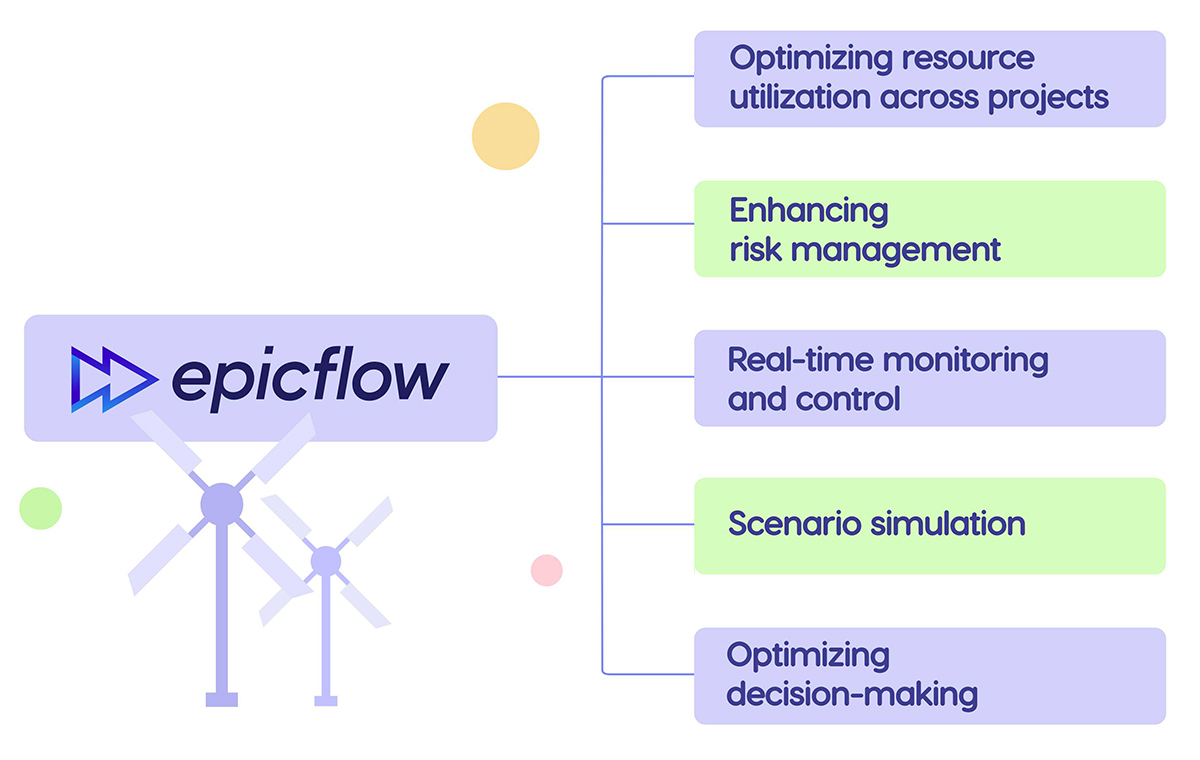
As was discussed before, project management in renewable energy requires advanced project and resource management tools, which have proven their efficiency in practice. As an example, let’s consider Epicflow, an AI-powered multi-project management solution that suits perfectly for managing renewable energy projects, bringing the best strategies to life.
- Optimizing resource utilization across projects. Epicflow enables smart utilization of available resources (human, materials, equipment) across multiple initiatives simultaneously. It provides real-time visibility into all available resources of an organization as well as has capacity planning, resource allocation and workload management capabilities. Finally, it eliminates resource bottlenecks to ensure high efficiency of available resources.
- Enhancing risk management. Often underestimated risk shows itself at the most unsuitable moment and can cause a chain reaction. Epicflow can help project managers plan for risks, develop risk mitigation plans as well as predict and prevent bottlenecks disupring the project flow.
- Real-time monitoring and control. Epicflow provides visibility through every step of project execution and the situation at the resource level. For example, its Pipeline that shows projects’ progress and milestones feasibility. Also, its dashboards help you track project budget and performance on the level of the entire portfolio. These tools let managers stay updated and time detect issues that require management attention.
- Optimizing decision-making. Epicflow has scenario planning capabilities that simplify decision making: you can play different scenarios to find the best course of action and analyze the effect of changes on your project environment.
- Delivering more with available resources: Epicflow’s capabilities aim to enable organizations deliver more work and value with resources they already have. This is achieved thanks to intelligent resource management, eliminating bottlenecks, optimizing decision-making as well as providing comprehensive monitoring and control.
This list of Epicflow’s capabilities contributes to effective renewable energy project delivery. To learn more details, you can contact our experts and see in practice how Epicflow can drive your project to success.
Future Trends in the Management of Renewable Energy Projects
1. Artificial intelligence.
Artificial intelligence and machine learning become indispensable for project management in renewable energy. Such tools as predictive analytics or AI-powered capacity management software depend on actual project data and process huge datasets to give accurate insights, helping managers and executives simplify decision-making while also enhancing risk detection and project productivity.
2. Advanced technologies.
We can now observe the growing tendency to use advanced renewable energy project management software to increase the effectiveness of planning and quickly adjust to the changes. Simple task management software and spreadsheets aren’t reliable in managing multiple concurrent processes because they are filled manually, which is time-consuming and ineffective. In addition, they lack advanced capabilities like scenario planning and automation that are vital for prioritization, risk management, and high project performance.
3. Focus on sustainable development.
This trend means that as the first steps of planning and defining specific characteristics of a project’s success, managers and executives should take into account social and ecological impact, ensuring that the project not only provides clean energy but also promotes sustainable development.
4. Agile and Lean methodologies.
These methodologies give a lot of benefits for effective project management in renewable energy. Agile is flexible and allows quick adaptation to changes. Lean is focused on delivering the most value and eliminating waste. These methodologies are a perfect match for complex projects in renewable energy field. They combine flexibility with continuous improvement and value delivery, allowing companies to grow and develop while adapting to market shifts.
Conclusion
Let’s summarize the most important statements of the article.
- The renewable projects are ones that produce energy from renewable resources such as wind, sunlight, water, etc. Their growing demand is explained by climate changes, politics, and a high level of air pollution.
- Project management in renewable energy requires detailed planning, control over execution, intelligent risk and resource management, effective change management, and decision-making.
- The main challenges that such projects can face are budget overruns because of poor planning and complexity of such projects, misalignment between stakeholders, regulatory compliance, and long-term lifecycles combined with short innovation cycles.
- To drive a renewable project to success, you need to implement efficient and detailed planning, manage risks and supply chains to avoid disruptions and delays, provide control of quality and budget, and, last but not least, optimize performance using advanced project management software.
Frequently Asked Questions
What is renewable energy project management?
Managing renewable projects is the process of planning, executing, and controlling projects that produce power from renewable resources, like wind, sunlight, or water.
What is an EPC model in renewables?
EPC model stands for engineering, procurement, and construction. It is a model of managing renewable projects where one single contractor is responsible for:
- Engineering: system’s design.
- Procurement: equipment and materials.
- Construction: building and commissioning the infrastructure.
What are the stages of renewable energy project development?
The renewable project lifecycle can be described as 4 stages:
- Project planning and site preparation stage.
- Construction stage.
- Testing and fixing stage.
- Managing and maintaining.
What are the main challenges of project management in renewable energy?
The biggest challenges of project management in renewable energy are issues in stakeholders’ alignment, budget overruns, high regulatory complexity, and difficulties in managing long-term projects.
What are the best software tools for project management in renewable energy?
Epicflow is directly designed for managing lots of concurrent and complex projects and processes, which makes it perfectly suitable for renewable energy projects. Also, it provides powerful AI tools and real-time analytics that predict risks, optimize decision-making, and help with resource management.
What are future trends in managing renewable energy projects?
From our perspective, the most promising tendencies in managing renewable energy projects are growing demand for advanced and AI-powered tools, use of Agile and Lean methodologies, and the focus on sustainability.
Why is project management so important in renewable energy?
Because project management in renewable energy helps to handle the complexity of renewable projects, operate budgets, optimize resources, and decrease the impact of potential risks. Also, efficient management helps organizations managing these projects stay competitive and expand into new markets.
What are the best practices in managing clean energy projects?
We suggest managers and executives pay more attention to cost and risk management, regular control checks, performance optimization, proper project planning, and supply chain management to deliver projects successfully and make sure they deliver value to customers and the organization itself.