Project Success Criteria Explained: Key Elements & Examples
 Victoria Sokolova
.
March 18, 2026
.
Project Management
.
24 mins READ
Victoria Sokolova
.
March 18, 2026
.
Project Management
.
24 mins READ

Successful project completion is the main goal of project management efforts, but what does project success really mean? Delivering a project on time and within budget, you may think. Yes, but that’s not enough. If you want your initiative to be successful, it’s a good idea to determine what success will look like for this particular project.
This is where project success criteria come into play. Read the article to learn more about these criteria, and how to define success criteria for a project.
Key takeaways:
- Project success criteria are the standards used to decide whether the project has been successful in the eyes of stakeholders.
- Traditionally, project success criteria refer to a project’s scope, time, budget, and quality of the deliverable.
- Defining project success criteria for each project before its beginning ensures customer satisfaction and improves risk management.
What Are Project Success Criteria?
First off, let’s clear up the project success criteria definition: they are “the standards by which the project will be judged at the end to decide whether or not it has been successful in the eyes of the stakeholders” [1]. In other words, these criteria determine if a project meets the expectations and requirements established at the beginning of its implementation, and if its outcomes satisfy customers/clients, the project managers, the team, and company executives.
Success Criteria vs Success Factors vs KPIs
When defining success criteria, it’s important to distinguish this term from other similar ones. Here are the main differences between success criteria, success factors, and key performance indicators.
| Success criteria | Success factors | KPIs | |
| Main function. | Define what success is. | Influence success. | Measure success. |
| Focus area. | Results. | Actions. | Measurement. |
| Example. | Delivery on budget. | Correct budget assessment. | Budget variance. |
Read more: 10 PMO KPIs: Essential Metrics to Drive Project Portfolio Performance
Why Defining Success Criteria Matters
You may think that when a project is completed, it’s clear for everyone if it has been successful or not. But the thing is that the concept of a successful project is rather blurred, so every project participant may interpret it differently.
For example, a project manager may consider a project to be successful when it’s completed without a delay and budget overrun. At the same time, customers who want the developed product to meet their requirements to the full may turn a blind eye to a project delay and/or cost overrun if it’s necessary to deliver the product they need. Finally, these criteria will be different depending on the industry, company, and project goals.
Let’s explore the additional benefits of determining project success criteria.
- All the parties involved in a project will have clear expectations of project outcomes.
- Defining project success criteria makes it possible to track a team’s progress towards the end goal.
- Understanding the success criteria makes it easier to recognize possible threats to the project flow and in such a way minimize risks.
- Determining project success criteria increases interaction between the project team and other stakeholders.
- Project success criteria can be used to analyze what working practices should be improved in the future. [2]
To sum up, defining the criteria for project success at the beginning will increase chances for better project outcomes at the end.
Read more: How Project Management Tools Can Improve Business Performance in 2026
How to Define Project Success Criteria
There are several approaches to determining what standards should be regarded as success criteria. For example, as stated in PMBOK Guide, the success of a project is measured in terms of completing it within the constraints of scope, time, cost, quality, resources, and risk.
According to the other approach [1], project success criteria are divided into two categories:
- Project management success criteria that show efficiency of the project management process itself.
- Project deliverable success criteria that describe the success of a product/services delivered as a result of a project.
Let’s explore how a project management office can define organization-wide success criteria for projects. Project managers, CXOs, and portfolio managers should be involved in the decision-making process. For some client-oriented projects, having a representative from a client involved can be necessary.
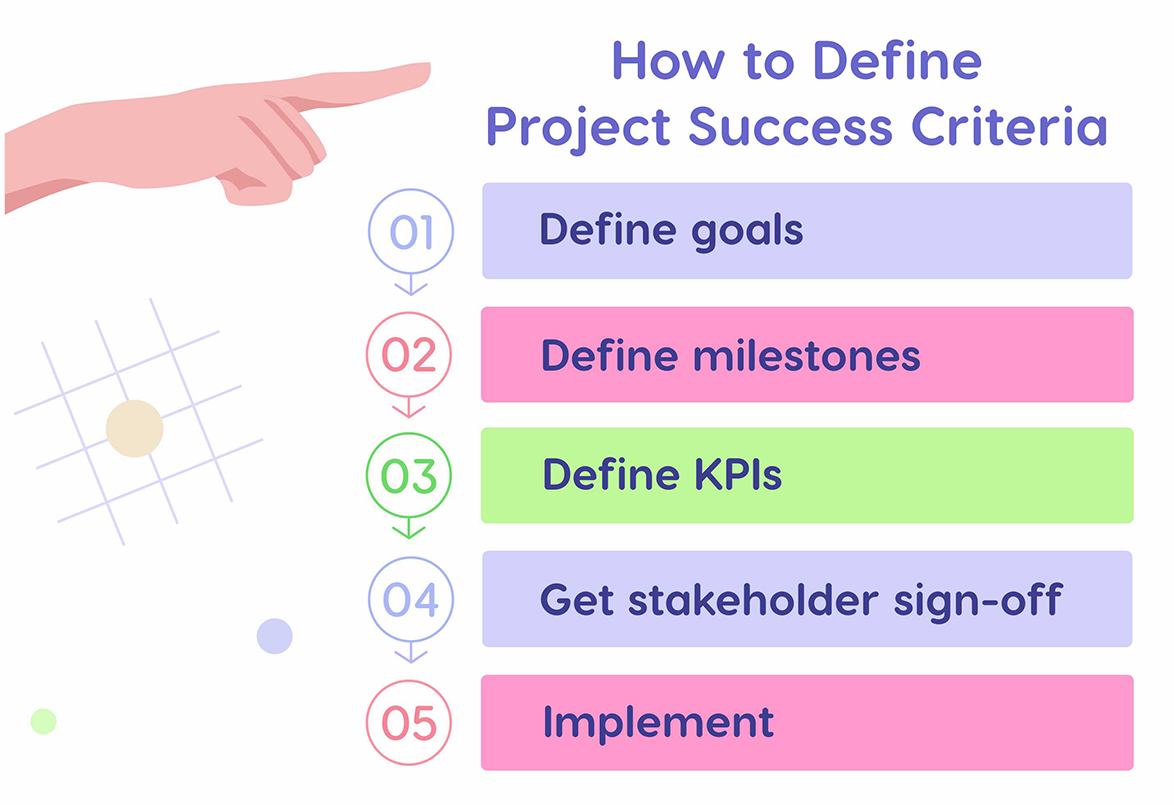
Define goals
The first thing you should define is project goals: what this project intends to achieve, both for clients and for the organization. These two can be different, but not contradictory. Let’s take a look at an example of a basic client-oriented project, developing a website.
Client-oriented project goals are:
- Develop a website that meets technical specifications.
- Develop a website that meets the list of features provided by the client.
Company-oriented project goals are:
- Maintain a margin rate of 25% or more.
- Deliver the project on time to avoid cash flow deviations and delays to further projects.
Internal R&D and governance projects might have different sets of goals and objectives.
Define milestones
Once goals are defined, you need to establish the timeline and milestones. Judging from experience with previous projects, determine when large parts of the project have to be delivered to avoid jeopardizing meeting overall project goals.
Now, success criteria start to look more concrete. Success criteria examples in project management related to milestones are:
- Project meets client brief.
- Project is in line with internal quality standards.
- Project is delivered on budget.
- Milestone 1 is met by week 1, milestone 2 is met by week 2, project delivered by week 4.
Define KPIs
Define how you’re going to monitor project progress and evaluate meeting success criteria for project management. For the example we’ve been using, this can look as follows:
- Budget burnup rate for confirming margin rates.
- Website performance metrics for confirming quality.
Define monitoring and mitigation workflows
Not all projects go as planned, and you need to monitor performance to ensure that project is on track to meet the success criteria. For example, a set of metrics in resource management software can be used to keep track of project timeline and do budget monitoring as most projects’ costs rely on billable hours as well as supplies.
Define how you are going to monitor metrics relevant to you. In many cases, tracking KPIs is enough for this, but your projects might need more industry-specific ways of monitoring progress.
Get stakeholder sign-off
Once everything is well defined, present the success criteria documentation to project stakeholders and confirm everything is in line with their vision. This step might require some persuasion or changing the project criteria for success.
Implement
Hand off the success criteria for a project to project managers in case they’re developed by the portfolio management team. Establish best practices and reporting structure to be informed about project progress.
In case you’re developing a set of company-wide criteria, it may be necessary to share workflows you’ve used to define them, so that project managers can set success criteria themselves for any upcoming projects.
Revisit project success criteria
It’s important to revisit project success criteria from time to time and analyze whether they serve their purpose well. If you find that they are unrealistic or too loosely defined, you can always change them and provide an update to all stakeholders.
How To Evaluate Project Management Success
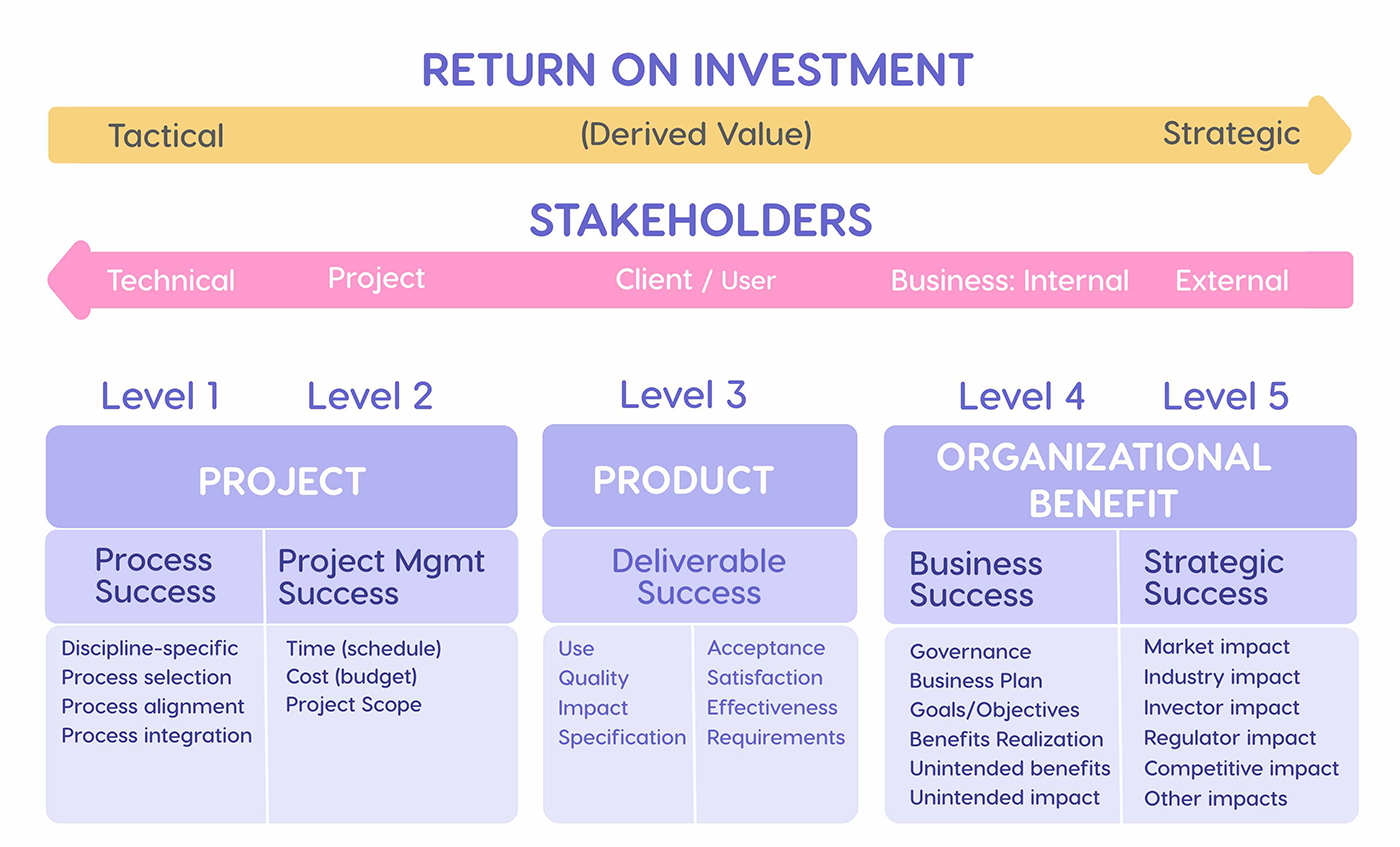
The framework embraces five levels of criteria for a successful project that make it possible to assess a project from several stakeholder perspectives at different times after the project closeout. According to it, you can define project success by the highest level of benefit that can be achieved by a project at any point of reflection. The framework covers three main areas of focus:
- the project itself (effectiveness of the processes),
- the product (or the main deliverable of the project),
- organizational benefits (achievement of business objectives, etc.).
These three milestones are divided between 5 levels to help define project success. The framework is represented in the picture below.
Let’s overview each level of the framework.
Level 1. Process success
Determining success at this level involves assessing the adequacy of the processes applied during the work on a project, their alignment with the project goals, and effectiveness for achieving desirable project outcomes. Analysis at this level provides feedback to the project team and makes it possible to use the lessons learned to improve future projects. Success at this level means that technical and managerial processes were:
- chosen appropriately for the purpose,
- aligned with the project objectives,
- integrated with each other,
- effectively implemented.
Level 2. Project management success
This level covers typical project management success criteria: cost/budget, scope (namely project, not product scope), and time/schedule. Accordingly, success at this level means that the budget hasn’t been exceeded, the scope has been fully implemented, no scope creep occurred, and project due dates haven’t been missed.
Level 3. Product success
Criteria belonging to this level refer to the product or services being delivered. As a rule, they describe both the deliverable (if it meets the requirements, specifications, and quality expectations) and customer/user satisfaction (e.g., effectiveness of the product).
Level 4. Business success
This level relates to net benefits that an organization gains from the project. It describes the degree to which the project has met the goals and objectives that motivated the investment approval and if the expected business benefits are realized. In addition, assessment of net benefits includes both unintended benefits and negative impacts arising from the investment.
Read more: The World’s First Value-Optimised Portfolio Engine
Level 5. Strategic success
This level involves the assessment of organizational benefits by external stakeholders (e.g., investors, competitors, industry analysts, etc.). Strategic success is determined by business growth and development, a company’s competitive advantage, and/or other strategic gain.
As we can see, the multilevel project success framework offers a comprehensive approach to defining project success, which makes it possible to get a broad overview of its outcomes from different stakeholder perspectives. Such an approach is especially relevant for large-scale complex projects.
3 Examples of Project Success Criteria
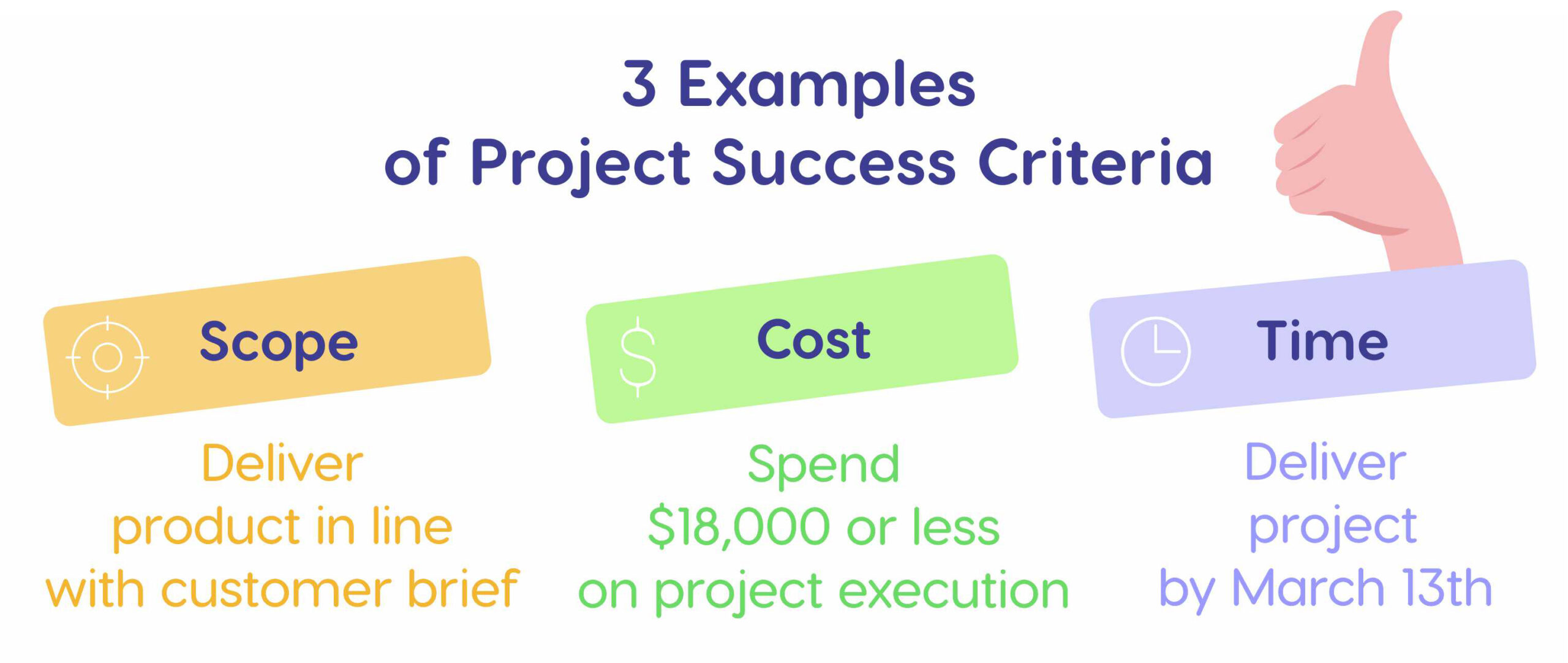
The commonly known model of project success revolves around three core areas:
- Scope.
- Cost.
- Time.
Let’s review what these areas entail and what project success criteria can be set across each.
Project scope success criteria example
Project scope is the combination of all expected deliverables, their prerequisites, acceptance criteria, and limitations that contribute to a project’s success.
For an app development project, a set of project success criteria examples in scope might look like this:
- The app contains features requested by the client.
- The app works as intended on all devices.
- The app can handle up to 300,000 users simultaneously.
- The app meets platform cybersecurity requirements.
For a manufacturing project, success criteria related to project scope can be:
- Produce 1,500 units.
- The batch meets client specifications in standardized testing.
For an R&D project in the aerospace industry, success criteria of its scope may be as follows:
- Mathematical modelling is done for the prototype.
- Prototype is manufactured.
- Prototype goes through all mandated testing.
- Test results are recorded according to company standards.
Project cost success criteria example
Project cost is the sum of the cost of human resources and supplies spent on creating a project. Typically, it only involves direct cost, as even though the final cost of a project does depend on overhead, there are no ways to influence it in the scope of a project.
For an app development project, cost-related project success criteria examples can look like:
- Spend less than $18,000 on project execution.
- Do not go over 360 billable hours.
- Do not purchase any additional software.
For a manufacturing project, these set of criteria may look like:
- Spend less than $75,000 on project execution.
- Do not go over 950 billable hours.
- Keep defect rate under 1.5%.
- Keep product failure rate under 1%.
For an aerospace R&D project, the project cost success criteria can be:
- Keep project cost under $200,000.
- Spend 730 billable hours or less on modelling.
- Spend $90,000 or less on prototype manufacturing.
- Spend less than $50,000 on testing.
Project time success criteria example
The timeline of a project delineates what is an acceptable timeframe for project completion. This might be important to meet the contractual obligations or to allow acceptance of further projects. Timelines can be broken down into milestones in case there are strict deadlines associated with delivery of certain parts of the project.
For a software development project, the timeline project success criteria examples might look like:
- Deliver project in two months.
- Deliver the app in a month and a half.
- Do the testing and bug fixes in two weeks.
For a manufacturing project, these set of criteria may look like:
- Produce and prepare units for shipment in six weeks.
- Leave a one-week buffer to compensate for supply delays and defect rate.
For an aerospace R&D project, the project cost success criteria can be:
- Finish the project in six months.
- Deliver mathematical modelling in two months.
- Create a prototype in three months.
- Finish testing in under a month.
Conclusion — Setting Your Project Up for Success
Creating project success criteria is the difference between operational chaos and clear understanding of what delivery means. To develop success criteria, you need to go through a planning process with your team that involves defining goals, milestones, and KPIs. Review the success criteria regularly to refine and improve them.
Use portfolio management software to monitor meeting operational goals and develop a quality assurance process to measure project delivery goals.
Frequently Asked Questions
What are success criteria in project management?
Success criteria in project management are a set of concrete definitions of what it would take for the project to be considered a success.
Why is it important to define success criteria at the start of a project?
Defining success criteria at the start of the project ensures that everyone is on board with the requirements of the project’s success in terms of deliverables and timeline.
Who is in charge of setting project success criteria?
Project success criteria are determined by multiple people, typically the project sponsor and key stakeholders. Some company-wide guidelines for determining success criteria can be in place.
What are examples of project success criteria?
Success criteria can be defined across several areas:
- Timeline. Finish milestone 1 by the end of the first week, finish the project by the end of the month.
- Cost. Spend $15,000 or less on project execution.
- Deliverables. Meet the client’s brief requirements.
What are common challenges in setting project success criteria?
The common challenges of defining success criteria include setting unrealistic expectations, setting unclear or untrackable goals, and navigating stakeholder disagreements.
How is project success typically measured and evaluated?
For each success criteria, a set of KPIs should be defined that allows measuring whether it’s met. For example, for cost-related success criteria, budget variance and burnup rate can be measured to see if the project is on track to meet its cost goals.
What factors contribute most to achieving project success?
Competence of the project team, clear and achievable goals, and communication define project success.
What is the difference between project success and project management success?
Project success is typically concerned with the more long-term outcomes, while the project management success definition refers to the short-term execution of the project.