Resource Management Conflicts Caused by Matrix Organizational Structure
 Victoria Sokolova
.
March 27, 2026
.
Resource Management
.
29 mins READ
Victoria Sokolova
.
March 27, 2026
.
Resource Management
.
29 mins READ

Matrix organizational structure has become common for a great number of business organizations and that’s for a good reason: it facilitates flexibility, contributes to employee engagement and retention, and lets companies utilize the potential of a diverse pool of resources. At the same time, it has some inherent limitations that can wipe out the convenience and benefits of this corporate framework. What exactly are the strengths and weaknesses of matrix organizations? And how to overcome the difficulties? Let’s dive deeper into these issues.
Key Takeaways:
- Matrix structure implies that an organization’s employees report to multiple managers – a functional manager and a project manager.
- There are three types of matrix organizations: weak, balanced, and strong.
- The benefits of matrix organizations are efficient utilization of resources, effective collaboration, flexible resource allocation, employee engagement and retention.
- The disadvantages of matrix structure of organization are resource conflicts, the risk of overloads and resource shortages, performance evaluation difficulties.
- To overcome matrix organization drawbacks, companies need to establish clear authority lines, ensure resource data visibility, monitor and balance workloads, and adopt advanced resource management software for optimum resource utilization.
What Is a Matrix Organization?
A matrix organizational structure means that a company’s employees report to multiple managers, e.g., a project (or product) manager and a functional manager. This approach makes it possible to engage resources from different departments (e.g., engineering, marketing, finance, etc.) to work on projects more effectively. Having originated in the aerospace industry, matrix organizational structure is now typical for project-based companies in manufacturing, engineering, and A&D industries. The main purpose of this organizational structure is to improve collaboration and facilitate flexibility. At the same time, it can create additional complexities and cause resource conflicts.
How Do Matrix Organizations Work?
We can represent the work of a matrix organization as the following scheme:
- Employees are part of a functional department, where they report to functional managers who are responsible for skill development.
- The same employees are assigned to one or more projects and report to a project or a program manager responsible for delivery timelines and results.
- Resources are shared across multiple projects, not a single endeavor.
- Decision making and prioritization are coordinated between functional and project managers.
When done right, matrix organization in project management improves flexibility and collaboration, helps balance workloads, and facilitates efficient utilization of resources.
For better understanding, take a look at this matrix organization chart showing a typical unit of this structure.
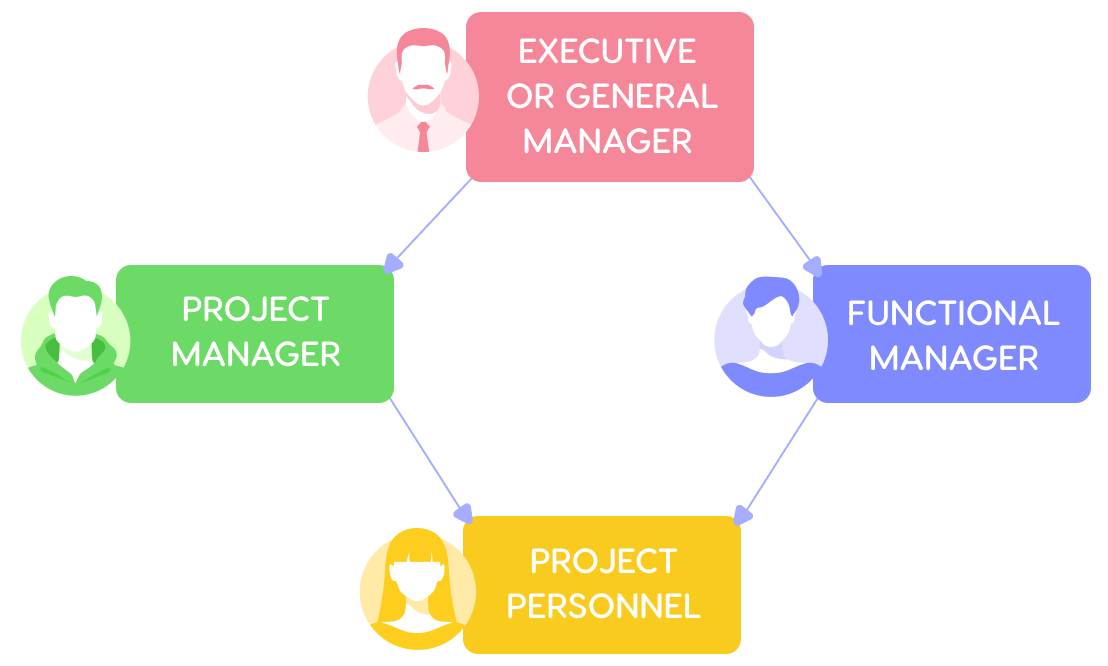
Matrix Organizational Structure Example
A software company has functional departments like Engineering, Marketing, and Finance. An engineer reports to the engineering manager who is in charge of technical standards, skill development, and performance reviews. The same engineer is also assigned to Project A and reports to its project manager. This engineer can spend 50% of time on Project A and 50% in Project B. Resources from other departments are utilized in the same way.
The resource allocation process in a matrix organization requires strong coordination between functional and project managers to balance capacity, skills, and competing priorities. As a result, the company can utilize resources efficiently, yet it requires wise coordination to prevent resource conflicts and overload.
Types of Matrix Organizations
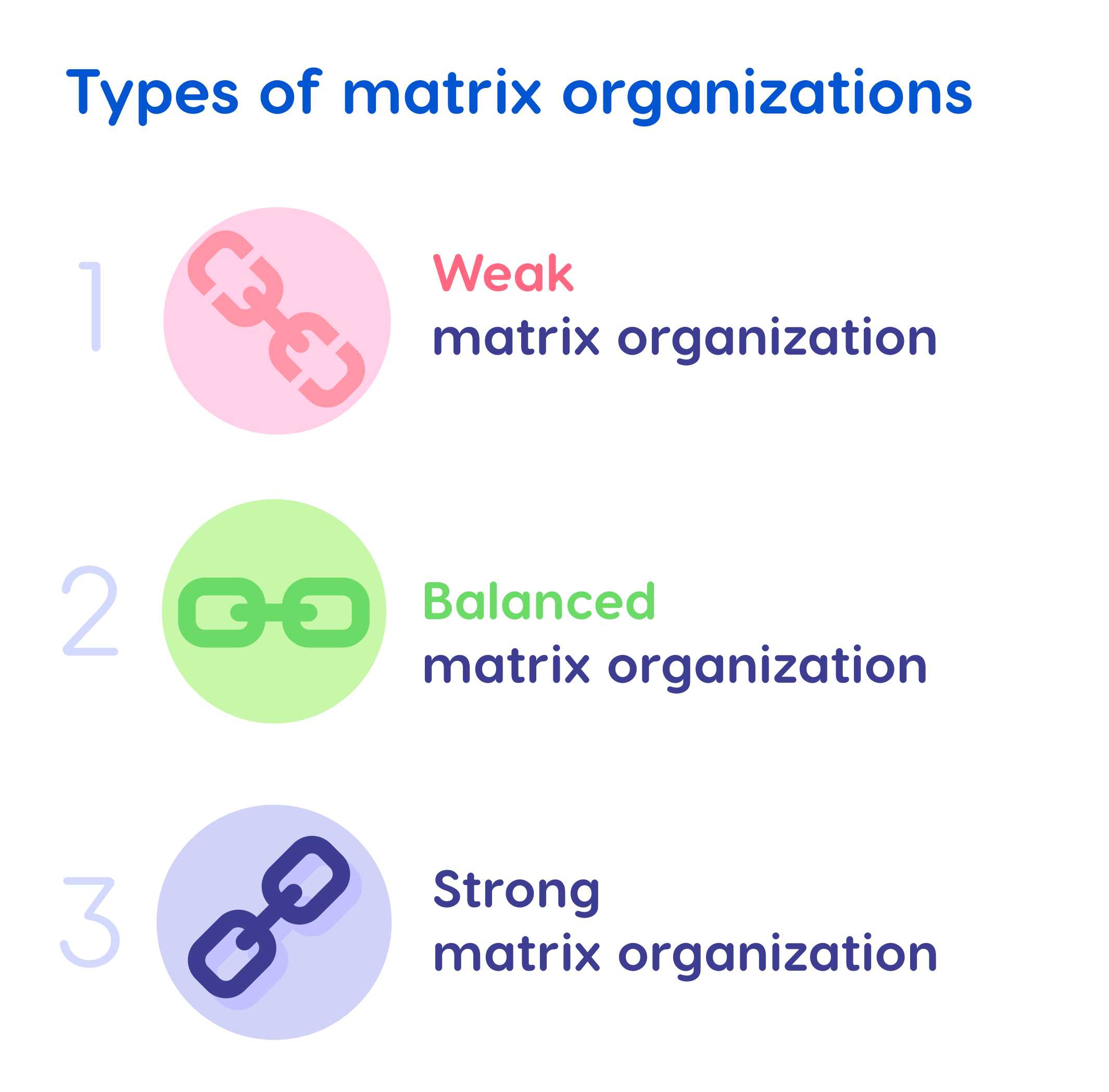
Matrix organizations can have different matrix structures in terms of the proportion of functional and project managers’ authority. This correlation depends on project needs, organizational size, or other requirements. Let’s consider some of the most common types of matrix companies.
1. Weak matrix organization.
In this case, project managers have limited power, unlike functional managers. PMs act rather as coordinators, don’t have much control over employees, and have little participation in decision-making.
2. Balanced matrix organization.
This organizational structure implies that a project and a functional manager have equal authority. They both participate in resourcing decisions, conduct performance analysis, prioritize work, etc. This type of matrix organization requires effective communication between both managers to prevent misunderstandings and conflicts.
3. Strong matrix organization.
This model of an organizational structure implies that project managers have more authority than functional managers: they are responsible for assigning resources, creating schedules, managing budgets, and administering all other project-related processes. A functional manager plays a secondary role but still manages employees from their departments and ensures their skills correspond to projects’ needs.
A matrix isn’t an all-size-fits-all solution; so let’s now review matrix organization advantages and disadvantages.
Matrix Organization Advantages

The main benefit of a matrix organization model is that it creates favorable conditions for managing complex projects and their resources. This is achieved thanks to the following factors.
Efficient use of resources
In a matrix organization, resources are usually shared across multiple projects and departments. For example, it’s impossible to hire hundreds of people to work on one large project and fire them upon completing it. So, the same pool of resources is usually engaged in multiple projects. This means that companies should optimize the utilization of available personnel, equipment, and facilities to ensure the timely completion of all project activities.
Matrix organization for portfolio management allows leadership to prioritize projects strategically and allocate resources across the portfolio based on projects’ value and resource constraints, which contributes to efficient utilization of available resources.
Effective collaboration and enhanced communication
A matrix organization structure facilitates more effective communication across departments thanks to uniting employees from various functional units. In turn, this improves collaboration between their employees. As a result, companies can take advantage of available skilled resources without the need to recruit more people, minimize silos, and increase the effectiveness of joint work.
Retention of skilled personnel
In a matrixed organization, diverse specialists stay within a company regardless of projects running in it. This also means that all the knowledge and experience obtained while working on a project stays within a company and can be used by team members for work on other projects, which facilitates more productive project work.
Employees’ engagement
Employees’ morale and engagement tend to be higher in matrix organizations for the following reasons.
- More opportunities for growth and development. Involvement in multiple concurrent projects forces team members to deal with diverse tasks and challenges, which contributes to their professional development.
- Frequent feedback. A matrix organizational structure implies interaction with different managers (a functional and project manager), which creates opportunities for receiving frequent feedback and acknowledgment.
- Communication and collaboration. A lot of communication and collaboration promote effective teamwork, a culture of mutual support, and uniting efforts toward achieving a common goal.
Flexibility in resource allocation
In a matrix form of organization, it’s much easier to adapt to changing requirements and priorities. Thanks to having access to the shared resource pool, project managers have more opportunities to find an available team member with the required skill sets. Also, the resources can be more easily reallocated in response to shifting priorities.
At the same time, a matrix organizational model isn’t a silver bullet; also has its limitations. In fact, resource management problems are one of the biggest issues of matrix organizations. Jump into the next section to consider them in more detail.
Matrix Organization Disadvantages: Resource Management Problems

The nature of matrix organizations and the need to report to different managers leads to specific resource management challenges.
Resource conflicts
Resource conflicts can be caused by the fact that project and functional managers can have their own priorities and require resources for those conflicting purposes. For example, project managers are interested in assigning a team member immediately to a project to ensure its timely completion. At the same time, a functional manager strives for their department’s productive work and requires the same team member for this purpose. This situation can result as follows:
- Project delays if a team member isn’t timely assigned to a project;
- Reduced productivity as a result of this team member’s overload;
- Bad multitasking and poor quality of this employee’s work
Finally, this results in inefficient resource utilization and failure to achieve project and organizational goals.
Uncertainty about managers’ roles
Matrix organizational structure implies that both a project and a functional manager have the same authority over an employee, which means that they can have conflicting requirements and instructions. These dual reporting lines lead to misunderstandings, blurred priorities for a team member, and confusion, which negatively impacts overall productivity and efficiency. Also, there can be potential for conflict between managers, employees’ disengagement, and missed deadlines.
Resource shortages
In matrix organizations, resource shortages may arise in the following situations:
- When a project and a functional manager have conflicting priorities;
- When there are multiple projects and unclear priorities;
- When there’s a lack of centralized resource planning and management;
- When resources are allocated based on one of the manager’s influence.
These situations are likely to result in bottlenecks, project delays, and missed opportunities for an organization.
High probability of overloading people
The dual authority structure of a matrix organization implies the employees are involved in multiple projects simultaneously. At the same time, they report to different managers and may feel the pressure to satisfy both managers even if their priorities are conflicting. Finally, if there are resource shortages, employees can be assigned more work so that the project can be completed on time. All these factors lead to employees’ stress and overload which in turn leads to bottlenecks and missed deadlines.
Performance evaluation challenges
First, assessing resource performance in matrix organizations can be challenging due to its dual reporting structure and ambiguity in employees’ accountability. Also, their involvement in multiple projects makes it difficult for functional managers to gather and objectively assess the performance data. Finally, a lack of a centralized approach and specific tools for performance assessment make it difficult to determine employees’ achievements.
How can matrix organizations overcome all these difficulties and ensure their employees are efficient and engaged and their workflows are smooth? Jump into the next section to find the answers.
Read more: Tracking Performance: Switching from Project to Resource Level
How To Optimize Resources In Matrix Organizations?
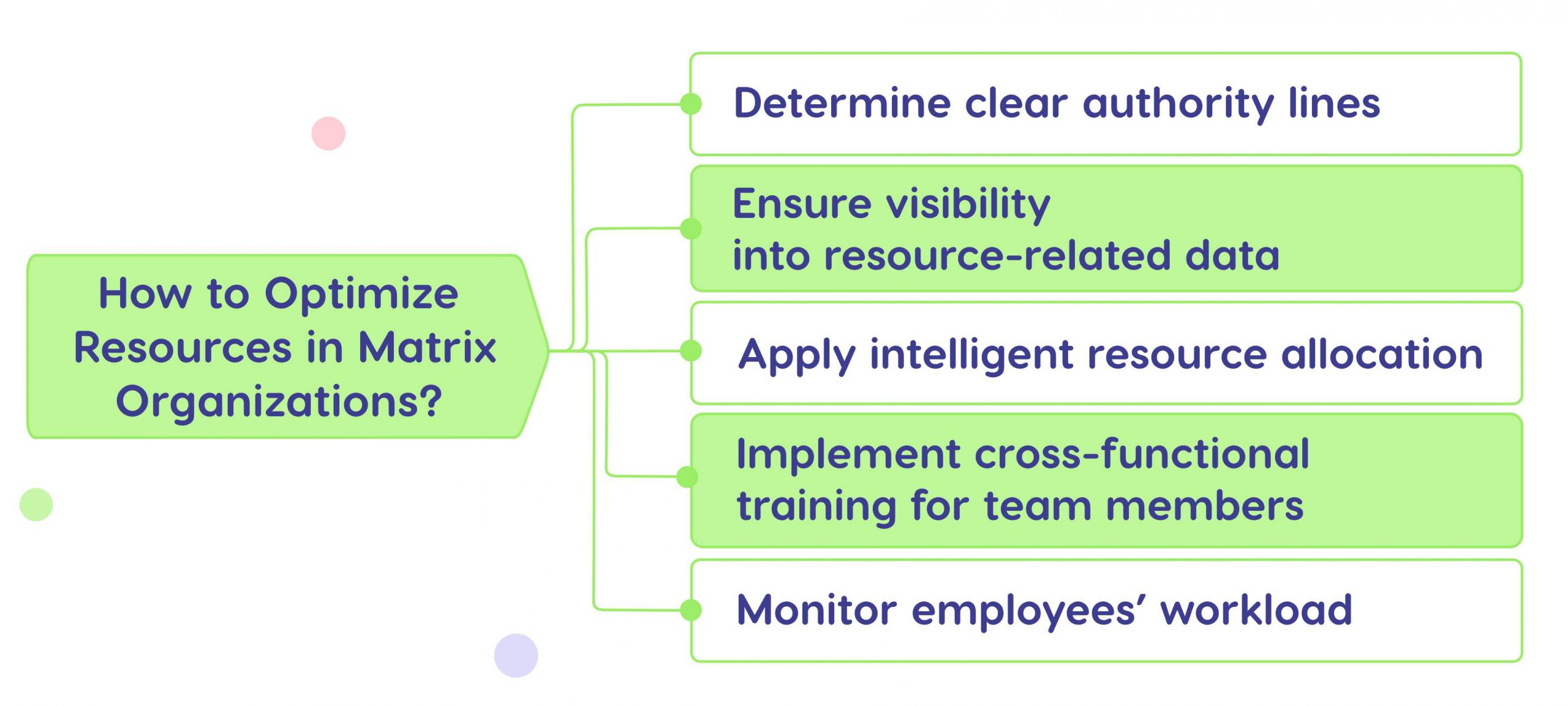
Overcoming resource management challenges in matrix organizations requires thoughtful resource management strategies. Let’s briefly review some actionable tips that will set the direction for your further optimization efforts.
Determine clear authority lines
It’s critically important to define the decision-making authority of both functional and project managers. It will eliminate potential conflicts and help employees determine the right priorities. Clear authority also improves accountability among shared resources.
Ensure visibility into resource-related data
Comprehensive resource visibility is crucial for effective resource planning, allocation, and performance analysis. Without accurate, real-time data, managers risk overloading teams or misallocating key resources. Also, centralized visibility facilitates better coordination between managers.
Apply intelligent resource allocation
To distribute resources fairly and efficiently, you should allocate them to projects in line with their skills, capacity, and availability. This will increase their productivity and eliminate the probability of resource conflicts and shortages. Relying on a robust resource management system helps allocate resources effectively and quickly find the right person even in large organizations with thousands of employees involved in projects.
Implement cross-functional training for team members
Cross-functional training will help employees work effectively across different departments within an organization. This will add to flexibility, prevent resource shortages, optimize decision-making processes and problem-solving as well as increase the efficiency of work. Additionally, it improves overall organizational resilience and makes it less vulnerable to resource shortages.
Monitor employees’ workload
Regular assessments of employee workload can help managers detect and eliminate the sources of bottlenecks. As a result, employees won’t be stressed and snowed under, and the workflow will be smooth without bottlenecks and delays.
Almost all these activities require an intelligent workforce planning software preferably with AI-powered functionality. Epicflow is one of them, and here’s how matrix organizations can benefit from it.
Effective Matrix Management with Epicflow Solution

Epicflow is a multi-project resource management tool specifically designed to handle the complexities of multi-project environments, which makes it particularly valuable for matrix organization challenges. The solution can provide them with the following benefits.
Efficient resource allocation.
Epicflow’s resource allocation advisor automatically suggests the right person to assign to a task based on their skills, capacity, availability, experience, and other attributes. All this data is kept in the system and is quickly accessible when needed.
Dynamic prioritization.
Epicflow dynamically prioritizes tasks across the whole project environment, allowing employees and managers to focus on high-impact activities. This reduces the tension between competing projects, ensuring timely delivery without overwhelming resources.
Capacity-driven portfolio optimization.
Epicflow’s AI-driven portfolio optimizer allows for prioritizing initiatives with the highest potential for business value delivery based on current resource constraints. This helps direct limited resources to really important projects, while minimizing resource conflicts and the risk of overload.
Capacity planning and workload balancing.
Epicflow’s capacity planning tool provides visibility into each team member’s workload, helping prevent resource overuse and bottlenecks. This enables functional and project managers to make data-driven decisions on resource allocation.
Efficient collaboration.
Communication within matrix organizations is crucial, and Epicflow’s collaborative features help synchronize project teams across functional departments and provide them with a single source of truth. Managers can track progress, share updates, and resolve issues more efficiently, reducing bottlenecks and enhancing overall productivity.
Comprehensive performance monitoring.
Epicflow’s capabilities provide insights into resource output vs. capacity, project progress, and workload distribution. This allows managers to track performance, identify bottlenecks, and make adjustments proactively.
Therefore, using a tool like Epicflow helps matrix organizations achieve balanced and efficient resource utilization, minimize conflicts between managers, and ensure successful project completion. Contact us to learn how leveraging Epicflow can drive your organization’s productivity and improve overall business performance.
Conclusion
Matrix organizations have gained popularity thanks to their flexibility, cross-functional collaboration opportunities, and the possibility to tap into a diverse resource pool. At the same time, this type of organizational structure has limitations, and most of them are related to resource management: resource conflicts, resource shortages, overloads, challenges in assessing resource performance, and more. The key to these challenges can be the adoption of a reliable AI-driven resource management solution like Epicflow, which helps optimize resource utilization, provides visibility into the whole pool of resources, sets the right priorities, and prevents resource conflicts. With such software, you can take advantage of a matrix organizational structure and improve your project management and business performance.
References
- Wigert, B. (2021). Too Many Teams, Too Many Bosses: Overcoming Matrix Madness. Gallup. Retrieved from: https://www.gallup.com/workplace/354935/teams-bosses-overcoming-matrix-madness.aspx
Frequently Asked Questions
What is a matrix organizational structure?
A matrix organizational structure is a model where employees report to both functional managers and project or program managers, and share responsibilities across multiple projects.
What are types of matrix organization structure?
There are three types of matrix organization structure: weak, balanced, and strong. In a weak matrix structure, a project manager’s role is limited; a balanced matrix organization implies that a functional manager and a project manager have equal authority; a strong matrix means that more authority goes to a project manager rather than to a functional manager.
What are the problems with matrix organizational structure?
The main problems of matrix organizational structure include unclear authority, resource conflicts, overloaded employees, increased risk of burnout, and complex performance evaluation.
Why does a matrix structure create resource management conflicts?
Conflicts arise because resources are shared across projects, priorities compete, and decision-making authority over people and workloads is often unclear.
Can resource management software help resolve resource conflicts in matrix organizations?
Yes. Resource management software provides real-time visibility, supports data-driven decision making, and helps balance workloads across shared resources.
How can organizations reduce resource conflicts in a matrix setup?
Resource conflicts can be reduced through centralized resource planning, transparent prioritization, clear role definitions, and cross-functional alignment.