A Guide to Aerospace Risk Management: Frameworks, Processes & Examples [2026]
 Victoria Sokolova
.
Updated
.
Project Management
.
28 mins READ
Victoria Sokolova
.
Updated
.
Project Management
.
28 mins READ
![Epicflow – A Guide to Aerospace Risk Management: Frameworks, Processes & Examples [2026]](https://www.epicflow.com/wp-content/uploads/2022/06/Risks-of-Aerospace-Engineering-Projects_1-1024x640.jpg)
The aerospace sector deals with mostly large-scale and highly complex projects, which makes it particularly sensitive to risk. Even minor risk can escalate quickly and affect safety, project timelines, and overall performance. When not managed properly, these risks can impact people’s safety and lead to considerable financial losses.
So, the importance of aerospace risk management cannot be overestimated – it’s better to stay ahead of all possible threats to your project.
What are the most typical risks associated with aerospace projects, and how to manage them effectively? Let’s figure it out in the article.
Key Takeaways:
- Aerospace risk management the process of detecting and mitigating risks in aerospace projects to ensure their successful completion and compliance with regulations and high safety standards.
- Effective risk management in aerospace projects and programs helps maintain safety focus, prevent production delays and cost overruns.
- The aerospace sector uses industry-specific risk management frameworks: NASA Risk Management Framework, EASA Risk and Safety Frameworks, or AS9100 Risk-Based Quality Management Standard combined with project risk management standard.
- To manage risks effectively in aerospace projects, organizations need to implement risk management frameworks (both project management and industry-specific), gain real-time visibility into workflows and processes, and monitor risks continuously throughout the project lifecycle.
What is Aerospace Risk Management?
In the project management context, aerospace risk management is a structured process that involves identifying, analyzing, and mitigating risks within aerospace projects to ensure successful delivery, regulatory compliance, and operational safety. Due to the complexity of aerospace programs and projects, long development cycles, and strict certification requirements, risk management in the aerospace industry becomes particularly important.
Unlike traditional project risk management, aerospace industry risk management must address industry-specific challenges like technological complexity, safety-critical system failures, supply chain disruptions and dependencies, constantly evolving regulatory standards, etc. If not managed properly, these risks can disrupt project and program timelines, increase budget, and reduce overall performance.
Why is Aerospace Risk Management Important?
We know how important it is to manage risks in projects. But when it comes to aerospace projects and programs, the significance of risk management increases exponentially. Below, we’ll explain the importance of aerospace risk management through the prism of aerospace projects’ peculiarities.
Focus on safety.
Safety is the top priority for the aerospace industry, and even minor failure can lead to catastrophic outcomes, where people’s lives are at stake. Effective risk management helps identify failure points early and reduce the likelihood of accidents.
High costs.
Aerospace projects are characterized by huge budgets, long development cycles, leveraging expensive materials and technology. Without proper risk management, delays can be super-costly and project ROI can collapse.
Project complexity.
Aerospace projects and programs often take years or even decades and involve multiple stakeholders, changing requirements, and deal with complex supply chains across the globe. This complexity increases uncertainty, which should be addressed to keep projects on track.
Strict regulatory standards.
Aerospace projects and programs must comply with regulations from authorities. Improper risk management can result in certification delays, legal consequences, or even inability to launch a product.
Supply chain vulnerabilities.
Aerospace projects depend on specialized suppliers. Supply chain risks include component shortages, quality issues, geopolitical disruptions, etc. Managing this kind of risks helps prevent bottlenecks and production delays.
Aerospace Risk Management Standards and Frameworks
To address the complexity of aerospace risk management, organizations should implement a comprehensive approach and apply specific risk management standards and combine them with project risk management. Let’s consider them in more detail.
NASA Risk Management Framework
The NASA Risk Management Framework is widely recognized in the aerospace sector for handling highly complex and high-stakes projects and their risks. It emphasizes continuous risk identification and tracking, quantitative risk analysis, and integration of risk management processes in the project lifecycles. This framework is particularly valuable for large-scale aerospace programs, high-uncertainty R&D projects, and mission-critical system development.
FAA Risk Management Handbook
The Federal Aviation Administration (FAA) promotes Safety Risk Management (SRM) guidance for aviation projects. It focuses on identifying hazards, assessing their severity and likelihood, and implementing safety controls during flight operations and aviation activities. Project managers can still apply SRM principles during testing and certification phases and operational readiness planning.
EASA Risk and Safety Frameworks
The EU Aviation Safety Agency provides regulatory guidance for risk and safety management in European aerospace projects. These frameworks support compliance with certification requirements, risk-based decision making, safety assurance throughout the project lifecycle. They are especially relevant for aircraft development and approval in European markets.
AS9100 Risk-Based Quality Management Standard
AS9100 is an international standardized quality management system for the aerospace industry, which aims to improve safety and reliability of aerospace products. Risk management is an essential part of the standard: it incorporates risk-based thinking into all aspects of projects and production processes. In contrast to traditional risk management frameworks, this standard embeds risk management directly into operational and project workflows, which is critically important for managing risks in aerospace projects.
PMBOK Risk Management
The Project Management Institute outlines risk management processes in their PMBOK Guide, which is widely used for managing projects across industries, including aerospace. It provides the project management backbone for aerospace projects, while industry-specific frameworks add technical and regulatory layers.
Taking an integrated risk management approach and combining frameworks allows aerospace project managers to manage both technical and project risks, ensure compliance with regulatory standards, and at the same time maintain control over cost, schedule, and performance.
Main Risks Affecting Aerospace Projects
There are various classifications of risk types and categories. Speaking about the risk-bearing events affecting aerospace projects, we can divide them into three groups: project management, engineering risks, and those that are typical for the aerospace and defense industry. Let’s take a closer look at each of the groups.
Project management risks
These are the factors that can create roadblocks for the successful management of any project regardless of the industry. They touch upon the following project management areas:
- Planning (e.g., developing a poor project plan),
- Executing (e.g., unfeasible milestones, unavailability of a critical employee),
- Estimating (e.g., unrealistic or inaccurate estimates),
- Communicating (miscommunication between the project participants). [1]
There’s no doubt that these challenges can significantly hamper the workflow.
Engineering risks
Risk management is aerospace development covers the following issues.
Changes in regulations and standards.
Aerospace engineering projects must strictly comply with standards and regulations, so any changes in them will result in rework and a project delay.
Probability of accidents.
This mostly refers to the aerospace manufacturing process. For example, welding can be dangerous for workers; assembling an air- or a spacecraft involves moving large-scale parts from one facility to another, working on the top of an air-/spacecraft increases chances for accidents and/or employees’ injuries.
Problems with outsourced parts.
They can be delivered with delays, be defective or ill-fitting. [2]
Digital technology implementation
Aerospace companies have been actively embracing digitalization during recent years. Apart from numerous benefits, this process is accompanied with certain risks, too. First, there can be a lack of enough digital workforce to staff projects, which is a typical challenge for initiatives that require implementation of digital technologies. Second, people may require more time to get used to working with innovation technologies and equipment, which may lead to project delays. Finally, increased digitalization carries cybersecurity risks that can put sensitive data as well as a project’s safety at stake.
Read more: Digitalization of Aerospace Engineering: Main Difficulties and Ways to Overcome Them
Industry-specific risks in aerospace projects
Volatility in the geopolitical and economic environment.
The aerospace and defense industry is highly sensitive to geopolitical and economic uncertainty. Ongoing geopolitical conflicts, trade restrictions, sanctions, fluctuations in energy and raw material prices, and inflation can significantly affect project stability. In aerospace projects, these factors can result in budget overruns, supply disruptions, and schedule delays.
Managing the supply chain.
The A&D supply chains are complex and involve many different types of suppliers, which increases the dependence of A&D organizations on them. Issues with the supply chain lead to poor quality of products and delays in aerospace projects.
Competition at the domestic and international markets.
Large aerospace companies (Boeing, Airbus, Lockheed Martin) hold a significant market share, which poses additional challenges for smaller players in terms of staying competitive. For aerospace project management this means cost constraints and increased performance expectations.
Talent management challenges.
The aerospace and defense industry continues to experience talent challenges, e.g., a limited number of tech-savvy employees, competition for them with technology companies; a significant number of people is reaching the age of retirement, but the younger generation cannot replace them quickly enough. For aerospace projects this results in resource shortages, delays in execution, and reduced productivity.
Exposure to cyber risks.
As mentioned earlier, these risks are caused by increased connectivity and digitalization. These risks can affect sensitive data, system integrity, and overall project safety.
Risks defined by AS9100 standard
The standard doesn’t determine a fixed set of risks, but emphasizes three critical areas where risks should be actively managed.
- Product safety: It involves the safety of the production process and the staff involved in it as well as the safety of the end product and in turn the end user.
- Input acquisition and prevention of counterfeit parts: Sub-par materials will inevitably affect the quality of the final product making it dangerous for the end users.
- Customer satisfaction: Building an air-/spacecraft costs millions of dollars, so the end product must meet the customers’ requirements to the full; otherwise, aerospace manufacturers will face huge losses. [3]
In the project management context, these areas translate into continuous risk identification, strict quality control, and alignment with customer and regulatory requirements throughout the project lifecycle.
Implementing Risk Management In Aerospace Projects

Effective aerospace risk management requires a systemic approach that combines industry best practices with project management methodologies. So, we’ll consider two sides of aerospace risk management: managing project risks and operational risk management outlined in the aerospace quality management standard AS9100.
Project risk management
The traditional approach to managing project risks is applicable to aerospace projects, too. Due to their complexity, long development cycles, and strict regulatory requirements, this process must be applied consistently throughout the entire project lifecycle, from design to development. The aerospace risk management process typically includes the following steps.
Step 1: Planning for risks
As part of a project management plan, a project manager or an engineering team develops a risk management plan that includes all necessary information for the project team: the goal and objectives of the risk management process, necessary tools and techniques, documentation, reporting, responsibilities and roles.
Step 2: Identifying risks
To identify possible project risks, it’s reasonable to analyze historical data, consult stakeholders and the project team as well as perform simulations. The classifications of risks mentioned in the previous section will also be useful to determine possible threats.
Step 3: Analyzing risks
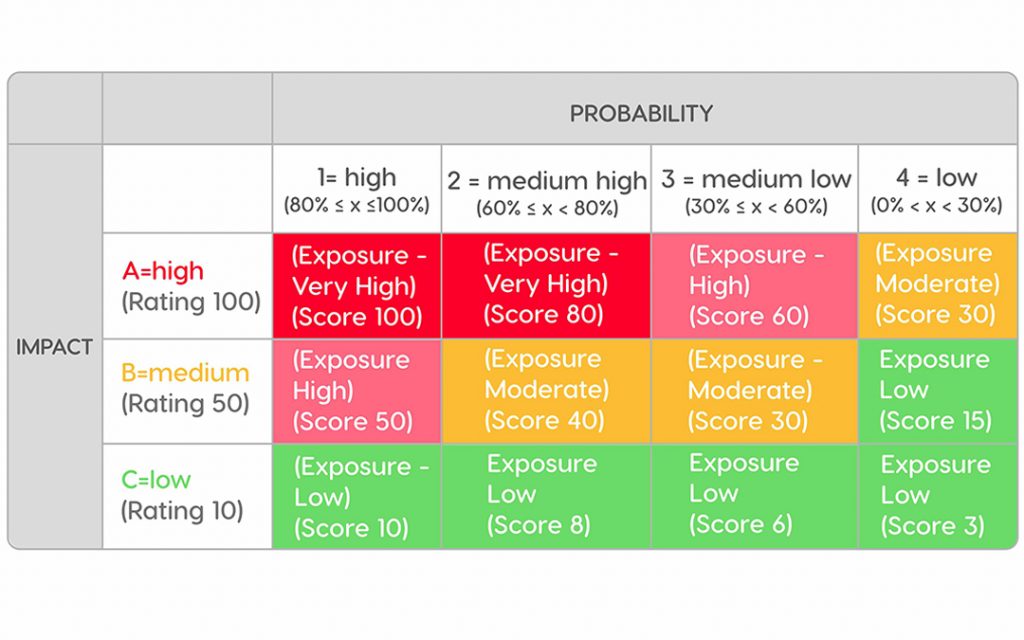
Risk analysis involves estimating the probability of risk occurrence and the impact of the defined risks. The estimation implies performing qualitative and quantitative analysis. The results can be represented in the form of a risk matrix which is given below as an example.
Step 4: Developing risk response strategies
There are four possible strategies of responding to risk-bearing events:
- Acceptance: no actions are taken to mitigate a risk;
- Avoidance: trying to eliminate the cause of a risk;
- Mitigation: taking actions to minimize the negative impact of a risk on a project;
- Transfer: sharing a risk with another party.
Step 5: Monitoring and controlling risks
It’s an iterative process that includes the following actions:
- Identification of any new risks and planning for them;
- Review of the existing risks to check if they require reassessment or if other risks have become critical over time, etc.;
- Risk reclassification if necessary;
- Risk reporting (basically, this can be done with the help of a risk register). [4; 5]
This was the standard framework for managing all possible project risks. However, it can be not enough given the nature of aerospace engineering projects.
To ensure that monitoring risks can be done effectively, organizations need to improve traceability of risk assessment procedures and other related workflows. This ensures that in case something goes wrong, there’s clear information on how company processes are structured and where a mistake was made. It also is an audit-readiness requirement in some standards such as AS9100.
As we’ve mentioned before, developing products in the aerospace sector is guided by the AS9100 quality management system, where risk management is given a particular emphasis. Let’s explore this approach in the subsection below.
Operational risk management
While project risk management focuses on individual projects, operational risk management extends across the entire organization. It addresses the uncertainties and hazards that arise in day-to-day business activities.
The AS9100 standard explains the need for operational risk management by the complexity of aerospace and defense products and services and the severity of consequences of potential failures. The process aims to achieve the following goals: to get an insight into risk impacts on operational processes as well as to make decisions on operational processes and ways to manage potential undesired effects.
Operational risk management poses the following requirements to aerospace organizations:
- assigning responsibilities for managing risks (team members, teams, or a department);
- defining the risk criteria (likelihood, consequences, risk acceptance);
- identifying, assessing, and communicating risks (possible risk-bearing events should be immediately communicated to corresponding people);
- identifying, implementing, and managing risk mitigation actions where possible;
- accepting remaining risks (some risks cannot be either mitigated or avoided).
Also, the AS9100 standard dwells upon the concept of risk-based thinking. It can be considered as “an extended version” of risk management, as it should be applied throughout the whole organization, not just for projects. Companies should consider what risks they come across at every stage of their operational processes and manage them continuously at the organizational level. Importantly, standard emphasizes that risks should be regarded both as unfavorable events and opportunities for growth. [6]
What is also important is that risk-based thinking doesn’t exclude project risk management, but makes it possible to implement it on the level of the whole organization and increase its efficiency.
Why Does Aerospace Risk Management Fail?
Risk management in aviation is a difficult process and can break down due to several reasons:
- Poor risk visibility. When data on risk is siloed and spread between multiple risk management tools, risk managers can lose track of relevant data and make misinformed decisions.
- Poor risk verification. When identified risks are not tested and verified to assess their possibility and severity, it leaves decision making to opinions, not facts.
- Poor risk response times. When identified risks are not acted upon, this puts risk management in a difficult position where potential improvements may be realized too late to avoid consequences.
- Poor real time data collection. When your risk management solution can’t effectively collect data in real-time, risk prevention may lag behind consequences instead of being proactive.
Aerospace Risk Management Example: NASA Artemis Mission
The Artemis program is one of the most complex aerospace projects in recent decades, as it’s aiming to return humans to the Moon and enable long-term space exploration. Due to its scale, technological complexity, novelty, and safety requirements, it provides a strong example of how aerospace risk management looks like in practice.
When NASA launched its Artemis program, they faced a typical challenge of aerospace projects – managing extreme uncertainty. After the uncrewed Artemis I mission, engineers noticed something unexpected: the Orion spacecraft’s head shield (designed to withstand the intense temperatures) showed signs of material loss. This was a risk that couldn't be ignored.
This forced NASA to pause and investigate. They analyzed flight data, ran simulations, and performed additional testing to understand what had happened.
To mitigate this risk, NASA adjusted the spacecraft’s reentry trajectory and continued ground testing to validate the heat shield’s performance. What is important is that Artemis II, the first crewed mission, was positioned not as the final step, but also a test mission to reduce uncertainty and risk before future lunar landings. [7; 8]
This reflected a broader approach to aerospace risk management:
- Identifying risks early, even if they seem minor;
- Analyzing them thoroughly using real mission data;
- Mitigating them through testing and design adjustments;
- Validating step by step rather than taking unnecessary risks.
Notably, each Artemis mission becomes not just a milestone, but a way to reduce risk for the next one. These missions highlight that aerospace risk management is a continuous, data-driven, and iterative process.
Now, it’s time to consider the final component of effective risk management in aerospace projects
Risk Management in Aerospace Industry with Epicflow
Effective risk management in aerospace projects depends not only on frameworks and standards, but also tools and execution data. In complex aerospace programs with multiple interdependent projects, resource constraints, and strict deadlines, tools like Epicflow helps project managers turn risk management from a reactive activity into a continuous and data-driven process.
Epicflow is multi-project resource management software developed for addressing the complexity of dynamic and resource-constrained multi-project environments. Here are some examples of its risk management support for complex aerospace projects.
- Proactive risk management: Epicflow forecasts project outcomes based on real capacity and highlights potential delays and feasibility issues before they occur, which allows teams to proactively address risks rather than react to their consequences.
- Preventing workflow disruption: The system continuously monitors resource loads and bottlenecks and offers comprehensive support in eliminating them, which reduces the risk of cascading delays and even project failures.
- Supporting decision making: Epicflow’s What-if analysis helps managers simulate changes (e.g., adding more projects, reallocating critical engineers) and make more confident decisions under conditions of uncertainty and change.
- Improving predictability and on-time delivery: Epicflow ensures full portfolio visibility and dynamic prioritization to improve flow efficiency and increase the likelihood of timely delivery in complex aerospace projects.
- AI-assisted risk-based portfolio optimization. Epicflow Portfolio Optimizer helps A&D managers analyze and sequence projects based on risk assessment, resource availability, and business benefits.
- Financial risk management. Epicflow allows to analyze the financial side of resource utilization and consider it during resource planning.
Therefore, Epicflow strengthens aerospace risk management by means of connecting project data, improving resource management and portfolio visibility, and eliminating bottlenecks. This helps aerospace organizations identify risks earlier, reduce uncertainty in execution and decision making, and improve delivery performance in complex aerospace projects.
Contact Epicflow experts to learn more about Epicflow’s assistance for complex aerospace project and risk management.
References
- Bell, Megan. Risk Types in Project Management.
- Pittman, Bruce. (2019). Risk Management in Engineering.
- Dawson, Scott. (2019). AS9100 Biggest Risks.
- Roseke, Bernie. (2012) Crash Course in Engineering Risk Management.
- Lavanya, N. & Malarvizhi, T. (2008). Risk analysis and management: a vital key to effective project management.
- Aerospace Standard. (2016). Quality Management Systems – Requirements for Aviation, Space, and Defense Organizations. Rev. D
- Erika Peters. NASA Identifies Cause of Artemis I Orion Heat Shield Char Loss. Retrieved from: https://www.nasa.gov/missions/artemis/nasa-identifies-cause-of-artemis-i-orion-heat-shield-char-loss/
- Abbey A. Donaldson. NASA Shares Orion Heat Shield Findings, Updates Artemis Moon Missions. Retrieved from: https://www.nasa.gov/news-release/nasa-shares-orion-heat-shield-findings-updates-artemis-moon-missions/
Frequently Asked Questions
What is aerospace risk management?
Aerospace risk management is the process of identifying, analyzing, and mitigating risks in aerospace projects to ensure safety, regulatory compliance, and successful delivery. It combines project management practices with industry-specific standards to manage technical, operational, and external risks.
What are the main risks in aerospace projects?
The main risks in aerospace projects typically include project management risks (e.g., poor planning, resource constraints), engineering risks (e.g., regulatory changes, design complexity), industry-specific risks (e.g., supply chain disruptions, geopolitical factors).
What is the aerospace risk management process?
The aerospace risk management process usually includes the following steps:
- Planning risk management
- Identifying potential risks
- Analyzing their probability and impact
- Developing mitigation strategies
- Monitoring and controlling risks throughout the project lifecycle.
What is the AS9100 risk management clause?
AS9100 is a risk-based quality management standard for the aerospace industry that integrates risk-based thinking into all organizational processes. It requires aerospace organizations to identify, assess, and manage risks related to product safety, supplier quality, and customer requirements throughout operations.
What is aerospace risk management software?
Aerospace risk management software is a digital solution that helps aerospace organizations identify, assess, monitor, and mitigate risks across projects and operations. An example of such a tool is Epicflow. It assists with managing aerospace risks by providing visibility into project performance, optimizing resources, identifying and eliminating bottlenecks, and facilitating informed decision making. This enables early risk detection and mitigation as well as better project predictability.
What is the difference between aerospace risk management and aviation risk management?
Aviation risk management focuses on flight operations, air traffic control, and aircraft maintenance and safety procedures. Aerospace risk management covers a broader scope: aircraft and spacecraft, engineering and manufacturing, project and program risks, supply chain, R&D.