Product Portfolio Matrix: How to Build & Use the BCG Model
 Mykhailo Kulakov
.
May 20, 2026
.
Project Portfolio Management
.
23 mins READ
Mykhailo Kulakov
.
May 20, 2026
.
Project Portfolio Management
.
23 mins READ

An average enterprise typically has more products and product ideas than investment funds. The question that lies before leadership is how to distribute the investments to reach more market share, more cash flow, and more revenue.
Among many ways of making that decision, the product portfolio matrix is one of the most popular and convenient ones. In this article, we’ll explore how you can create a BCG product portfolio matrix and use it to drive strategic decisions.
Key takeaways:
- A BCG product portfolio matrix is a strategic decision-making tool that maps products across the axes of market share and growth rate.
- It can help define product investment strategy, cash flow streams, and liquidation decisions.
- The limitations make it difficult to employ it in fast-growing markets and require considering other factors like resource constraints to make better decisions.
What Is a Product Portfolio Matrix?
A product portfolio matrix, also referred to as growth share matrix, is a strategic decision making tool that maps existing and planned products across several axes to evaluate their relative strengths and weaknesses and do strategic planning for different products.
Types of product portfolio matrices
The most widely used product portfolio matrix, the BCG model, was popularized by the founder of Boston Consulting Group, Bruce Henderson, in an essay titled The Product Portfolio back in 1970.
This matrix divides products into four groups based on their market share and market growth: stars, cash cows, question marks, and dogs or pets. It has become synonymous with the term product portfolio management matrix, and it’s the one we will be extensively covering in this guide, but there are other matrices as well.
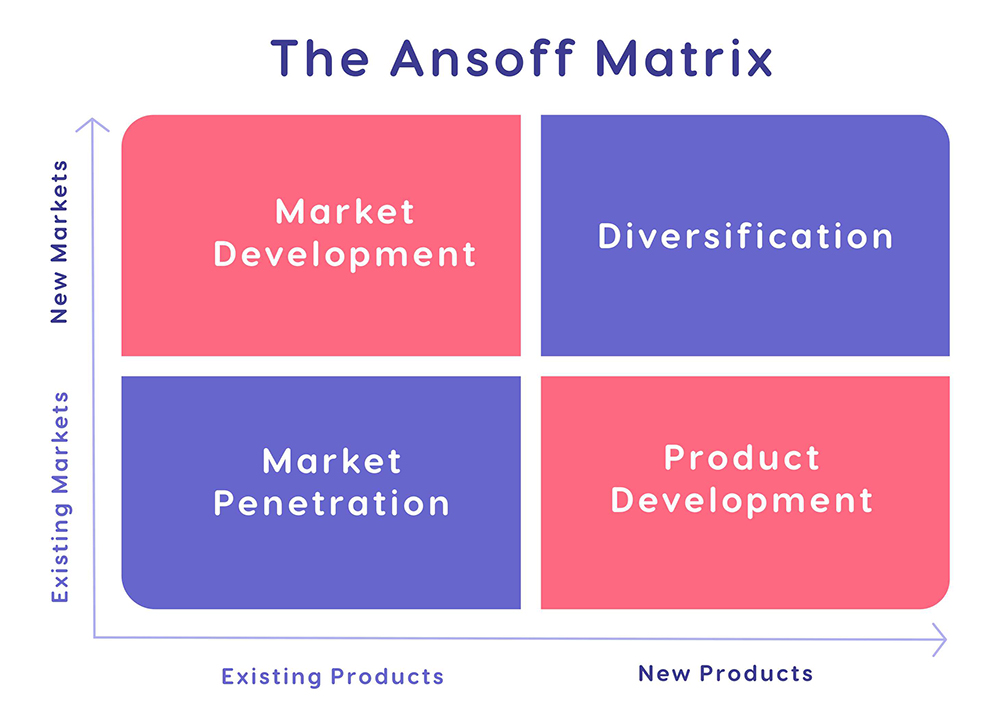
The Ansoff matrix places products in a portfolio on two axes: new or existing market and new or existing product. It’s a simpler matrix to create and is useful for developing a marketing strategy for products.
The GE-McKinsey matrix places products on a 3x3 grid based on the axes of industry attractiveness and competitive strength of the business unit. Based on this matrix, an organization can gauge whether a product needs investment to maximize gains, stability, or stopping the product line altogether.
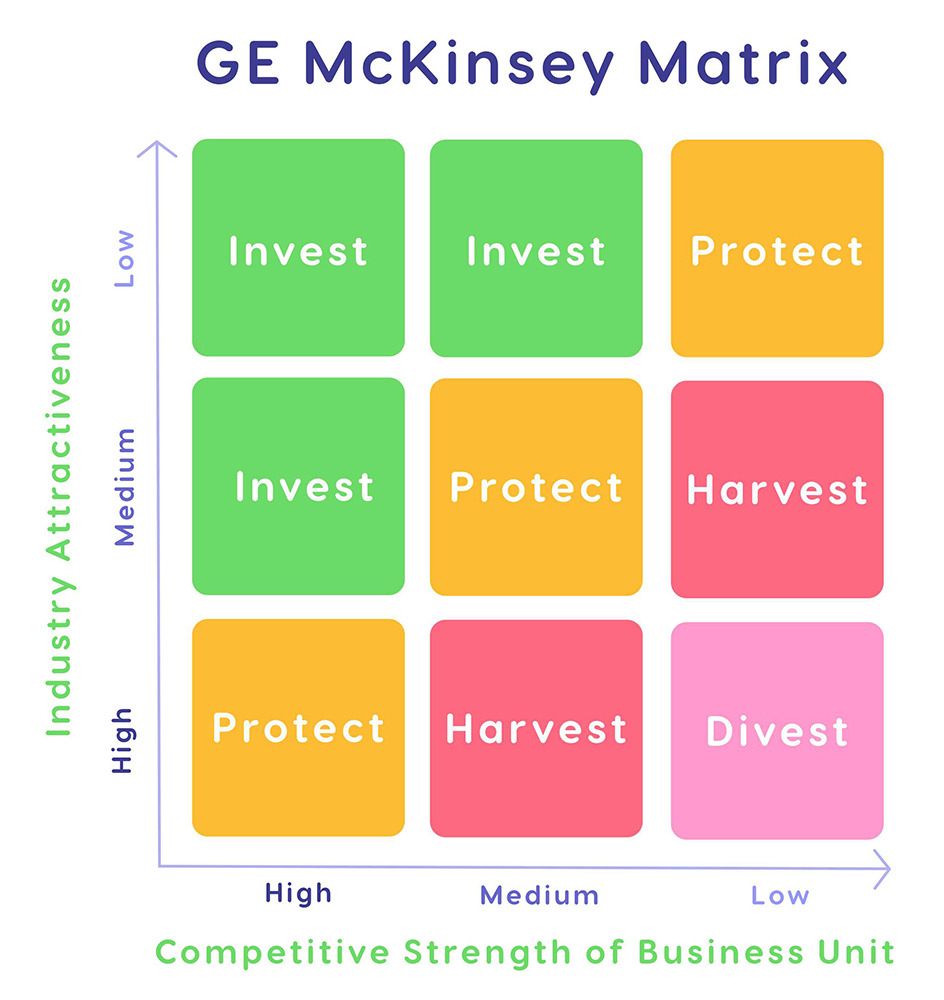
The scale of each axis is typically calculated through a voting system.
What types of businesses can benefit from product portfolio matrix
Given some limitations of the BCG matrix, it’s best suited for companies that have:
- An extensive number of existing products.
- Experienced long periods of sustained product performance.
- Extensive amounts of data on product market performance.
- The resources to effectively analyze market share and market growth rates.
- The resources to invest in developing new products and increasing market share.
These five points describe established large companies operating in markets with predictable growth. Startups, new companies, and companies in rapidly developing markets may not see much benefits from using the BCG model.
Advantages of Using a Product Portfolio Matrix
Mapping out your company’s products on a product portfolio matrix can help with:
- Product visibility. See all products in one place, compared to each other.
- Strategic clarity. Understand how your current portfolio aligns with strategic goals.
- Identifying growth opportunities. Find opportunities for growth in your portfolio.
- Improved decision making. Make better, data-backed decisions.
Limitations of the BCG Product Portfolio Matrix
A product portfolio matrix can be a great strategic tool, but only if you understand its limitations and can work within that framework. Here are the main limitations of the BCG product portfolio matrix.
- Its accuracy depends on your ability to determine market share and market growth rate.
- Using only market share and growth rate as predictors of success discards others like brand equity or organization’s resource capacity.
- The speed of market change has increased drastically compared to 1970 when the matrix was devised.
- Market share is not a concrete predictor of sustained performance any longer.
- Investing in increasing market share doesn’t always provide an expected ROI due to high costs.
If you can account for these limitations, the BCG matrix for product portfolio analysis can be a tool that promotes growth.
The BCG Product Portfolio Matrix Explained
The BCG product portfolio matrix positions products across two axes: current market share and market growth, classifying them into four quadrants:
- Stars.
- Cash cows.
- Question marks.
- Dogs/pets.
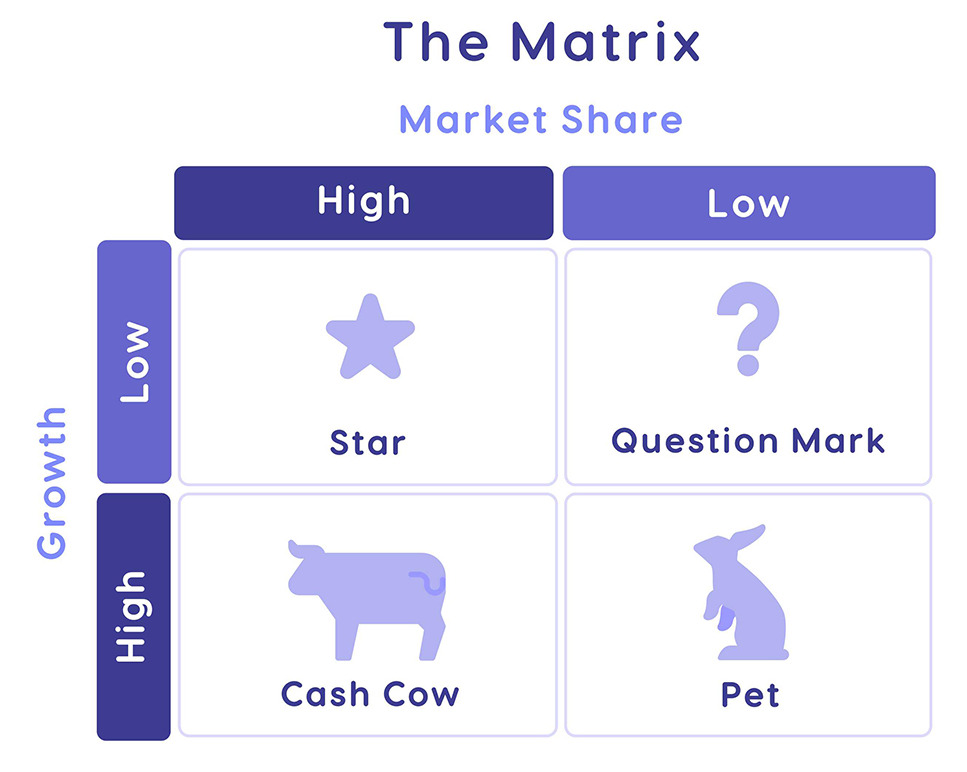
Let’s review what each of the quadrants stands for and what strategies are applicable to products placed in them.
Stars
Stars are products with a high market share and high growth. These are products that are growing rapidly, have high earning potential, and require investments to compete for the share of the market.
They’re often the focus of a company’s investment as they promise to increase ROI with investment.
Cash cows
Cash cows are products with a large market share and low growth potential. Typically, these products are established and stable ones that promise a sustained return on investment but won’t grow if investment increases.
These products, as the name suggests, provide the much needed cash flow to invest in stars and question marks.
When a star product reaches maximum market saturation and stops growing as fast, it migrates into this category.
Question marks
Question marks are products with high growth potential and low market share. These are promising new products that nevertheless have a chance of failure. They require a more cautious approach when investing in them, typically including a robust risk management approach to avoid losing investments.
If a product is successfully growing, it can transfer into the category of stars. If it doesn’t, it might become a dog.
Dogs/pets
Dogs or pets are products with low market share and low growth potential. Typically, products in this category are:
- New product ideas with unclear potential.
- Products that aren’t growing due to lack of investment.
- Products that are past their prime.
Careful analytics is necessary to understand whether these products are worth keeping in the portfolio or discontinuing to free up cashflow for other endeavors.
Product Portfolio Matrix Examples
The four quadrants of the BCG matrix are best understood based on concrete examples. Here’s a brief overview of what products can fit each category.
BCG matrix in the fast food industry
In a company like McDonald’s, notable examples of each Boston matrix category are:
- Cash cows: menu staples like cheeseburgers, McChicken, fries, and beverages.
- Stars: growing products like McCrispy Chicken.
- Question marks: products with growth potential like wraps and chicken strips.
- Dogs: underperforming products like salads and plan-based burgers.
BCG matrix in the automotive industry
In an established automotive brand like Toyota, the BCG matrix example is:
- Cash cows: established models like Camry, Corolla, or RAV4.
- Stars: growing models like Prius, and Lexus brand.
- Question marks: models with potential for growth like a Camry hybrid and the EV line.
- Dogs: no longer popular models like Celica and Tundra.
How to Build a Product Portfolio Matrix Step-by-Step
Creating a Boston matrix product portfolio analysis requires a lot of data analytics. Here are the main steps for doing that.
Organize products for analysis
The first step is to choose which products you want to analyze. Typically, this includes all products in the portfolio you’re managing, but sometimes, you can analyze a specific segment of products.
Create product cards and add all the relevant information about them.
Another important aspect of this step is categorizing products because market share data is only relevant for the narrow slice of market the product belongs to.
Define markets
Define the markets you will be analyzing based on the product categories. For instance, in the automotive industry, you may be analyzing not the global automotive market, but local markets in:
- Mid-sized cars.
- SUVs.
- EVs.
Obtain reliable market data
The next step is finding reliable market data to base your analysis on. This is a crucial step, and also a very difficult one. Most of the publicly available data is only an approximation, and data on market sizes can differ from one supplier to another.
Data on some of the narrower markets may be unavailable. In that case, you’ll need to analyze your products in a broader scope.
Use reliable, trusted sources:
- Gartner.
- Forrester.
- IDC.
- Statista.
- Bloomberg.
- U.S. Census Bureau.
- Bureau of Labor Statistics.
- Bureau of Economic Analysis.
Calculate market share
Next, calculate the market share based on market size data and internal sales data. The basic formula for this is:
Product market share = Product sales / market size * 100%
For instance, if your company has generated $20 million in product sales in a market worth $200 million, the calculation would look like this:
$20m/$200m*100% = 10%
Whether your market share figures can be considered high or not depends on the nature of the market you’re in. The more consolidated it is, the higher the standard is for calling a particular share high. Inversely, in fragmented markets with high competition, even relatively small market figures can be considered high.
Decide how you want to structure your market share scale based on that information and on the market leader positions. You can also decide to use relative market share as the main figure here, a comparison between your product and the biggest competitors.
Calculate growth rate
After this, calculate the other axis — growth rate. You can either calculate growth of the market share or use year-over-year sales growth.
Determine how you’re going to measure whether the growth rate is high, medium or low. You can either compare the existing growth rates and them as a scale, or create an arbitrary cut-off number.
Create a visualization
With all this done, all you have to do is place your products across the two axes and create a visualization to see which quadrant each project belongs to. After this, you can start making strategic decisions based on the data.
How to Use the BCG Matrix to Make Strategic Decisions
The BCG product portfolio matrix provides data on where your products stand in terms of market share and growth speed. But it can’t directly tell you how your investments should be structured.
Below you’ll find several tips on how to use the BCG matrix effectively in decision making.
The basic BCG investment strategy
The most basic investment strategy for each quadrant are:
- Stars: Invest heavily to dominate the market.
- Cash cows: Keep investments at maintenance level to generate cash flow.
- Question marks: Invest heavily to turn into stars or divert investments.
- Dogs: Liquidate or reform the product.
Determine optimal investment level for stars
Star products require investment, but the question is, how much investment is too much? The thing is, these products are not only drawing cash flow from others in the portfolio, they might require so much investment to increase market share that it results in a negative ROI.
Investing blindly in these might not be the best idea. Instead, you need to analyze a product's potential to understand at which point the marginal gains from further investment are no longer financially viable.
Unless your goal is dominating the market with no short-term financial gains, you want to cap investment at that level.
Analyze dogs and question marks
These two types of products can be budget sinks or they can turn into stars with some effort. You need to analyze their potential to understand which strategy is better for each product.
Most dog products will require outright discontinuation, but some can remain useful with significant changes. Don’t treat them as rejects, treat them as opportunities to either increase cash flow or cut costs.
Monitor transitions between quadrants
Most products do not remain at one quadrant of the BCG matrix, but transition through them during the product lifecycle. All projects start as question marks, then turn into stars for some period of time, and hopefully turn into cash cows, with transition into dogs possible at all stages of product development.
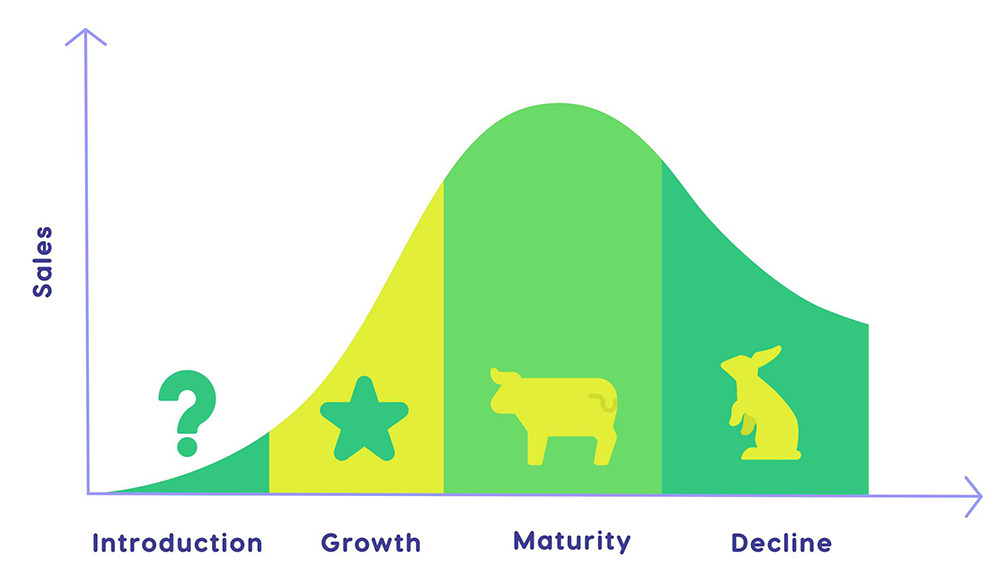
Since different product types require different investment strategies, you need to monitor your product portfolio to know when you should change your approach to each project.
Consider speed of market change
The BCG matrix is best suited for products in more or less stable markets. If a market you’re in is changing rapidly, with new competing products quickly gaining market share or new technologies changing the market, you need to be ready to reassess your products on the matrix and change your strategy accordingly.
Include portfolio risk management
Investing in cash cows and star products is an obvious choice, but determining how much to invest in question marks or whether to keep some dogs in your portfolio is more difficult. A common way of understanding what level of investment you can afford to place on these two strategies is to create a portfolio risk matrix.
This instrument lets you gauge the overall risk level of your portfolio and understand how many risky products can your organization safely take on without risking significant financial losses.
Consider resource constraints
Finally, you should take company resource constraints into account. Finances are a major constraint when it comes to investing in new and existing products, but ultimately, your company’s ability to create and support projects relies on the number of work hours it can invest.
Use an enterprise resource management platform like Epicflow to gain visibility into your organization’s resources, form an understanding of how much capacity you can invest in developing your products, and plan execution.
Book a call with our representative to learn more about opportunities Epicflow can provide for your business.
Frequently Asked Questions
What is the product portfolio matrix used for?
A product portfolio analysis matrix is used for gaining visibility into a company’s product portfolio and making strategic product investment decisions.
Is the BCG matrix the same as a product portfolio matrix?
The two terms are often used interchangeably, and the BCG matrix is the most commonly used product portfolio matrix right now. There are, however, a few other matrices, namely, the Ansoff matrix, and the GE-McKinsey matrix.
What are the 4 components of the BCG matrix?
The four components of the Boston Consulting Group product portfolio matrix are the four quadrants it divides the product portfolio in:
• Stars.
• Cash cows.
• Question marks.
• Dogs/pets.
What companies use product portfolio matrices?
Portfolio matrixes are best suited for large companies with established product lines that perform in stable growing markets. Products in markets that develop fast and unpredictably may not reap the full benefits of using a BCG matrix.
What is the origin of the BCG matrix?
The BCG product portfolio matrix was introduced in 1970 by the founder of Boston Consulting Group (hence the name).
How product portfolio matrices help product managers?
Product portfolio matrices help product managers to understand the differences in market share and growth rates between different products, categorize them, and develop appropriate investment strategies for different kinds of products.
Is the BCG matrix outdated?
The BCG matrix hasn’t changed much since 1970 when it was first introduced, while the world has changed immensely. It’s not outdated per se, but rather has some significant limitations. If you can account for them, it can still be a pretty good decision-making instrument.