Project Portfolio Management Challenges in Shipbuilding: Key Issues & Ways to Solve Them in 2026
 Victoria Sokolova
.
Published
.
Project Portfolio Management
.
18 mins READ
Victoria Sokolova
.
Published
.
Project Portfolio Management
.
18 mins READ

Shipbuilding projects are extremely complex. But managing a portfolio of initiatives in this sector introduces a new level of difficulty – all of these complex projects share limited resources, infrastructure, or suppliers, and have interdependencies with each other. The statistics are disappointing: shipbuilding programs are frequently delayed by 1-3 years, and the majority of projects miss delivery dates and face cost overruns. [1]
What obstacles prevent shipbuilding companies from achieving desired portfolio performance? How can they overcome them to deliver maximum value with resources they have? We’ll discuss these issues in the article.
Key Takeaways:
- Shipbuilding projects are characterized by high complexity and customization, long lifecycles, high costs, the need for strict regulatory compliance, and dependency on complex supply chains.
- Shipbuilders face the following challenges when managing project portfolios: a lack of portfolio visibility, competing priorities, cascading bottlenecks, changing requirements, and misalignment between strategy and execution.
- To manage shipbuilding portfolios effectively, companies need to ensure real-time portfolio visibility, align portfolio strategy with execution, plan work around constraints, reduce bottlenecks and optimize flow, and adopt advanced PPM solutions.
What Makes Shipbuilding Projects Unique?
Shipbuilding projects are different from typical construction or manufacturing projects. Their scale, complexity, and uncertainty create a set of conditions that should be taken into account when managing a project portfolio in this domain. Let’s consider their key peculiarities.
Long project lifecycles
Shipbuilding projects can last for several years, during which there can be multiple internal and external changes: e.g., demand volatility, shifting regulatory requirements, or technology changes. This increases the risk of misalignment between the initial plan and reality and makes long-term forecasting unreliable.
Shared resources across projects
Though it’s not an exclusive characteristic of shipbuilding projects, it makes project portfolio management in this field extremely challenging. Projects compete for skilled labor, dry docs and specialized equipment, and key subcontractors, which poses the need for intelligent coordination of resources across projects of the portfolio.
Dependency on complex supply chains
Shipbuilding relies on a global network of suppliers providing specialized components, which may also have long production and delivery cycles. This impacts project delivery schedules and introduces additional uncertainty about project timelines.
Regulatory compliance
Shipbuilding projects must comply with a wide range of international and local regulations, especially in defense and maritime safety. These requirements increase documentation and approval cycles, introduce additional dependencies and waiting times, and limit flexibility in execution.
Engineering-to-order production
In contrast to mass manufacturing, shipbuilding uses an engineering-to-order model. This means that project scope may vary, changing requirements affect the entire workflow, and project plans are always evolving.
High costs
Shipbuilding projects are costly, which means that mistakes in managing project portfolios and resources may result in significant financial losses.
Project portfolio management affected by these factors is where things get especially difficult, because the portfolio environment is interconnected, constantly changing, and sharing limited resources.
6 Common Project Portfolio Management Challenges in Shipbuilding
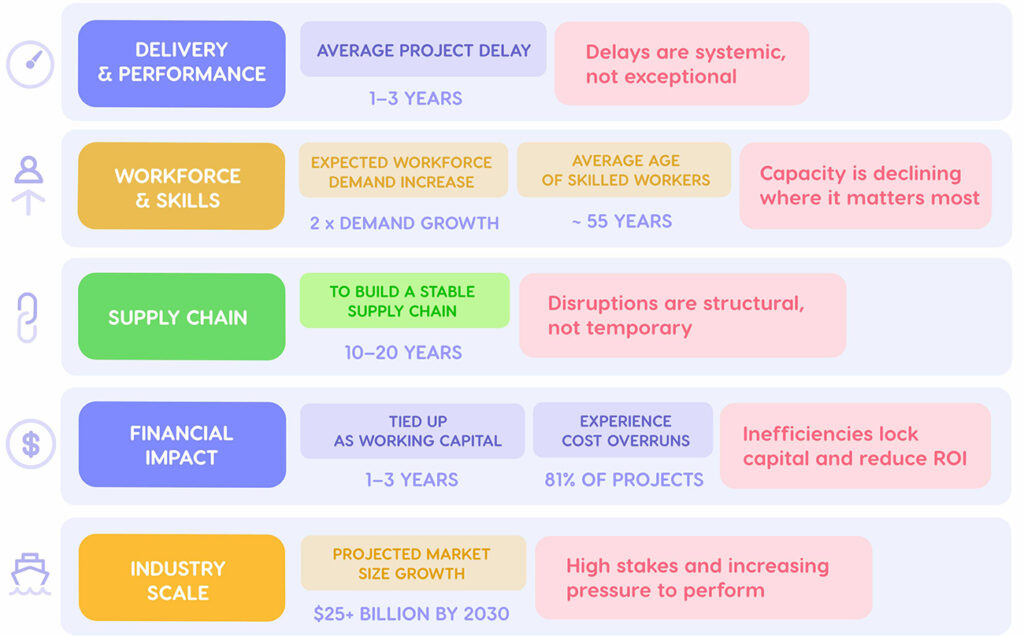
Shipyards operate as complex multi-project and interconnected systems; under these demanding conditions, poor project portfolio management typically results in the following issues:
- Deliver delays,
- Cost overruns,
- Low throughput,
- Reduced ROI.
These problems aren’t isolated or accidental; they are results of deeper systemic PPM challenges. Understanding them is essential for improving portfolio performance and achieving reliable delivery. Let’s consider them in more detail.
Limited visibility at the portfolio level
Many organizations have limited visibility into the entire project environment, processes and interdependencies within it. This can result in hidden bottlenecks that are noticed too late, reactive firefighting instead of preventing problems, and uninformed and ineffective decision making.
Conflicting priorities between projects
As we’ve mentioned earlier, shipbuilding projects often compete for resources, either human or material. What is more, every project has its own deadlines, stakeholders, and strategic importance. This leads to conflicting priorities, delivery delays, low portfolio performance, and inability to generate value from projects executed.
Resource allocation challenges
The same engineers, welders, and equipment are shared across projects, which makes resource allocation within the portfolio extremely difficult. Also, poor visibility into resources negatively affects resource capacity planning, makes it difficult to adjust resource allocation if priorities change, and can lead to overloading critical resources with work. Poor resource allocation results in bottlenecks, increased waiting times, cascading delays across projects of the portfolio, and low portfolio value.
Bottlenecks across multiple projects
Every shipyard has a few critical constraints or bottlenecks that limit overall throughput. When it comes to human resources, even one bottleneck resource can negatively impact other projects and cause cascading delays across the portfolio. This is what makes them extremely harmful not only for individual projects execution, but for the success of the entire project portfolio and its value potential.
Misalignment between strategy and execution
Managing a portfolio of shipbuilding projects should begin with determining the strategy. When it doesn’t happen, there’s a high risk of investing resources into projects that don’t generate expected business value. This will keep resources busy, while the value of the effort will remain low and the ROI will be far from desired.
Deterministic portfolio plans in a changing environment
Managing highly uncertain shipbuilding projects requires flexibility in planning. Creating deterministic plans for projects with constantly changing requirements, priorities, and external factors results in constant replanning that takes time as well as slow response to changes and disruptions that are typical for an uncertain portfolio environment in the shipbuilding domain. Finally, inflexible plans lead to the gap between plans execution, which doesn’t bring the company closer to successful delivery and value creation.
How to Overcome Project Portfolio Management Challenges in Shipbuilding and Ensure High Portfolio Performance
Ensure real-time visibility into the entire portfolio
Effective portfolio management starts with a clear, real-time understanding of what is happening across all projects of the portfolio. Otherwise, organizations operate reactively and respond to problems only after they disrupt the execution. To achieve visibility:
- Establish a single source of truth for all project and resource data
- Monitor progress, workload, and bottlenecks in real time.
When visibility is combined with data-driven decision making, organizations can act faster, reduce uncertainty, and prevent significant disruptions.
Synchronize strategy, prioritization, and execution
To close the gap between strategy and execution and ensure consistent value delivery, companies need to ensure that they select projects based on their business value (sometimes based on projected ROI, sometimes based on specific criteria). Value-driven portfolio prioritization will help allocate resources to the most impactful projects. Finally, managers need to make sure that the execution reflects shifting priorities. As a result, shipyards focus their efforts on the projects that generate the highest business value and don’t waste limited capacity on low-impact work.
Apply constraint-based planning
In multi-project and portfolio management, resources determine what actually can be delivered. Ignoring resource constraints is a typical and costly mistake that leads to overloaded teams, bottlenecks, and snowballing delays across projects. Instead, a more efficient approach involves:
- Identifying critical constraints (key specialists, equipment, facilities)
- Planning projects based on available capacity
- Ensuring that workloads are balanced.
This approach allows companies to significantly improve flow across projects and increase overall throughput without adding resources.
Take a proactive and adaptive PPM approach
Relying on static planning is often ineffective in managing complex portfolios, especially in the uncertain environment of the shipbuilding domain. Proactive portfolio management approach involves continuously monitoring risks and bottlenecks to detect potential problems and take timely action to prevent them or mitigate their negative impact. Also, the plan should be flexible enough so that companies could respond to changing priorities. This will allow shipyards to maintain control even under conditions of uncertainty and change and prevent significant disruption in the workflows.
Optimize flow and minimize multitasking
One of the most overlooked performance drivers is flow efficiency. When resources are spread across too many projects simultaneously, productivity drops and lead times increase. To avoid this situation, shipbuilding companies should limit work in progress across the portfolio, which can be achieved by staggering lower-priority projects. Another method of flow optimization is eliminating bottlenecks, which can be achieved by balancing workloads or assigning more resources to extra-large tasks. These measures will contribute to faster and more predictable delivery.
Use intelligent PPM software
Adopting the right PPM software will ensure high portfolio performance in the shipbuilding industry, but with one condition: the tool should be suitable for managing multi-project resource constrained and highly dynamic environments. Look for the following capabilities:
- Full portfolio visibility with all active and planned projects, resource allocation, dependencies and risks;
- Advanced resource and capacity planning tools with early detection of bottlenecks and workload management;
- Bottleneck detection and mitigation;
- Value-based prioritization and strategic alignment enabling answering the question: “Are we doing the right projects?”
- Scenario planning and what-if analysis for making informed decisions under uncertainty;
- Portfolio-level financial management;
- Real-time monitoring and early warnings;
- Integration with systems like ERP, scheduling tools, HRM, BI, etc.
Epicflow is the solution designed to support system-level optimization of projects and resources in dynamic and resource-constrained environments. Instead of managing individual projects, it optimizes the entire portfolio to let organizations invest resources in the right projects and achieve maximum value without increasing headcount.
Contact us to learn how Epicflow can improve portfolio performance and drive desired business outcomes at your organization.
References
- Chen, E. (2025). U.S. Shipbuilders Struggle to Meet Navy Demands, Face Delays and Cost Overruns. Financial Analyst. Rerieved from: https://thefinancialanalyst.net/2025/03/11/u-s-shipbuilders-struggle-to-meet-navy-demands-face-delays-and-cost-overruns/
- Weddle, B. et al. (2026). Helming a sea change: Building the future workforce for US shipbuilding. McKinsey. Retrieved from: https://www.mckinsey.com/industries/aerospace-and-defense/our-insights/helming-a-sea-change-building-the-future-workforce-for-us-shipbuilding
- Ship Building Market Outlook 2025-2034: Market Share, and Growth Analysis By Product. Market Research. Retrieved from: https://www.marketresearch.com/OG-Analysis-v3922/Ship-Building-Outlook-Share-Growth-41217860/
- Shipbuilding Global Strategic Industry Report 2024-2025 & 2030: Defense Upgrades, Trade Expansion, Green Tech Fuel, Eco-Friendly Vessels, Naval Modernization, E-Commerce Boom Bolster Growth. GlobeNewswire. Retrieved from: https://www.globenewswire.com/news-release/2025/04/07/3056577/28124/en/Shipbuilding-Global-Strategic-Industry-Report-2024-2025-2030-Defense-Upgrades-Trade-Expansion-Green-Tech-Fuel-Eco-Friendly-Vessels-Naval-Modernization-E-Commerce-Boom-Bolster-Growt.html
FAQ
What are navy shipbuilding challenges?
Navy shipbuilding faces almost the same challenges as shipbuilding in general. The difference lies in technical complexity, stricter requirements, longer project lifecycles, and higher consequences of failure.
What are shipbuilding industry challenges?
The biggest shipbuilding challenges involve supply chain disruption, fuel price volatility, environment regulations and decarbonization pressure, fleet utilization, geopolitical risks and trade restrictions, labor shortages, safety and operational risks.
What is project portfolio management in shipbuilding?
PPM in shipbuilding is the centralized management of multiple shipbuilding projects to optimize resource allocation, prioritize work based on business value, and ensure alignment with strategic objectives.
What are the main project portfolio management challenges in shipbuilding?
The main challenges include limited portfolio visibility, conflicting priorities, resource management challenges, bottlenecks across projects, misalignment between strategy and execution as well as inflexible planning.
What makes shipbuilding projects different from projects in other industries?
Shipbuilding is an engineering-to-order and highly customized industry with long project lifecycles and complex dependencies. It doesn’t deal with mass production, which means that every vessel is unique, which adds a layer of complexity to effective coordination of a project portfolio.
How to manage project portfolios in shipbuilding effectively?
Effective PPM in shipbuilding includes synchronizing strategy, priorities, and execution, ensuring visibility, planning projects around existing constraints, optimizing flow and reducing multitasking, and adopting proactive and adaptive PPM approach.
What is the best software for shipbuilding projects?
An example of a robust software for shipbuilding projects management is Epicflow: it helps shipyards manage complex project portfolios by providing real-time visibility, supporting resource capacity planning, enabling scenario analysis, and improving prioritization. It also helps identify and eliminate bottlenecks and optimize workflows across multiple projects.