How to Prioritize Projects: Methods, Criteria & Matrix (A Complete Guide)
 Victoria Sokolova
.
March 16, 2026
.
Project Portfolio Management
.
29 mins READ
Victoria Sokolova
.
March 16, 2026
.
Project Portfolio Management
.
29 mins READ

Organizations of any scale face challenges during project execution, and one of the biggest problems is deciding which project has the highest priority. It may not be so critical for smaller companies, but for larger organizations that often deal with multiple projects simultaneously, prioritizing projects within the portfolio and aligning them with business objectives becomes a difficult task.
Project prioritization can become a game-changer that allows companies to execute strategy, deliver value, prevent bottlenecks, and achieve significant results. But it’s really easy to get lost in a wide range of prioritization methods and points to keep in mind, isn’t it? Read our guide to get a full picture of project prioritization, its importance, methods, challenges, and best practices.
What Is Project Prioritization?
Project prioritization is the process of identifying the most urgent and important projects for an organization that should be done first. It can be based on different prioritization criteria such as potential return on investment (ROI), risks, strategic alignment with business goals, and available resources. It is like a bridge between strategy and execution, and without it, organizations often fall into one of two traps:
- Overcommitments – when managers approve too many projects without proper resources.
- Misalignment – when the team is working on a project with low impact, while critical initiatives remain without needed attention.
Many companies face difficulties with project prioritization because they consider everything important and must be done yesterday. That is why you need to implement a project prioritization system into your workflows.
Why Is Project Prioritization Important?
Project prioritization gives you an opportunity to maximize ROI, set realistic business goals, and allocate the right resources to reach them in a multi-project environment. It may be obvious, but many organizations still struggle to apply this in practice. Without setting proper project priority, companies find themselves overwhelmed with work that isn’t necessary or doesn’t even need to be done, while important projects are left without proper attention.
The PMO Outlook Report 2023 shows disappointing statistics:
- 92% of responders said that their projects weren’t aligned well with strategic business purposes. As a result, teams work on projects that don’t support the company’s goal, resources are wasted, and the most harmful: high-impact projects are delayed or even ignored.
- Over 50% of project practitioners reported that resource management is their top challenge. In fact, 77% of responders said that they don’t have enough resources to meet demand. Prioritizing projects is the key to allocating resources effectively across projects.
That’s impressive, isn’t it? The fact that many of these obstacles could have been avoided just by incorporating project prioritization shows how critical this approach is for every business that wants to succeed. But there is a reasonable question: which points do I need to consider while prioritizing projects?
Project Prioritization Criteria
Project prioritization criteria are a set of factors that help compare and score projects that are most valuable for the company and make the right decision. Determining proper criteria to prioritize projects isn’t an easy process, it involves applying multiple metrics, and you have to be prepared for lots of discussions. This set of decision criteria will be different for every project and company, but the list described below can be the basis you can rely on.
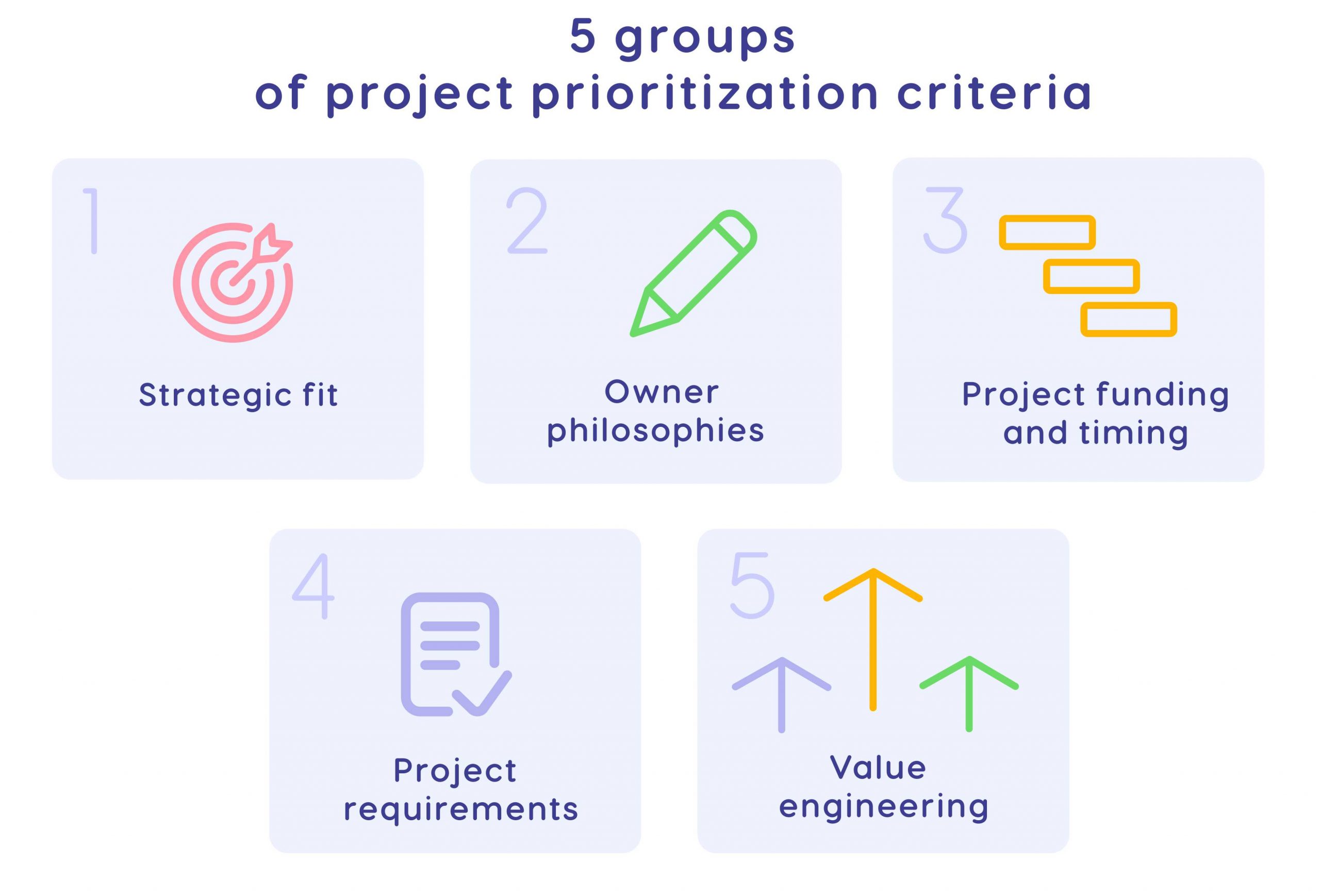
The article outlines 5 groups of decision criteria that provide the necessary information for prioritizing infrastructure projects, which makes it also suitable when managing government organization projects. So, here are the suggested project prioritization criteria:
1. Strategic fit.
This group of factors helps answer the question: “Does the project make sense in the bigger picture?” It includes understanding the purposes and needs; and to identify them clearly, you should consider the following points:
- How does the project support company goals?
- What is the value of a project for end customers?
- How does it improve the end customer’s lives?
This group of criteria include the following ones: needs and purposes, consistency, government priority, investment studies, economic issues and impact, environmental issues and impact, team members and stakeholder coordination, public involmenet, and good governance.
2. Owner philosophies.
This group of criteria showcases the project from the perspective of the owner’s philosophy and includes the following criteria: design philosophy, operating philosophy, maintenance philosophy, the possibility for future expansion, the degree of innovation, risk level as well as contractual conditions and procurement model. As we see, this group of criteria can be also applied for product development projects.
3. Project funding and timing.
This group of criteria is connected to the financial side and timelines. Firstly, it investigates potential sources of investment by analyzing their availability and reliability: will there be enough funds to complete the project? Secondly, it includes the understanding of the project’s schedule and duration, to set realistic deadlines and milestones that should be achieved. The third criterion includes possible contingencies.
4. Project requirements.
Here, we look at what a project actually needs to succeed. This group embraces ten criteria that are specific to infrastructure projects. We’d like to mention the most versatile ones that can be applicable to a wide range of projects:
- project objectives statement,
- functional classification and use,
- evaluation and compliance,
- required resources,
- resource utilization,
- scope of work.
5. Value engineering.
This group of criteria demonstrates how a project can get the most value with the least waste. The criteria included here are as follows: possible value engineering procedures, design simplification, and materials alternatives.
Based on the above-listed criteria groups, we can summarize the most versatile and essential for prioritization of any projects with no regard to their type:
- Aligning to business goals (expansion into new markets, supporting the brand’s growth, increasing ROI, increasing sales, etc.)
- Potential ROI
- Scope of work (technical and safety requirements, main functions, user interface, etc.)
- Risk management (complexity, risk of not doing this project)
- Resource availability (financial, human, equipment, etc.)
- Value for end customers (defining users’ pain points)
- Urgency (deadlines)
These are project prioritization criteria examples that you can customize for your company – personalization is key for setting effective project priorities.
Now you know how to define the right criteria, but the real challenge is to apply them to all of your projects. Without a proper tool, you’ll hardly do it manually. Result? Long, repetitive work that takes time and money.
Epicflow can help you to solve this problem by providing automated prioritization based on real-time changes in deadlines, dependencies and other metrics. Contact us to make your workflows simpler but still aligned with business goals.
Project Prioritization Methods
Once you know what criteria matter most to your company, the next step is choosing the best way to prioritize projects. Approaches here are different, so let’s take a closer look at the 3 most popular project prioritization methods:
- Scoring project prioritization model.
- Project prioritization matrix.
- Weighted shortest job first.
The PMO Outlook Report 2023 demonstrates that methods which are used for the project prioritization process are often basic or even ineffective – high/medium/low priority model (39%), executive order (30%), or informal “Do what needs to be done” (21%). These are disappointing statistics, so we decided to consider more effective and sophisticated techniques in this section. Below you’ll find detailed explanations for each of them.
Scoring model
This may be one of the most widely used models of project prioritization. The main idea is how to score and prioritize project requests according to their importance for your company’s goals and success criteria. How does it work?
- Choose the most important success criteria for your business (let it be ROI, strategic fit, urgency, value for customers, risk).
- Assign weight to each criterion (for example, ROI – 30%, strategic fit – 20%, urgency – 20%, value for customer – 20%, risk – 10%). In total, all percentages must give 100%.
- Score each project on each criterion (where 1 – very low, 5/10 – very high).
- Multiply each score by the criterion’s weight and sum up.
- Choose the project with the highest score as top-priority.
Project prioritization matrix
A project prioritization matrix is also known as the Eisenhower matrix. It is one of the most popular project prioritization techniques and called like that because of the speech and famous quote of Dwight D. Eisenhower, 34th President of the United States:
“I have two kinds of problems, the urgent and the important. The urgent are not important, and the important are never urgent.”
The difference between urgent and important projects may be unclear, so let’s explain it simply:
- Urgent projects need to be done as soon as possible, and ignoring them may lead to immediate consequences.
- Important projects contribute to long-term results and strategy.
Now we are ready to build the project prioritization matrix. It contains 4 squares:
- Urgent and important = Do it now. These are projects with the highest priority that have tight deadlines or high reputational risks if they will be delayed.
- Important but not urgent = Plan it. These projects create long-term value but don’t need attention immediately. They don’t have strict deadlines, but are important for the company’s growth and building capabilities for the future.
- Urgent but not important = Delegate it. These projects have deadlines that put pressure on teams, but don’t add strategic value. They should be completed, but can be delegated to other not so critical teams, employees, or managers.
- Not important and not urgent = Eliminate it. These projects have almost or even no strategic value for the company but use resources for other, more important initiatives.
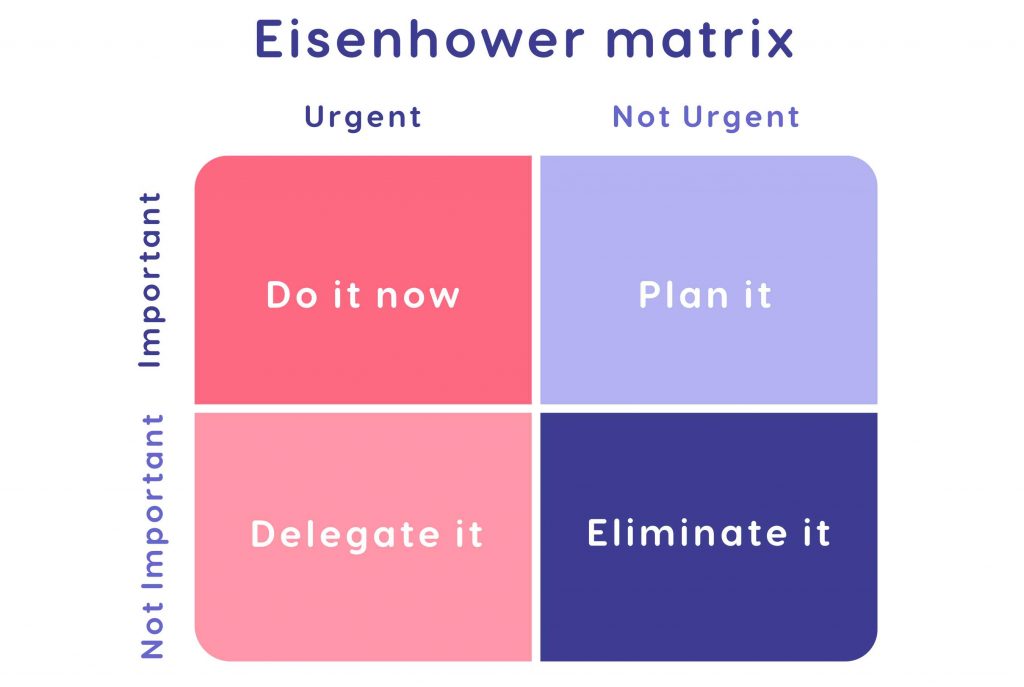
Prioritize first those projects that are urgent and important simultaneously.
There is also another variant of project priority matrix — value vs effort matrix. It also contains 4 squares:
- High value & low effort (quick wins): projects that are easy to do with high impact – prioritize first.
- High value & high effort (big projects): projects with high impact, but need a lot of resources – plan and evaluate risks.
- Low value & high effort (time wasters) – low ROI – you should avoid or drop these projects.
- Low value & low effort (fill-ins) – projects that are easy, but with low impact – you can do them if time and resources allow.
Weighted shortest job first
This method is used in Agile project management and helps to decide how to prioritize projects. It refers to the Cost of Delay (CoD) method of prioritizing projects. In a nutshell, it’s used to measure how much money or value a company will lose for delay. The formula is simple:
Cost of delay = Business value + Time criticality + Risk reduction and/or Opportunity enablement.
Where:
- Business value — how much money/benefit the project brings
- Time criticality — how urgent the project is
- Risk reduction / Opportunity enablement — how much risk it reduces or opportunity brings.
The Weighted Shortest Job First combines CoD with Job Duration (how long the work takes).
WSJF = Cost of delay / Job Duration
You should prioritize projects with the highest score. This method considers not only high-value projects, but also speed to deliver value.
However, all of these project prioritization methodologies are static, they give you a picture of priorities at a single moment, not dynamically. Epicflow has got advantages from different prioritization methods and improves them with:
- Automatic prioritization, so project managers and executives don’t need to calculate task priorities on their own;
- Real-time change tracking, to dynamically update priorities if it’s needed;
- What-if scenario analysis function, to test different situations in advance and predict results with AI-driven features.
Explore all features of Epicflow and book a consultation with our experts to increase the efficiency of your projects with just a single tool.
Project Prioritization Examples
Setting the right priorities and taking all these things into account sounds difficult, so let’s look at how to prioritize projects in practice.
Imagine that you are working for an outsource/outstuff IT company that runs multiple projects. It also has its own projects, important for market position and reputation. The company’s goal is quite obvious: expand into new markets and countries, gain trust and loyalty of current customers and attract new ones. The team isn’t big yet, so the number of human resources is limited, and management needs to decide which projects to prioritize and how to allocate resources wisely.
Step 1: Gather projects.
Project A – develop a fintech mobile app for a national bank
Project B – create an e-commerce solution for an online fashion store
Project C – maintain and upgrade a legacy system for an exciting long-term client
Project D – create AI chatbot prototype for a startup
Step 2: Define criteria.
Start by defining business goals, strategy and aligning prioritization criteria with stakeholders. Evaluate the percentage of importance for your company:
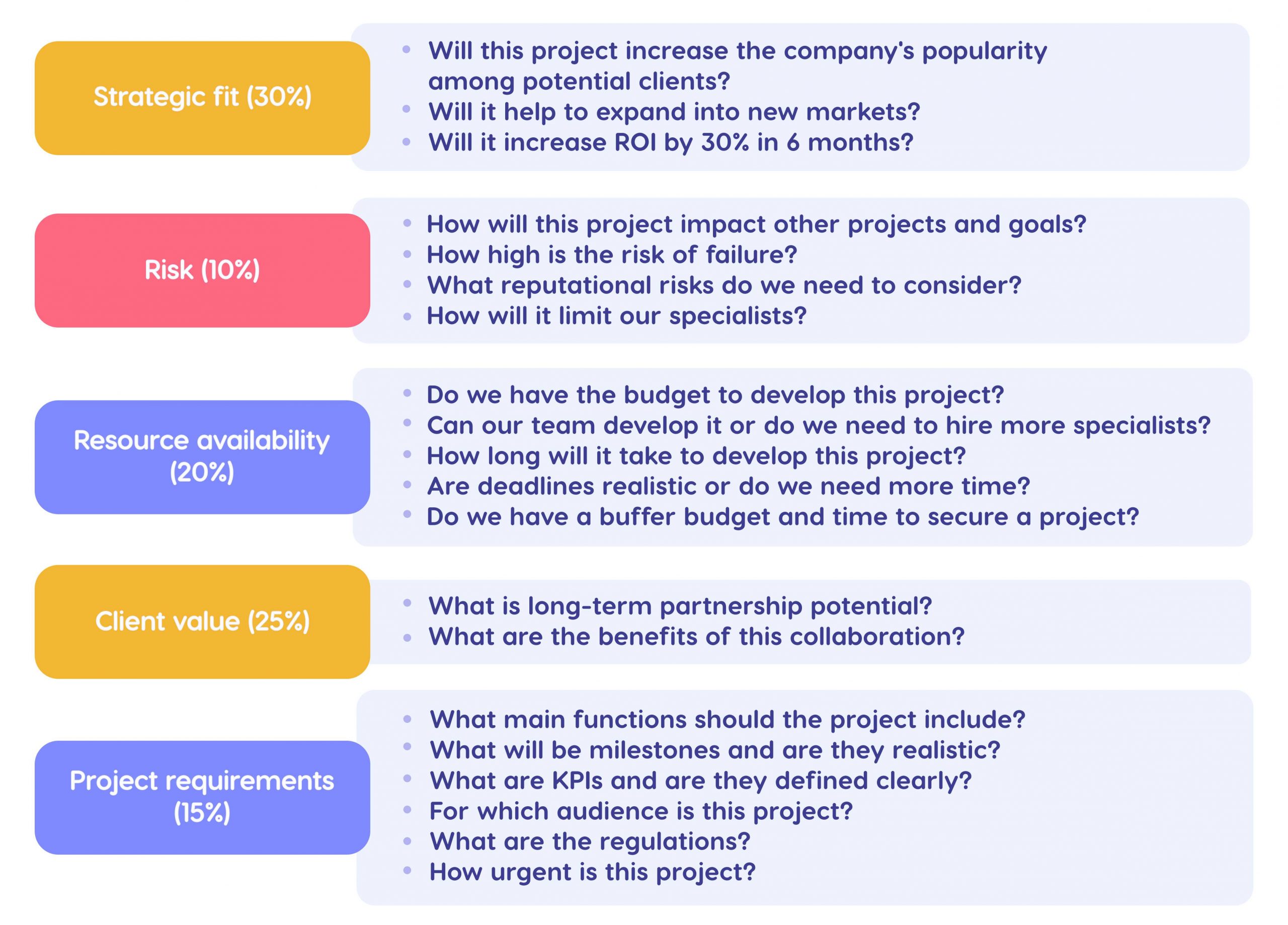
Step 3: Score projects.
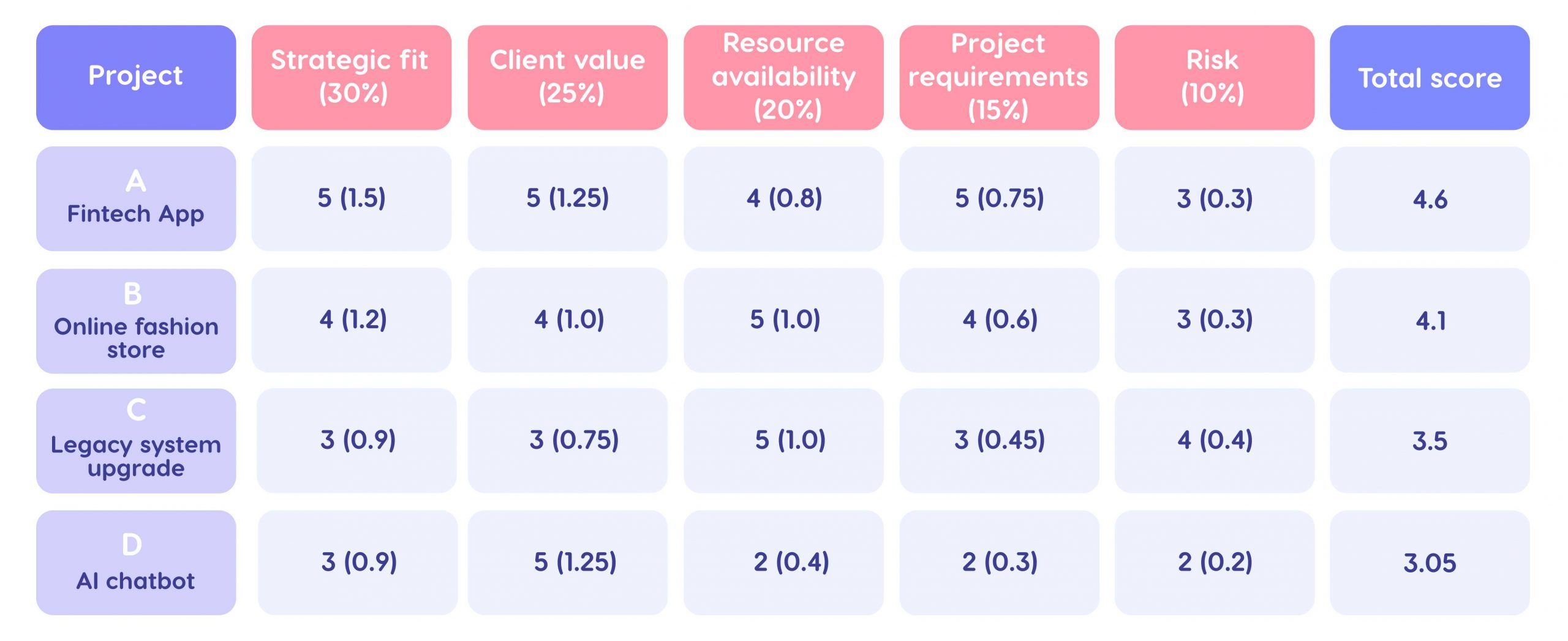
Step 4: Prioritize projects.
Finally, now your team can prioritize projects. As was described before, it will look like that:
- Project A (Fintech App – 4.6) has the highest priority: the project fits the business strategy, its requirements are realistic, and risks are low.
- Project B (Online fashion store – 4.1) is of the second priority: it has high client value and available resources.
- Project C (Legacy system upgrade – 3.5) has the third priority: it’s important for the client, but less urgent.
- Project D (AI chatbot – 3.05) has the lowest priority: it’s innovative, but the risks are high.
We hope that after this project priorities example, you will better understand this process.
Common Challenges of Project Prioritization & How to Overcome Them
As was discussed earlier, many companies face challenges without implementing project management prioritization. Let’s now take a look at the common challenges of prioritizing projects to find ways to effectively deal with them:
1. A lack of clear prioritization criteria.
The absence of clearly defined and approved prioritization criteria leads to the situation when projects are selected and prioritized based on stakeholders’ assumptions. The other situation is too many projects in execution. As a result, a company utilizes resources ineffectively and fails to deliver desired results.
How to improve the situation? It’s a good idea to select and approve some unified project prioritization criteria to be used by your organization or department.
2. “Everything is important” mentality.
This kind of mentality is common for a great number of organizations, including those that manage large and costly projects and programs that require correct prioritization.
For example, the experimental implementation of Epicflow conducted at the Dutch Ministry of Defense has shown that they lacked proper prioritization mechanisms and considered all projects equally important. Consequently, the number of projects in execution was too large, resources were overloaded, and it was impossible to complete required projects on time.
Read more about this experiment and how experimental implementation of Epicflow helped the Dutch MOD increase portfolio performance dramatically:
Why Smarter Delivery Beats Bigger Spend: Experiment at the Dutch Ministry of Defense
To overcome this problem, be guided by the rule: fewer active projects mean more resources available for each, higher efficiency, and earlier delivery.
3. Poor visibility into project processes and available resources.
It can be really difficult to prioritize projects in multi-project environments when there are hundreds of projects in the pipeline and thousands of people involved in them. Especially when a company uses outdated or ineffective project management tools that don’t provide a big picture of all projects and available resources.
To overcome this challenge, use robust portfolio management tools whose functionality will provide you with intelligent insights regarding all processes and all resources. Some solutions, like Epicflow, also have prioritization capabilities – upon assigning business values, the system will suggest the order of project execution.
Project Prioritization Tools: Epicflow Example
Epicflow is one of the best tools for project prioritization and management, designed for running multiple concurrent projects. Its functionality is based on the innovative approach to managing resources and setting the right priorities in a multi-project environment.
Let’s take a quick look at the fundamentals of prioritization as part of Epicflow’s philosophy.
- Prioritize tasks to eliminate bad multitasking and increase productivity. Every employee needs to understand what task requires their attention at the moment and focus on its completion. Otherwise, they will be trying to do a little bit of everything, which will reduce productivity and cause delays. Epicflow’s Task List automatically prioritizes tasks for every team member.
- Prioritize projects based on resource availability and business value. You cannot consider all projects as equally important. You need to determine the ones that will bring the biggest value to your organization. Forget about prioritization based on the available funds – switch to prioritization based on resource constraints. Epicflow’s AI-powered project staggering suggests rescheduling projects in line with their business value and resource availability if there are resource constraints.
Other essential features of Epicflow include:
- Multi-project management: Epicflow provides a single source of truth for running multiple projects simultaneously, which is essential for companies transforming into global businesses.
- Resource allocation: Epicflow helps to allocate proper resources to projects, based on their skills, location, availability, experience; the system identifies the best-matched people for projects.
- What-if analysis: Epicflow allows managers to simulate different scenarios, for example, “What if we delay project A for 2 weeks?”. This feature helps select the best strategy and make decisions to avoid bottlenecks.
- Capacity planning: Epicflow has in-built AI-powered capacity planning tools to forecast and predict resources’ capacity for planning your projects and resources in advance.
- Predictive analytics: Epicflow provides AI-based dashboards to predict delivery dates, risks and bottlenecks, future workloads, and design your processes accordingly.
Conclusion
Project prioritization has become a necessity for big companies that run multiple projects simultaneously. It defines projects that you should put effort and resources into, based on different factors: potential ROI, risks, urgency, available resources, and others, which may vary according to the company’s needs. How do you prioritize projects effectively? Automating this process will help you not only reduce costs but also decrease human factor mistake risks while prioritizing. Contact our experts to find out how Epicflow can help you prioritize projects correctly, optimize processes and resource utilization, and drive your business to the next level.
Frequently Asked Questions
What is project prioritization in project management?
Project prioritization is the process of finding the most important project for a company that should be done almost immediately. The importance of a project can be based on different prioritization criteria, which can vary for different organizations, depending on their goals, resources, and strategy.
What are the best project prioritization methods?
The best project prioritization methods include:
- Scoring model, which allows you to rank projects according to prioritization criteria;
- Project prioritization matrix;
- The Weighted Shortest Job First framework, which is used to measure how much money or value a company will lose because of delay.
What criteria should I consider when prioritizing projects?
Prioritization criteria you should consider while prioritizing projects are:
- Aligning with business goals;
- Scope of work (technical and safety requirements, development complexity, main functions, user interface, etc.);
- Risk management (complexity, risk of not doing this project, delays);
- Available resources;
- Value for end customers (defining user’s pain);
- Resource allocation (can we allocate available resources to this project? Or will it be too costly/ ineffective?);
- Urgency (deadlines).