PPM Tool Requirements: The Complete Guide to Selecting the Right Project Portfolio Management Tool
 Victoria Sokolova
.
January 26, 2026
.
Project Portfolio Management
.
24 mins READ
Victoria Sokolova
.
January 26, 2026
.
Project Portfolio Management
.
24 mins READ

In a great number of modern companies, especially large enterprises, running multiple projects simultaneously is an ordinary practice and a part of their business strategy. However, managing such a big variety of initiatives with their unique priorities, objectives, and deadlines can be really challenging. To drive organizational success, using project portfolio management tools is as necessary as breathing. But how should portfolio management leaders choose the proper tool?
This article will guide you through the PPM tool requirements to consider while choosing the right project portfolio management software for your organization.
What Is Project Portfolio Management (PPM) Software?
Before diving into required functionality of PPM software, let’s take a quick look at the essence of project portfolio management.
Project portfolio management (PPM) is an advanced approach to managing multiple concurrent projects and programs within an organization and ensuring they are aligned with overall business purposes. PPM deals with all ongoing and planned initiatives, rather than focusing on a single project.
Key characteristics of the project portfolio management process include the following:
- Focus on strategic alignment;
- Managing the entire portfolio rather than projects one by one;
- Selecting projects based on projected value and alignment with business goals;
- Portfolio-level management of shared resources;
- Balancing risks across the entire portfolio.
In turn, a robust PPM software should combine strategy, governance, resource management, performance tracking, and decision making into a single platform. With its help, companies can keep control of all projects and programs running in an organization, plan and allocate available resources to projects, forecast risks and project outcomes, prioritize projects, and ensure that each of them contributes to strategy execution.
Who Uses a PPM Tool?
PPM tools are used by a wide range of professionals and teams across the organization.
- Executives and senior management. This group requires enterprise-wide visibility across all portfolio of projects and processes to make investment decisions and be sure that the organization is focused on the right priorities.
- Portfolio managers. Such specialists need to drive strategic alignment, track value, standardize project management practices across the company, and ensure consistency in reporting.
- Portfolio analysts. Their responsibility is collecting and analyzing the data about project and program performance, helping with prioritization and resource scheduling.
- Portfolio management office. The responsibility of these specialists is establishing standards and reporting for the decision-making process.
- Project managers. The purpose of this group is to plan, track, and execute individual projects within the portfolio.
- Resource managers. These professionals require tools that identify available human and material resources and help allocate them properly. Also, they need to prevent resource overbooking and support resource capacity planning.
- Finance teams. Keeping track of budgets and ensuring investments deliver expected returns is the highest concern of these specialists and businesses overall. Finance professionals should have full visibility into project-related spending, cost forecasts, and performance across the portfolio.
- Team leaders & team members. This group requires access to task assignments, deadlines, progress updates and changes in the scope of work.
- Stakeholders and clients. Investors should be aware of project statuses and have detailed and transparent reporting.
It should be noted that not all these professionals use project portfolio management tools in the same way. For example, we can say that executives, portfolio managers, portfolio analysts, PMO members, and resource managers are primary users of PPM tools. Project managers and finance teams can use it in the context of their responsibilities, but they are rather regular users. Finally, leaders and team members as well as stakeholders can use these tools from time to time for reference.
By the way, Epicflow is an advanced PPM tool that is designed specifically for supporting diverse project portfolio management processes. For example, it provides portfolio visibility, performance tracking dashboards, AI-powered portfolio optimization capabilities, as well as decision making support. To learn more about Epicflow capabilities, book a call with our experts.
Now, it’s time to take a closer look at the main requirements for a PPM tool.
Key PPM Tool Requirements
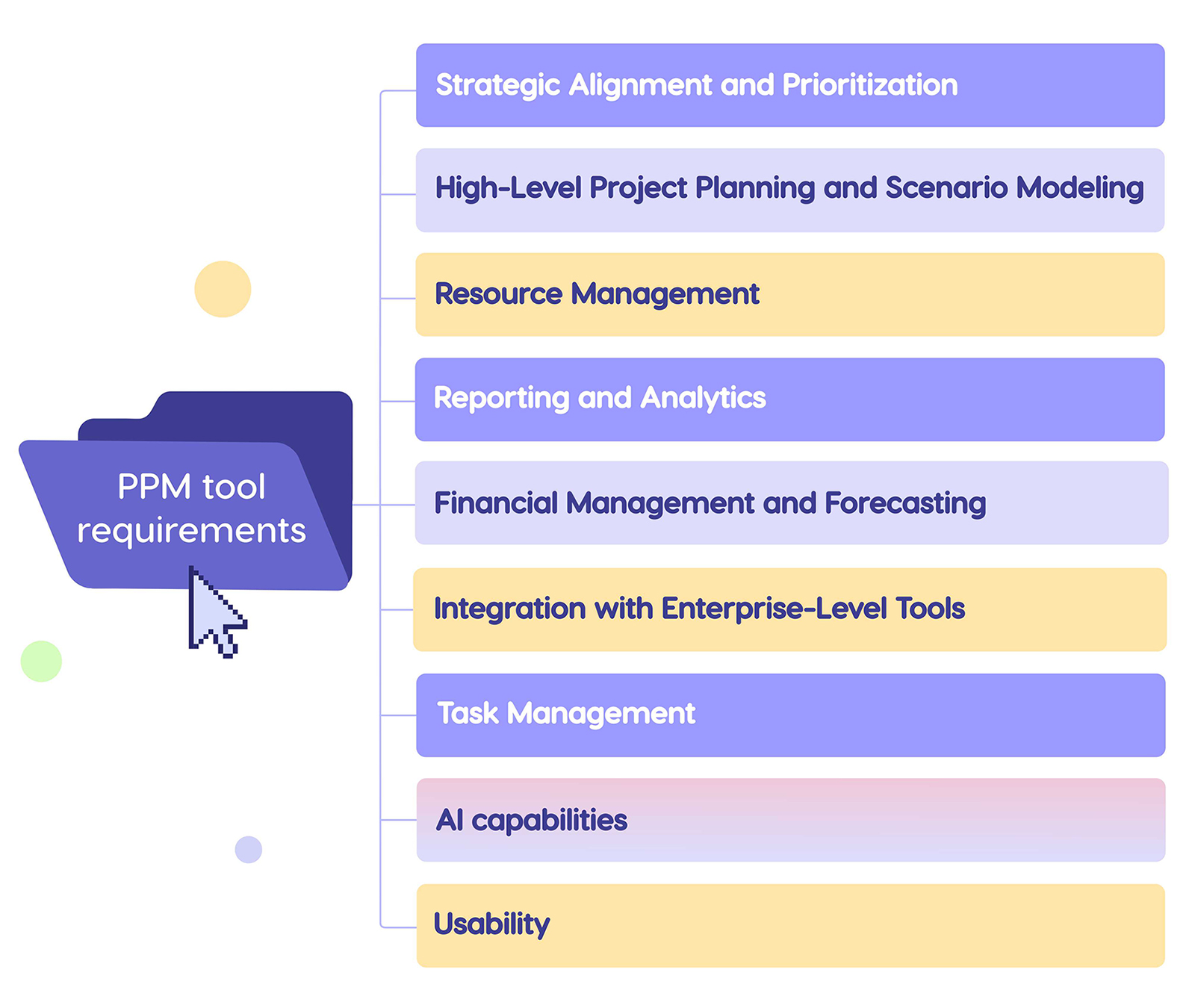
Selecting the right PPM tool begins with understanding the requirements that matter most to your organization. We’ve analyzed and collected the core PPM tool requirements you should consider when evaluating which solution to choose.
1. Strategic Alignment and Prioritization.
The first requirement to any effective PPM tool is its ability to ensure that projects are aligned with organizational strategy. It must enable companies to prioritize projects based on strategic value and optimize the entire portfolio.
A robust system should allow users to:
- Rank and score projects according to their strategic value.
- Model and test different scenarios to optimize portfolio value.
- Support consistent and mature prioritization process to prevent overinvestment in low-priority projects.
2. High-Level Project Planning and Scenario Modeling.
One of the core functions in the PPM tools must be project planning. It will be different from planning in single project management. High level project planning means that you need to define project scope and timelines, estimate budget and resource needs, align the plan with strategic objectives, and understand how this plan will affect the overall portfolio.
In this case, a what-if scenario analysis is one of the core PPM tool capabilities which can be a helpful hand thanks to the ability to simulate potential outcomes of different scenarios. Also, you should consider the following points:
- The tool must be adaptable to the changes and new business scenarios.
- The ability to integrate with the ERP (enterprise resource planning) will ensure accuracy of financial and resource data.
- Mature risk management and mitigation through running various scenarios and ability to see immediate and long-term consequences.
What-if scenario analysis allows managers to test various possible strategies before implementing new ideas into life, which gives portfolio leaders confidence in future plans and better predictability of the outcomes.
3. Resource Management.
A good PPM tool has functions that allow managers to search for specific resources, effectively allocate them to avoid overbooking or vice versa underutilization, and estimate their impact on the project delivery.
Key features of project portfolio management tool for effective resource management are:
- Real-time workload visibility across all projects.
- Supporting capacity planning.
- Skill-based resource planning to estimate future demand and allocate shared resource effectively.
- Analytics that help identify resource gaps, bottlenecks, and optimization opportunities across the portfolio.
4. Reporting and Analytics.
A PPM system’s value lies in its ability to turn data into clear and actionable insights. An effective PPM tool must ensure that real-time and historical data is accessible for everyone involved, from portfolio managers to stakeholders.
Read more: Portfolio Management and Resource Allocation: What Do They Have in Common?
The ideal PPM tool should include such capabilities as:
- Centralized portfolio data to create a single source of truth across projects.
- Real-time reporting and analytics to support informed decisions.
- Predictive analytics to anticipate potential bottlenecks and risks.
5. Financial Management and Forecasting.
Effective cost management is an essential part of project and portfolio success. Your PPM software should help you maintain constant financial oversight and meet the needs of the finance and accounting teams.
So it’s important to look for such PPM tool capabilities as:
- Accurate financial forecasting of project and portfolio costs.
- Real-time budget tracking and financial reporting.
- Seamless integration with the existing financial systems.
Thus, a reliable project portfolio management tool ensures every investment remains aligned with strategic and financial goals, giving leaders the visibility they need for reporting and decision making.
6. Integration with Enterprise-Level Tools.
For maximum efficiency, an ideal PPM software should integrate with already existing enterprise systems like ERP (enterprise resource planning), CRM (customer relationship management), HRM (human resources management), etc.
This helps to achieve seamless data flow between departments, eliminates data silos, and reduces duplication of effort. Integration also enhances collaboration and helps synchronize project planning, financial management, actual project execution, and reporting for stakeholders.
7. Task Management.
Task management is an essential part of project portfolio management software. Creating tasks and automatically assigning them to available resources according to their skills and experience enhances more efficient portfolio planning, forecasting, faster decision making.
Look for such PPM tool capabilities as:
- Gantt charts and scheduling.
- Real-time progress tracking and status updates.
- Tracking project and task dependencies.
- Smart task prioritization (e.g., based on the project’s remaining buffer).
8. AI capabilities.
Modern PPM tools increasingly rely on AI capabilities. Artificial intelligence (AI) and machine learning (ML) allow managers to predict challenges and come up with potential strategies to overcome them, prioritize projects and tasks in a way that will deliver the most value for the company, and optimize performance to maximize ROI.
Some AI-driven functions you should look for to add to your list of PPM tool requirements:
- Portfolio optimization (recommending optimum portfolio composition based on business value and resource constraints).
- Predicting risks and bottlenecks.
- Scenario-based decision support.
- Capacity and demand forecasting.
9. Usability.
Usability is a critical factor in the successful adoption of any project portfolio management tool. If a system is difficult to work with and overloaded with a complex interface, teams may struggle to adopt it effectively, which will reduce its value. In contrast, an intuitive and user-friendly interface enables faster onboarding and helps achieve results as quickly as possible.
A modern portfolio management tool should offer:
- Intuitive navigation for users of all levels.
- Customizable dashboards and visualization.
- Accessibility for remote and distributed teams.
- Minimal training requirements.
Selecting a PPM Tool: First Steps to Project Success
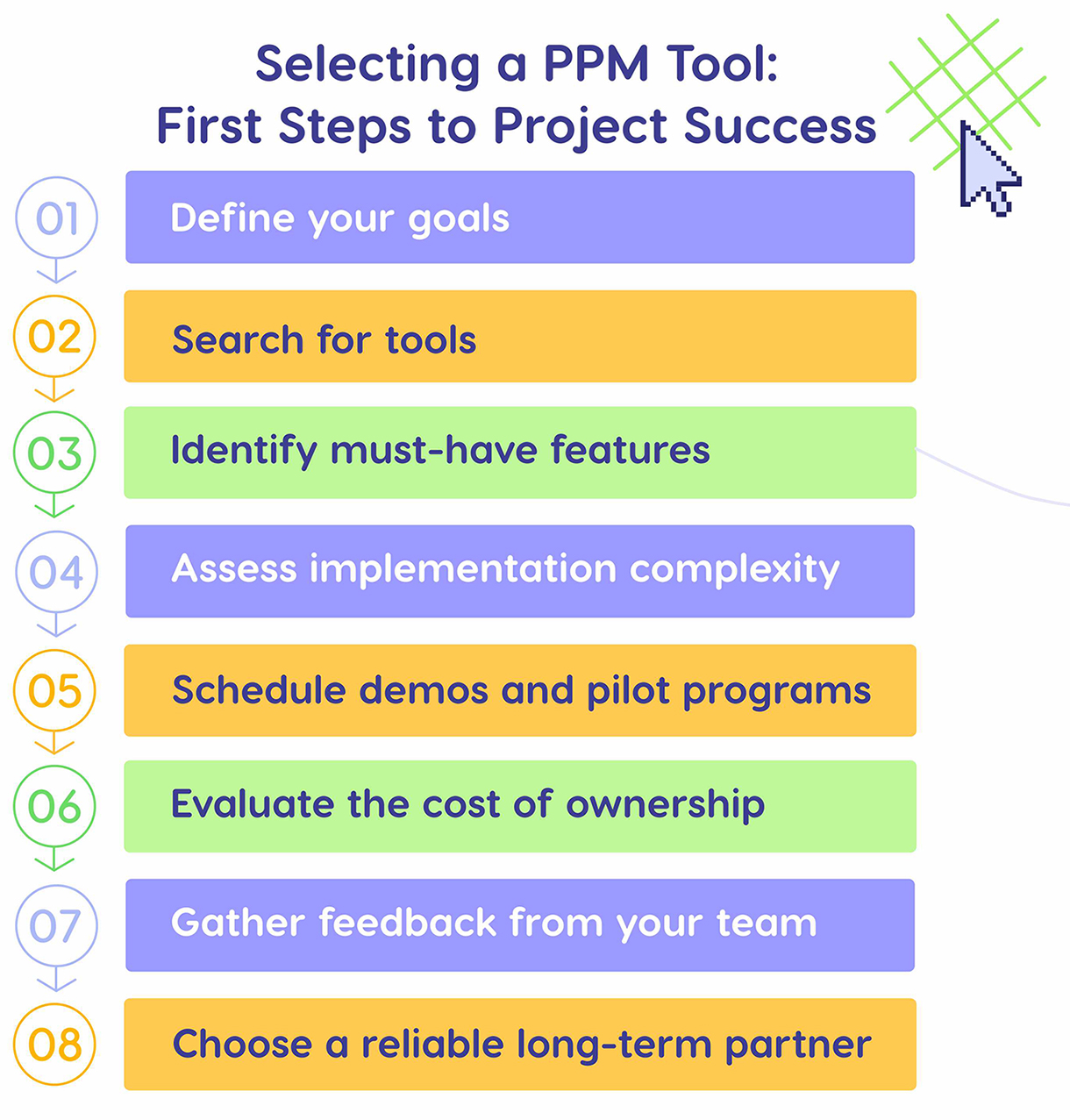
Once you understand the most essential PPM tool requirements for your organization, you should finally evaluate and select the best one. Here is the step-by-step guide for selecting a ppm tool.
Define your goals.
Identify what problems the portfolio management software should address. It can be lack of visibility across a portfolio, efficient task and finance management, smart resource allocation, or advanced capabilities like forecasting or scenario planning.
Search for tools.
Create a shortlist of potential PPM solutions. In addition to researching the market, you can use verified user reviews and analytics provided by trusted consultancies like McKinsey & Company or Gartner.
Identify must-have features.
Think of functions that are a must for your portfolio management processes and you can’t refuse them. For instance, it can be integration with existing systems, strong resource management, or AI-driven capabilities.
Assess implementation complexity.
A powerful tool is only valuable when your organization can adopt it with minimum losses. Check how easy it will be to deploy and adopt the tool, what setup requirements or licensing dependencies it has, and the level of effort needed for configuration and change management.
Schedule demos and pilot programs.
As soon as you’ve created a short list of tools you’re interested in, request to see demo versions in practice. Then you can test the user interface and define how well features are aligned with your requirements. Also, check if the tool can be customized for your specific needs and actual workflows.
Evaluate the cost of ownership.
Calculate the total cost of using the software, including:
- Fees for training your employees to work with this tool.
- Monthly or annual trials.
- Implementation, customization, and setup.
- Cost of additional features.
Gather feedback from your team.
Involve project managers, portfolio managers, resource managers, and executives into the selection process. Different opinions and ideas always help think more critically and make sure that the tool will meet different needs.
Choose a reliable long-term partner.
Select a software vendor that offers strong onboarding, training programs for employees, customization for your needs, and responsive service.
Epicflow is often chosen by enterprises that need advanced yet user-friendly tools capable of managing multi-project environments with shared resources. It offers the following PPM capabilities
- Portfolio visibility. Epicflow provides end-to-end visibility into all active and inactive projects, and shows the statuses of projects in execution.
- Scenario planning. Epicflow’s What-if scenario analysis helps managers and executives to test different scenarios in an independent environment before making portfolio management decisions.
- Forecasting. Epicflow is powered by predictive analytics to forecast bottlenecks, project and resource-related risks as well as portfolio performance.
- Prioritization. Epicflow automatically prioritizes projects based on defined business values and helps reschedule low-priority initiatives.
- Task management. Epicflow has an AI-driven Task List where the system automatically calculates task priorities for every team member to focus on the most important work for the moment.
- Resource management. Epicflow assists with proper resource planning and allocation, resource capacity planning and workload balancing, as well as performance analysis.
- Integration. Epicflow can be easily integrated with a variety of tools (project management software, HRM systems, BI tools, etc.) for centralized management, a single source truth across departments, and streamlining workflows.
- User interface. Epicflow has a clean, intuitive design which allows organizations and teams to quickly get used to it.
With Epicflow, you can achieve higher efficiency of processes, improve utilization of available resources and portfolio performance. So, don’t hesitate to request a demo to see how the solution can drive your business success.
Final Words
Selecting the right project portfolio management software was never an easy task to do. But if you successfully identify PPM tool requirements and find the one that will fit perfectly for your organization’s needs, you’ll dramatically improve portfolio value and gain a competitive advantage. The right software can make life easier for everyone, from senior managers to team members, directly responding to the main company’s pain points in such complex processes as resource allocation, risk mitigation and management, finance control, task assignment, progress tracking, and forecasting.
Frequently Asked Questions
What is a PPM tool?
A PPM tool is a software solution that helps companies select and prioritize projects across a portfolio, manage multiple projects and resources in a way that ensures strategic alignment, optimal use of resources, and delivers maximum value.
Why use a PPM tool?
Project portfolio management software gives organizations full visibility into all projects and resources, enables values-based prioritization, optimizes resource allocation, facilitates risk reduction, and improves decision making. As a result, teams can focus on the right initiatives and deliver maximum business value with limited resource capacity.
What capabilities are essential for a PPM tool?
When choosing and evaluating which project portfolio management software, pay attention to the following functions:
- Integration with existing tools.
- Resource and risk management.
- Reporting and analytics.
- AI capabilities.
- Prioritization of tasks and projects.
- Cost management.
- Portfolio optimization.
Is resource management important in a PPM tool?
Yes, resource management is critical, as most portfolio issues stem from limited capacity. A good PPM tool must provide visibility into resource capacity and availability, workloads, and bottlenecks to ensure optimum utilization of available resources across the portfolio.
Why is AI essential for project portfolio management tools?
AI and predictive analytics improve PPM tools by forecasting risks and bottlenecks as well as recommending optimum portfolio and resource decisions based on real data.
How can organizations evaluate whether a PPM tool meets their requirements?
Organizations should define clear requirements, run demos and pilot projects, test real portfolio scenarios, gather user feedback, and assess total cost of ownership before making a final decision.
What is the best PPM tool?
The best PPM tool is the one that perfectly fits the needs for your organization and addresses its pain points. For example, Epicflow is a portfolio management tool whose functions help businesses manage risks, resources, project dependencies, and set the right priorities to deliver projects on time and within the budget. Some of its functions are as follows:
- Value-based project prioritization.
- Bottleneck identification and mitigation.
- Resource allocation based on the resource availability, skills, and capacity.
- Smart task and budget management.
- AI-driven predictive analytics to forecast future resource demand and possible bottlenecks.