Project Portfolio Manager Career Path: Essential Skills, Opportunities, and How to Become One
 Victoria Sokolova
.
Updated
.
Project Portfolio Management
.
25 mins READ
Victoria Sokolova
.
Updated
.
Project Portfolio Management
.
25 mins READ

Managing multiple projects and programs simultaneously becomes more and more challenging for modern companies. Especially for large enterprises running hundreds of projects, it is extremely hard to coordinate them all and ensure they support the business strategy and deliver measurable value.
One of the key experts ensuring effective coordination of these complex environments and achieving desired outcomes is a project portfolio manager. Let’s discuss their role in more detail and learn how to become one.
Key Takeaways:
- A project portfolio manager is a senior-level professional responsible for managing project portfolios and ensuring their alignment with organizational goals.
- Project portfolio managers are responsible for overall portfolio governance, strategic alignment, portfolio composition, its planning and optimization, risk and resource management, performance analysis as well as communication with stakeholders.
- A portfolio manager’s career path can look like this: portfolio administrator / portfolio analyst – project portfolio manager – senior PPM – head of portfolio management – chief portfolio officer.
What Is a Project Portfolio Manager?
A project portfolio manager is a high-level specialist that manages an array of projects and programs, or even multiple portfolios within the organization. They group and categorize projects, prioritize them by strategic business value, estimate deadlines and required resources, and find resource conflicts that block success of each individual project within the portfolio.
The main goal of a portfolio project manager is to ensure that all projects within the company collectively contribute to its strategic objectives and generate expected business impact. Rather than focusing on the success of individual projects, the portfolio project manager oversees the full picture and decides which initiatives will deliver maximum value. They select and prioritize projects to ensure that limited resources are invested in the most valuable ones.
Project Portfolio Manager's Roles and Responsibilities
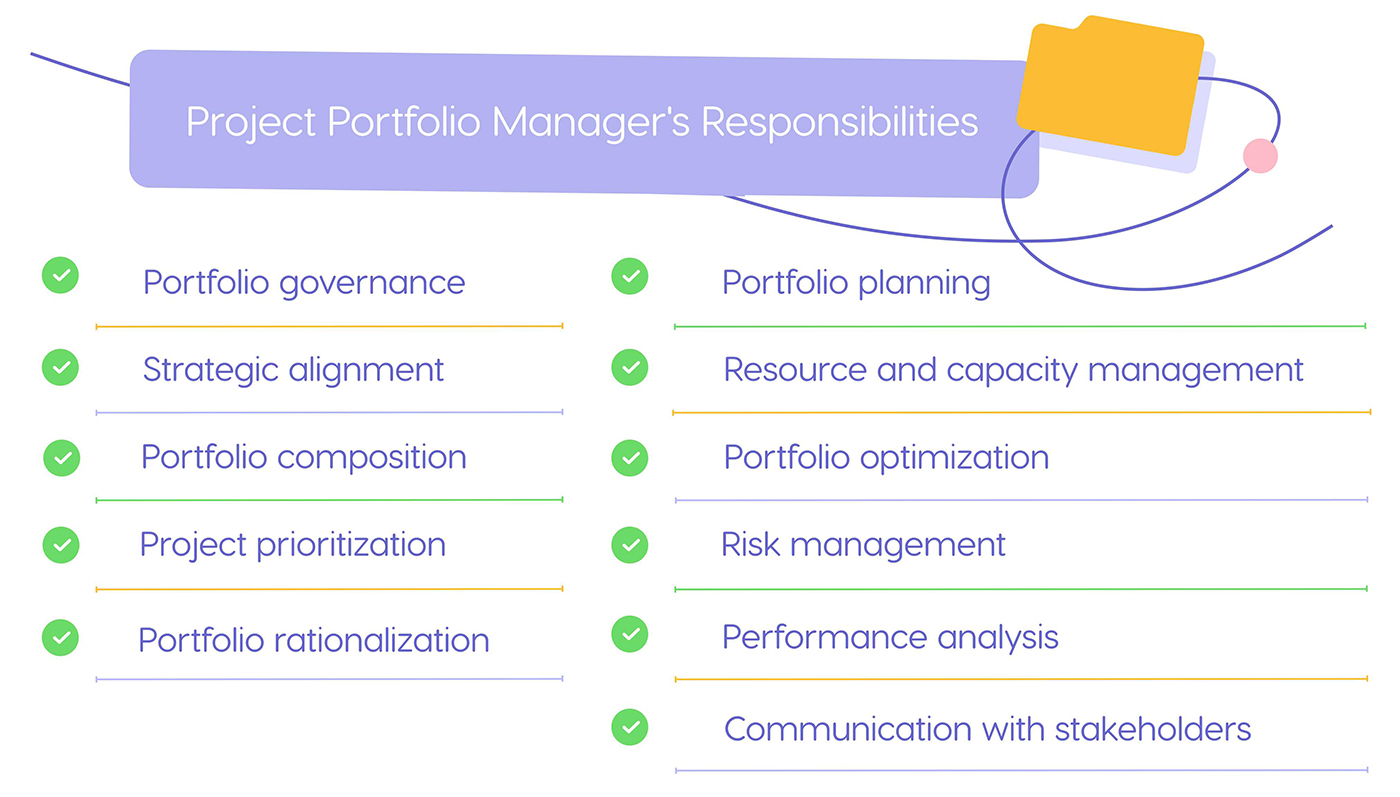
Before beginning your project portfolio manager career path or considering hiring one, you need to understand why companies need such specialists. In a nutshell, a project portfolio manager ensures that a company is doing the right projects at the right time. This can be achieved through the following activities.
1. Overall portfolio governance.
In most organizations, portfolio project managers are responsible for ensuring seamless coordination of projects across the portfolio and smooth flow of portfolio management processes like project selection and prioritization, performance analysis, etc.
2. Aligning projects with strategic goals.
According to PMO Outlook Report, responders said that 92% of their projects aren’t well aligned with strategic business goals. But why is it a problem? When projects are selected and executed with no regard to the business strategy, the value of its efforts is low. A project portfolio manager ensures that every initiative within the portfolio helps the organization implement its strategy and deliver business value.
3. Portfolio composition.
Project portfolio management involves selecting the right combination of projects that help an organization achieve its strategic objectives. So, one of the key responsibilities of a portfolio manager is creating an optimum portfolio composition, in particular :
- Selecting the right mix of projects and programs;
- Balancing the portfolio based on risk, value, timelines, resource constraints, and strategic factor;
The output of this process is a set of approved projects that are aligned with the business strategy and have the highest value potential.
4. Project prioritization.
Project prioritization aims to rank projects based on specific criteria like business value, strategic impact, ROI, resource availability, or other criteria. In a nutshell, it defines the order in which the selected projects will be executed. Correct prioritization allows organizations to allocate limited resources to the most valuable initiatives to maximize portfolio outcomes and a clearly defined execution order.
5. Portfolio rationalization.
By performing portfolio rationalization, a portfolio manager answers the question: “Should all current projects remain in the portfolio?”. With this in mind, they analyze current projects to determine which of them are underperforming or has low value potential. These initiatives should be postponed or terminated to allocate limited resources to the highest-value projects.
6. Portfolio planning.
As soon as projects of the portfolio are selected and prioritized, project portfolio managers perform portfolio planning, i.e., create a feasible execution roadmap. This includes sequencing projects over time, managing dependencies between them, aligning demand with resource capacity, resolving cross-project conflicts, etc.
7. Resource and capacity management.
Effective PPM is impossible without intelligent resource management: projects share the same resources, and without their proper coordination, it will be impossible to deliver projects on time and gain expected benefits. So, portfolio managers’ responsibilities include portfolio resource management activities: forecasting resource demand coming from projects of the portfolio, aligning it with available capacity, tracking resource utilization, and making adjustments to resolve cross-project conflicts.
8. Portfolio optimization.
Portfolio optimization is one of the most essential responsibilities of a project portfolio manager. This activity is aimed at continuous improvement of the overall portfolio performance and maximizing portfolio value given the existing constraints. Optimization activities will depend on the constraints an organization is facing (resource, budget, schedule).
“From my experience, most organizations aren’t aware that limited resource capacity is their primary constraint. They continue investing in underperforming projects or push their people to work harder, but the only thing they need is aligning strategy with real resource capacity.”
Dr. Ir. Albert Ponsteen, researcher and portfolio management expert, co-founder of Epicflow.
9. Portfolio-level risk management.
Similarly to project risk management, portfolio-level risk management aims to identify risks affecting the whole portfolio and develop proper responses to them. So, risk management responsibilities of a portfolio manager include:
- Identifying individual and portfolio-level risks;
- Developing risk assessment criteria;
- Determining current portfolio risk level;
- Developing risk mitigation strategies to protect portfolio value.
10. Performance monitoring and reporting.
Portfolio managers should regularly monitor portfolio performance to make necessary adjustments as early as possible. In particular, they track KPIs at the portfolio level (e.g., value, cost, risk, capacity), detect bottlenecks and gaps, and provide executives with portfolio-level insights and recommendations. This allows executives to get a full picture of ongoing processes, statuses, and progress as well as make more confident decisions if it’s necessary to make changes to the portfolio.
11. Communication with stakeholders.
Last but no least is stakeholder communication. The PPM process in general and portfolio manager in particular act as a connecting link between the strategy and execution. This means that they should promote transparency and facilitate informed decision making. Some activities promoting effective communication with stakeholders include:
- Coordinating discussions on trade-offs
- Preparing scenario analyses
- Documenting outcomes
- Presenting objective data.
These help ensure that the right information reaches the right decision-makers at the right time.
To sum up, the role of a project portfolio manager is the one of strategic enabler: they facilitate the execution of a company's strategy and goals through projects and contribute to generating maximum value with resources available to a company.
Read more: Value-Based Portfolio Management Explained: How to Maximize Business Value with Available Resources
Key Skills Required by Project Portfolio Managers
The skills required to become a project portfolio manager are based on the main responsibilities discussed in the previous section. To start your career path for a project portfolio manager you need to develop both hard and soft skills. Let’s review them in more detail.
Hard skills
- Portfolio management expertise: A project portfolio manager should understand every component of the PPM process and know how to manage them effectively (portfolio composition, benefits realization, ensuring strategic alignment, etc.)
- Financial analysis: Portfolio managers work with financial aspects of PPM as well, so they should be proficient in such activities as cost forecasting and control, capital allocation, etc.
- Strategic planning: This group of skills involves the ability to develop long-term strategic plans, perform scenario modeling, being aware of market conditions, and translating strategy into execution.
- Risk management: This group of skills involves the ability to perform portfolio-level risk assessment, analyze risk impact across the portfolio as well as mitigation planning.
- Resource management: Must-have resource management capabilities of a portfolio manager involve resource capacity planning, demand forecasting, resource allocation modeling, detecting bottlenecks, and tracking utilization.
- Data analysis and reporting: PPMs should be able to define and track KPI, create dashboards, interpret data, and create reports for stakeholders.
- Proficiency in using software tools: PPM tools are indispensable helpers of project portfolio managers; they may also need to work with BI tools or enterprise systems.
Soft skills
- Analytical skills: As project portfolio managers work with different types of data (portfolio performance, KPIs, resource utilization, etc.), they should be able to analyze them and transform them into actionable insights to be applied in the PPM process.
- Strategic thinking: Project portfolio managers should be able to see “the big picture” of the project portfolio and its place within organizational strategy; they should realize what impact their decisions and actions will have in the long run and act accordingly.
- Communication and negotiation skills: PPMs should be able to communicate effectively – be persuasive, rationalize their point of view, present complex insights in a clear and understandable form, and resolve conflicts.
- Decision making: Portfolio managers should be able to make decisions, often quickly and with some degree of uncertainty, which involves evaluation of possible options and choosing the possible scenario.
- Adaptability: Portfolio environments are dynamic, so a PPM should quickly adapt to changes and be ready to implement them if necessary, e.g., adjust priorities, rebalance investments, etc.
The skills listed above enable portfolio managers to executive their responsibilities efficiently and deliver strategic value to an organization.
Educational qualifications for project portfolio managers
Here are some basic educational requirements to a portfolio manager’s position.
Bachelor’s or master’s degree
A bachelor’s degree is typically a minimum qualification for the career path of project portfolio manager. Relevant fields are: business administration, engineering, management, finance or economics, information technology or computer science. A master’s degree in project management or MBA are more preferable for a senior-level portfolio manager.
Professional certifications
More important than degrees are portfolio management certifications like PfMP (Portfolio Management Professional) by PMI or MoP (Management of Portfolios). As many portfolio managers progress from program or project management roles, they can also have certifications like PMP, PgMP (Program Management Professional), PRINCE 2, or SAFe.
Additional courses
To continuously develop in the portfolio manager career path, specialists should always be aware of new technologies and industry trends. In this case, taking courses on Coursera, edX, PMI, or any relevant platforms will be a great advantage. Relevant areas include financial analysis, strategic management, risk management, business analytics, or change management.
Experience
In some cases, experience can be more important than degrees. PPMs are expected to have 5+ years of experience in project or program management, work in multi-project environments, managing large budgets and resource pools. This is natural because a portfolio manager is rarely an entry-level role.
Project Portfolio Manager Career Path
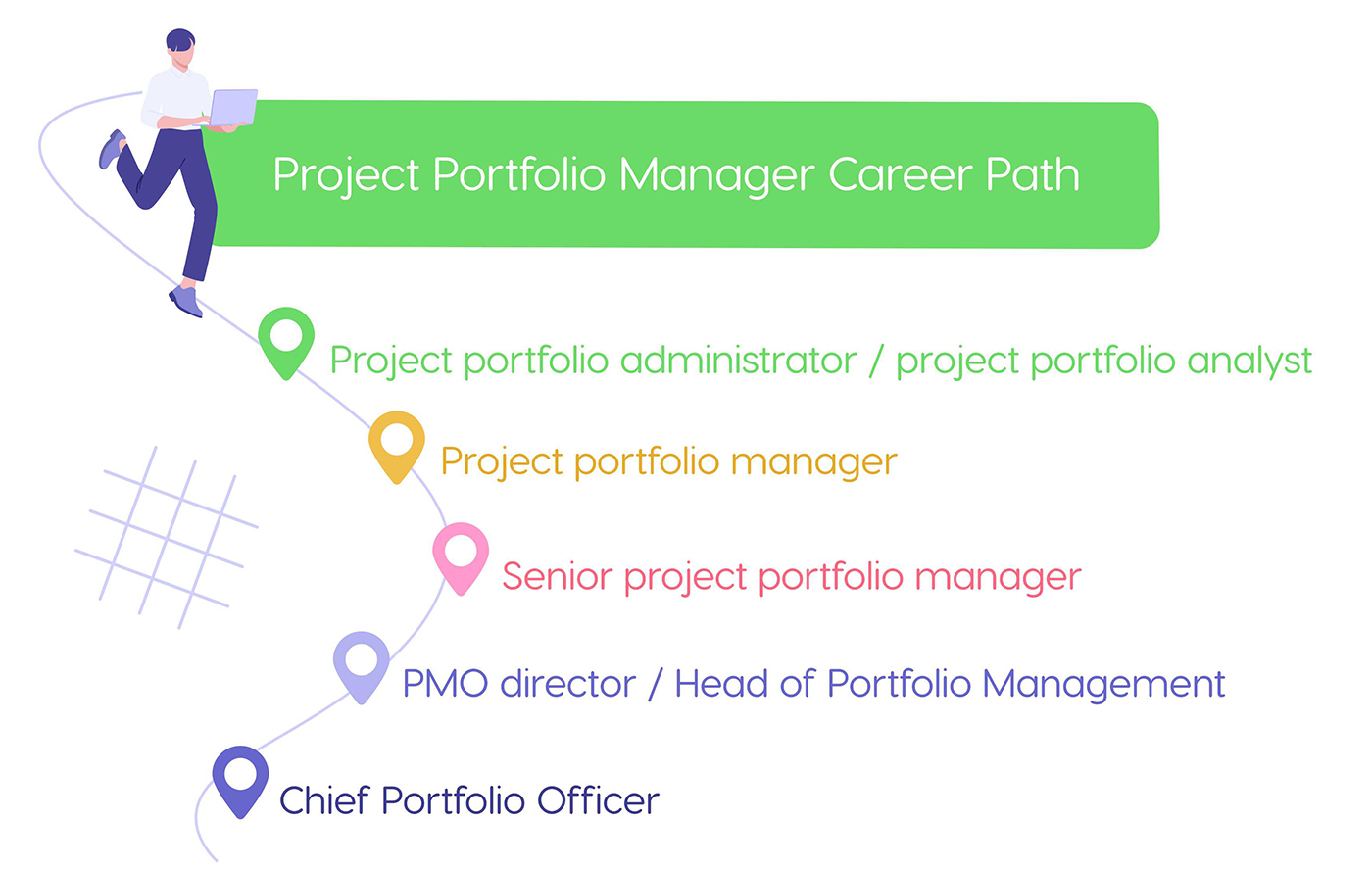
It is important to know that the project portfolio manager career path doesn’t start directly from becoming a portfolio project manager. Let’s take a look at the basic steps you need to go through to become a project portfolio manager.
Step 1: Starting from entry-level positions.
Typically, most portfolio management professionals start from project management, then move to program management before they gain required experience in managing project portfolios.
However, PPM specialists can start from “junior” positions, too. Project portfolio administrator and project portfolio analyst are two supporting roles that are perfect to start a project portfolio management career.
Project portfolio analyst.
This is the perfect role to make the first step in the career path of a project portfolio manager. These specialists are rarely involved in developing new strategies and implementing them, but they are responsible for collecting timely data about projects in the portfolio and ensuring that data in the PPM tool is accurate and actual. Often, they analyze the data and improve already existing reports, checking the data quality. In a nutshell, they are responsible for:
- Gathering and analyzing the project data;
- Developing portfolio dashboards and performance reports;
- Supporting prioritization decisions;
- Identifying and reporting about trends and bottlenecks within the portfolio.
Such specialists may be needed in large enterprises to help portfolio project managers as well as in mid-sized companies to be standalone specialists.
Project portfolio administrator.
A project portfolio administrator ensures that strategic portfolio processes and documentation are consistent and up-to-date. They act as a link between project portfolio analyst, senior management, and project teams, gathering project statuses from project and portfolio managers and ensuring that this information is correct and complete. So, they are responsible for:
- Maintaining and updating the data in the PPM system;
- Supporting data entry, scheduling, and reporting;
- Communicating updates between project teams and leadership
These specialists are often hired to mid-size and large companies to assist a portfolio project manager or portfolio analyst, but smaller organizations can simply benefit just from one of these positions.
At this step, you can build the foundation for the portfolio manager’s role: gain the understanding of the PPM processes, reporting, data analysis, and the use of portfolio project management tools.
Read More: The Diversity of Project Manager Position Types: How to Choose a Job Among Different Titles
Step 2: Moving to a project portfolio manager role.
It's a more middle-level role that requires enough experience and qualifications. At this stage, the specialists already have an understanding of portfolio processes and business strategy, have developed required soft and hard skills to switch from support to coordination and leadership.
Step 3: Advancing to a senior-level professional.
A senior portfolio manager operates at a different level: they shift focus from managing the portfolio to supporting organizational investment decisions and strategic execution. They also ensure that organizational investments deliver measurable strategic and business value. Finally, senior PPMs bridge the executive strategy and current execution conditions.
Step 4: Becoming a PMO Director or a Head of Portfolio Management.
These positions are considered as executive-level ones. At this stage, specialists go beyond managing portfolios and become a part of the executive team responsible for overseeing all organizational project investments and their connection with business strategy. They define governance standards, establish standards and processes, and ensure consistent management of projects and portfolios across the enterprise.
Step 5: Evolving in Chief Portfolio Officer (CPO)
A Chief Portfolio Officer is a senior executive responsible for ensuring that projects, programs, and portfolios are aligned with the organization’s strategic goals and business priorities. The role focuses on maximizing the value of organizations investments by means of guiding portfolio decisions and overseeing the execution of the business strategy across the enterprise. It's a strategic role that has a significant impact on a company's success, competitiveness, and innovation.
At every stage of the portfolio manager’s career path, an intelligent project portfolio management solution can become a powerful assistant for managing projects and resources, analytics, and decision making. Let’s take a closer look at PPM tools’ capabilities that will be useful for project portfolio managers.
Epicflow PPM Software: Smart Assistant for Project Portfolio Managers
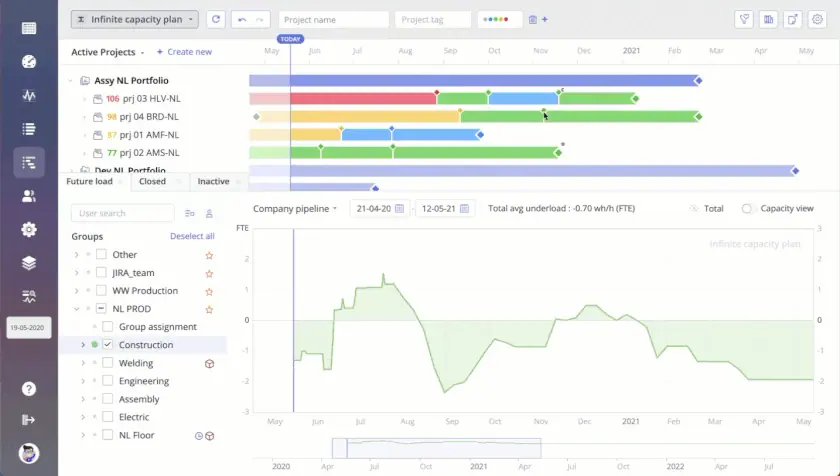
Epicflow is an AI-powered advanced portfolio management platform that helps to manage multiple projects and their shared resources effectively and deliver maximum business value. Here are its most powerful PPM capabilities.
- Portfolio visibility: Epicflow visualizes all projects within the portfolio along with their statuses, milestones, and due dates, which gives portfolio managers transparency and immediate insight into changes, priorities, risks, and performance.
- Portfolio optimization: Epicflow Portfolio Optimizer is an AI-driven capability that helps maximize portfolio output by focusing constrained resources on the highest-value projects.
- Prediction: Epicflow calculates expected delivery times based on priorities, business value, and resource constraints to ensure realistic and optimized project scheduling.
- Resource and workload management: The software helps balance resource workload to prevent overload and underutilization, which ensures that constrained resources are used in the most efficient way.
- Forecasting and capacity planning: Epicflow forecasts future resource demand and capacity constraints, which allows managers to evaluate hiring needs and make strategic portfolio decisions based on real capacity.
- Risk management: Epicflow helps managers monitor risks, detect bottlenecks, and take timely action to mitigate problems before they impact delivery.
- Scenario planning: The solution allows managers to simulate different portfolio decisions, e.g., adding, delaying, or reprioritizing projects and immediately see their impact on resource load and delivery dates.
With Epicflow, you can achieve maximum efficiency of portfolio management processes, optimize resource utilization, gain real-time control over the entire portfolio as well as make smarter decisions and ensure faster delivery without increasing headcount. So, don’t hesitate to book a consultation with our experts to explore more opportunities for seamless project portfolio management with Epiclow.
Read more: AI in Project Management: Benefits, Use Cases, and Future Trends [2026]
Final Words
Project portfolio manager’s work is at the intersection of strategy and execution. The path to becoming a project portfolio manager starts with building hands-on experience in multi-project management, then evolves into analytical portfolio coordination and finally strategic portfolio leadership. This journey requires continuous learning and adaptability, but has a high impact and wide opportunities at the senior level.
Frequently Asked Questions
What is the goal of a portfolio manager?
The main goal of the project portfolio manager is to ensure that all projects and programs within the portfolio help organizations achieve their strategic objectives and deliver business value.
What does a portfolio project manager do?
A project portfolio manager is responsible for coordinating, prioritizing, and optimizing a portfolio of projects to ensure that they collectively deliver strategic business value.
What is the career path of a project portfolio manager?
The career path of a project portfolio manager typically progresses from project coordination or portfolio analyst roles to project or program management, then to portfolio leadership positions, and finally to senior or executive roles overseeing enterprise strategy execution.
Is a portfolio manager an entry-level job?
No, the job of a portfolio project manager requires several years of experience in portfolio analysis or project management as well as strong understanding of business strategy and resource planning.
What is needed to be a portfolio manager?
To become a portfolio project manager, specialists need:
- A bachelor's or master’s degree in business, management, or in another related field.
- Experience in managing or coordinating multiple projects.
- Strong strategic and analytical thinking, data analysis, risk and resource management, change control, communication with stakeholders.
What is a portfolio manager’s salary?
A project portfolio manager’s salary varies by region and experience. It typically ranges from mid-five figures to over six figures annually. Higher earnings are in the US and at larger organizations.
What's above the position of a project portfolio manager?
If you want to move forward just portfolio management, there are some more advanced positions:
- Senior portfolio manager.
- Head of PMO / Director of Portfolio Management.
- Chief Portfolio Officer (CPO).
Is a portfolio manager a higher-level role than a project manager?
Yes. A portfolio manager typically holds a broader and more strategic role than a project manager. The latter is responsible for effective management and successful delivery of an individual project, while a PPM oversees a collection of projects to ensure that they align with organizational goals.