The Ultimate Guide to Enterprise AI Transformation: Building a Scalable, Multi-Year Strategy for 2027 And Beyond
 Victoria Sokolova
.
Published
.
Digital Transformation
.
35 mins READ
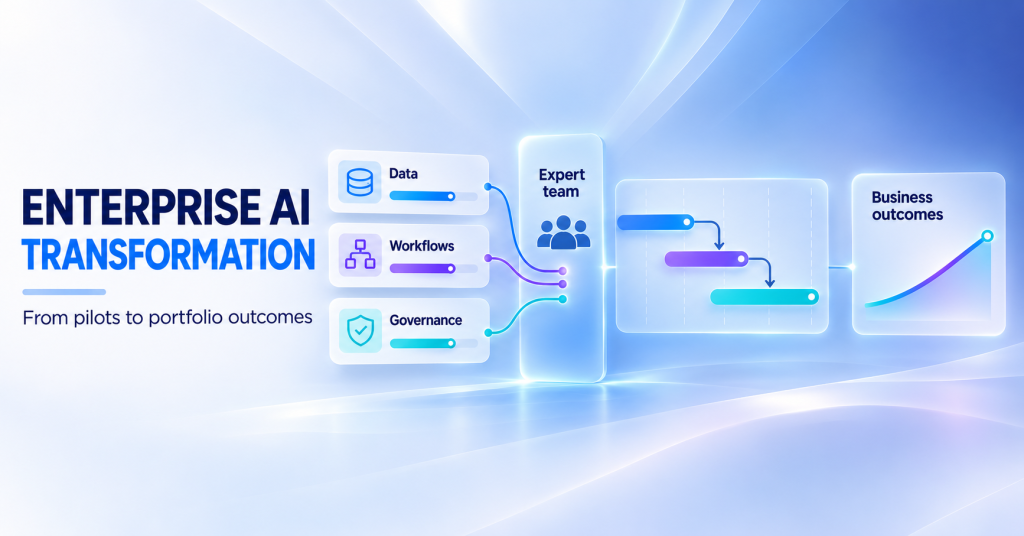
AI transformation is the redesign of an organization's strategy, operating model, data and workflows so that AI makes or supports core business decisions, beyond individual tasks. AI adoption puts tools in people's hands. AI transformation changes how work is done, decided and staffed across the enterprise.
Most enterprises have done the first part. In 2025, 88% of organizations used AI in at least one business function (Stanford HAI, 2026). Far fewer have done the second. A 2026 Gartner survey of 1,303 organizations found that only 22% had scaled AI across several business units or adopted an AI-first approach (Gartner, 2026). The result: AI is making everyone faster, and nothing is finishing sooner.
This guide, based on peer-reviewed research and surveys from 2024 to 2026, shows how to build an AI transformation strategy that lasts. Its central argument: an AI transformation is a portfolio of initiatives that compete for the same few experts, the bottleneck every initiative waits for.
An AI initiative pays back only when it shortens the queue in front of your scarcest people.
See your portfolio as it really is
Key takeaways
- Define an artificial intelligence transformation by outcomes. Usage shows adoption, not transformation.
- It is an operating-model change. AI leaders put about 70% of the effort into people and processes and 10% into algorithms.
- Expect a dip before the gains. Measured productivity often falls before it rises.
- Your experts are the bottleneck. Sequence initiatives by what each week of waiting costs.
- Run it as a portfolio, in cycles. Every quarter: finish, measure, stop or scale, and move the experts.
What Is AI Transformation In the Modern Enterprise?
AI transformation is a multi-year program in which an enterprise rebuilds its decisions, workflows and enterprise data around AI systems. It covers four layers: strategy (which outcomes AI should move), the operating model (who owns AI decisions), data (what models can see and use) and culture (how people work with AI every day). AI needs its own management rules because it acts with growing autonomy, learns over time and is hard to inspect (Berente et al., 2021).
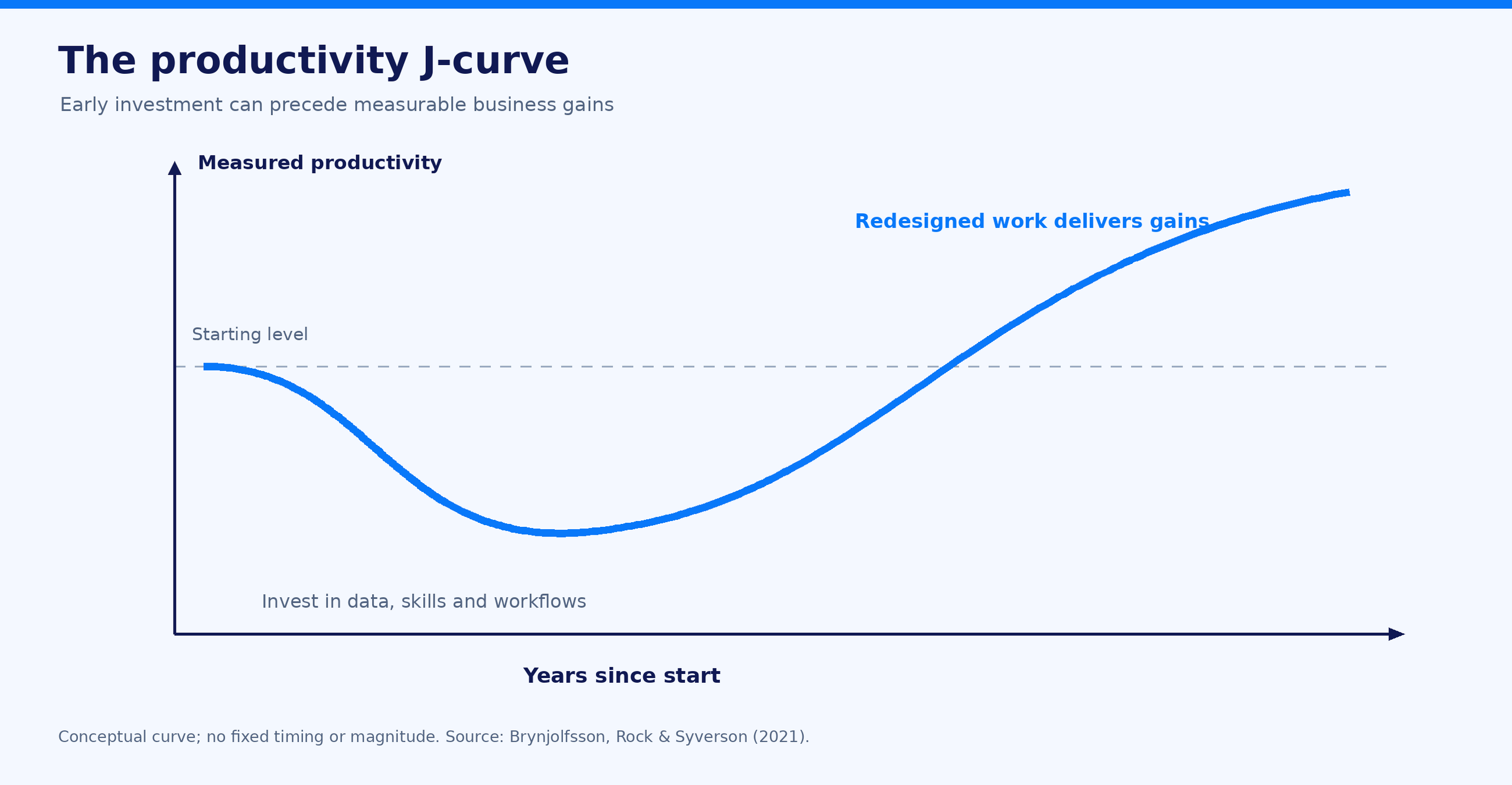
An artificial intelligence transformation is judged by business outcomes, not by usage: shorter lead times, more projects delivered, lower unit cost. It also takes years: general purpose technologies pay off only after firms invest in new processes, skills and data. Those investments hardly show on the balance sheet, so measured productivity first dips and then rises. Economists call this the productivity J-curve (Brynjolfsson et al., 2021). A 2025 study of US manufacturing plants found the same pattern for industrial AI: short-term losses came before longer-term gains (McElheran et al., 2025).
What is the difference between digital transformation and AI transformation?
Digital transformation moved work into software that follows rules people wrote. AI transformation adds systems that learn from data, give probabilistic answers and increasingly act on them.
| Digital transformation | AI transformation | |
|---|---|---|
| Core logic | Rules written by people | Patterns learned from data |
| Output | Same input, same result | Probabilistic; can be confidently wrong |
| Main asset | Processes moved into software | Enterprise data and the workflows built on it |
| What to govern | Access, uptime, change control | Data rights, accuracy, drift, bias, human review |
| Typical failure | Late or over budget | A pilot that never reaches production |
| Who must change | IT and process owners | Every role whose decisions AI informs |
AI driven digital transformation is the overlap: AI built on processes that are already digital. Measure its return like any digital transformation ROI case: by outcomes, not activity.
What are the current rates of AI adoption?
Broad AI adoption is now normal. Value at enterprise level is not.
- Scale: 44% of McKinsey's 2026 respondents say their organization is scaling AI, up from 38% a year earlier (McKinsey, 2026).
- Value: 37% see any EBIT impact from AI, and about 6% are AI high performers. CEOs say only 25% of their AI initiatives delivered the expected ROI (IBM, 2025a).
Task-level gains are real: customer support agents with a generative AI assistant resolved 15% more issues per hour, and less experienced agents 30% more (Brynjolfsson et al., 2025). Firm-level effects are small so far. In Denmark, two years after ChatGPT's launch, researchers found no measurable effect on earnings or hours worked (Humlum & Vestergaard, 2025). That is the gap to close.
Read more: AI in Project Management: Use Cases & Future Trends
Why Do Most AI Transformations Fail?
AI programs fail more often than ordinary IT programs. RAND notes that, by some estimates, more than 80% of AI projects fail, twice the rate of IT projects without AI (Ryseff et al., 2024). In a preliminary 2025 study, MIT's NANDA initiative reported that 95% of organizations were getting zero return from generative AI (MIT NANDA, 2025).
1. The pilot trap
Pilots run in clean conditions, with no owner for scaling and no rule for stopping. In 2025, 42% of companies abandoned most of their AI initiatives, up from 17% a year earlier, and the average company dropped 46% of its proofs of concept before production (S&P Global Market Intelligence, 2025). Every dropped pilot has already used expert time.
2. Enterprise data that is not ready for AI
AI models are only as good as the context they get. Gartner found that 63% of organizations lack, or are unsure they have, the right data management practices for AI. It predicts that through 2026, organizations will abandon 60% of AI projects that lack AI-ready data (Gartner, 2025a).
3. Technology searching for a problem
RAND interviewed 65 experienced data scientists and engineers. Of the five root causes they named, a misunderstood problem came first. Chasing the latest technology instead of a real user problem was another (Ryseff et al., 2024).
4. New tools on old workflows
A copilot added to a ten-step approval chain speeds up each step, not the chain. In BCG's survey of 1,000 executives, about 70% of AI challenges came from people and processes, 20% from technology and only 10% from algorithms (BCG, 2024). Value comes from redesigning the work around the AI.
5. Too many initiatives for too few experts
This cause rarely makes the list. Every AI initiative needs the same people: data engineers who connect systems, domain experts who define and check the output, process owners who redesign the work. Run fifteen initiatives on five experts and all fifteen wait. Research on multi-project organizations calls this the resource allocation syndrome: the fight over shared people becomes the central management problem (Engwall & Jerbrant, 200300113-8)). AI expertise is scarce: in a Bain survey, 44% of executives said a lack of in-house expertise is slowing AI adoption (Bain, 2025).
AI leaders respond with focus. They pursue about half as many AI opportunities as their peers (BCG, 2024). Gartner's 2026 high performers managed AI initiatives as a portfolio and regularly moved funding away from, or stopped, those that underperformed.
Read more: AI Capacity Planning: Driving Resource Efficiency and Project Success
What Does an Enterprise AI Transformation Roadmap Look Like?
An AI transformation roadmap turns strategy into a sequence of decisions. Each of the seven steps ends with one: go on, change course or stop.
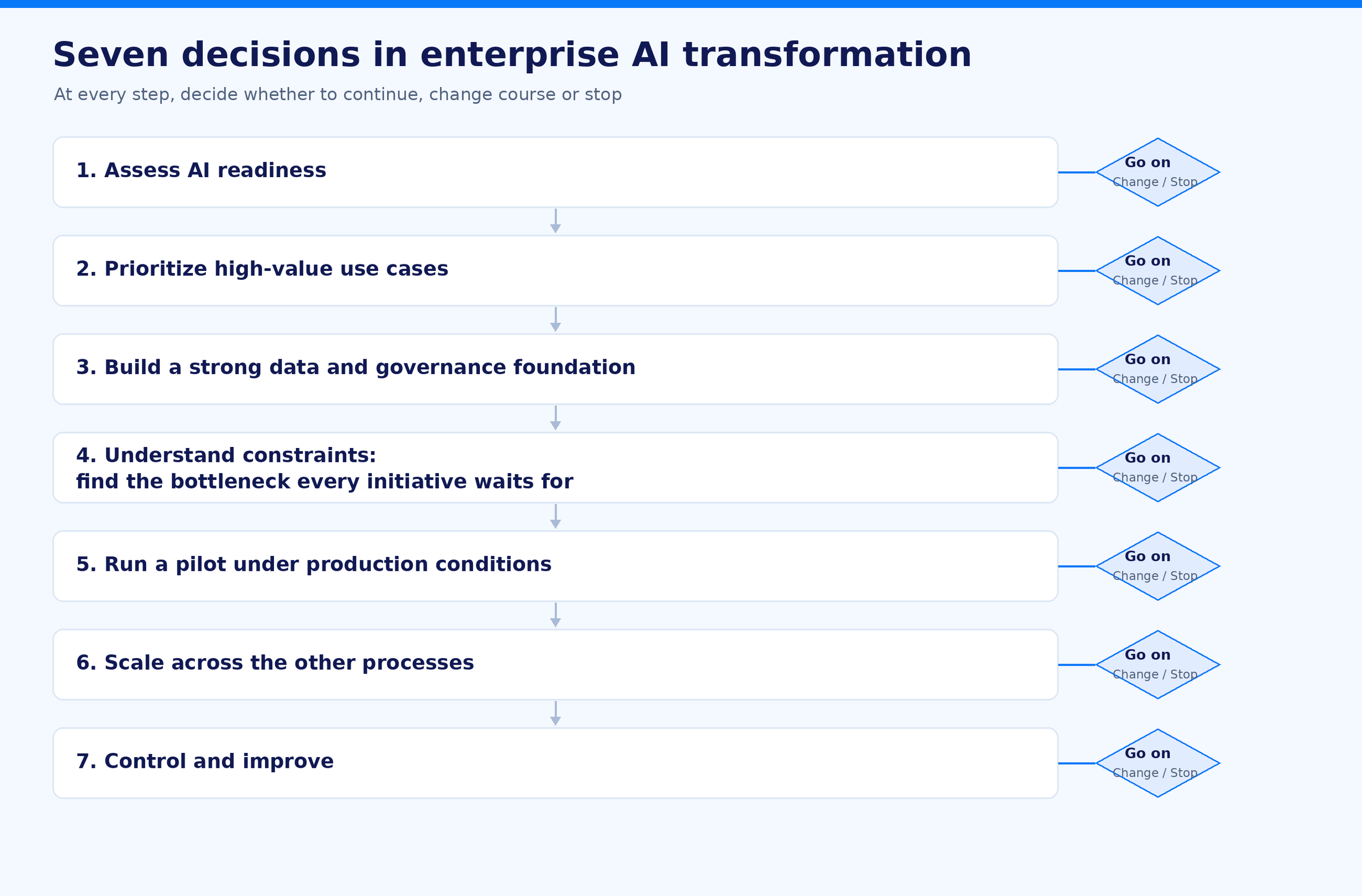
1. Assess AI readiness
Assess each use case, not the whole company: data, people, governance, technology and evidence of value. Record today's costs, lead times and output first, or you cannot prove a result later. Our AI readiness assessment guide gives the checklist and the gates that should block a pilot.
2. Prioritize high-value use cases
Score candidates on impact and feasibility, then apply three tests most companies skip:
1. Is anything waiting on this work?
2. Does the wait cost real money?
3. Can a machine do it well enough for a person to sign off?
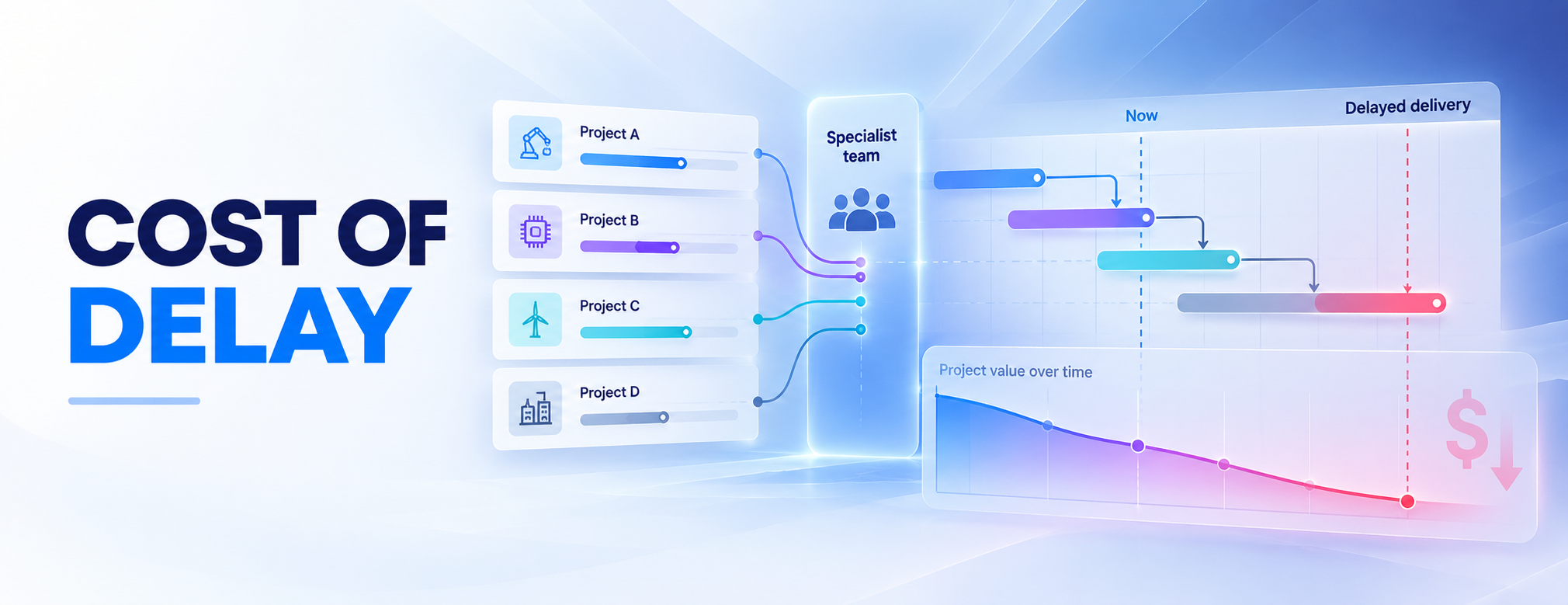
Rank the use cases that pass by cost of delay, the money lost per week of waiting (Reinertsen, 2009), divided by the weeks of expert time each one needs. Focus on one to three business domains.
3. Build a strong data and governance foundation
Decide who owns which enterprise data, who may use it for which model, and how quality is checked. Build data governance on a public framework such as the NIST AI Risk Management Framework or ISO/IEC 42001. In the EU, rules for general-purpose AI have applied since August 2025, and AI Act duties for high-risk systems listed in Annex III apply from 2 December 2027 (European Commission, 2026). Keep governance light enough for pilots to start.
4. Understand constraints: find the bottleneck every initiative waits for
Some constraints are easy to list: model latency, API costs, legacy integration, privacy and industry rules. Give each one an owner.
The constraint that sets the pace is harder to see: the few experts every initiative needs at the same time. That group is your bottleneck, a resource constraint in people and skills, not a step in a process.
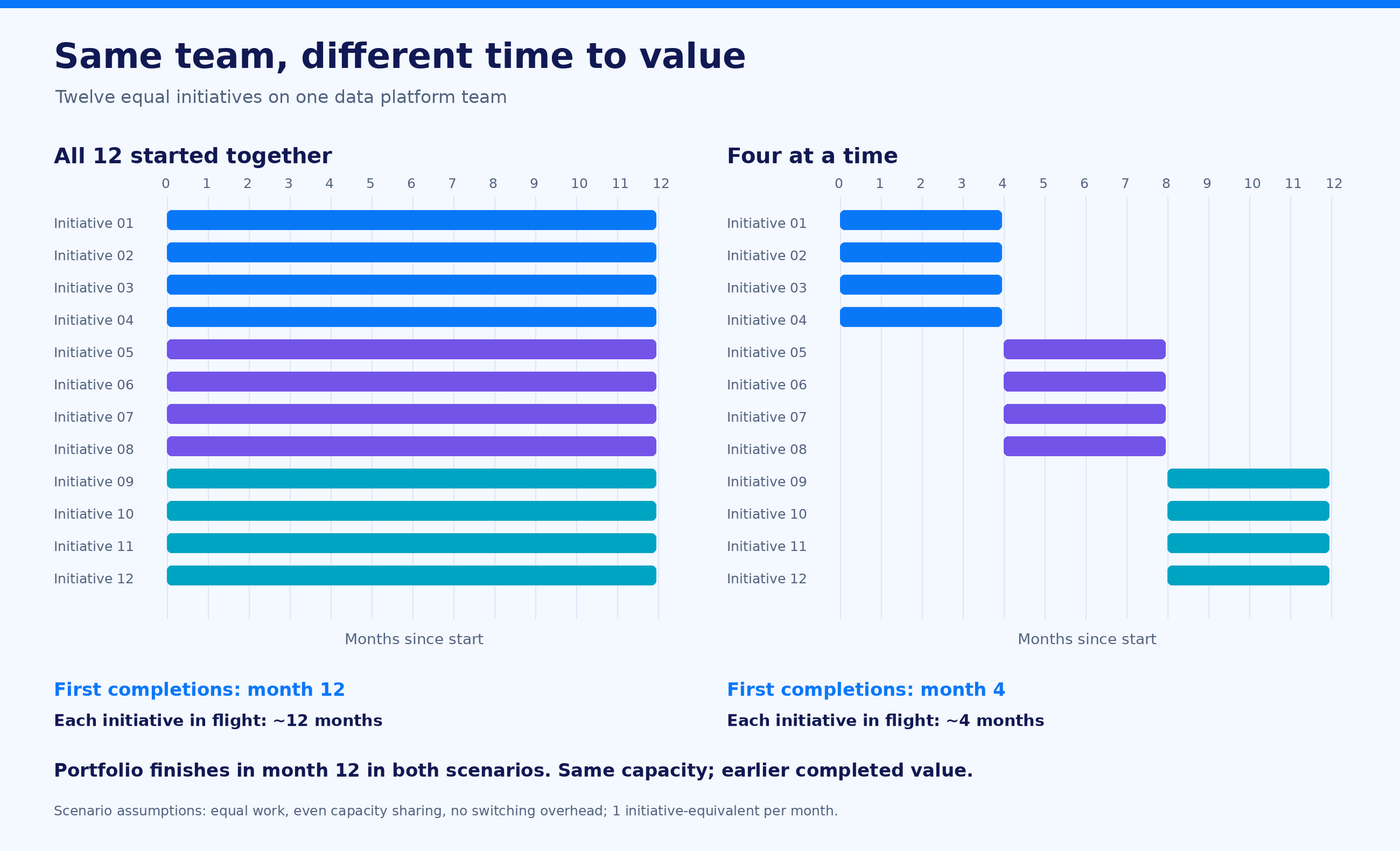
Illustrative example: twelve AI initiatives share one data platform team that can finish one integration a month. Start all twelve at once and each takes about twelve months to land. Run four at a time and each lands in about four months. Same people, same capacity. Value arrives three times sooner.
"An hour lost at a bottleneck is an hour lost for the total system." Eliyahu M. Goldratt, The Goal (1984)
Epicflow, a portfolio platform that plans multi-project work around the specialists you actually have, shows which team each initiative is queuing for, weeks before the queue reaches a status report. See resource capacity planning.
5. Run a pilot under production conditions
Use real data, real users, a baseline, a stop rule and a named decision owner. Test where AI helps and where it hurts. In a field experiment with 758 BCG consultants, AI users completed 12.2% more tasks and worked 25.1% faster on tasks inside AI's capabilities. On a task outside them, they were 19% less likely to find the correct solution (Dell'Acqua et al., 2026). Count net expert hours after review and rework, and count the hours that reach your bottleneck.
6. Scale across the other processes
Reuse the pilot's data pipelines, test sets and governance. Start the next domain only when the previous one runs in production, limit how many initiatives run at once, and plan training with the rollout.
7. Control and improve
Track accuracy, drift, cost, adoption and the business outcome. Give every initiative a stop rule and use it. Gartner expects over 40% of agentic AI projects to be canceled by the end of 2027 (Gartner, 2025b). A planned stop costs far less than a late one.
Running several AI initiatives on the same expert teams? Explore how Epicflow identifies resource bottlenecks, shows which initiatives are likely to wait longest, and reveals the potential cost of those delays. Build your own demo.
How Do AI Transformation Cycles Work?
The program has no single finish line. It runs in cycles, and each cycle is a portfolio decision. A quarterly rhythm works for most organizations:
1. Review what finished and what it delivered against the baseline.
2. Stop or scale against the criteria set at the start.
3. Check the expert load again. New people, tools or AI resources change where work queues.
4. Release the next initiatives into the freed capacity, not before.
Plan for years: in Deloitte's 2025 survey of 1,854 executives, a typical AI use case needed two to four years to reach satisfactory ROI, and only 6% paid back within a year (Deloitte, 2025).
In Epicflow, What-If analysis tests a new order of initiatives before you commit and shows how dates and money change. For larger portfolios, the Epicflow Portfolio Optimizer, delivered as PMO as a Service, searches millions of combinations of sequence and resources and recommends one. Your people decide.
Which Next-Generation Capabilities Matter, From NLP to Agentic AI?
Each capability changes something different and fails differently.
| Capability | What it changes | Where it fails |
|---|---|---|
| Natural language processing | Finds, summarizes and routes text | Domain terms, poor source documents |
| Generative AI | Drafts text, code, designs and test data | Confident errors outside its strengths |
| Agentic AI | Executes multi-step tasks with tools | Cost, unclear value, weak controls |
| IoT and smart technologies | Feeds sensor data from physical operations | Data quality, integration |
| Computer vision | Inspects, counts and measures from images | Lighting, rare defects, edge cases |
Natural language processing
Natural language processing (NLP) lets AI systems read and write human language: specifications, contracts, tickets and reports. Its first enterprise value is finding knowledge in documents nobody has time to read.
Generative AI
Generative AI creates text, code, images and synthetic data. In one experiment, professionals finished writing tasks about 40% faster, with about 18% higher quality (Noy & Zhang, 2023). Gains are uneven, so test where they hold.
Agentic AI
Agentic AI plans and executes multi-step tasks with tools and little human input. The market was valued at $7.29 billion in 2025 and is projected to reach $139.19 billion by 2034 (Fortune Business Insights, 2026). Among large companies, the share scaling agents in at least one function rose from 27% to 40% in a year (McKinsey, 2026). The person who checks an agent's work can become the new bottleneck, so plan each agent like a resource. Epicflow plans an AI agent like any other resource, with capacity, a rate and dates, and shows where it earns the most. See AI agents as a resource.
IoT and smart technologies
IoT sensors are not AI by themselves. They supply the live data AI uses for predictive maintenance, energy and quality control.
Computer vision
Computer vision turns camera and scan images into measurements and decisions. On a production line, it checks parts at full speed and flags suspect ones for a person to review.
Read more: AI Agents for Project Management: Tools, Trends & Examples
How Do You Manage Culture And Change to Scale AI Adoption?
Widespread AI adoption depends on people more than tools. Employees often move first: in 2024, 75% of knowledge workers used generative AI at work, and 78% of them brought their own tools (Microsoft, 2024). Unmanaged use carries risk: one in five organizations reported a breach linked to shadow AI (IBM, 2025b).
Overcome resistance through augmentation
People resist AI when they expect it to replace them. Frame it as more output from the same people, and show it: in the support study above, the least experienced workers gained the most. Research warns against pushing automation or augmentation alone, because each depends on the other (Raisch & Krakowski, 2021). Only 36% of employees in BCG's 2025 survey felt adequately trained, and those with more than five hours of training were much more likely to use AI regularly (BCG, 2025).
Establish an AI center of excellence (CoE)
An AI center of excellence joins IT, business owners, legal and change managers. It owns governance, training, approved tools and the reuse of models across units. Give it one more job: a single list of AI initiatives, the expert load and the stop rules.
Redesign workflows and give business leaders ownership
Adoption stalls when AI produces an answer and the next handoff stays the same. Business leaders, not IT, must own the targets: put AI outcomes into operational KPIs and redesign roles around them. In Prosci's practitioner research, excellent change management made projects about seven times more likely to meet objectives than poor change management (Prosci, 2026).
Key Takeaways
- Measure outcomes, not usage, and plan for two to four years of payback.
- Fix data and governance early, with the EU AI Act dates in view.
- Find the bottleneck. Your scarcest experts set the pace of the program.
- Run it as a portfolio: fewer initiatives in flight, owners, stop rules, a quarterly review.
Epicflow, a portfolio platform that plans multi-project work around finite specialist capacity, treats an AI transformation strategy as a portfolio of initiatives that compete for the same experts. It shows which team each initiative waits for, puts a price on every week of waiting and tests a new order before you commit. At KPN, managing projects this way took due-date performance from 18% to 80%.
Tell us what keeps going wrong - late projects, clashing priorities, too much work in progress - and see only the parts of Epicflow that deal with it. Show me the fix for my problem.
Frequently Asked Questions
1. What is AI transformation?
AI transformation is the redesign of an organization's strategy, operating model, data and workflows so that AI makes or supports core business decisions. Unlike AI adoption, it changes how work is decided, and it is measured in outcomes such as lead time, output and margin.
2. Should enterprises build custom AI models or buy existing solutions?
Buy for general tasks; build only where your own data gives you an edge. A preliminary 2025 MIT NANDA study found that projects with external partners reached deployment about twice as often as internal builds: about 67% against 33%.
3. What is an example of AI transformation?
Illustrative example: a verification team is the bottleneck for 20 engineering projects. AI drafts first-pass test reports and engineers review them. The freed hours go to queued projects, so more projects finish with the same people.
4. What is the framework for AI transformation?
Most frameworks combine strategy, data governance, a platform, talent, workflow redesign and adoption. Research adds four organizational capabilities: AI project planning, co-development, data management and model lifecycle management (Weber et al., 2023).
5. Why do many enterprise AI transformation projects fail to show ROI?
Pilots are not tied to outcomes, data is not ready, and gains arrive only after a dip. Many programs also count hours saved, but hours saved away from the bottleneck rarely move a delivery date or the P&L.
6. How do we identify the highest-value AI use cases for our organization?
Start with the work everything else waits for. Keep use cases where waiting costs real money and a person can sign off the output. Rank them by cost of delay per week of expert time, and focus on one to three domains.
7. How long does a full enterprise AI transformation take?
Several years. In Deloitte's 2025 survey, a typical AI use case needed two to four years to reach satisfactory ROI, and only 6% paid back within a year. Plan in quarterly cycles.
8. How is AI transforming work?
AI changes tasks before jobs. Gains so far go mostly to less experienced workers, and new tasks appear, such as reviewing AI output. With complementary software, just over 46% of jobs could see more than half their tasks affected by large language models (Eloundou et al., 2024).
9. Why is unified enterprise data essential for AI systems?
AI systems need consistent, permissioned context to answer correctly; fragmented data produces errors and security gaps. Gartner predicts that through 2026, organizations will abandon 60% of AI projects that lack AI-ready data.
10. Is AI always 100% correct?
No. AI models work with probabilities and can be confidently wrong. In one field experiment, consultants who used AI on a task outside its strengths were 19% less likely to reach the correct solution. Critical workflows need human review, test sets and monitoring.
References
Bain & Company. (2025, March 4). Widening talent gap threatens executives' AI ambitions [Press release]. https://www.bain.com/about/media-center/press-releases/20252/widening-talent-gap-threatens-executives-ai-ambitions--bain--company/
Berente, N., Gu, B., Recker, J., & Santhanam, R. (2021). Managing artificial intelligence. MIS Quarterly, 45(3), 1433-1450. https://doi.org/10.25300/MISQ/2021/16274
Boston Consulting Group. (2024, October 24). AI adoption in 2024: 74% of companies struggle to achieve and scale value [Press release]. https://www.bcg.com/press/24october2024-ai-adoption-in-2024-74-of-companies-struggle-to-achieve-and-scale-value
Boston Consulting Group. (2025, June 26). AI at Work 2025 [Press release]. https://www.bcg.com/press/26june2025-beyond-ai-adoption-full-potential
Brynjolfsson, E., Li, D., & Raymond, L. (2025). Generative AI at work. The Quarterly Journal of Economics, 140(2), 889-942. https://doi.org/10.1093/qje/qjae044
Brynjolfsson, E., Rock, D., & Syverson, C. (2021). The productivity J-curve: How intangibles complement general purpose technologies. American Economic Journal: Macroeconomics, 13(1), 333-372. https://doi.org/10.1257/mac.20180386
Dell'Acqua, F., McFowland, E., III, Mollick, E., Lifshitz, H., Kellogg, K. C., Rajendran, S., Krayer, L., Candelon, F., & Lakhani, K. R. (2026). Navigating the jagged technological frontier. Organization Science, 37(2), 403-423. https://doi.org/10.1287/orsc.2025.21838
Deloitte. (2025, October 22). AI ROI: The paradox of rising investment and elusive returns. https://www.deloitte.com/global/en/issues/ai/ai-roi-the-paradox-of-rising-investment-and-elusive-returns.html
Eloundou, T., Manning, S., Mishkin, P., & Rock, D. (2024). GPTs are GPTs: Labor market impact potential of LLMs. Science, 384(6702), 1306-1308. https://doi.org/10.1126/science.adj0998
Engwall, M., & Jerbrant, A. (2003). The resource allocation syndrome: The prime challenge of multi-project management? International Journal of Project Management, 21(6), 403-409. https://doi.org/10.1016/S0263-7863(02)00113-8
European Commission. (2026). AI Act: Regulatory framework for artificial intelligence (updated 19 October 2026). https://digital-strategy.ec.europa.eu/en/policies/regulatory-framework-ai
Fortune Business Insights. (2026). Agentic AI market. https://www.fortunebusinessinsights.com/agentic-ai-market-114233
Gartner. (2025a, February 26). Lack of AI-ready data puts AI projects at risk [Press release]. https://www.gartner.com/en/newsroom/press-releases/2025-02-26-lack-of-ai-ready-data-puts-ai-projects-at-risk
Gartner. (2025b, June 25). Gartner predicts over 40% of agentic AI projects will be canceled by end of 2027 [Press release]. https://www.gartner.com/en/newsroom/press-releases/2025-06-25-gartner-predicts-over-40-percent-of-agentic-ai-projects-will-be-canceled-by-end-of-2027
Gartner. (2026, September 1). Gartner survey finds only 22 percent of organizations have successfully scaled AI across multiple business units [Press release]. https://www.gartner.com/en/newsroom/press-releases/gartner-survey-finds-only-22-percent-of-organizations-have-successfully-scaled-ai-across-multiple-business-units
Goldratt, E. M., & Cox, J. (1984). The goal: A process of ongoing improvement. North River Press.
Humlum, A., & Vestergaard, E. (2025). Still waters, rapid currents: Early labor market transformation under generative AI (NBER Working Paper No. 33777, revised 2026). https://doi.org/10.3386/w33777
IBM. (2025a, May 6). IBM study: CEOs double down on AI while navigating enterprise hurdles [Press release]. https://newsroom.ibm.com/2025-05-06-ibm-study-ceos-double-down-on-ai-while-navigating-enterprise-hurdles
IBM. (2025b, July 30). IBM report: 13% of organizations reported breaches of AI models or applications [Press release]. https://newsroom.ibm.com/2025-07-30-ibm-report-13-of-organizations-reported-breaches-of-ai-models-or-applications,-97-of-which-reported-lacking-proper-ai-access-controls
International Organization for Standardization. (2023). ISO/IEC 42001:2023 Information technology: Artificial intelligence: Management system. https://www.iso.org/standard/81230.html
McElheran, K., Yang, M.-J., Kroff, Z., & Brynjolfsson, E. (2025). The rise of industrial AI in America: Microfoundations of the productivity J-curve(s) (CES Working Paper 25-27). U.S. Census Bureau. https://econpapers.repec.org/RePEc:cen:wpaper:25-27
McKinsey & Company. (2026). The state of AI in 2026: On the road to ROI. https://www.mckinsey.com/~/media/mckinsey/business%20functions/quantumblack/our%20insights/the%20state%20of%20ai/the-state-of-ai-in-2026-on-the-road-to-roi-aug-2026.pdf
Microsoft. (2024). 2024 Work Trend Index: AI at work is here. Now comes the hard part. https://www.microsoft.com/en-us/worklab/work-trend-index/ai-at-work-is-here-now-comes-the-hard-part
MIT NANDA. (2025). The GenAI divide: State of AI in business 2025 (preliminary report). https://mlq.ai/media/quarterly_decks/v0.1_State_of_AI_in_Business_2025_Report.pdf
National Institute of Standards and Technology. (2023). Artificial intelligence risk management framework (AI RMF 1.0) (NIST AI 100-1). https://doi.org/10.6028/NIST.AI.100-1
Noy, S., & Zhang, W. (2023). Experimental evidence on the productivity effects of generative artificial intelligence. Science, 381(6654), 187-192. https://doi.org/10.1126/science.adh2586
Prosci. (2026). The correlation between change management and project success. https://www.prosci.com/blog/the-correlation-between-change-management-and-project-success
Raisch, S., & Krakowski, S. (2021). Artificial intelligence and management: The automation-augmentation paradox. Academy of Management Review, 46(1), 192-210. https://doi.org/10.5465/amr.2018.0072
Reinertsen, D. G. (2009). The principles of product development flow: Second generation lean product development. Celeritas Publishing.
Ryseff, J., De Bruhl, B. F., & Newberry, S. J. (2024). The root causes of failure for artificial intelligence projects and how they can succeed (RR-A2680-1). RAND Corporation. https://www.rand.org/pubs/research_reports/RRA2680-1.html
S&P Global Market Intelligence. (2025). Voice of the Enterprise: AI & machine learning, use cases 2025, as reported by CIO Dive (14 March 2025). https://www.ciodive.com/news/AI-project-fail-data-SPGlobal/742590/
Stanford Institute for Human-Centered Artificial Intelligence. (2026). AI Index Report 2026: Economy. https://hai.stanford.edu/ai-index/2026-ai-index-report/economy
Weber, M., Engert, M., Schaffer, N., Weking, J., & Krcmar, H. (2023). Organizational capabilities for AI implementation: Coping with inscrutability and data dependency in AI. Information Systems Frontiers, 25(4), 1549-1569. https://doi.org/10.1007/s10796-022-10297-y