A Guide to Aviation Project Management [2026]
 Victoria Sokolova
.
December 10, 2025
.
Project Management
.
28 mins READ
Victoria Sokolova
.
December 10, 2025
.
Project Management
.
28 mins READ
![Epicflow – A Guide to Aviation Project Management [2026]](https://www.epicflow.com/wp-content/uploads/2022/04/aircraft_engineering_1-1024x577.jpg)
Aviation is a complex and constantly developing sector of aerospace and defense, where experts from various areas of technical expertise are involved. In turn, project management in aviation industry embraces a wide range of processes, from aircraft engineering to operational improvements. What makes it even more complicated is that it’s impacted by present-day trends and challenges in the aerospace and defense domain.
To be able to stay competitive in the market and cope with any arising issues, aviation companies should seek ways to improve operational efficiency in general and engineering processes in particular.
What drives the efficiency of aircraft projects? What are the common challenges of aviation project management, and how to address them? Let’s consider these key issues in the article.
Key Takeaways
- Aviation project management involves planning, executing, and controlling projects in aviation, aerospace, and defense industries.
- Aviation projects embrace aircraft design and production, engineering and maintenance, repair and overhaul, airport infrastructure upgrades, and sustainability initiatives.
- Key challenges of aviation project management include working in complex regulatory environment, addressing risks and uncertainties, overcoming resource constraints, managing complex interdependencies, managing supply chains, and timely delivery of complex long-term projects and programs.
- To manage aviation projects effectively, organizations should: select and prioritize projects strategically, implement proactive risk management process, optimize limited resources, manage dependencies across multiple projects, make data-driven decisions, and adopt project management aviation software.
- PPM software supports aviation project management by helping companies manage multiple projects with shared resources, prioritize projects, track performance and resource utilization, and optimize portfolio delivery without extra costs.
What Is Aviation Project Management?
Aviation project management involves planning, execution, and monitoring of projects in the aviation sector. Aircraft projects are among the most demanding ones: they cover both the engineering domain (e.g., aircraft engineering projects) and effective operations management (e.g., maintenance operations and overhaul). They can involve the design, development, testing, and production of aircraft and related systems as well as effective coordination of aviation processes and implementing regulatory compliance programs.
Aviation project management examples
For the deep understanding of the specifics of aviation project management, let’s review some examples.
- Aircraft design and development: Developing a new aircraft model or modernizing the existing one.
- Aircraft manufacturing: Managing production processes, assembly lines, and supply chain management.
- Airport infrastructure projects: Building new terminals, airport construction, extending runways, integrating smart security systems.
- Maintenance, repair, and overhaul: MRO contributes to aircraft safety and ensures regulatory compliance with aviation regulations.
- Supply chain optimization projects: They can be focused on optimizing logistics, reducing dependence on global suppliers, and improving supply chain management.
- Sustainability initiatives: Developing fuel-efficient engines, using lightweight materials, and achieving carbon neutrality.
Based on the above-mentioned specificity of aviation projects, let’s consider the main challenges you may face when managing them.
Common Challenges in Aviation Project Management: How Project Specifics Impact Complexity
Here are some key specific challenges that define aviation and aircraft engineering projects.
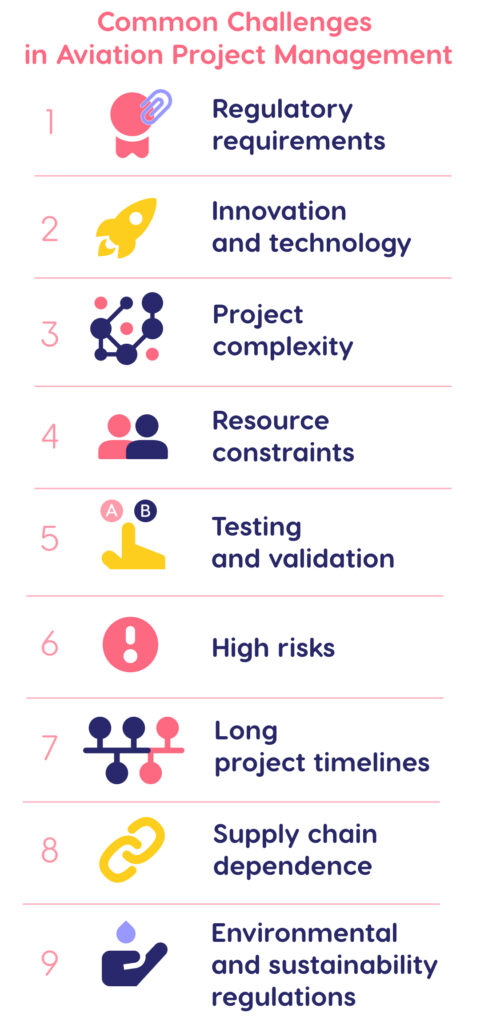
1. Stringent regulatory environment.
The aviation sector requires compliance with strict global and national standards and requirements, e.g., complying with safety standards or quality standards. This involves preparing documentation, conducting testing, and ensuring high quality. For example, design, components, processes must undergo certification, and even a minor deviation can result in delays in aerospace engineering projects. Complex and ever-changing aviation regulations add complexity to aviation project management.
2. Innovation and technology challenges.
Aviation sector is rapidly evolving. More and more aviation companies tend to use the latest technologies and alternative materials to optimize costs and reduce environmental impact. But at the same time, these innovations may introduce additional risks. For example, the team members need time to get used to the new ways of working, or the results of new technology implementation can be unexpected.
3. Project complexity.
Any aviation project is complex – they embrace various complex processes and interdependencies, utilize costly technologies and diverse resources, must comply with strict requirements, and meet tight deadlines. Without proper coordination of all project processes, the right methodologies and software tools, these complexities may lead to disruptions in aviation projects.
4. Resource constraints.
Aviation projects require highly specialized human resources, e.g., aircraft engineers, compliance experts, software developers, etc. In addition, to implement innovative technologies, aviation companies need tech-savvy people who are in high demand across industries. So, despite increased automation and AI, aviation organizations face resource shortages, which can prevent them from implementing projects on time.
5. Constant testing and validation.
This mostly refers to aircraft engineering projects. On the one hand, constant testing is a must for ensuring safety. On the other hand, it can result in making numerous changes to the initially developed product, which can lead to delays. Moreover, if the results of testing don’t comply with the established standards, it will lead to project delays and cost overruns.
6. High risks.
Given the technical complexity of projects, the need to comply with safety requirements, high uncertainty, the probability of supply chain disruptions, and high costs, aviation project management requires increased emphasis on risk management.
7. Long project timelines.
Aircraft engineering and production isn’t fast; the same can be said about airport modernization. Some projects can last for years and decades, which increases uncertainties and adds risks for aviation project management.
8. Dependence on complex supply chains.
Aviation companies rely on international suppliers. But as we’ve seen multiple times since COVID-19 outbreak, supply chains can be disrupted, causing material shortages, transportation delays, and schedule disruptions.
9. The need to meet environmental and sustainability regulations.
In many countries, there’s a demand for reducing carbon emissions, improving energy efficiency, and meeting other sustainability requirements. These demand adds complexity to the aircraft projects.
Therefore, the successful execution of aviation projects requires technical excellence and the right strategy to cope with a variety of challenges that arise throughout the project lifecycle.
But all these efforts should be complemented by the right portfolio management tools. For example, Epicflow is designed to overcome the complexity of projects and multi-project management, work on projects with high uncertainties and risks, and optimize their shared resources. Book a call to learn the details.
Tips on Managing Aircraft Projects with Maximum Efficiency

Prioritize projects intelligently
Under conditions of resource constraints, high costs, and technical complexity, you need to wisely select and prioritize projects you add to the pipeline. You need to determine the prioritization criteria you’ll rely on – business value, ROI, or other factors essential for your organization for the moment. But there’s one criterion you should take into account for any project portfolio – resource availability. Without considering that, when resources are stretched too thin across projects in the portfolio, your company will face delays, teams will be overloaded, and managers will be stressed.
Keep control of changing requirements
As aircraft engineering involves the designing process, changes to the developed products are inevitable. However, when there is no control over these changing requirements, your project can easily go off the rails, which will result in missing due dates, dissatisfied customers, disengaged project team, and exceeding project budget. To avoid these unfavorable consequences, a project manager has to apply proper aircraft requirements management that involves:
- documenting the initial requirements and stakeholder expectations,
- clarifying the consequences of changes to the stakeholders who require them,
- developing a change control procedure for every change request, which should be strictly followed by all the project participants.
Read more: How to Compile a Project Requirements Document
Include buffers in project planning
One of the ways to deal with uncertainties in project management is including buffers at the stage of planning a project. For example, you can add a time buffer so that a project won’t be delayed if some unexpected events occur. Also, you can add a capacity buffer, which is especially helpful for environments with shared resources. This kind of buffer will protect the workflow from resource unavailability in case a critical employee falls ill, for example. Given the technical complexity and resource constraints, buffers will protect the aviation projects’ workflow from disruptions and delays and contribute to their timely completion.
Optimize resources across the portfolio
As we’ve mentioned earlier, aviation companies face resource shortages. Resource optimization can let them deliver required projects on time even when resources are limited. Here are some resource optimization steps.
- Resource capacity planning: makes sure that people are assigned to projects based on their available capacity.
- Assigning limited resources to the highest priority projects first.
- Workload balancing to prevent overload, bottlenecks, and delays.
- Allocating resources based on their capacity, availability, and skills.
These steps will considerably increase the efficiency of limited resources, which will allow companies to compete more projects with the same resources.
Read more: Deliver Faster with Less Effort: How Smart Project Management Prevents Employees from Overload
Pay attention to project dependencies
As a rule, the tasks within a project are dependent on each other: e.g., resource dependencies imply that the same team member is required for several tasks; logical dependencies indicate that a certain task cannot start until its predecessor is finished. A project manager has to be aware of all these dependencies within a project: if there are some problems with one task, how will it affect the other ones? What actions should be taken to mitigate the risks? Otherwise, insufficient attention to task dependencies may lead to significant delays and corresponding budget overrun.
What is more, a great number of aerospace engineering companies implement numerous projects at the same time. Such an environment poses additional challenges for aircraft project management — you need to cope with dependencies between all these projects and ensure efficient utilization of shared resources. This challenge can be successfully solved with the help of efficient project/resource management software that is capable of meeting the needs of a multi-project environment.
Read more: Managing Project Dependencies In a Multi-Project Environment
Ensure efficient collaboration within a team/between teams
One of the prerequisites for successful project management in the aviation industry is ensuring that a project team works like a single organism, where everyone knows their role and does their best to achieve a common goal. Effective collaboration and communication among project team members gains even more importance when the team members work from various corners of the world, which makes their effective collaboration rather challenging. What helps project/resource managers ensure productive teamwork?
- Frequent communication to make sure that every team member clearly understands their role in a project: the project scope and the amount of work that is expected from them, the timeline, project goals, successors and predecessors of their tasks.
- Ensuring that none of the team members is overloaded and hampers their colleague’s work.
- Leveraging an effective resource management solution – it shows changes occurring in a project’s workflow and in such a way provides a single source of truth for every team member as well as makes it possible to track the team’s progress.
Read more: 4 Tips on How to Manage Globally Distributed Teams with Maximum Efficiency
Apply proper risk management
Aircraft engineering projects are more than other domains subjected to various risks: changing market and technology trends, prices for raw materials, high costs, the need for implementing technological innovations, and any other contingencies related to a project’s scope, timeline, and resources. To be able to mitigate the negative consequences of unexpected situations, it’s important to develop thoroughly all aspects of risk management plan at the beginning. When a project is protected with such a plan, the team will have fewer surprises and know exactly how to respond to risk-bearing situations. Less surprises and better predictability make the work on a project much more efficient.
Implement data in decision-making
Making decisions in such complex and risky environments as aviation and aerospace engineering is a bunch of unknowns. What is more, the price of improper decisions in aviation project management is extremely high. This is why it’s essential to incorporate data into the decision-making process. For example, you can use What-if analysis feature of portfolio management software tools to run and analyze scenarios before making decisions.
To implement these recommendations effectively, you’ll need the assistance of intelligent portfolio management software. Let’s consider its role in more detail in the section below.
Aviation Project Management Software Tools
A significant part of the work on a project can be optimized thanks to leveraging an effective multi-project or portfolio management solution. Creating the right project schedule, assigning resources with perfectly matching skills, forecasting future roadblocks, and providing real-time data on projects – this is just a part of the functionality available in portfolio and resource management software.
Let’s examine how this works through the example of Epicflow. It’s a multi-project resource management solution with intelligent PPM functionality, developed by experts with about 20 years of experience in multi-project management. Here are some of its functions that can increase the efficiency of managing aviation and aircraft engineering projects.
Keeping the focus on the highest-priority projects and tasks
Epicflow offers a different approach that increases chances for successful delivery of projects: no matter how many projects there are in the pipeline, every team member knows the most important tasks they should work on at the moment. It’s possible thanks to automatic task prioritization across the portfolio. In addition, the system analyzes all changes made by users (completing tasks, moving milestones, reassigning tasks, etc.) and automatically recalculates priorities, so that none of the important tasks are missed. Finally, in the portfolio management mode, Epicflow prioritizes projects depending on the business value you’ve assigned to them.
Monitoring a project’s health
Making sure that a project is on track and timely detection of bottlenecks is an important prerequisite for successful project delivery. It becomes even more essential when you have multiple projects underway with complex dependencies between their tasks and resources. Epicflow has several instruments that help monitor the state of projects:
- Pipeline presents a prioritized list of all current projects and milestones, and projects that require maximum management effort are placed at the top. For convenience, the projects are marked with colors depending on their “health”, so you can assess the state of your multi-project environment at a glance.
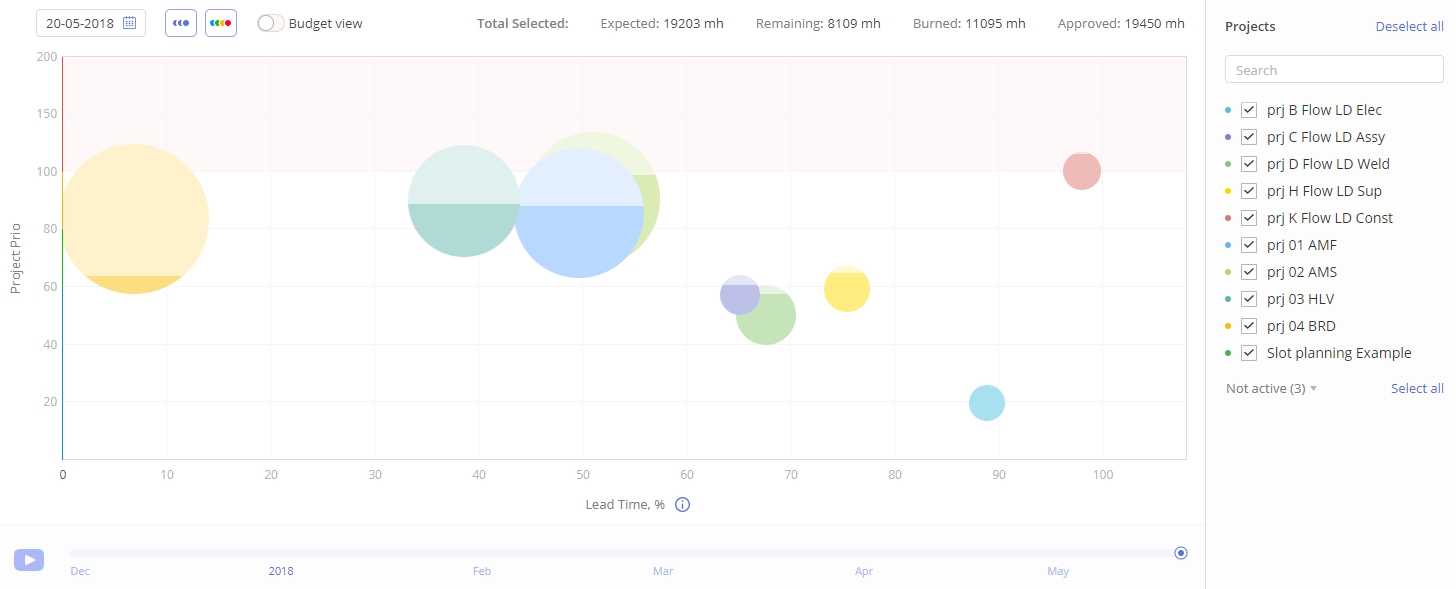
- Bubble Graph, which is an improved version of Fever Chart, demonstrates the size and structure of projects, the amount of remaining work and budget as well as possible roadblocks threatening a project’s success.
Read more: Bubble Graph: Critical Chain Fever Chart Re-Imagined
Keeping control of material resources
Aircraft engineering also deals with manufacturing, therefore it’s essential to manage material resources engaged in the production process. Epicflow makes it possible to specify material resources required for a project (raw materials, equipment, tools, etc.) and add all the necessary information about them (price, hourly rate, measurement unit, and risk factor). In addition, material resources used in a project can be united into a Unit Pool, which allows assigning tasks to them, specifying their availability, capacity, and the number of working hours per day.

Facilitating efficient resource utilization
One of the ways to increase project performance is efficient utilization of the available resources. In Epicflow, this can be achieved in several ways:
- thanks to task prioritization, so that every team member is focused on the most important assignments for the moment;
- Epicflow’s AI-powered capacity planning tool allows for capacity planning across the entire portfolio;
- with the Competence Management feature that makes it possible to keep track of every team member’s skills, their levels, and capacity as well as suggests the right talent to complete a certain task based on the above-mentioned data;
- by means of preventing employees from being over- or underloaded: in the Future Load Graph, you can see the team members’ workload in the future depending on their current tasks and adjust the situation if necessary; the Historical Load Graph allows you to analyze the team’s historical output and use this data to plan their workload.
Giving grounds for informed decision-making
It’s much easier to make the right decisions if you know exactly what consequences they will have. Epicflow’s What-if Analysis feature allows you to analyze possible outcomes: you can change various parameters (add or remove projects, move milestones, etc.) and see what these changes will result in.
Optimizing portfolio management
Epicflow allows for delivering projects with the highest business value under conditions of resource constraints. It prompts how to reschedule projects in the portfolio to deliver the highest-priority ones successfully, which is the key factor for achieving optimum portfolio performance. In addition, its AI-powered Portfolio Optimizer helps create a sequence of projects that will deliver maximum value for the organization without increasing headcount.
Are you interested in learning more about Epicflow’s capabilities to increase the efficiency of your projects? Don’t hesitate to book a call with us.
Final words
- Aviation project management is complex: it is affected by the ongoing challenges in the aerospace and defense industry, involves the management of technically complex projects and compliance with strict regulatory standards.
- To manage aviation and aircraft engineering projects successfully, you should keep control of changing requirements, manage project dependencies, optimize resources, facilitate proper collaboration between teams, and effectively manage risks.
- The right aviation project management software can optimize all aspects of aviation project management and contribute to improving outcomes of complex aerospace engineering projects.
Frequently Asked Questions
What is aviation project management?
Aviation project management is the process of planning, executing, and controlling projects in the aviation sector of aerospace and defense industry. It combines traditional project management principles and following specialized standards, safety requirements, leveraging cutting-edge aviation technology.
What are aviation projects?
Here are some examples of aviation projects: aircraft design, development, and production; aircraft engineering; aircraft maintenance, repair, and overhaul; aircraft infrastructure upgrades; sustainability initiatives, and more.
What makes aviation projects different from other industries?
In contrast to projects in other industries, project management in aviation operations must follow strict safety and compliance requirements. They embrace complex processes, require diverse resources and innovative technologies, and coordination among cross-disciplinary teams.
How can PPM software support aviation project management?
Project portfolio management tools help aviation organizations in the following ways:
- Managing multiple concurrent projects and their shared resources;
- Prioritizing projects based on business value and resource availability;
- Track resource and portfolio performance;
- Optimize resource utilization;
- Deliver projects within portfolios and programs faster and without extra resources.
What are the challenges of aviation project management?
Common challenges of managing aviation projects include the following ones:
- Managing interdependencies across multiple projects,
- Ensuring compliance with complex regulations and standards;
- Dealing with complex supply chains;
- Addressing resource constraints;
- High risks;
- Extended project timelines;
- Project complexity.
How to manage aviation projects effectively?
Effective aviation project management involves the following steps:
- Wise project selection and prioritization,
- Robust risk management;
- Resource optimization;
- Effective management of project dependencies;
- Implementing data-driven decision making;
- Adopting project management aviation software solutions.