Earned Value Management (EVM): Key Metrics, Benefits, and How to Calculate It
 Victoria Sokolova
.
December 27, 2025
.
Project Management
.
22 mins READ
Victoria Sokolova
.
December 27, 2025
.
Project Management
.
22 mins READ
Managing projects without the reliable performance data is like acting blindfold – you can’t be sure that the project remains on the right track. This is especially critical for complex multi-project environments, where projects have interdependencies.
But there’s a solution – earned value management (EVM) is a proven technique that can provide you with a clear picture of project performance from multiple perspectives.
Read our quick guide to learn the core EVM metrics as well as how to calculate and interpret this data.
What Is Earned Value Management (EVM)?
Earned value management is a project management technique used to track project progress and performance from different perspectives. It includes three indicators: planned value, actual cost, and earned value. Project managers use these parameters to track cost and schedule performance, identify potential risks, and forecast project outcomes.
In a nutshell, earned value management aims to answer the questions:
- Is the project on schedule?
- Is it on budget?
- How much will it cost to finish the project?
Except for getting insights into project performance, why is it important to analyze earned value in project management? Let’s figure it out in the next section.
Key Components of Earned Value Management
EVM analysis is a comprehensive process that requires several components.
1. Planned value.
PV refers to the approved amount of work that should be completed by a specific date. It’s calculated before starting a project and can serve as a project baseline. Its main purpose is to show how much budgeted work you planned to complete.
For example, if the total project budget is $200,000, and by the 4th month you’ve completed 40% of the work (according to the schedule), the planned value by this time will $80,000. How did we calculate that? Use the formula:
PV = total project budget x %work completed
200,000 x 40% = 80,000
2. Earned value.
It’s one of the critical project management metrics that is also used for earned value management. It’s an indicator of the budgeted cost of project work that has been completed up to a given point in time. It also shows whether a project is on schedule and within budget, and the value of the completed work.
So, how to calculate earned value in project management? You need to multiply the total project budget by the percentage of work completed.
3. Actual cost.
Finally, as you can guess from the name of this parameter, it shows the actual amount of money spent on the work performed.
Now, let’s consider how these parameters are used in earned value management.
Earned Value Management Formulas and Metrics: How to Analyze Performance
Earned value management involves both calculation and analysis. Let’s start with calculations using EVM formulas.
The above-mentioned components of EVM provide the raw data that can be further used for performance management. With their help, we can calculate a variety of indicators that will give insights into project performance. Here are earned value management formulas you can employ.
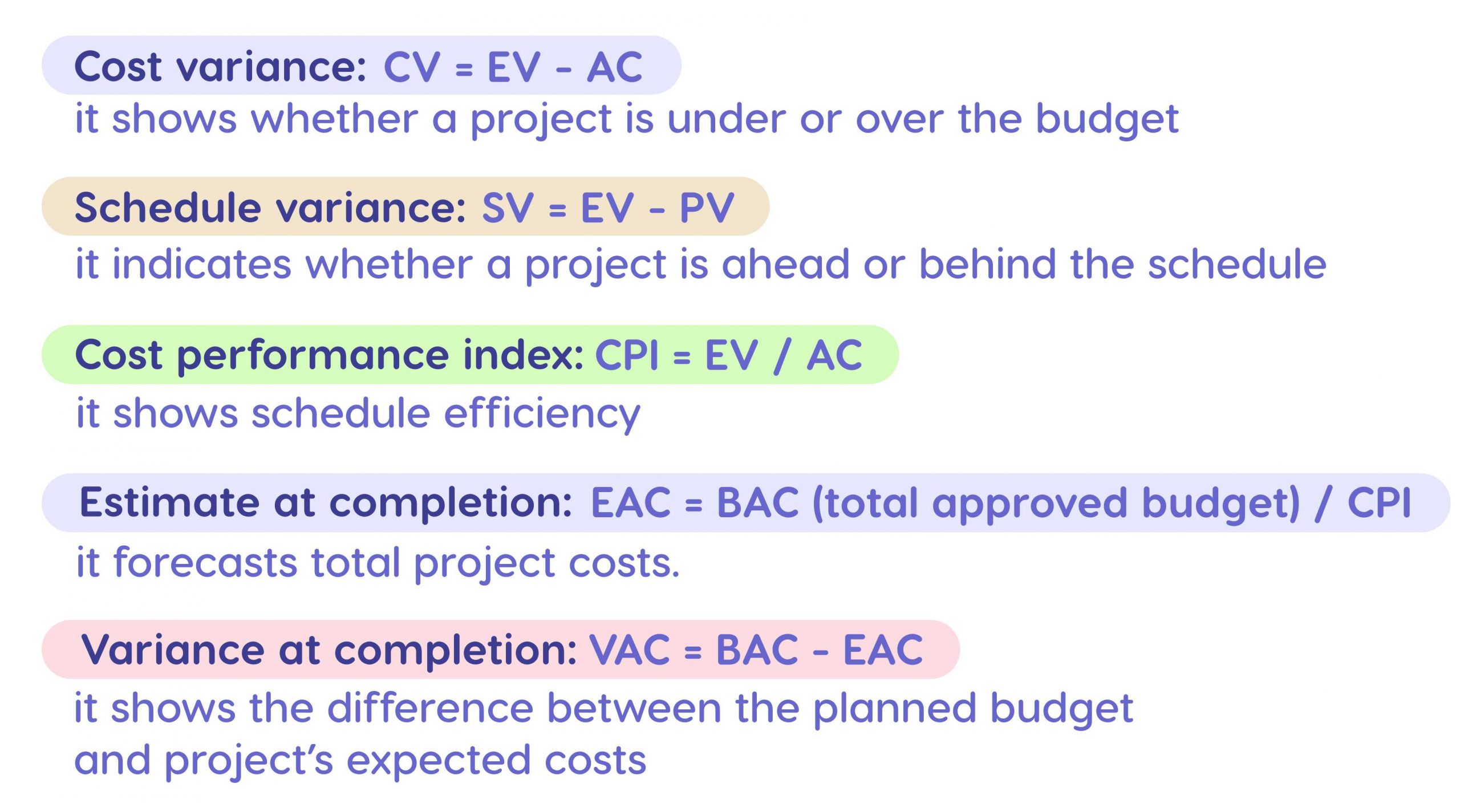
Analysis of EVM metrics
But making calculations is not enough if you don’t interpret the results you’ve got. Let’s now consider the details of these indicators’ interpretation and variance analysis.
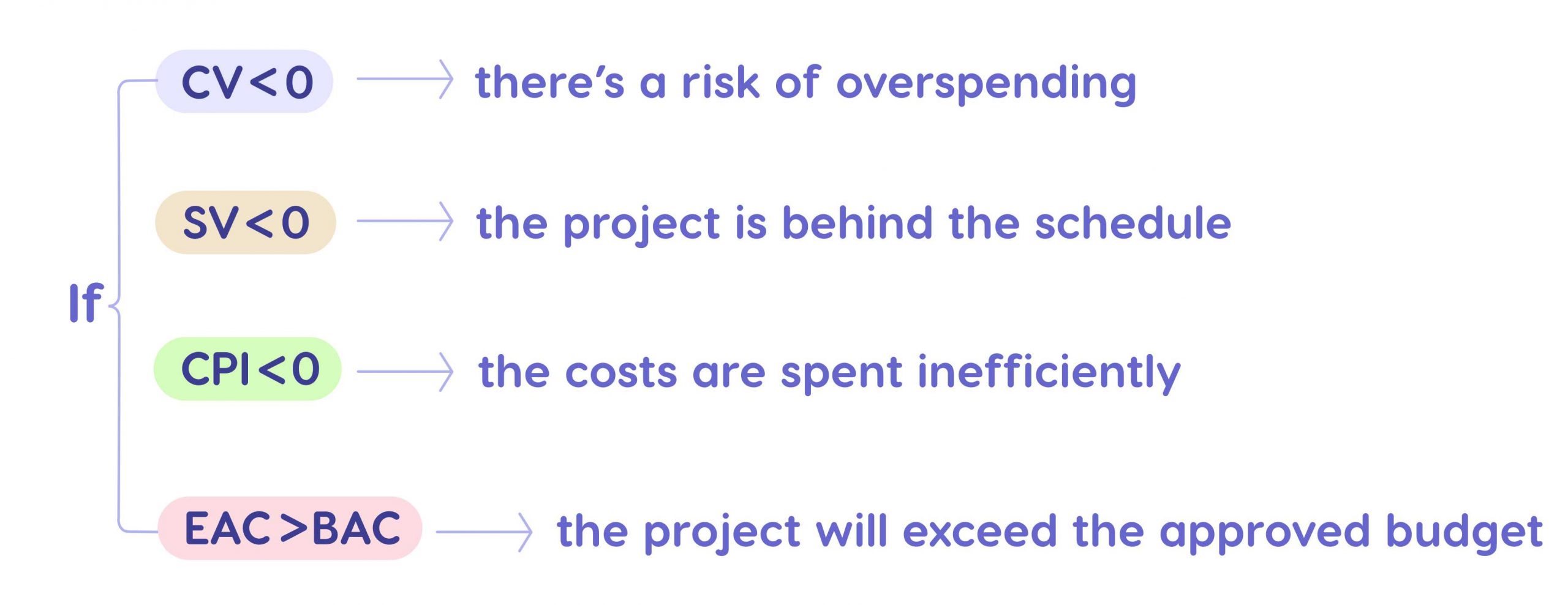
All these situations require corrective actions to get the project back on the right track. This is how earned value management becomes the basis for decision-making.
Importance of Earned Value Management in Project Management
The main benefit of earned value management is that, in contrast to tracking progress, cost, or project schedule separately, earned value method allows you to get a comprehensive view of how a project is performing. Here are some more reasons to analyze EVM in project management.
- Getting early warnings: Project managers can identify cost and/or schedule variance early and timely act to prevent negative consequences.
- Reducing project management risks: Regular control of schedule and costs minimizes the risk of project delays and cost overruns.
- More accurate performance assessment: EVM is calculated using a formula with several parameters, which increases the accuracy of performance evaluation.
- Optimized decision-making: Analyzing performance rate provides managers with grounds for making decisions, e.g., adding resources, adjusting project scope, changing the due date, portfolio optimization using earned value management metrics’ analysis, etc.
Why is EVM important for multi-project management?
Earned value management is especially important for multi-project management. When you manage multiple projects or a project portfolio, they usually have shared resources, complex dependencies, and overlapping due dates. What is more, issues in one project can negatively affect other projects due to dependencies between them. Here’s how earned value management can change the game:
- It provides performance tracking across projects.
- Early issue detection prevents the negative consequences of issues on other projects.
- Multiple projects often share the same resources, while EVM helps set the right priorities and adjust resource allocations if necessary.
- EVM is one of the forecasting instruments that helps forecast total costs across a portfolio.
- It can give grounds for comparing projects in terms of cost and schedule efficiency and correct prioritization.
- It provides project stakeholders with insights they require.
Therefore, earned value management is more than just tracking budgets or schedules, it can tell you whether the money invested is producing expected results. In multi-project management, earned value management is even more important than for single-project management, as it helps both track individual performance and see the big picture of the project portfolio.
When to Use Earned Value Analysis in Project Management?
Now, you may ask, when should I perform these calculations and analysis? At what stage of project execution are they most important and reliable? Let’s figure out the key points when EVM matters most.
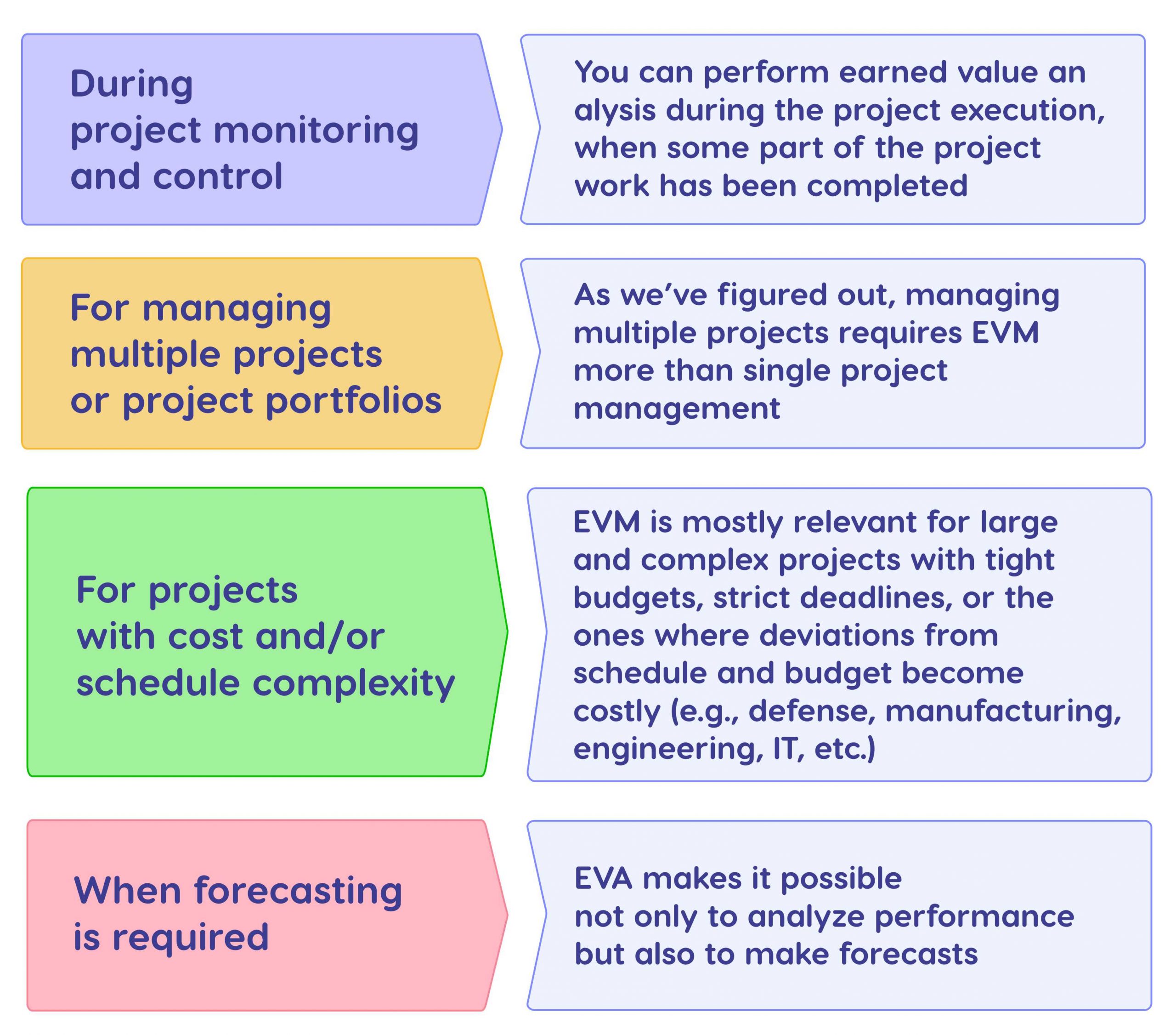
- During project monitoring and control: You can perform earned value analysis during the project execution, when some part of the project work has been completed.
- For managing multiple projects or project portfolios: As we’ve figured out, managing multiple projects requires EVM more than single project management.
- For projects with cost and/or schedule complexity: EVM is mostly relevant for large and complex projects with tight budgets, strict deadlines, or the ones where deviations from schedule and budget become costly (e.g., defense, manufacturing, engineering, IT, etc.).
- When forecasting is required: EVA makes it possible not only to analyze performance but also to make forecasts.
Are there situations when you don’t need EVM? Yes, there are. Earned value analysis and management are less useful when you manage small short-term projects, where all these calculations and analysis will be too cumbersome and redundant. The other case is managing Agile projects – traditional EVM is more suitable for more or less linear project structure or waterfall projects.
What Are the Participants of the Earned Value Analysis Process?
Last but not least: who is responsible for earned value management? There are several roles in the organization that can deal with this process.
1. Project managers.
If you work in a multi-project environment, there will be individual project managers. Project managers are the primary performers of earned value management. They can monitor its key indicators (PV, EV, AC), calculate and interpret other parameters. Also, they can take some corrective actions, e.g., scope adjustment.
In a multi-project environment, project managers report performance metrics to the senior level – portfolio or program. They also collaborate with other project managers, e.g., when it comes to shared resources and their allocation to projects.
2. Project team members.
Team members also contribute to obtaining earned value management metrics: they collect the required data and provide updates (e.g., the percentage of work completed). In a multi-project environment, their contribution remains important and becomes a component of earned value analysis on the portfolio level.
3. Portfolio manager.
This role appears on multi-project levels. A portfolio or a program manager reviews earned value across all projects, analyzes their performance, and identifies those that drain resources or those that are likely to generate value. They also can make decisions regarding project prioritization, e.g., to postpone a less promising project to free up resources for the one that is expected to generate more value.
4. Project management office.
In organizations managing multiple complex projects or project portfolios, PMO is a critically important organizational unit. As a participant of earned value management, a PMO validates the accuracy of the data collected across projects. They also use this data to create dashboards and reports and provide executives with a single source of truth regarding portfolio performance.
5. Finance department.
First, the finance department can provide accurate cost tracking: they provide a single source of truth regarding actual costs. Also, this department ensures that financial resources are properly allocated across projects. They also track costs of human and material resources. Finally, in multi-project and project portfolio management, the finance department compares portfolio expenses with organizational budgets
6. Senior executives.
Senior management can analyze EVM reports, identify trends and challenges, and make decisions regarding the implementation of changes (e.g., adjusting priorities, changes in funding, etc.).
Final Words
Therefore, earned value management (EVM) is not just a set of formulas. It’s rather a decision making framework that provides multi-sided performance insights. It combines diverse metrics to provide you with an understanding of whether a project is on the right track and where it’s heading. Also, it allows you to detect red flags early on and take timely action before it’s too late. When done right, EVM can relieve project leaders of guesswork and provide them with a reliable technique for measuring project performance.
Portfolio management software tools like Epicflow can serve as earned value management systems supporting the EVM process. For example, it shows real-time project progress with milestone feasibility, provides a comprehensive view of the budget planned a spent, offers risk management capabilities, and has Gantt chart and time-tracking features that have a direct relation to project costs. Also, its scenario planning capabilities can forecast project and portfolio performance and allow you to test various scenarios if the situation requires corrective action. Contact us to find out more insights into performance analysis with Epicflow and how to use it for game-changing earned value management.
Read more: Optimizing Portfolio Profit Through DIPP-Guided Resource Allocation
Frequently Asked Questions
What is earned value in project management?
Earned Value (EV) in project management is an indicator of the budgeted value of the work completed by a certain point in time. It’s used to compare the actual cost of the work completed with what has been planned.
What is earned value management in project management?
Earned Value Management (EVM) is a technique used in project management to track project progress by comparing the planned work, actual costs, and completed work. It brings together scope, cost, and schedule information to demonstrate to project leaders whether a project is on the right track.
How to perform earned value management?
To perform earned value management, you need to know its key components: Planned Value (PV), Earned Value (EV), and Actual Costs (AC). Knowing these three parameters, you will know how to use earned value management metrics (cost and schedule variance, cost and schedule performance index, and others). The analysis of indicators calculated with PV, EV, and AC will provide you with multi-sided information on project performance.
What is the purpose of earned value management?
The purpose of earned value management is providing project managers with a clear and objective way to track cost and schedule performance. Comparing planned work, actual costs, and the work completed, you can timely identify problems, forecast future outcomes, and keep projects on time and within budget.
Is EVM used in Agile?
Earned value methodology is less suitable for the Agile approach than for linear projects with a predictable structure. However, with some adjustments, it can also be used for managing Agile projects. For example, Agile teams can measure earned value based on completed story points and compare progress with actual delivery.
Can small-scale projects utilize EVM?
EVM index can be used for small projects. Regardless of the size of a project, you can track its progress, compare the budget planned and spent, and identify the core components of earned value project management technique. However, for smaller projects with simple tasks and short timelines, simpler project tracking may be enough.
Is EVM a KPI?
EVM, as earned value management, is rather a process and a technique than a KPI. At the same time, this technique embraces KPIs like cost or schedule performance index, variance at completion, etc. that you can calculate when performing earned value management.
When not to use earned value management?
Earned Value Management (EVM) can be less useful for small, short-term, and low-budget projects, i.e., where the effort and time spent on calculating EVM KPIs outweighs the benefits. Also, EVM is not very suitable for projects with flexible deliverables, for example, research and development projects.
What tools are used for earned value management?
An earned value management system is a tool that helps project managers evaluate cost and schedule performance using the indicators (PV, EV, AC) and combining them into a single framework. Earned value management systems (EVMS) and tools range from good old spreadsheets, where you track all indicators manually, to project or portfolio management software. The latter supports EVM by providing the data on project progress, schedule and budget tracking capabilities, and forecasting.
What are the advantages and disadvantages of earned value management?
The main advantage of earned value management is providing the objective view of cost and schedule performance, which helps managers detect problems and fix them. The disadvantages of this technique involve the need for accurate data, making additional reporting effort, and limited flexibility for projects with a flexible scope, like Agile and R&D.