Resource Scheduling in Project Management: Advantages, Disadvantages, and Ways to Optimize It With a Resource Management Tool
 Victoria Sokolova
.
March 27, 2026
.
Resource Management
.
31 mins READ
Victoria Sokolova
.
March 27, 2026
.
Resource Management
.
31 mins READ

Ensuring fruitful work on a project isn’t easy – you need to assign resources properly so that they are maximum efficient and aren’t overloaded with work. In addition, project managers need to ensure that the project will be delivered on time and within budget. To meet all these requirements, project managers sometimes use resource scheduling.
Read further to learn more about this technique, its advantages and disadvantages, and find out the alternative ways to ensure efficient resource allocation and smooth workflow.
Key takeaways:
- Resource scheduling is a part of project resource management that aims to sequence project tasks in line with resource availability.
- The advantages of doing this are removal of bottlenecks and increased productivity.
- To schedule resources the right way, you need to audit your resources and demand for them, set priorities, and simulate resource allocation scenarios to find an optimal resource schedule.
What Is Resource Scheduling in Project Management?
Everyone knows Gantt Chart as the main project scheduling tool. But let’s consider the other approach to scheduling. Project resource scheduling involves determining each task’s start and finish dates according to the availability of resources needed for their delivery and creating a schedule based on this information. Such a technique allows you to monitor the project timeline from start to finish and make sure that the project resources (employees, equipment, facilities, etc.) are utilized efficiently. Most often, resource scheduling is used for large and complex projects with a limited number of resources.
Resource scheduling steps
In a nutshell, scheduling resources can be represented as a series of the following essential steps.
- Dividing the project scope into the list of tasks that must be completed and estimating their duration (can be expressed in days, hours, or man-hours).
- Identifying constraints for each task: a deadline, certain skills required to complete the task, employee availability, etc.
- Determining the resource demand: the types and number of resources required for completing each task.
- Analyzing resources’ capacity: the amount of work they typically perform each day, their current and forecasted workload, any planned days off, new hires, etc.
- Matching available resources with the listed tasks – assigning each resource to perform a specific task at a specific date. If a resource has no capacity for completing the task and there are no alternatives, this task will be postponed and scheduled for the dates when this employee is available.
Importance of Resource Scheduling
Scheduling resources in project management allows you to minimize resource overload by scheduling projects with resource constraints in mind.
We can distinguish the following advantages of scheduling resources.
- The team members know their task completion deadlines, which in turn contributes to better predictability of the workflow for them.
- Proper resource scheduling takes team members’ capacity into account, which helps ensure a more balanced workload, minimizes the probability of overload, and contributes to more efficient resource utilization.
- It will be easier for a project manager to monitor the general project schedule to make sure that the project’s due dates won’t be missed.
- Scheduling material resources (if they are required for project completion) will be a good way to ensure their availability and proper distribution across project tasks, which in turn reduces the probability of delays.
In fact, the Dutch Ministry of Defence was able to increase expected due date performance from 24% to 77% by using Epicflow’s PPM software to schedule resources in a project management environment.
Read more: Unlocking a Defense Company’s Potential to Complete More Projects
Now that the essence and importance of resource scheduling are clear, let’s review the technique’s main advantages and disadvantages.
What Are the Disadvantages of Resource Scheduling?
Creating resource schedules isn’t the only right solution to assign resources in the most efficient way. Let’s take a closer look at the limitations of the technique.
It’s time-consuming
You have to gather and analyze lots of data regarding employees’ availability, which becomes especially cumbersome when the number of employees involved in a project is large.
It’s too deterministic
There are plenty of reasons why changes will have to be made to this schedule, which you cannot predict at the scheduling stage. Also, resource scheduling doesn’t take into account the uncertainty that usually accompanies projects, especially when a great number of people are involved. Such a deterministic approach won’t allow you to respond to necessary changes properly.
Read more: Fighting Uncertainty in Organizations, Including Matrix Ones
It can lead to project delays
Creating a resource schedule involves determining each task’s start and finish dates; however, it can be difficult to estimate the task duration accurately. For example, when a team member is going to work on an assignment for the first time, his or her estimation will be far from accurate which can result in delays.
It can reduce the team member’s productivity
Setting task deadlines can reduce the fruitfulness of project work due to student syndrome and Parkinson’s law. In the first case, the team members can procrastinate and start work on the task as close to the deadline as possible. In the second case, the work on a task will expand to fill all the time allotted for its completion, even if it requires less time in reality.
It’s not suitable for a multi-project environment
In a multi-project environment with a shared resource pool, scheduling resources is an exhausting process. First, it can be explained by numerous dependencies between projects: e.g., task dependencies or shared resources. In this case, the schedules will overlap or changes made to one project will affect the whole project environment and you’ll have to reschedule a huge number of activities. Second, it’s too complex and time-consuming to create a schedule with regard to every person’s availability, capacity, and other projects’ schedules.
As we see, the disadvantages of resource scheduling are rather remarkable, especially when you work on multiple concurrent projects with shared resources. Jump to the next section to learn about an alternative approach to the resource scheduling process provided by resource management software.
Resource Scheduling vs Resource Management: Key Differences
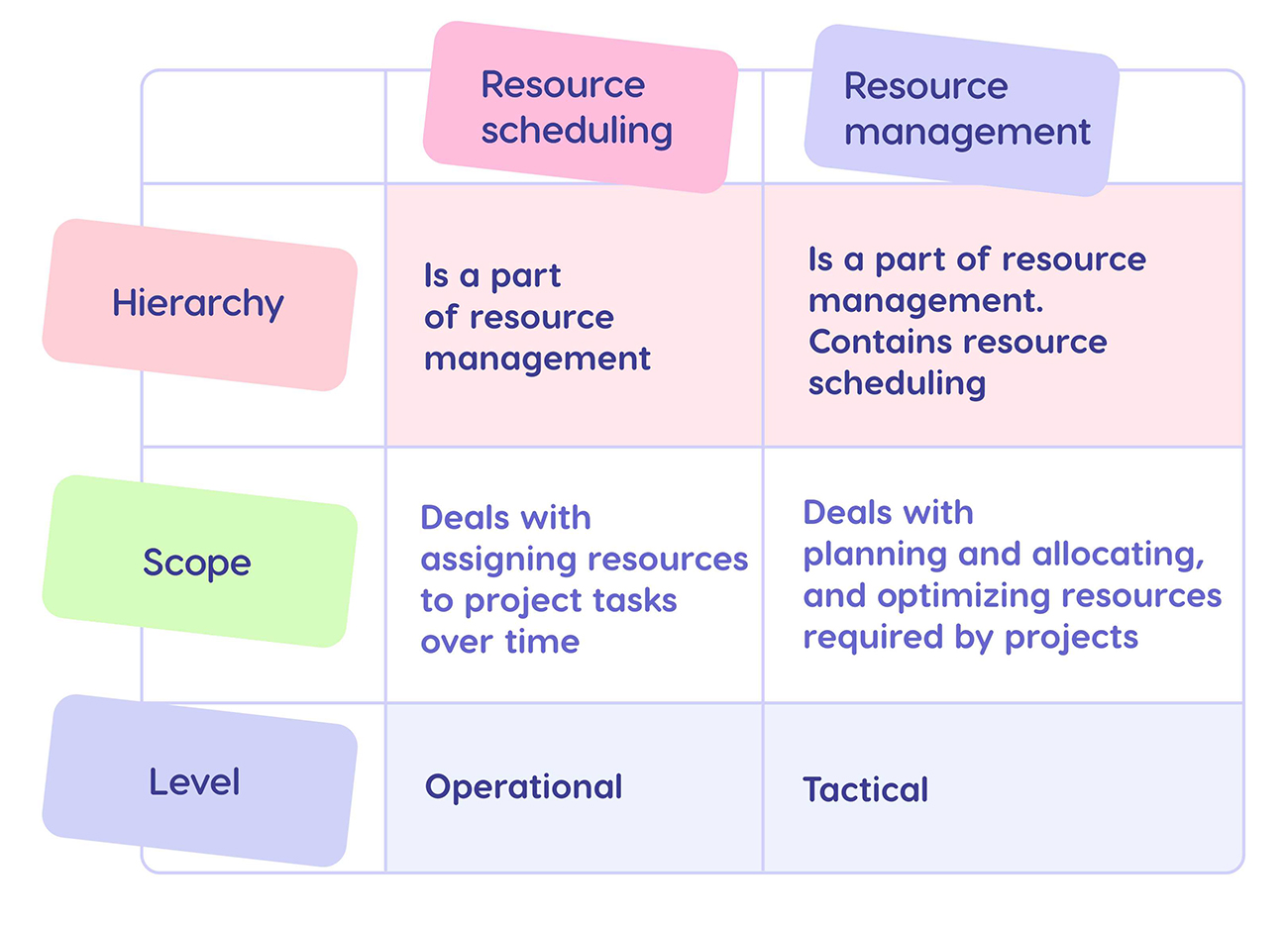
Resource scheduling is part of resource management and one its main techniques. Here are a few key differences between the two.
Types Of Resource Scheduling
There are two methods of scheduling project resources: time-constrained and resource-constrained scheduling. The choice of the method depends on the constraint that is considered the most essential for the project.
- Time-constrained scheduling implies that you cannot change the project timeline, so you schedule resources so as not to miss project deadlines. When applying time-constrained resource scheduling with a limited number of people, resource managers may require additional resources to be able to complete the project on time. As a result, this may lead to exceeding the project budget.
- In resource-constrained scheduling, it’s resource capacity and availability (i.e., resource constraints) that matter most. You can change the project’s timeline, e.g., start or finish it later depending on the availability and capacity of employees working on it. This type of resource scheduling protects people from overload but can lead to missing a project’s due date.
How To Create A Resource Schedule
Resource management and scheduling is a long process, here’s how you can break it down into six major steps.
Understand resource availability
The first step is understanding your organization’s resource availability. Take inventory of the resources available to each team and their skillsets. You can do that in your resource management software or by requesting data from HR and team leads or heads of departments.
You should also analyze resource constraints. Look up how many projects they’re involved in and how much capacity they have left.
Understand resource demands for project
You need to form an understanding of how many resources each project requires. For new projects, hold a meeting with subject matter experts and vote on what resources a project needs. Include:
- How many hours the project is expected to take.
- How many people should be involved.
- What their skills and skill level should be.
- What departments/teams you need to involve in the project.
- What material resources you might need.
For projects that are already being executed, you need to:
- Check project performance to estimate whether it can meet the due date.
- Check resource load for conflicts and overload.
- Based on this data, decide whether you need to reschedule the project.
Understand project priority
The next step is understanding project priority. It will allow you to make the right decisions in resource-based scheduling situations. When the number of resources is a major constraint, as it often is, you’ll need to shift deadlines and timelines to ensure projects get delivered without bottlenecks.
The only way to do it and keep business value production across the portfolio high is to keep projects with high priority and postpone those with low priority.
In most portfolios, you’ll determine project priority by analyzing its business value. If your organization hasn’t yet prioritized projects in its portfolio, you’ll have to go through the whole list.
Read more: A Comprehensive Guide to Prioritization In Multi-Project Management
Simulate resource allocation scenarios
Now that you have a full understanding of resources available to your organization as well as project priority and resource demands, you can start planning the resource schedule. The best way of doing this is to use scenario planning software to look at outcomes of different resource scheduling decisions.
Simulate a couple of scenarios, present the most productive ones to the governance board, and approve changes to the schedule.
Create a resource schedule
Once that’s done, implement your resource schedule plan. Add the necessary changes to your resource management tools or PPM software and make sure the information passes down to the teams responsible for executing projects.
Monitor & iterate
After the new resource schedule is in effect, all you have to do is monitor resource performance. Make sure that resources schedules don’t overlap and teams aren’t overloaded. If that’s the case, go back to the drawing board and find a way to solve this.
Common Resource Scheduling Challenges
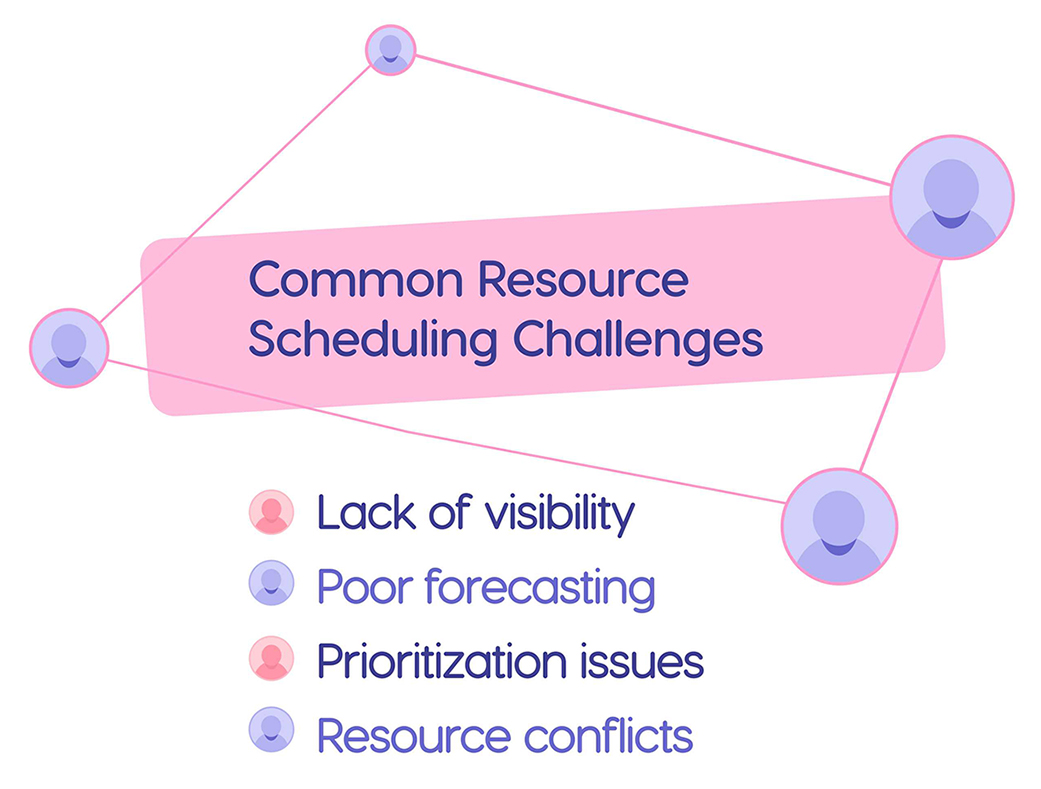
Risk scheduling is a complex activity that comes with a few inherent challenges. Here are the main ones.
Lack of visibility
Understanding what resources your organization has and what capacity they possess at the moment is paramount to proper resource scheduling. Organizations that have poor visibility into those areas will inevitably create schedules that underperform.
One of the advantages of project scheduling is that visibility is easy to gain if you use the right tools. Using resource management software that displays all of your resources and their current load makes it easy to understand the portfolio and schedule it accordingly.
Poor forecasting
Visibility into how resource load looks at the moment isn’t the only thing you should have. You should also understand the resource load in the future. When you have that understanding, you’ll be able to schedule resources months in advance and avoid creating bottlenecks. Resource capacity planning software can help you with this issue.
Prioritization issues
In multi-project and portfolio management, resource scheduling depends on prioritization as much as on resource availability. Not understanding what priorities your company should have and how these priorities are reflected in each project can lead to adding too many projects to a portfolio simultaneously, resource conflicts and overload, and ultimately, to delivery delays.
To fix this, you should hold strategic meetings to determine the company’s strategic course and monitor portfolio performance.
Resource conflicts
A common resource scheduling problem is that several key skilled resources can be needed for multiple projects at once. They soon become overloaded and are the reason behind project delivery delays. To fix this, you can create a resource scheduling plan that doesn’t overload skilled resources.
An alternative to this is to reduce their role in projects.
5 Rules For Effective Resource Scheduling
Let’s take a look at several tips for better project resource scheduling. These five should cover most of the important areas.
Know your resource availability
The most important thing is understanding your company’s resource availability and constraints. You should have a clear picture of how many resources your company has, what skills do they have, and how busy they are currently and across the closest few months.
This gives you a better understanding of how much leeway you have in terms of shifting projects around.
Match skills with projects
Assigning enough resources to a project is not enough. You should also make sure the people assigned to it have an adequate level of skills relevant to the project. Ignoring this factor typically leads to delays, poor quality, or both.
Look for software with skill management capabilities to manage that dimension of resource scheduling.
Plan for absence
Most employees typically schedule their vacations ahead of time so that managers know what to expect. But even with this, a resource scheduling plan can change in a moment if one or more key employees have to be absent due to a disease or family events.
You should have a contingency plan for situations like these and be able to either substitute the absent person temporarily or extend the project deadline.
Be flexible
A good resource schedule should have enough flexibility. It can mean the difference between failing and properly responding to:
- Shifts in the resource pool and availability.
- Changing priorities.
- Adding new projects.
Create multiple scenarios where something can go wrong and develop contingency plans for each.
Use the right tools
Using resource management tools simplifies a lot of aspects of this hard work. It can help you with improving resource visibility, projecting resource load, and forming an optimal resource schedule. In the next section, we’ll explain how Epicflow can help you reach your resource scheduling goals.
An Alternative Approach to Resource Scheduling: Epicflow’s Solution
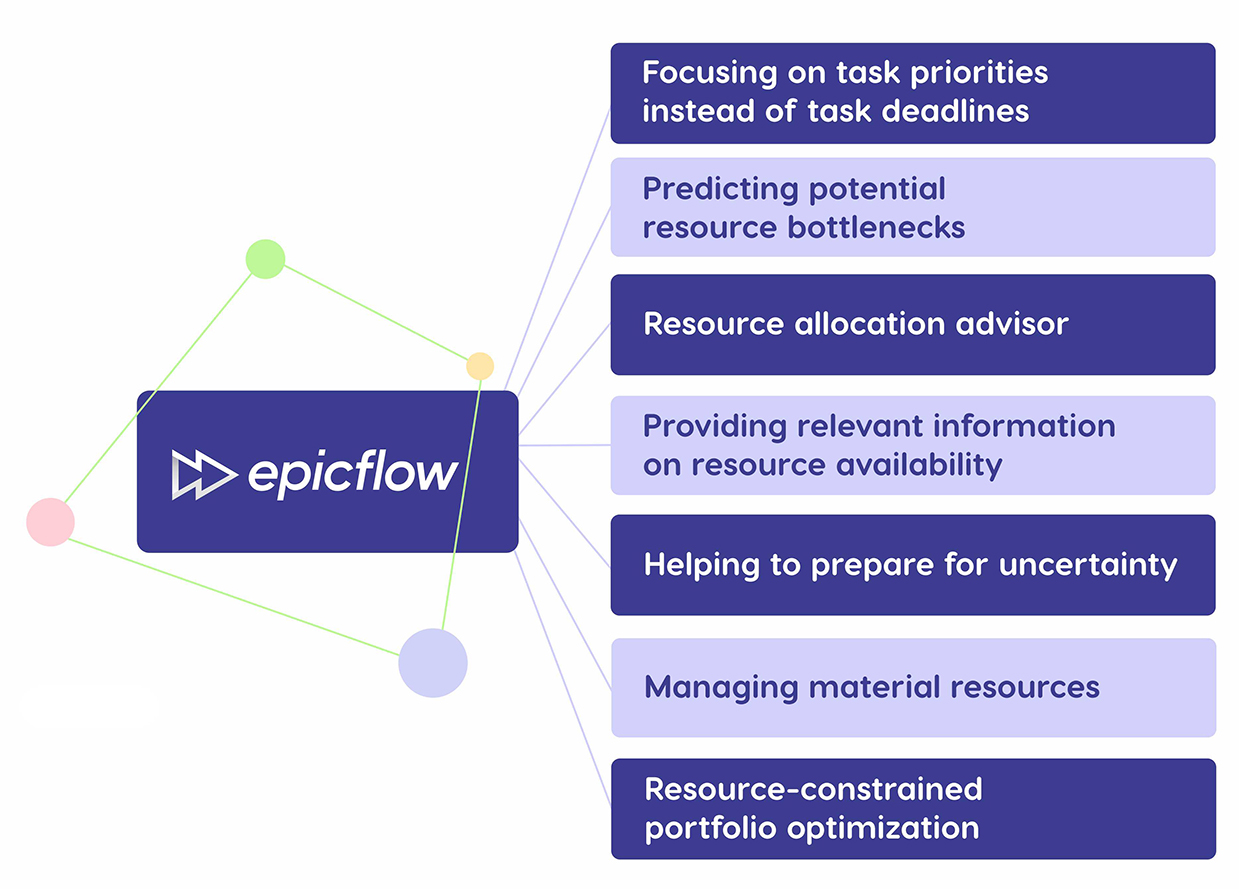
To overcome the limitations of resource scheduling, assign resources in the most efficient way, and ensure timely project completion, it’s a good idea to choose the appropriate resource scheduling software. Epicflow is an AI-driven resource management solution that facilitates the timely delivery of every project in a multi-project environment thanks to a unique approach to project and resource management. Here are the main capabilities that increase the efficiency of resources and work on projects in general.
Focusing on task priorities instead of task deadlines
In our system, there are no deadlines for individual tasks. Instead, Epicflow’s task management functionality sets task priorities across the whole project environment and provides each team member with a prioritized task list. In addition, our approach to estimates implies that a team member should complete the highest priority tasks as soon as possible to eliminate the harmful effects of Student syndrome and Parkinson’s law. When changes to the project environment occur, the priorities are automatically recalculated, which means that changes won’t ruin the schedule and/or derail a project.
Predicting potential resource bottlenecks
Epicflow’s capacity planning tool is capable of resource forecasting: e.g., predicting employees’ capacity and future workload visualization in real time. It helps you determine future resource requirements and staff future projects in such a way that there won’t be any overloaded or idle team members that will later become bottlenecks for the workflow. Also, this protects project managers from resource shortages.
Resource allocation advisor
The system automatically matches a task with an available employee who has the necessary skill sets and capacity for its completion, which significantly simplifies the allocation of resources and increases its efficiency and contributes to resource optimization.
Providing relevant information on resource availability
Epicflow integrates with human resource management systems, so it provides real-time data on all the employees’ days off, vacations, sick leaves, or other availability changes that will be taken into account in the process of resource allocation, which eliminates the risk of assigning a task to an unavailable employee.
Helping to prepare for uncertainty
You can’t predict uncertainty, but you can prepare for it so that it won’t result in unpleasant surprises for project flow. In Epicflow, you should add the time buffer to the milestones and the due date of your project, so, if unexpected situations occur, you’ll have a leeway to respond to them. Epicflow can also reduce uncertainty in decision-making.
In its What-if Analysis mode, you can test different management decisions (reassigning resources, moving milestones, adding more resources, etc.) and choose the most reasonable one.
Finally, when you manage a project portfolio, Epicflow’s Project Staggering feature lets you reschedule lower-priority projects for later so that you can free resources’ capacity for working on the highest-priority projects and delivering them on time.
Resource-constrained portfolio optimization
Epicflow Portfolio Optimizer (EPO) is an AI-based optimization engine that plans your portfolio based on value per constrained hour. It takes your real-world resource constraints and business value projections into account and automatically calculates the best portfolio scenario for business value delivery with current resource availability.
Managing material resources
Similarly to assigning human resources, in Epicflow, you can assign material resources to project tasks. Its real-time insights will help you keep track of material resource consumption and ensure that all the necessary equipment and/or facilities are available at the time they’re required for project work.
Therefore, leveraging a resource management solution like Epicflow can ensure effective resource scheduling when you manage multiple projects – it provides the benefits of resource scheduling and at the same time helps overcome the drawbacks of this technique. As a result, you can ensure smooth project flow, the productivity of resources, as well as timely and successful completion of every project in the portfolio.
Contact our experts to learn more about how Epicflow can help you manage multiple projects and their shared resources successfully.
Conclusions
Resource scheduling means determining each task’s start and finish dates based on the availability of resources. This technique is mostly used for project environments with limited resources, as it helps utilize them efficiently across multiple projects and ensure that their workloads are balanced. However, this technique has some essential disadvantages, e.g., it’s rather deterministic and not very suitable for complex and dynamic environments. In addition, resource scheduling can become cumbersome and time-consuming due to large amounts of data you have to analyze to schedule resources involved in multiple projects.
Fortunately, there’s a decent alternative that combines the benefits of resource scheduling and levels out its disadvantages. This entails leveraging resource management solutions for multi-project environments. These tools ensure optimum resource utilization, smooth project flow, and contribute to achieving project objectives.
Frequently Asked Questions
What does resource scheduling mean?
Resource scheduling means determining each task’s start and finish dates according to the availability of required employees. Based on this information, a resource schedule is created.
Why is resource scheduling important?
The most important benefit of resource scheduling is that it takes team members’ availability and capacity into account, which helps balance workloads and reduces the risk of resource overloads.
What is the difference between resource planning and scheduling?
Resource planning deals with resource assignment — allocating resources to projects and tasks in line with their skills, availability, and capacity. Resource scheduling means sequencing critical activities based on the availability of resources required to complete them.
How to create a resource schedule?
To create a resource schedule, you need to divide the project scope into a list of tasks and estimate their duration. Then, you need to determine constraints for each task (a deadline, employee availability, etc.). After that, you should determine what resources are required for completing each task and analyze available resource capacity. Finally, assign available resources to tasks on specific dates. If there’s no one available for a specific date, you can postpone this task for later.
What are the disadvantages of resource scheduling?
Resource scheduling can be too cumbersome and time-consuming for multi-project environments where hundreds or thousands of resources are involved and the possibility of resource conflicts is high. It’s a rather deterministic technique, which makes it hardly suitable for dynamic project environments when changes occur frequently. Establishing strict task deadlines reduces employees’ productivity, as it makes them subject to student syndrome and Parkinson’s law.