8 Current Trends in Project Management [2026]: What to Prepare for?
 Victoria Sokolova
.
February 26, 2026
.
Project Management
.
32 mins READ
Victoria Sokolova
.
February 26, 2026
.
Project Management
.
32 mins READ
![Epicflow – 8 Current Trends in Project Management [2026]: What to Prepare for?](https://www.epicflow.com/wp-content/uploads/2024/01/Current-Trends-in-Project-Management_2026_1-1024x643.jpg)
As we’re stepping into 2025, it’s high time to discover what trends in project management are expected to shape the domain in the near future. In the era of constant transformation, project managers and business leaders should stay informed of the tendencies that determine the way they work on projects. So, let’s take a closer look at how project management trends are expected to evolve in the coming year.
Key Takeaways:
- Technology adoption continues: AI (including generative AI), automation, predictive analytics, virtual assistant, and data analytics with shape PM practices.
- Evolvement of hybrid PM methodologies: Fit-for-purpose approaches will be tailored to each project’s unique needs.
- Value-focused management: Value-centric approaches and value management offices will remain central to maximizing business outcomes.
- Focus on soft and digital skills: Project managers will need strong soft skills and digital capabilities to coordinate the dynamic PM landscape effectively.
- Sustainability and ESG: Project management will focus on delivering value to society, environment, and corporate governance.
What Are the Trends in Project Management in 2026?
1. Diverse applications of Artificial Intelligence.
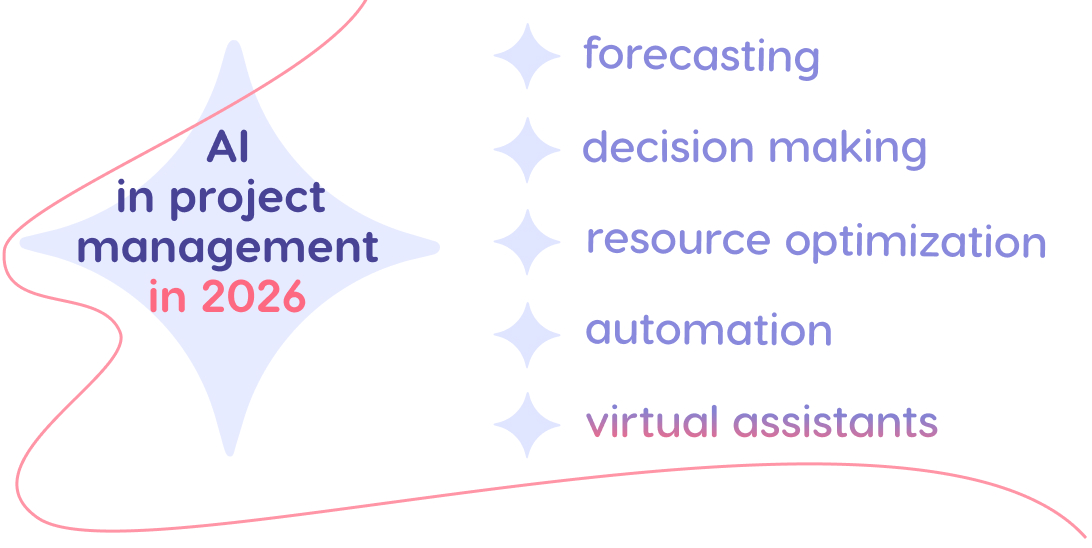
The application of artificial intelligence (we also include here machine learning, automation, predictive analytics, and generative AI) is gaining momentum among the current trends in project management landscape, which revolutionizes the ways projects are planned and managed. In a nutshell, AI automates repetitive tasks and makes predictions thereby increasing efficiency, streamlining workflows, and improving decision-making. Project managers can utilize the power of AI by leveraging project/resource management tools where the technology is incorporated.
In 2026, AI becomes even more essential to project work and is evolving from an assistant into a proactive collaborator, which is explained by the rise of agentic AI and no-code automation. People across industries (and project management is no exception) are increasingly using generative AI tools like ChatGPT or Google Gemini to perform a variety of work: writing emails, generating plans, getting insights from raw data, and more. But now the technologies go further – organizations can develop tailored autonomous AI agents that not only make suggestions but execute tasks or adapt project plans in real time. Agentic AI is gaining momentum, so its role in project management will grow significantly in 2026 and beyond.
Let’s now review the most common applications of artificial intelligence in project management.
Forecasting and decision-making
Thanks to predictive analytics, PM tools analyze historical data along with current project metrics to predict how the project environment will change. You can forecast project delays, resource bottlenecks, budget overruns, project performance, etc. AI-powered capacity planning software lets project leaders forecast resource demand as well as possible bottlenecks, which helps plan projects and their staffing more effectively. But most importantly, predictive analytics helps perform scenario analysis that allows you to find an optimum way to prevent future bottlenecks and risks. As a result, project managers can make informed decisions, identify and mitigate risks, and contribute to better project outcomes.
Managing resources
AI makes resource management much more effective, especially for large organizations where hundreds/thousands of employees are involved in projects. First, it assists in resource allocation: it analyzes the data on each employee’s skills, capacity, previous experience, location, or other essential parameters to find the right person to assign to a task quickly. Second, AI helps plan resources’ capacity, which is critically important for smooth workflows in multi-project environments with a shared resource pool. Third, as we noted earlier, predictive analytics makes it possible to detect improper workload which becomes the source of resource bottlenecks. Therefore, AI-powered project resource management software can automatically address bottlenecks and adjust workflows if necessary by rebalancing workloads, shifting priorities, reallocating resources, or reassigning tasks.
Automating routine tasks
AI can automate a number of project manager’s tasks, especially those that require work with large amounts of data, e.g., creating schedules and generating reports. In addition, AI-powered virtual assistants can send reminders and notifications to team members. How does this help? Project managers have more time for strategic tasks and initiatives, and the possibility of human errors decreases.
In 2026, these capabilities evolve even further: agentic AI will automate not only individual tasks but multi-step workflows. What is important, this automation is available for every organization, as it doesn’t require involvement of IT experts.
Virtual assistants
Virtual assistants are software applications that leverage AI technologies like natural language processing, machine learning, and sometimes voice recognition to provide users with interactive support. In project management, they can be used to improve communication between a project manager and the team, assist the team members in their tasks, help quickly obtain necessary information (status updates, project metrics, etc.), notify a project manager of potential risks or upcoming bottlenecks, and more. In 2026 we’ll see the evolution of virtual assistants’ role from helpers to collaborators.
An example of AI agents is Epicflow Portfolio Optimizer. It provides comprehensive assistance for value-driven portfolio optimization: setting priorities, staggering projects, and assigning limited resources to projects with the highest potential for business value. Contact us to find out more.
AI remains one of the leading future trends in project management in 2026 and beyond. It’s no longer an add-on but a core capability that enables smarter and more intelligent project execution. It’s also important to note that the technology isn’t going to replace project managers—AI is only an assistant that must be combined with human intelligence to achieve desired outcomes.
Watch the webinar to gain more insights into AI applications in project management: Utilizing AI on Different Levels of Multi-Project and Resource Management
2. Leveraging data analytics.
Along with the adoption of AI, project managers are already increasingly relying on data in their work—when making decisions, forecasts, analyzing performance, etc. Though data analytics is primarily associated with data-driven decision-making, here are some more reasons why it is a must in project management:
- It increases decision accuracy and objectivity, as is grounds choices instead of relying on intuition;
- It enables the monitoring of project progress and resource performance and gaining important insights from these data;
- It reduces uncertainty thanks to forecasting capabilities and analysis of possible outcomes;
- It allows for forecasting risks and bottlenecks: detecting early warning signs and evaluating their impact;
- It eliminates the effect of office politics by promoting objectivity and reducing bias;
- It facilitates more effective resource utilization thanks to identifying inefficiencies.
Therefore, all these factors create opportunities for detecting problems, making corresponding adjustments, and improving project outcomes. So, in 2026, we anticipate the focus on data analytics and data-driven decision-making to rank high among future project management trends.
As we see, the future of project management trends is increasingly digital, and we’ll see even more advancements in the years ahead.
3. Latest project management software trends.
Leveraging PM software remains among the latest project management trends in 2026. Project management software serves as an all-in-one solution that addresses various PM needs. The variety of these solutions on the market is huge—from simple task management tools to comprehensive solutions embracing resource and project portfolio management functionality. As the complexity of projects is increasing, leveraging PM software and its variations (e.g., portfolio management tools, enterprise project management tools, etc.) becomes more and more common in the project management practice, especially when dealing with multi-project environments.
In 2026, we see that more and more project management tools integrate AI in their functionality. So, in the years ahead, we’ll see more sophisticated capabilities of this software to support project planning, execution, and decision-making. The other trend is integrating project management software with other tools used in organizations: CRM, HRM, business intelligence tools, etc. This increases visibility, creates a single source of truth across processes, and improves project execution and delivery.
Read more: How to Choose the Right Project Management Tool: Selection Guide
Let’s take a quick look at the example of Epicflow, a comprehensive solution for managing multiple projects, resources, and project portfolios. Based on CCPM principles, its distinctive approach helps optimize shared resources, prevents people from overwork, and allows for consistent workflow and the successful completion of each project running in a company.
Epicflow offers a robust set of features, including but not limited to the following ones:
- Automatic prioritization of tasks throughout the entire project environment;
- Resource allocation based on employees’ skills, availability, capacity, and essential attributes like experience and location;
- AI-driven portfolio optimization based on business value and resource constraints;
- Forecasting resources’ capacity and workload;
- Conducting simulations with What-if Analysis;
- Presenting real-time data on project progress;
- The capability to analyze resource performance;
- Virtual assistant Epica interacts with project managers and the team and keeps them updated regarding the state of a multi-project environment.
Organizations employing Epicflow utilize their available resources efficiently, maintain balanced workloads, make data-driven decisions, and have a comprehensive view of the whole project environment. Contact our experts to learn more about our solution and how it can address your business needs.
4. New competencies: soft and digital skills.

The latest trends in project management require PM professionals to develop specific competencies to be able to implement these innovations effectively in their work. Additionally, they need to adapt to new ways of working: e.g., be increasingly flexible, manage distributed teams, etc. Here are some of the most essential skills.
Soft skills
In the era of increased automation of “technical” tasks, leveraging PM software and AI, a project manager’s soft skills gain particular importance. Last year’s PMI Pulse of the Profession report emphasizes the importance of developing soft skills (or how they call them “power skills”) in the coming years; and this set of skills remains relevant for 2026:
- Communication and relationship building,
- Problem-solving,
- Collaborative leadership,
- Strategic thinking,
- Commercial awareness.
Project Management Institute emphasizes the need for prioritizing these skills in organizations in the years ahead—they’ve found that companies that give particular importance to soft skills achieve better project outcomes and have higher levels of project management maturity and organizational agility.
Let’s take a look at some more essential soft skills.
Emotional Intelligence
Emotional intelligence involves the ability to understand and interpret one’s own emotions, express and control them as well as understand other people’s emotions and behavioral motives. Emotional intelligence allows for much more effective interaction of a project manager with the team members, customers, and a company’s management—resolving conflicts, establishing relationships and communication, promoting more effective collaboration, creating a supportive atmosphere within a team, etc.
Adaptability
Being able to quickly adapt to changes is becoming rather a necessity in the present-day dynamic world, and the project management domain, which is also transforming, is no exception. Projects are often subject to changes and market volatility, affected by external factors or implementation of new technologies; and a project manager’s adaptability implies that they will be able to quickly adjust their approach or make non-standard decisions which will help them keep the projects on track and navigate volatile business environments.
Digital skills
In response to the active implementation of technologies and data analytics, project managers also require developed digital skills that should be regularly updated. The idea isn’t new but is expected to remain relevant in 2026 and beyond in response to the constantly evolving technological landscape and their increased integration in day-to-day work on projects. The need for developing digital skills is also emphasized by the PMI; they distinguish the following ones:
- Data science skills (data management, analytics, big data);
- Innovative mindset;
- The ability to make data-driven decisions;
- Collaborative leadership;
- Legal and regulatory compliance knowledge;
- Security and privacy knowledge.
Therefore, 2026 will still be marked by embracing the above-mentioned skills by project managers who strive to succeed in their careers and address the complexities of the modern project management landscape.

5. Value Management Office and general focus on value.
More and more companies become selective when investing money and resources. In response to this, value-focused approaches are gaining traction in project and portfolio management. One of the examples is the concept of a Value Management Office (VMO) that has evolved from a Project Management Office (PMO). Its main purpose is to help companies change the focus from project outcomes to maximizing business value. Here are some more essential characteristics of a VMO.
- It prioritizes value over process.
- It enhances strategic alignment between projects and a company’s strategic goals.
- The work of a VMO involves determining and tracking metrics and analytics indicating value from project delivery.
- VMO helps manage risks that may impact value delivery.
- It helps ensure the right resource allocation so that critical resources are assigned to projects that deliver maximum business value.
- VMO facilitates agility and effective change management.
Using the above-mentioned potential of technologies, VMOs can make a huge difference in how organizations deliver projects and generate business value. So, in 2026 and beyond, VMOs and the value-driven approach in general will gain popularity as facilitators of value-driven project management and maximizing business effectiveness. This trend also emphasizes the need for PMO software to maintain project management standards, ensure strategic alignment, and track projects across the entire organization effectively.
Read more: Value-Based Portfolio Management Explained: How to Maximize Business Value with Available Resources
6. The evolvement of hybrid project management approaches.
More and more organizations recognize the importance of applying flexible PM methodology rather than sticking to solely Agile, Waterfall, or any other single method. Projects are becoming more and more complex, and it becomes difficult and ineffective to address their complex needs with the only PM methodology. So, the list of recent trends in project management cannot but include the application of hybrid PM approaches. As a rule, they combine the traditional structured framework of predictive methodologies (like Waterfall) with the flexibility and customization of Agile principles. In a great number of cases, project managers have already used hybrid approaches intuitively, as they helped work on projects more effectively.
Even though the trend for applying hybrid methodologies is expected to persist in 2026, they will be used somewhat differently. The research conducted by the Project Management Institute has shown that the choice of a certain project management methodology doesn’t make a decisive difference in increasing project performance. What is more, there’s no common standard for hybrid approaches except that they combine the principles of predictive and agile approaches. The combination of these principles will depend on a number of factors: the type of a project, the business environment, the project team, the expected outcomes, the industry, current PM framework used in the company, etc. This means that project management approaches will be selected for every particular project’s needs, and a hybrid PM approach will evolve into a customized or fit-for-purpose approach.
What’s new in 2026? Hybrid methodologies will be increasingly supported by different applications of AI and data analytics, which will facilitate even more flexibility and reliance on data. This combination is expected to increase project performance and help business organizations achieve greater efficiency.
Read more: Agile Product Development: Agile Methodology Explained
7. Sustainability and ESG practices.
Sustainability has been one of the leading trends in all industries, so it cannot but affect project management. Businesses are implementing sustainable practices in their work, e.g., reducing emissions and waste, optimizing supply chains, reasonable resource utilization, etc. But how can project management contribute to sustainability? The answer is implementing ESG (environmental, social, and governance) practices and ensuring a positive impact on society, the environment, and corporate governance practices. Here are some examples:
- Facilitating local employment or buying from local businesses;
- Promoting environmental protection;
- Reducing consumption of energy and materials;
- Minimizing waste and environmental pollution;
- Enhancing physical and mental well-being;
- Facilitating equality, diversity, and inclusion.
These are how project management can deliver value to the people involved in it, society, and the environment. But how can businesses ensure these principles’ implementation in their projects? For example, they can integrate ESG goals in project portfolios and prioritize projects accordingly. Also, companies can establish specific metrics to track ESG performance and provide training for project managers and team members to better understand sustainable and ethical project management. Finally, organizations can prioritize long-term value creaton instead of focusing on gaining immediate profits.
In 2026, PM professionals along with companies’ management are expected to continue their efforts to incorporate ESG practices in their work to be in line with emerging trends in project management. Again, project managers will rely on AI and analytics as well as value-driven portfolio management to monitor ESG impact, make more effective decisions, and deliver value to the organization itself, society, and environment.
Read more: Best Multi Project Management Software Solutions to Test in 2025
8. Ongoing resource constraints in projects.
While new technologies are transforming project management, some challenges still persist. Resource management remains one of the critical concerns for a great number of companies.
“The real bottleneck has shifted: it’s longer the budget, it’s limited resource capacity”, says Albert Ponsteen, researcher, portfolio management expert, and co-founder of Epicflow.
This challenge is amplified by hybrid and distributed work models, sharing resources across projects, and increasingly dynamic project environments. As a result, a great number of organizations still face resource bottlenecks, skill gaps, overloaded teams, and inability to allocate shared resources effectively across projects.
But the good news is that technologies provide opportunities to mitigate this ongoing challenge. As we wrote earlier, AI-driven tools can provide organizations with the following benefits:
- AI-driven resource allocation to quickly find the right person among thousands of employees;
- Resource capacity planning based on forecasting so that you cannot start a project without being sure that there are enough resources for its execution;
- Dynamic scenario planning: AI-driven software lets play different scenarios to address resource bottlenecks: e.g., see different variants of resource distribution or the effect of adding a project on resources’ workloads.
We expect that the rise of AI and data analytics as well as their integration in project management tools may change the situation for the better, helping organizations utilize their resources intelligently. But there’s one more essential factor that can solve the resource management challenge: business leaders must realize the resources are the key bottleneck in their organizations and plan their projects accordingly.
We at Epicflow advocate for a people-centric approach to multi-project and portfolio management, empowering business organizations to optimize their limited resources and maximize business value. Contact us to discover how our methodology can transform your project delivery and drive measurable results.
Conclusion
So, what are the latest trends in project management? So, what are the latest trends in project management? In 2026, project management will continue to evolve as a technology-driven, value-oriented, and adaptable discipline. AI, automation, data analytics, and innovative project management software will increasingly support decision making, while sustainability and ESG practices will shape how value is defined and delivered. Hybrid approaches will persist and evolve into fit-for-purpose models. Resource constraints will remain but we anticipate digital technologies and innovative resource management software to mitigate this ongoing challenge. Finally, project managers will be expected to possess strong digital skills with leadership capabilities and well-developed soft skills.
References
- The Future of Project Work: Moving Past Office-Centric Models. (2024). Pulse of the Profession. PMI.
- Power Skills: Redefining the Project Success. (2023). Pulse of the Profession. PMI.
- The Project Manager of the Future. Developing Digital-Age Project Management Skills to Thrive in the Disruptive Times. (2018). Pulse of the Profession: In-Depth Report. PMI.
- Project management predictions for 2026: The trends shaping delivery. (2025). PRINCE2.
- Harrin, E. (2025). What’s The Future of Project Management in 2026 and beyond? RebelsGuideToPM.
Frequently Asked Questions
What are the trends in project management in 2026?
In 2026, the project management domain will be marked by diverse applications of artificial intelligence (including agentic AI) and big data analytics, the growing popularity of the value-based management approaches, the evolvement of project management approaches and increased use of hybrid methodologies, the implementation of sustainability and ESG practices, and increased use of project management software.
How is AI transforming project management?
AI is transforming project management by automating routine tasks, improving forecasting efficiency, enabling smarter data-driven decisions. It also improves resource allocation, detects risks, and provides real-time insights that help teams prevent potential issues.
Will project management be replaced by AI?
No, it won’t. Gaining the benefits of AI implementation is impossible without human intelligence and assistance in data preparation, interpreting AI-generated insights, and taking action.
What is hybrid project management?
Hybrid project management is a combination of different PM approaches. As a rule, it unites the elements of traditional and deterministic methodologies (Waterfall) with more flexible ones (Agile). Hybrid approaches make it possible to customize the PM methodology for the specific needs of a project and achieve better results.
How can ESG and sustainability be integrated into project management?
In 2026, ESG and sustainability are becoming core elements of project management strategy. Organizations can integrate ESG goals into project portfolios, prioritize high-impact initiatives, and ensure projects deliver environmental, social, and governance value alongside business outcomes.
What is the future of project management?
The project management future will be shaped by increased automation and combination of advanced tools with human intelligence.