Project Cost Estimation: Overview of the Process, Main Challenges, and Best Practices [2026]
 Victoria Sokolova
.
June 14, 2026
.
Project Management
.
22 mins READ
Victoria Sokolova
.
June 14, 2026
.
Project Management
.
22 mins READ
![Epicflow – Project Cost Estimation: Overview of the Process, Main Challenges, and Best Practices [2026]](https://www.epicflow.com/wp-content/uploads/2022/07/project-cost-estimation_1-1024x640.jpg)
Estimation of project costs is one of the core practices of the project initiation stage, which becomes the basis for the approved project budget. However, the main challenge of this process is that it has to be performed under conditions of uncertainty – you can forecast only the approximate budget you’re going to spend on a project. At the same time, the forecasted costs should not be too overestimated or underestimated. In the first case, the stakeholders may find it infeasible to take on this project; while in the second case, the budget overrun will become an unpleasant surprise.
Therefore, a proper project cost estimation is about finding a fine line in this complex process. What helps make cost estimation simple and efficient? Let’s figure it out in the article.
Key Takeaways:
- Estimating project costs means forecasting the costs required to complete a project.
- You can calculate project costs based on the cost of resources and the time required to complete a project. In a multi-project environment, resource availability has a direct impact on project costs.
- Project cost estimation techniques include analogous, parametric, three-point, and bottom-up estimation.
- The main challenges of project cost estimate are a lack of necessary information, the pressure to reduce costs and at the same time complete the project as quickly as possible, and estimating costs in a dynamic and uncertain multi-project environment.
- To estimate project costs effectively, you need to combine several estimation techniques, use time and capacity buffers, analyze historical data, be realistic about estimates, and use predictive project management software.
What is Project Cost Estimation?
By definition, cost estimation in project management refers to predicting the amount of financial resources or the number of work hours it takes to complete a project. Accordingly, the estimated project budget can be expressed either in currency units or staff-hours/staff-days (man-hours/man-days). Apart from forecasting the budget, cost estimation has one essential function – it makes it possible to decide whether the project is feasible for a company at the moment. In other words, it answers the question: whether a company derives benefit from this project if it’s completed with the available resources and within a certain timeframe.
"Project cost is a really measure of resource use.”
Stephen Devaux, project management theorist, consultant, author, and educator.
Let’s consider the general scheme for the cost estimation process, its components and results.
How to Estimate Project Costs?
Generally, the project management cost estimation can be represented as a series of the following steps.
- Creating a work breakdown structure – it will split up the project into a set of deliverables and give an idea of the scope of work.
- Estimating the time required to complete each of these deliverables.
- Allocating people and material resources (tools, equipment, facilities) required to deliver each piece of work.
- Finally, the project cost will be calculated based on the time it will take to complete the deliverables and the costs of required resources. [1]
There are two types of project costs that should be taken into account in the estimation process – direct and indirect ones. Direct costs are those that are explicit and easily identifiable in a project, for example, the costs of employees’ labor and raw materials needed for a project. On the contrary, indirect costs are support costs also known as overhead or burden costs, for example, legal and financial fees, insurance, administrative expenses, etc. [2]
Having performed cost estimation, you can obtain more or less accurate estimates. PMBOK Guide suggests the following two types.
- Rough order of magnitude (ROM) is a type of cost estimates used at the project initiation phase. Its purpose is to give stakeholders (and/or decision makers) the idea of approximate costs required for a project (e.g., a million dollars or ten million). The accuracy of such estimates ranges from -25% to +75%.
- Definitive estimates can be used later in the project, during the project planning stage, when the project scope is already known. The accuracy of such estimates ranges from -5% to +10%, so they become the basis for a cost baseline and the project budget.
The main difference between them is the accuracy, which makes them applicable for different purposes at different phases of a project lifecycle. [3]
When to estimate project costs?
First and foremost, a project manager estimates project cost during the initiation phase, when a project charter or a business case is created. These documents require the information about financial resources necessary to complete a project. As a rule, it’s impossible to prepare detailed calculations at this stage, so a project manager usually comes up with rough estimates. However, the costs are estimated more than once – the procedure should be repeated from time to time throughout the project lifecycle. For example, if any changes are made to the project scope or timeline, or any new relevant information becomes available, project costs should be re-estimated.
Project Cost Estimation Techniques
There are various cost estimation techniques [3] that provide different degrees of estimates’ accuracy. Below, we’ve ranked the most prominent techniques from the most approximate to the most accurate one.
Analogous estimation
This technique involves estimation of project costs based on the budget spent for a similar project completed in the past. However, there cannot be two absolutely identical projects, so such estimates are rather approximate, which makes them applicable at initial stages of project lifecycle.
Parametric estimation
This technique involves the use of historical data combined with statistical modeling to calculate the expected amount of financial resources (or time) required to complete a project or its part. In particular, historical data (from previous projects, publicly available market data, statistics, etc.) is used to calculate the cost of a particular parameter (e.g., the cost of 1 mile in highway construction). And after that, it’s scaled to the size of the whole project.
Such an estimation is more accurate than the analogous one, but its accuracy can vary depending on the input data and its applicability to the current project. It means that this technique can be applied not only for initial estimation.
Three point estimation
This technique usually involves the application of analogous or expert estimates to determine the following three points:
- optimistic (best-case scenario, i.e., the financial resources are used most efficiently),
- pessimistic (worst-case scenario, i.e., the budget is spent in the least efficient way),
- the most likely estimate (the most realistic scenario).
These three points are used to determine the average cost estimate.
Bottom-up estimation
This technique is considered to be the most accurate one. It involves estimating the costs of certain activities performed as part of a project and then aggregating them to obtain the cost of the whole project. Bottom-up estimation can be performed by a project manager with the assistance of team members (or a department) responsible for completing the estimated piece of work.
Now, let’s examine the difficulties that a project manager comes across when performing cost estimation.
Challenges for the Cost Estimation Process
As we’ve noted above, the process of cost estimation is rather challenging, mostly due to the following factors.
Lack of necessary information
Before the project starts, it can be rather difficult to come up with certain figures as to its cost. Besides, there can be some unbudgeted expenses that you cannot know beforehand. We can also include the lack of requirements here, as they are an important element that will affect the project budget. Alternatively, they may change in the process of project implementation, which will also require additional expenses that were not envisioned at the project initiation stage.
Read more: Fighting Uncertainty in Project Management: Arm Yourself with the Right Tool
Office politics or "management by decibels"
Unfortunately, these phenomena still occur in some working environments. Among other things, they can affect distribution of human, material, and financial resources, which in turn will have an impact on the cost estimation process. In addition, some powerful stakeholders may ask a project manager to adjust figures to their own advantage to affect the decision regarding a project’s feasibility.
The estimation “knife-edge”
When performing estimations, a project manager experiences two competing pressures. On the one hand, they strive to reduce costs and deliver the project with minimum required resources as and quickly as possible. On the other hand, they try to plan for maximum contingency and add a maximum cost buffer to minimize the risks of budget or schedule overrun.
Cost estimation and management in a multi-project environment
First, when you calculate project cost in a multi-project environment, you will have to take into account resource dependencies between projects. For example, it can be unclear at the beginning whether you’ll need to hire more employees to complete the expected scope of work or you’ll manage to deliver it with the available number of resources. Second, monitoring costs of every project in a multi-project environment is a painstaking task, which is almost impossible to perform manually.
So, how to overcome all these hurdles and come up with reasonable cost estimates? The best practices listed below are here to help you.
Simple and Accurate Estimation of Project Cost: Useful Tips and Best Practices
Tip 1: Use multiple estimation techniques.
When performing project cost estimation, it’s better not to rely on just one method. It’s important to use techniques in combination. They complement each other, which will increase the accuracy of your cost estimation.
Tip 2: Base cost estimates on resource capacity.
This recommendation is relevant for multi-project environments with a shared resource pool. Project cost depends directly on the project duration, which, in turn, depends on resource availability. Ignoring this fact may lead to unrealistic estimates. Also, mind that there’s always the risk of bottlenecks that cause delays, so it’s more reasonable to present estimates as a range, not as a single figure.
Tip 3: Be realistic about time estimates.
Time estimates are the basis for cost estimates, so it’s important to calculate them realistically, with consideration to team members’ capabilities. First, you should remember that none of the employees works 100% of their work time. If a task takes 8 hours to complete, a person cannot be fully dedicated to it throughout this time – they need to have short breaks, and sometimes have unplanned meetings or additional tasks that take time.
Secondly, a project manager can be tempted to promise faster delivery to customers or stakeholders. But in this case, the project team can be overloaded, which will in fact cause delays due to bottlenecks.
Tip 4: Add time, capacity, and budget buffer.
Adding contingency is an integral part of any project plan. This is relevant for cost estimates, too. There are plenty of things that can go wrong or change in the process of work on a project, which may cause a delivery delay. In addition, there can also be multiple factors that will require additional expenses – e.g., changes of currency rate, increased costs of tools or equipment, etc. Therefore, when performing cost estimation, it’s reasonable to add some time buffer to a project’s time estimates and provide for contingent expenses, which will make the budget more realistic and protect the project from possible time and cost overrun.
Tip 5: Use historical data.
Past projects can be your benchmark, so you can use them in the project cost estimation process. Compare the project whose cost you’re estimating to similar projects completed in the past. Take into account its scope, complexity, risk, and resource availability. Relying on past experience will help you come up with more realistic estimates.
Tip 6: Use project management software for cost estimation and management.
It’s no secret that project and resource management solutions are widely used to simplify project orchestration and increase its efficiency. Moreover, when it comes to a multi-project environment, you can’t do without a proper software tool. Epicflow is one of such solutions: it has been developed by project management researchers and practitioners specifically for work in a multi-project setting. So, how does it help estimate and manage project costs?
Project Cost Estimation with Epicflow
Relying on data, not assumptions in your estimation
As we’ve noted earlier, initial cost estimation is often performed under conditions of uncertainty. Having a number of active projects in the pipeline, it’s impossible to know immediately what happens to the whole environment if one more project is added and what it will take to deliver it. Will there be available human and material resources for that? Or will you have to hire a freelancer, buy more equipment, or maybe postpone this project for later? Epicflow’s What-if analysis function is a perfect tool for improved decision making: when you’re not sure about your decision, you can analyze different options suggested by the system and choose the most advantageous one.
Prediction-based dynamic estimates
In Epicflow, cost estimation isn’t static. It’s closely related to resource availability and capacity, which are critical for getting the work done in a multi-project environment with a shared resource pool. Limited resources define how the work flows through the system, which directly impacts project duration and overall cost. With the Prediction feature, Epicflow continuously recalculates expected delivery timelines based on current priorities, resource load, and capacity constraints, which help you refine estimates when conditions change.
Monitoring the budget utilization with ease
Epicflow makes it possible to keep control over the budget of every project in the environment: it provides visualizations that present real-time data expressed in man-hours for quick and easy monitoring of project progress and budget utilization.
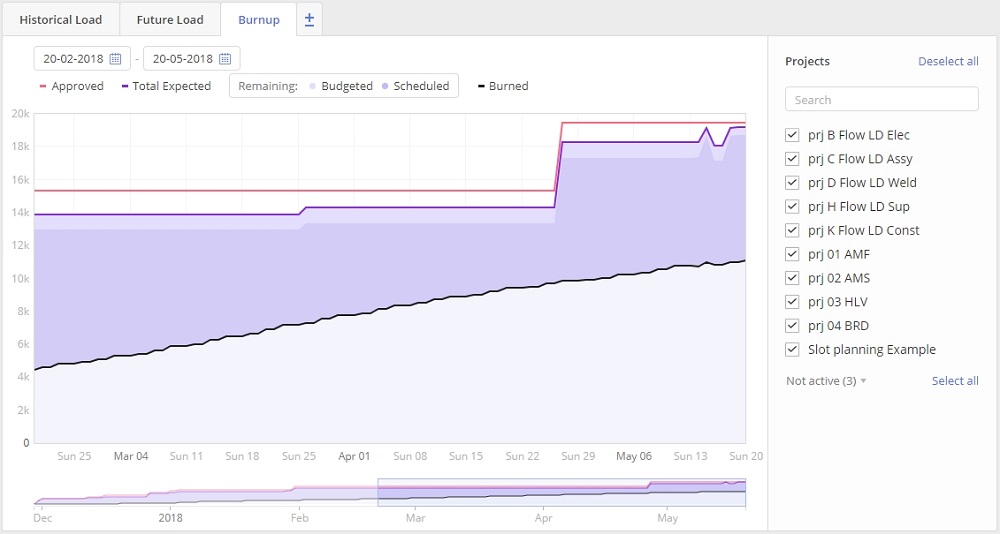
The first is the Burnup chart. It allows a project manager to monitor the planned and completed effort against the overall project scope, which can be used to track budget consumption.
In the Bubble graph, namely its budget view, you can check whether you’ve exceeded the limits of the approved budget across the pipeline. The dot-dash circle demonstrates budget utilization: if it's less than a bubble, you've spent more than it was approved; if it's around the bubble, there's no buffer left; while if it's larger that a bubble, you have available buffer.
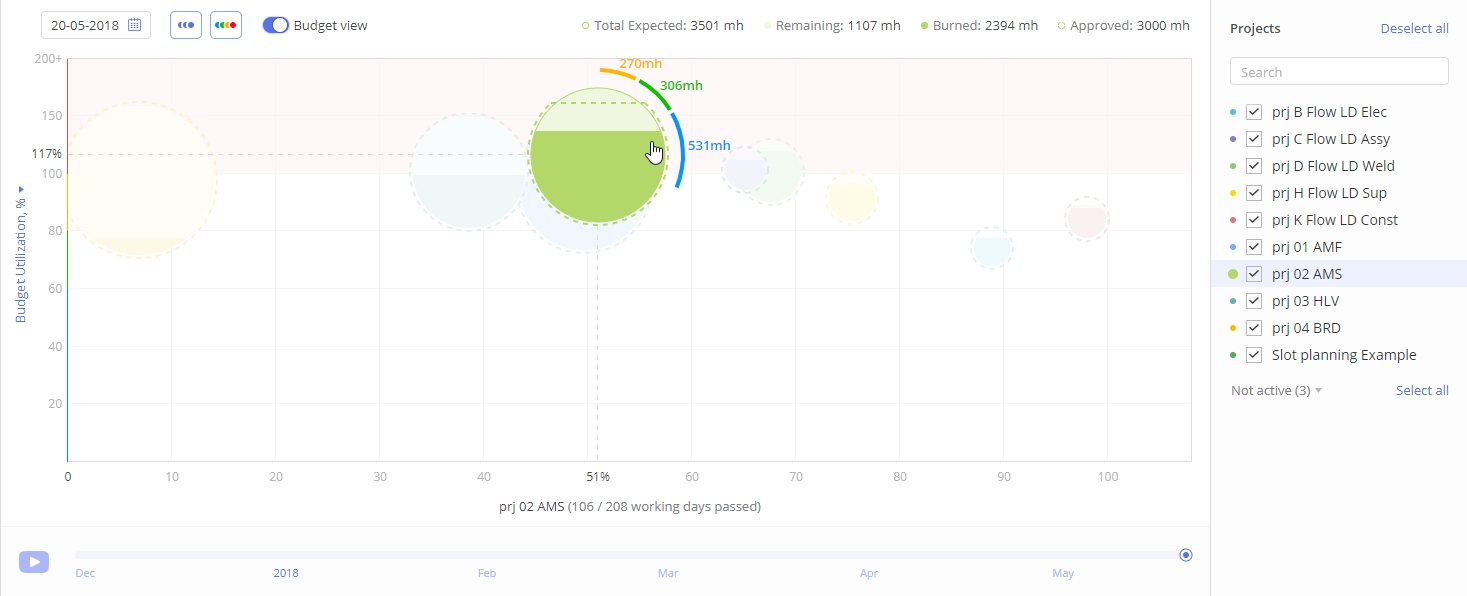
These graphs clearly illustrate the budget utilization across all projects in your environment. Having defined the approved budget in the system at the beginning, you will be provided with regular updates on its utilization throughout the project lifecycle.
Thus, Epicflow facilitates making data-driven decisions in your cost estimations as well as regular monitoring of budget utilization. As a result, you’ll come up with realistic estimates as well as have better budget predictability, which in turn will lead to stakeholders’ and customers’ satisfaction.
These features represent only a small part of Epicflow’s functionality contributing to efficient budget, project, and resource management. Don’t hesitate to contact our experts to learn more.
References
- Clayton, Mike. (2020). How to Estimate Project Costs: A Method for Cost Estimation. Online PM Courses.
- Usmani, Fahad. (2022). Direct vs. Indirect Cost. PM Study Circle.
- Estimating Cost of a Project: Techniques and Examples.
Frequently Asked Questions
What is cost estimation in project management?
Cost estimation in project management is the process of predicting the total cost required to complete a project, including resources, time, materials, and risks.
What are the main cost estimation methods?
The most common cost estimation techniques in project management include bottom-up, analogous, parametric, and three-point estimation.
How to calculate project cost?
To calculate estimated project cost, break the project into tasks, estimate the cost of each (labor, materials, tools), and then sum them up. Also, you need to add a contingency budget for risks and uncertainties.
What are the steps in estimating project costs?
The steps of project cost estimation include:
- Defining project scope.
- Creating the Work Breakdown Structure.
- Estimating resources required for each task.
- Assigning costs.
- Adding contingency for risks.
- Reviewing and validating the estimated costs with stakeholders.
What is the best method for cost estimation?
There is no single best method for estimating costs. The most reliable approach is to combine several methods – this will provide you with the most accurate results.
How do you track project costs?
You can track project costs by comparing actual spending against the estimated budget. The project cost analysis involves monitoring resource usage, expenses, and updating forecasts to identify variances.
What are the types of project costs?
The types of project costs include:
- Direct costs: labor materials, equipment
- Indirect costs: overhead, administration.
Which tool helps you estimate the cost of a project?
Project cost estimation can be done using spreadsheets, project management software, or specialized project portfolio management tools with financial capabilities. Advanced tools provide resource planning, forecasting, and scenario analysis to improve estimation accuracy.
What is a project cost estimate example?
Here’s a simple cost estimation example. If a project requires 100 hours of work at $5-/hour and $2,000 in materials, the estimated cost would be (100*$50) + $2,000 = $7,000 plus contingency for risks.