Planview vs Planisware: Start With Where Your Portfolio Breaks
 Victoria Sokolova
.
September 29, 2026
.
Project Portfolio Management
.
33 mins READ
Victoria Sokolova
.
September 29, 2026
.
Project Portfolio Management
.
33 mins READ
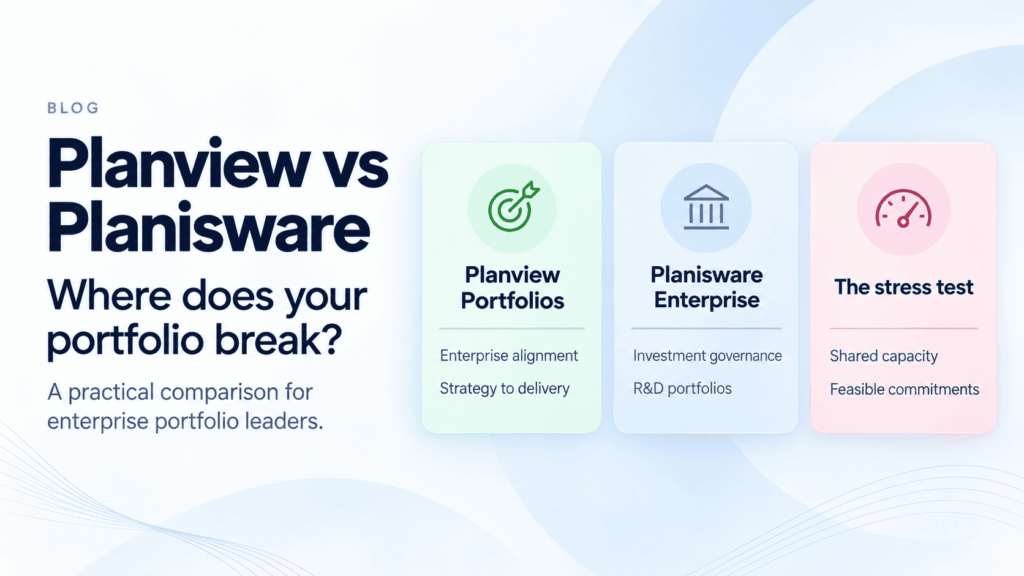
Planview Portfolios is a strong starting point when your hardest problem is connecting strategy, investments, capacity and delivery across an enterprise. Planisware Enterprise is a strong starting point when complex project, product or R&D governance drives the decision. Neither is confined to those roles: Planview sells product-development solutions, and Planisware also addresses IT strategy and PMO portfolios. The right choice depends on the product you buy and the decision it must help you make.
If approved projects repeatedly miss dates because they compete for the same specialists, can your proposed configuration produce a feasible sequence, show the effect on commitments and let managers act? We compare both vendors, then give you one demanding scenario to test them. For organizations constrained by shared capacity, we explain when Epicflow belongs on the shortlist.
Key takeaways
- Compare Planview Portfolios with Planisware Enterprise for a broad enterprise evaluation; other products may fit a narrower PMO, IT or R&D need better.
- Both vendors document capacity planning, scenarios, financial analysis and execution support.
- Planview is worth attention when connecting investments and delivery across many teams and tools is the main challenge.
- Planisware Enterprise and Nova is worth consideration when product and R&D investment governance defines the portfolio.
- If funded work stalls at a shared specialist pool, test the capacity-to-delivery decision before choosing the breadth of software you need.
Planview vs Planisware at a glance
“Planview” and “Planisware” refer to product families rather than single products. For the enterprise comparison below, we focus on Planview Portfolios and Planisware Enterprise. The table highlights what to consider when evaluating each option, rather than declaring a winner.
| Buying question | Planview Portfolios | Planisware Enterprise |
|---|---|---|
| Natural evaluation center | Enterprise strategy, investment and connected delivery across organizational and technology portfolios | Enterprise project and product portfolios with detailed investment, resource and governance decisions |
| Product and R&D context | Planview also offers new product development, product portfolio management and Advisor for investment scenarios | Enterprise supports complex R&D; Nova offers a product-centered R&D and new-product-development model |
| Capacity and scenarios | Portfolio capacity planning and scenario analysis; validate the proposed planning and delivery products together | Bottleneck and supply-versus-demand views, resource allocation and what-if scenarios; validate the configured model |
| Financial lens | Strategy-to-budget and investment-outcome analysis; ask how project dates change the financial view | Business cases, cash-flow inputs, NPV/ECV and portfolio selection within resource and budget constraints |
| Integration approach | Portfolios can connect with delivery tools via Planview Hub; confirm each system and licensed component | Enterprise describes an open REST API and enterprise application integrations; confirm objects, direction and refresh |
| AI procurement question | Map the Anvi capabilities available to the selected Planview products and license | Distinguish current AI features from Prisma, which Planisware describes as a planned paid beta for fall 2026 |
For a PMO-led project portfolio, also ask whether Planview ProjectAdvantage, AdaptiveWork or PPM Pro better matches your intended controls, and compare with Planisware Orchestra. For an IT-centered portfolio, assess Planisware Horizon alongside the relevant Planview offering. Selecting the right tier matters more than a generic brand-versus-brand checklist.
Where Planview and Planisware differ
Product scope and architecture: what exactly are you buying?
Planview offers products for strategic and project portfolios, collaborative work, software delivery and R&D. Portfolios connects roadmaps, objectives, resources and analytics. Another Planview product, or Planview Hub for data exchange, may be part of the workflow. Ask the vendor to trace a funding decision to delivery teams and identify each licensed product.
Planisware also has several products. Enterprise is the principal comparison; Orchestra serves PMOs, Horizon focuses on IT SPM, Nova on R&D and product development, and Valoris on capital assets. Being part of the same product family does not guarantee automatic data flow between modules. Compare how each offering handles deployment and data ownership. The “one platform versus acquired products” distinction is also too simplistic: Planisware itself acquired NQI, associated with Orchestra.
Ask whether a portfolio decision reaches schedules, people and reporting without a manual bridge, and what happens when systems disagree.
R&D, product investment and governance
Planisware Enterprise evaluates proposals using scorecards and measures such as cash flow, net present value (NPV) and expected commercial value (ECV). Its scenarios can compare portfolio value inside budget and resource limits. Planisware Nova puts products and product families at the center of the model, and describes product life cycles, skill-based bottleneck analysis and configured Stage-Gate workflows. That combination deserves a serious demo if your leaders decide which product concepts to advance, pause or retire across a long pipeline. For process and KPI context, see our R&D portfolio management guide.
Planview's new product development solution also connects R&D investments, roadmaps, capacity and execution, including gated governance. Planview Advisor describes business-case valuation and scenarios. Test your stage criteria, regulatory approvals, product hierarchies and commercial measures in both vendors. The right configuration lets your review board make and implement decisions with an audit trail.
Resource capacity, schedules and scenarios
Both vendors publish meaningful resource-planning capabilities. Planview Portfolios describes balancing capacity against demand, and integrated Gantt and assignment views; its strategic portfolio offering includes financial and capacity context for scenarios. Planisware Enterprise shows supply, demand and bottleneck views, role-based forecasts and what-if changes across a portfolio. Its product page also describes scheduling tools and prioritization within finite budget and resources.
Test whether a capacity chart can translate into an executable decision. How are skills, calendars, partners, partial assignments and dependencies modeled? Does moving one activity update other projects sharing the team? Can users compare sequences, approve one and explain what changed? These are questions about configuration and process. Ask the vendor to show the resulting work plan, beyond a red utilization graph.
Financial decisions: investment value and delivery timing
Planview's SPM materials connect investment allocation, outcomes, budgets and capacity in scenario planning. Planisware Enterprise documents business cases and portfolio scenarios using cash flow, NPV and ECV, alongside resource and budget constraints. These are strong starting points for choosing what to fund. Ask each team to identify the financial objects in the licensed product, their source of truth and the method for updating forecasts.
Then move from selection economics to delivery economics. If a constrained specialist moves a contractual milestone by two weeks, will the proposed system show the impact on a penalty threshold, the date an invoice can be raised and expected cash timing? This is a buyer-defined demonstration, not an assertion that either suite cannot do it. State the assumptions: contract rules, milestone acceptance, payment terms, exchange rates and manual overrides. “Cash-flow analysis” in an investment model is not automatically the same workflow as a live milestone-linked invoice forecast.
ERP, HR and BI integrations
Planview documents Hub links for Portfolios with tools such as Jira and Azure DevOps. Planisware documents ERP, HR, agile and BI pathways, including SAP-related flows, Jira, employee availability from HR systems and Power BI through BI-Box. The existence of a connector page is evidence of an available integration approach, not proof that your desired field maps, update frequency or error handling come in the quoted implementation.
Draw four arrows on the procurement whiteboard: approved budget from ERP; skills and availability from HR; actual work and schedule changes from delivery tools; and trusted portfolio facts into BI. For each arrow, record the source record, owner, direction, refresh interval, reconciliation rule, security boundary and implementation cost. Test one deleted resource, one rebaselined milestone and one rejected data transfer. If the portfolio cannot retain a stable identifier and explain conflicting values, attractive dashboards will not repair the decision process.
AI and human decision support
Planview Anvi is positioned as contextual AI across connected work, with capabilities that vary by product and workflow. Planview describes guidance, risk signals, recommendations and actions. Planisware describes AI-assisted portfolio capabilities within current products, while Planisware Prisma is a distinct conversational interface that, as of 24 September 2026, is on track for a paid beta in fall 2026. Its proposed action flow requires user confirmation before a record changes. Treat that roadmap status as a procurement condition, not a generally available feature.
Ask for a demo in the version and license you would actually receive. Have AI explain a recommendation, expose its input data and assumptions, propose a change, and show who may authorize it. Evaluate whether a human can reject the suggestion, inspect the resulting portfolio and recover from a bad input. AI should shorten the path to a sound decision; it cannot replace trustworthy schedule, capacity, and contract data.
Which portfolio operating model fits you?
The most useful distinction is where control breaks down in your organization. Use these as diagnostic starting points, not as rigid categories for any vendor.
| Observable failure | Leadership decision | First evaluation focus |
|---|---|---|
| Strategy, funding and work drift apart across business units | Which investments should change, and how will delivery teams receive the decision? | Planview Portfolios and connected products; also test Planisware's enterprise configuration |
| Product or R&D pipeline grows without consistent gates and economic tests | Which concepts should advance within budget and scarce expert capacity? | Planisware Enterprise or Nova; also test Planview's product and R&D portfolio offering |
| Approved programs queue behind the same few specialists | Which work gets scarce capacity next, and what happens to every promise? | Stress-test both suites on finite capacity; evaluate Epicflow if this is the binding need |
In the first case, finance and delivery may disagree about what is funded, while executives cannot trace a strategic change into team-level work. Planview's connected strategy-to-delivery model makes it a natural opening demo. Ask Planisware to perform the same trace if its proposed configuration fits your governance model.
In the second, the hardest decision happens before or during product investment: comparing many concepts, managing gates and balancing long-lived product economics against specialist demand. Planisware Enterprise and Nova are strong candidates; Planview's R&D offerings warrant the same scenario. In the third, governance may be functioning as intended: the selected projects are worth doing, but their dates are infeasible together. That calls for a live capacity and commercial-impact test, regardless of the platform's market category.
Planview or Planisware for strategic portfolio management?
For strategic portfolio management (SPM), start with Planview Portfolios if your primary question is how enterprise priorities, investments and outcomes connect to changing work across multiple functions and delivery systems. Start with Planisware Enterprise if investment scenarios, complex project or product governance and resource feasibility dominate the portfolio review. Both vendors describe strategy-to-execution capabilities, so these are buying hypotheses, not hard functional borders. Planisware Horizon also competes for an IT-centered SPM brief; Planview's R&D products can compete in product portfolios.
Write down the decision your executive committee makes every quarter, the data it trusts and the action that must follow. Then have each proposed product configuration reproduce that complete loop. A strategic scorecard that cannot change a feasible delivery plan is incomplete for some buyers; a detailed project plan that cannot explain its investment rationale is incomplete for others. For more category context, see our SPM tools guide.
Which is the better long-term choice?
Over a three-to-five-year horizon, the safer choice is the implementation you can extend and govern, rather than a prediction about which vendor will outlast the other. Two plausible changes are particularly useful for testing this: a new division joining the portfolio and a major source system being replaced. The key question is whether hierarchies, permissions, historical baselines, and integration mappings can survive either change. It is also worth distinguishing capabilities available in your current version from those that depend on a roadmap or a different product.
The comparison should also cover the upgrade path, data export and migration plan, administrator skills, regional support, contract renewal terms, and the cost of adding users or portfolios. Reference customers operating at a similar scale and under similar governance can provide useful evidence about how the implementation works in practice. If the initial quote covers only the easy planning view while the future operating model requires additional modules, a cheap first year can become an expensive transition. An end-to-end pilot provides a more reliable basis for judging either architecture before committing to it.
Reviews and market sentiment
Review sites are useful for finding adoption and implementation questions, but brand averages can combine unrelated products. For example, Gartner Peer Insights' SPM comparison displayed 4.6/5 from 122 Planisware reviews and 4.3/5 from 104 Planview reviews when checked on 24 September 2026. That is a category and time-specific snapshot, not a verdict on Planview Portfolios versus Planisware Enterprise; the numbers can change.
Read recent Planview Portfolios and Planisware Enterprise reviews side by side. Filter by company size, industry, deployment stage and role. Look for recurring evidence about data maintenance, reporting, user adoption, support and time to value. Bring two concerns from each product's reviews into the demo and ask for a customer reference that has solved them. One compelling anecdote or a small difference in rating should not override your workflow test.
Global enterprise portfolio fit
Both companies address enterprise portfolios, but a multinational rollout must prove more than a logo slide. A meaningful evaluation should reflect a global parent portfolio with two regional governance processes, different currencies, local resource calendars, and restricted financial views. The important distinction is what can be standardized across regions, what can vary locally, and how cross-region capacity moves are governed. Localization, data residency, identity management, and support coverage should be assessed against the contracted service rather than inferred from an enterprise product label.
The most revealing test is a regional change that affects a global priority: can headquarters see the implication without granting everyone access to sensitive local details? Document the work needed to import historical data and train administrators in each region before committing to a rollout sequence.
Pricing and three-year cost
Enterprise portfolio software is usually scoped to a proposal, so unverified per-seat figures and the smallest advertised package are poor bases for comparison. A meaningful three-year total-cost view should name the products, modules, user types, minimums, environments, storage, implementation, integrations, support, training, and renewal mechanics. Internal data-cleanup and change-management effort belong in the same calculation.
The commercial comparison should reflect the hard scenario, not just the standard demo. It should be clear which component calculates capacity, which exposes financial consequences, which connects Jira, ERP, and HR, and who maintains each integration mapping. Implementation milestones and acceptance criteria should also be defined before commitment. A higher license cost can be justified by a demonstrably better decision process; a lower one can be appropriate when the portfolio requires a more focused scope. Ultimately, the relevant comparison is the value delivered by the exact operating model you intend to deploy.
What about Clarity PPM vs Planisware?
If Broadcom Clarity is also on your shortlist, treat it as a separate enterprise SPM contender, especially where investment hierarchies, team financial management and the wider ValueOps environment matter. Planisware Enterprise still deserves a product-level test for resource-constrained scenarios and, where relevant, product or R&D governance. The same capacity, finance and integration proof applies to Clarity: have the vendor show a change from investment decision through constrained schedule and forecast.
Do not let an additional vendor turn the evaluation into a hundred-row feature spreadsheet. Decide whether your center of gravity is enterprise strategy and financial control, product/R&D investment governance, or the execution of a funded portfolio. Compare the relevant product and configuration in that lane. Our Planview alternatives guide offers a broader market context; a dedicated Clarity-versus-Planisware study would require its own current evidence and buyer scenario.
How to stress-test both vendors
Give Planview and Planisware the same data and the same meeting, then watch each team work through this case. Three approved programs need the same certification team within six weeks. Program A faces a contractual delay penalty. Program B unlocks a large invoice at an accepted milestone. Program C has the highest strategic score. The available specialists cannot meet all three original dates. Use your own anonymized skills, calendars, dependencies, contract rules and payment terms; mark invented numbers as hypothetical.
Ask each vendor to show, live:
- The binding constraint: demand versus usable capacity for that team, including holidays, partial availability and any uncertain inputs.
- The propagated plan: new milestone dates for A, B and C, plus the effects on other projects using the specialists.
- Two defensible alternatives: for example, protect A's penalty threshold or advance B's invoiceable milestone. Explain what happens to C in each scenario.
- The economic consequence: where the penalty rule, invoiceable date and expected cash timing are entered, calculated or exported. Separate configured inputs from forecasts.
- The working decision: how an approved sequence reaches task owners, who can override it and how fresh progress changes the forecast.
- The implementation boundary: products, modules, integrations, data owners and effort required to reproduce the demonstration in your environment.
Each checkpoint should have a buyer-defined weight and an evidence status: demonstrated in the quoted build, configured in a follow-up, or unverified. Screenshots, assumptions, and the revised schedule should be retained as part of the evaluation record. A vendor may solve your case with native capabilities, configuration or a connected tool; you need to understand which. This test makes the selection evidence-based without assuming an outcome in advance.
When a capacity-first option belongs on the shortlist
Suppose the portfolio committee has already chosen and funded worthwhile work, yet the same engineering, certification or regulatory specialists are promised to too many projects. More detailed approval stages will not, by themselves, create another week of those people's time. The operating question is what they should do next and what moving one commitment does to the rest of the portfolio. Keep Planview and Planisware in the test. Also consider a system built around that constraint.
Epicflow's capacity planning shows future load for resource groups; its what-if analysis lets managers test changes before updating the active plan. The Portfolio Optimizer emphasizes feasible sequencing and value under limited capacity. The useful demonstration is a connected loop: identify the overloaded group, calculate feasible dates, compare alternative assignments or sequence, see which contractual and financial milestones shift, approve a decision and observe the updated execution priorities. Request the exact version and data setup that supports the loop.
The financial language matters. Epicflow's current portfolio dashboard description links predicted dates to configured bonus or penalty rules. Its Cash Flow capability forecasts when a milestone becomes invoiceable and when cash is expected under the payment term. Those are planning forecasts, not confirmation that an invoice was issued or money received. Contract terms, milestone acceptance and source data determine the usefulness of the forecast. When discussing predicted profit, the published Pipeline definition is predicted revenue minus actual costs; do not mistake that for a complete forecast of all future costs.
There are two plausible buying paths. If your PMO's decisive problem is delivering a shared-resource portfolio and you do not need the full breadth of enterprise SPM, evaluate Epicflow as a focused alternative against your governance and financial requirements. If an SPM suite already governs investments, consider a scoped capacity layer for one delivery organization. In that case, verify the data exchange with the actual stack: Epicflow lists integrations including Jira, Microsoft Project and Primavera, but the proposed link to a specific Planview or Planisware deployment needs technical discovery. A one-pool pilot is a sensible evaluation design, not an assumed standard implementation.
If funded work consistently queues at the same specialists, book an Epicflow demo using the same three-program scenario. Ask to see the feasible sequence, what it does to milestones and how the financial timing is forecast.
The decision to make
Choose Planview or Planisware by the product configuration and portfolio decision you need to run, not by a slogan about breadth or depth. Compare their documented capabilities fairly, then make both vendors work through the same scarce-specialist case with your data. If the greatest exposure appears after projects are funded, add a capacity-first option to that demonstration. The platform that turns a constrained plan into a clear, governed action at an acceptable three-year cost is the better fit for your portfolio.
Frequently Asked Questions
Which is better, Planview or Planisware?
Start with Planview Portfolios for enterprise strategy-to-delivery coordination, or Planisware Enterprise for complex investment and product/R&D governance. Each covers more than those examples. Compare the licensed products and run the same stress test.
Which Planview product compares with Planisware Enterprise?
Planview Portfolios is the initial enterprise comparison. Advisor or other connected products may also enter the proposal. List every module, data flow and license before comparing with Planisware Enterprise. A brand comparison hides that implementation decision.
Is Planisware Orchestra comparable to Planview AdaptiveWork?
Both can enter a PMO shortlist, but compare their controls, collaboration and surrounding products directly. Ask each to build the same demand, resource, status and change workflow. For complex investment governance, also consider the enterprise products.
Is Planisware good for R&D portfolio management?
Yes. Enterprise supports investment scenarios and constrained resources; Nova models product families, lifecycle economics and R&D delivery. Planview also offers new product development and gated portfolio capabilities. Test your gates, skills, product hierarchy and financial assumptions.
Which integrates better with ERP, HR and BI?
There is no universal winner. Planview describes connections through its product and Hub ecosystem; Planisware documents ERP, HR, agile and BI integrations and an open REST API. Compare your specific records, direction, frequency, reconciliation, security and cost. Make both teams resolve one broken data exchange during the evaluation.
Which has better reviews or market sentiment?
A category-level rating can help form questions, but it cannot settle a product-specific procurement decision. Match Planview Portfolios against Planisware Enterprise in the same review category, note review counts and dates, and filter for organizations resembling yours. Use repeated complaints as demo prompts and request relevant customer references.
How much do Planview and Planisware cost?
Request current written proposals for the exact products, user types, modules, integrations and services required. Compare a three-year total including implementation, internal data work, support, training and renewal. Public list prices, if found, may omit the capabilities needed for your scenario; avoid a per-seat shortcut.
Do I need a full SPM suite to solve capacity bottlenecks?
Only if you also need its investment, governance and enterprise coordination scope. A funded portfolio delayed by shared specialists may justify a focused resource and execution system, either as the primary tool or alongside SPM. Test feasible sequencing, commercial consequences and integration before deciding the architecture.