Strategic Portfolio Management: Process, Benefits & Use Cases
 Mykhailo Kulakov
.
Updated
.
Project Portfolio Management
.
23 mins READ
Mykhailo Kulakov
.
Updated
.
Project Portfolio Management
.
23 mins READ

Focusing on simply delivering projects can lead a company to a place where productivity is commendable, but the actual achievement of business benefits is low. Strategic portfolio management (SPM) seeks to change that by ensuring all projects being pursued and all company resources are focused on achieving long-term strategic objectives.
In this article, we’ll explore what SPM is, the benefits of adopting it at your organization, and how to implement it.
Key takeaways:
- Strategic portfolio management is a set of activities aimed at aligning company efforts with its long-term goals.
- Unlike project portfolio management that focuses on how projects are executed and ensures their timely delivery, SPM focuses on what projects need to be done to move the company forward.
- The benefits of adopting SPM include strategic alignment, a better project selection , portfolio planning agility, decrease in firefighting, and ability to receive more value from the scarce resources.
- PPM tools support SPM through improving portfolio visibility, capacity planning capabilities, and shifting focus of planning to business value delivery.
What is Strategic Portfolio Management?
Strategic portfolio management is a practice that aims at aligning a company’s projects, initiatives, and investments with the long-term strategic goals. It involves project selection, prioritization, and management in a way that ensures company resources are focused on achieving strategic objectives.
Typical actions taken in the strategic management workflows are:
- Prioritizing, postponing, or canceling projects based on their alignment with strategic objectives.
- Adjusting financial investments in portfolios based on their strategic importance.
- Building straightforward capacity planning and resource management processes to ensure timely execution of high-priority projects.
- Continuously reviewing portfolio performance and rebalancing the portfolio as business conditions and strategic goals change.
Strategic portfolio management vs project portfolio management
The main difference between SPM and PPM is that the former focuses on ensuring all projects are adding to achieving company goals, while the latter maintains a focus on effective project execution. Here is a brief comparison of the two.
| SPM | PPM | |
| Focus | Project selection | Delivering project in the portfolio within resource, budget, and schedule constraints |
| Activities | Strategic planning | Capacity planning, prioritization, decision making, resource management, execution oversight |
| Timeline | Long-term | Mid-term |
| Metrics | Business value realization | Throughput, delivery performance, resource utilization |
| Ownership | C-level executives | PMOs, portfolio managers, program managers |
Who is responsible for strategic portfolio management?
Typically, strategic portfolio management processes and decisions are owned by C-level management unless there’s a dedicated SPM officer role in a company. Even in that case, they will work closely with company executives to ensure the strategic portfolio management framework they develop corresponds to the company’s long-term goals.
The roles that take part in the SPM process include CEO, CFO, PMO officers, and department leaders. If a strategic planning team exists, it handles the analytical part of strategic portfolio management. If not, these responsibilities can be taken on by data or business analysts.
What Are The Benefits Of Strategic Portfolio Management?
The main benefit of strategic portfolio management is alignment of the actions a company takes with larger business objectives. Below, you’ll find the benefits of SPM in more detail.
Alignment of strategy and execution
The key benefit of implementing SPM is the possibility to align the assortment of often vague company goals and objectives with the multitude of projects a company undertakes. This ensures that most if not all projects in the portfolio are adding to the achievement of long-term company goals, not just receiving short-term cash flow influxes.
Improved project selection and prioritization
Far too often large organizations that manage multiple projects accept projects based on budget restraints alone. This simplistic approach leads to a portfolio that overloads resources and delivers low strategic impact.
SPM practices force a new and better project selection strategy, one that takes into account resource constraints and strategic alignment. Focusing on these two factors allows companies that implement SPM to create portfolios that achieve strategic goals faster.
Greater agility in responding to change
Having a full understanding of where each project stands in terms of its potential to deliver business value allows the management to quickly and efficiently restructure work if some projects stop being feasible in the near future.
Having a clear framework for prioritization also helps reprioritize work in case company strategy or market conditions change, allowing for better agility in planning.
Higher return on finite capacity
Strategic portfolio management promotes a shift to a project acceptance strategy that’s focused on business value and balancing work with the finite resources the company possesses. This leads to a rise in efficiency of operations and allows the company implementing SPM to gain more value with the resources it has on hand.
Better investment decisions
Using SPM helps companies shift their focus from viewing projects as tasks that need to be finished to each project being an investment. Measuring how much investment a project needs in comparison to the value it can bring, either in direct or indirect way, leads to more efficient resource allocation and better investment decisions.
Strategic value realization
Finally, SPM ensures that strategic value is realized though projects that a company invests in, instead of those projects not contributing to long-standing goals.
Key Components of Strategic Portfolio Management
Strategic portfolio management involves dozens of analytical and decision-making processes, but it can be broken down into several major components.
- Portfolio inventory overview. Analyzing and planning company actions requires taking inventory of the portfolio.
- Strategic alignment. SPM practices involve analysis of strategic importance of all projects in the portfolio and prioritizing projects accordingly. The most important action strategic portfolio managers do is aligning projects in the portfolio with the strategic priorities.
- Financial planning. SPM practices encompass more than simple project execution and includes financials in the process of decision making.
- Resource allocation. Since resources are the main constraint in project delivery, analyzing resource capacity to balance resource use and optimize it is a big part of SPM.
- Strategic benefits realization. SPM practices ensure that projects a company takes on lead to strategic benefits realization.
- Continuous governance and monitoring. The work of an SPM specialist doesn’t end at planning. It also involves controlling execution and adjusting the plan if necessary.
How to Implement Strategic Portfolio Management
Implementing SPM in an organization is a long and multi-step process, the exact components of which are dependent on the organization it’s being implemented in, its goals, and capabilities. There are, however, a few key steps that will be repeated in most organizations.
Take inventory of strategic goals
The first step towards effective SPM implementation is dissecting strategic goals of the organization. Discover what the long term goals are and turn them into specific, measurable objectives that can be achieved through project execution.
Inventorize of the portfolio
The next step is to inventorize the portfolio. Gather data on:
- Resources your company has.
- Their current capacity load.
- Projects both being executed and planned.
- Their resource demands.
- Their strategic value to the company.
This inventory will serve as a basis for further analysis.
Analyze resource capacity
With that data, you can start analyzing resource capacity. You need data on current and future resource capacity. Both metrics can be arrived at by comparing total resource capacity with the resource demands of the projects that are scheduled to be executed at the same time.
Completeness of data integration plays a crucial role here. If there are updated resource demand estimates for projects that are not uploaded to your capacity planning tool, it could disrupt the analysis and result in faulty data.
Prioritize projects
The next piece of the puzzle is determining project priority based on their strategic value. Project prioritization involves components like strategic alignment, expected business value, resource requirements and existing constraints, risk and dependencies.
To assess it, the most accurate method is to create a formal scoring system and vote based on it for each project.
Plan work
After strategic priorities are defined and projects are selected, SPM specialists can begin organizing the portfolio based on resource capacity and project priority. The guiding principles in this process are:
- The maximum number of high-priority projects under the available capacity is accepted into the portfolio.
- Ensuring critical resources are allocated to priority work
- Balancing workload across teams and avoiding bottlenecks
- Resources are allocated according to their competencies.
- Evaluating trade-offs between competing priorities
In a multi-resource multi-project environment, arriving at an optimal portfolio composition manually is difficult and using a portfolio management tool to analyze scenarios, understand constraints, and make better resource and prioritization decisions.
Initiate execution
When the plan is formed and approved, initiate its execution. SPM teams communicate priorities, align stakeholders, and ensure delivery teams understand which initiatives matter most and why.
Monitor and adjust
SPM is an ongoing process, so organizations should continuously monitor portfolio performance, strategic alignment, risks, and changing business conditions, and adjust priorities and plans when needed.
Key Challenges in Strategic Portfolio Management
SPM is a difficult process and has several core challenges that all strategic portfolio managers face daily. Below, you’ll find the five most wide-spread ones.
Difficulty to align strategy and execution
The main goal of SPM is also its most common inherent challenge. Translating a list of often vague strategic statements into tangible results is not easy. Lack of data-based decision making and wishful thinking can often lead to pursuing projects that either lack real-world value or aren’t feasible in the present moment.
Difficulty to estimate project value
Another inherent challenge that SPM professionals face during the planning stage is the difficulty of correctly estimating the value a project can bring to an organization. A lot of decision-making here relies on personal opinions of people involved in voting on determining project value and probabilities, not data. This introduces an element of guesswork in the process.
It’s impossible to remove all uncertainty from these estimations, but adding more data, especially historical performance data, to the process can help improve accuracy of estimates.
Lack of real time data
In many organizations, data is siloed and stored separately in different departments. This poses an issue as incomplete or outdated data prevents effective analytics and will lead to mistakes in planning.
Doing a data audit to find the data your organization stores and how it stores it along with automating data imports to the analytical tools is crucial to ensure that your planning stands on a stable foundation.
Balancing resources
In multi-project environments with dozens or even hundreds of projects in execution simultaneously, allocating resources in a way that maximizes value and doesn’t disrupt other projects in the portfolio either through resource overload or operational delays is hard. Manual choices can lead to suboptimal decisions that prevent high-priority projects from being delivered faster.
The ultimate solution to this problem is implementing resource management or capacity planning tools. These tools will help your organization improve visibility into resource utilization and make better data-based decisions on resource allocation.
Evaluating tradeoffs
A major challenge in SPM is evaluating the tradeoffs between pursuing different projects. The priority can be summed up in a neat number, but ultimately, most projects will have differing sets of benefits. Some will provide more financial benefits, while others will provide strategic benefits with less of a financial profit.
Making these types of choices is an inherent difficulty of strategic portfolio management.
Resistance to change
Finally, large enterprises typically face some resistance to change when introducing new workflows. This can happen for multiple reasons, for instance, teams resisting new ways of handling business operations or project sponsors resisting their projects being postponed or cancelled.
This issue can be dealt with by change management and data analytics to convince the resisting elements of the company.
How PPM software supports strategic portfolio management
SPM is closely tied with PPM, as the latter ensures that strategically important projects get done on time and within budget. Let’s explore how PPM tools help SPM initiatives on the example of Epicflow.
Epicflow is an enterprise-grade project portfolio management tool that focuses on resource analytics. Here is how it supports SPM.
Intelligent work sequencing
Epicflow’s AI-driven Portfolio Optimizer, EPO, can take out the guesswork from portfolio planning. It analyzes projects in a portfolio and arranges them in a way that maximizes business value per constrained hour. That is, in a way that ensures all resources are focused on delivering the high-priority projects without unnecessarily impeding progress of others.
Improving portfolio visibility
A large challenge that SPM specialists face is lack of visibility into the portfolio and resource allocation and utilization. Epicflow solves this problem by serving as a single source of truth on portfolio composition and resource allocation.
This gives strategic portfolio managers the possibility to quickly gauge project interdependencies, progress, priority, and resource utilization to monitor progress and make better decisions.
Focus on business value delivery
Epicflow helps shift the decision-making process from purely budget-constrained to one that prioritizes maximization of business value delivery per constrained hour. Through its analytical capabilities, it highlights project priorities defined by business value estimates and resource constraints.
This helps create portfolio compositions that focus company efforts on the high-priority projects without overloading resources.
Bottleneck detection and resolution
When a group of resources is overloaded, it acts as a bottleneck that prevents timely execution of projects it’s assigned to and the projects planned for the future. Epicflow helps detect these bottlenecks with Historical Load Graph and resolve them through intelligent resource reallocation, scenario analysis, and project staggering.
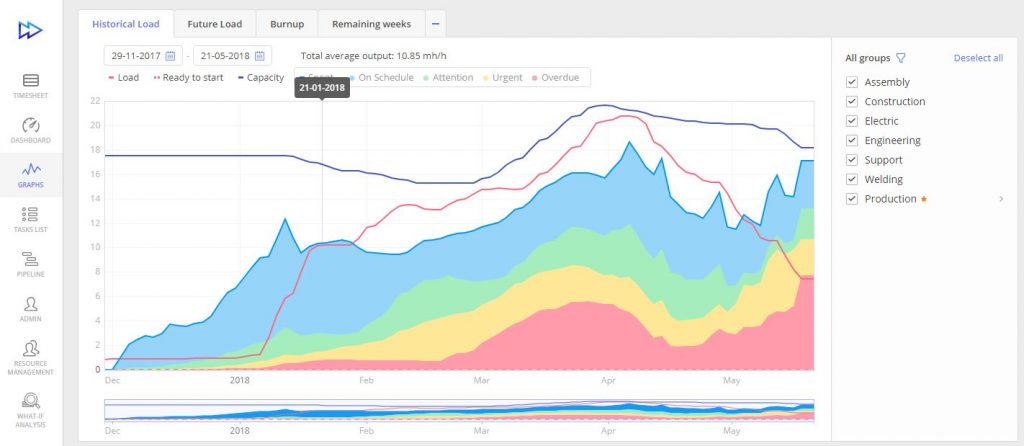
In the case of the Dutch Ministry of Defence, this optimization of resource use led to a 30% decrease in lead times without a headcount increase.
Predictive capacity planning
Future Load Graph can help predict future capacity to provide data for planning work and detect potential bottlenecks before they have a chance to hurt portfolio performance. This helps SPM specialists manage risks proactively and improve planning capabilities.
Scenario simulation
What-If Analysis allows the management and the planning team to test different portfolio compositions and resource allocation decisions.
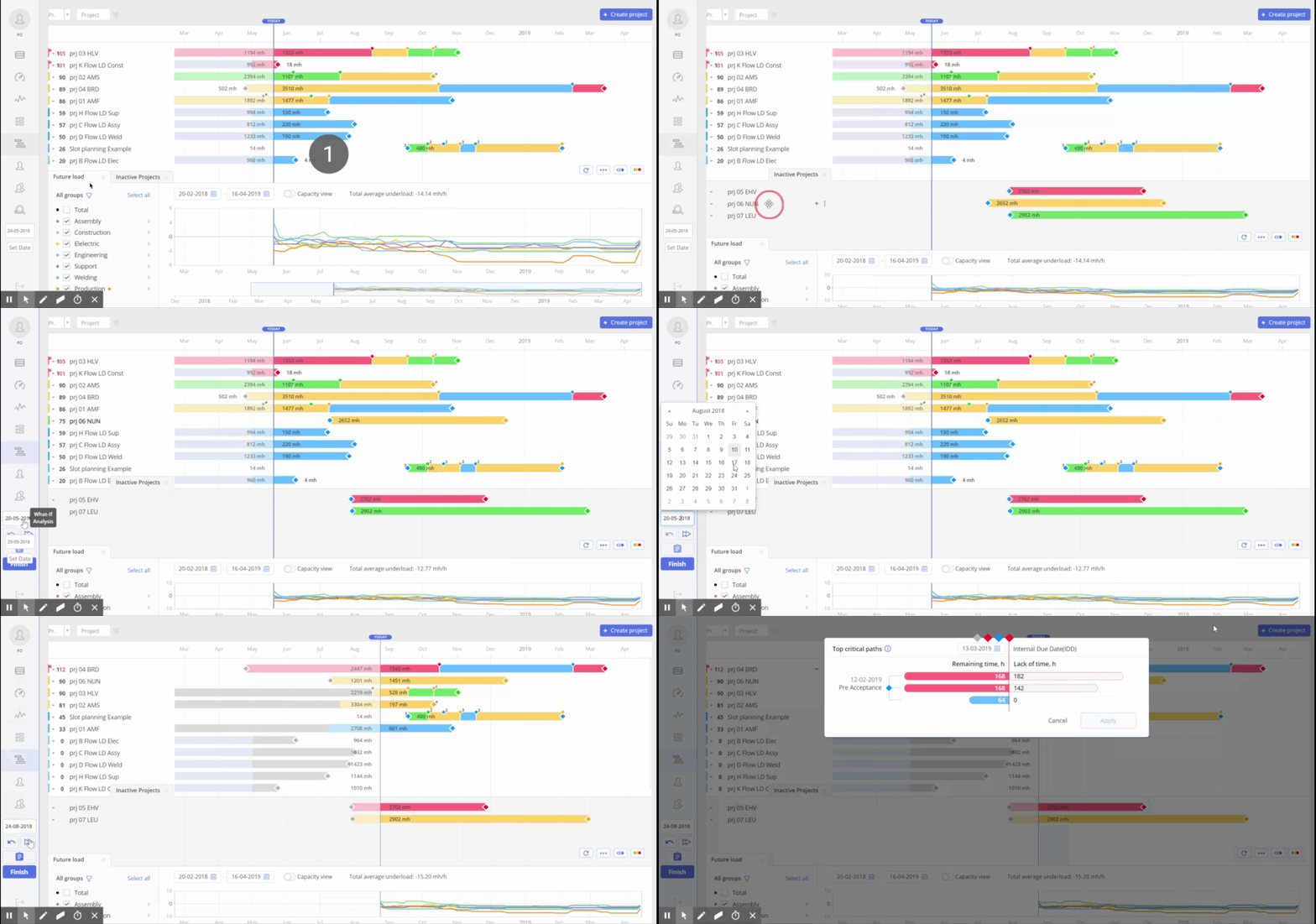
This improves the quality of planning and allows one to find the optimal portfolio composition through trial and error.
Book a call with our team to learn more about how Epicflow can support your company’s strategic portfolio management initiatives.
FAQ
What is strategic portfolio management?
Strategic portfolio management is a process of aligning projects in a portfolio with the organizational strategic goals. As a result, company resources can be used more efficiently to maximize the value being realized through projects and resource investments.
How does strategic portfolio management relate to project management?
SPM focuses on the alignment of the portfolio with the strategic goals, aiming to increase the business value it brings in. Project management is focused on executing projects on time and within budget.
How does strategic portfolio management support strategic goals?
SPM supports the achievement of strategic company goals by aligning projects that a company invests its resources into with them. Ideally, after SPM practices are applied, the portfolio is focused on moving the company closer to its long-term goals and minimizes the effort spent on low-priority projects.
What is portfolio analysis in strategic management?
Portfolio analysis refers to a set of data analytics practices that help SPM professionals to gain more visibility into the portfolio and make better planning decisions. These typically include but are not limited to resource utilization analysis, the BCG matrix, and risk-value analysis.
What is the difference between strategic portfolio management and strategic planning?
Strategic planning is a high-level process that aims at planning the strategy the company should follow. SPT is a tactical process that delineates how those strategic plans correspond to a portfolio of projects.
What is the McKinsey 7S Model in strategic management?
This refers to the following seven elements: strategy, structure, systems, shared values, skills, style, and staff.