The Project Financial Management Process: A PMO-Finance Workflow from Budget to Forecast
 Victoria Sokolova
.
Published
.
Project Portfolio Management
.
33 mins READ
Victoria Sokolova
.
Published
.
Project Portfolio Management
.
33 mins READ
The project financial management process is the governed cycle in which the PMO and Finance plan, approve, record, reconcile, forecast and act on the financial position of projects. It connects delivery assumptions and a feasible schedule with budgets, actual costs, contract rules and the accounting system, so the people with decision rights can act on a variance while it is still a forecast. It runs in eight steps: define the case, estimate, approve baselines, configure contract rules, reconcile actuals, compare plan with forecast, test interventions, then decide, close and learn.
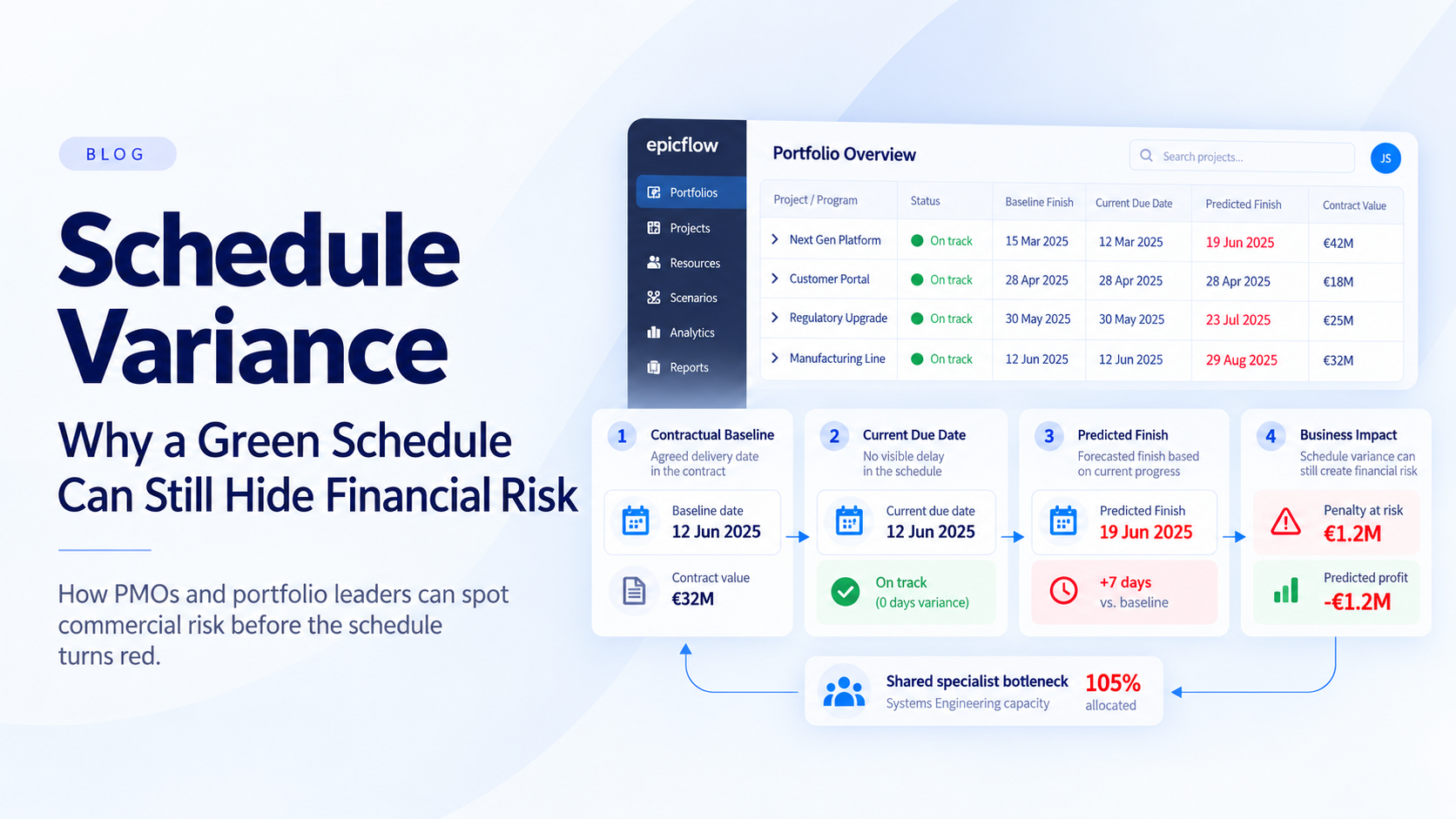
A typical scenario for a monthly review: the ledger has closed, Finance brings actual costs, the PMO brings status. Project A has $300,000 of budget left, so it looks safe. Two months later it misses its contract date, because the verification team it needed was booked on another project all along. The penalty was never in the cost report.
The cost report was correct. It answered a different question: what was spent, not whether the remaining work can finish on time with the people available.
Most processes are built around the budget, and the budget is only one of three decisions. The other two, which work is still worth the money and which work starts next, are left to the calendar.
A budget decides how much may be spent. It does not decide which work is still worth the money, or what starts next.
What is project financial management?
Project financial management, or financial management in project management, is the forward-looking control of a project's money: what it may spend, what it has spent, what it will earn, and how changes in scope, dates and people move those numbers. Its output is a decision, not a report: continue, change, park or stop.
Four terms are often used as synonyms. They are not:
| Term | Question it answers | Main owner | Main system | Time horizon |
|---|---|---|---|---|
| Project financial management | Will this project deliver its financial case, and what should we do now? | PMO with Finance | PPM, fed by ERP | Forward |
| Project accounting | What was spent, committed, invoiced and recognized? | Finance, project controller | ERP, accounting | Backward, by period |
| Project finance | How is a large capital asset funded? | Treasury, lenders | Financial models | Life of the asset |
| Portfolio financial control | Which projects, in what order, earn most from the money and people available? | Portfolio board, PMO | PPM | Rolling |
The process in this article sits across the first and last rows. It uses the ledger without replacing it.
Inside it, three decisions run at three different rhythms:
- How much may be spent. The spend envelope: an annual or funding-cycle approval by the executive team and Finance. It should stay stable.
- Which work is worth doing, and in what order. The investment ranking. It changes when value, cost or dates change, and the forum that sets it must be able to remove work, not only add it.
- What starts now. Work release: ready work goes to a team when that team has room. This happens continuously, week by week.
Collapse the three into one annual event and the approved list becomes a commitment nobody revisits. A project funded in January is still running in September after half its assumptions have changed, because the only decision anyone took was the budget. Flow Economics calls this pattern the frozen portfolio.
Project management financials, the individual fields such as Approved Budget, Remaining Budget and predicted profit, are defined in our guide to project financials. This article is about the process that uses them: who decides what, when, and with which numbers.
The systems and roles behind the process
Managing project finances means working across several systems. Each owns one kind of number, and the process works when everyone knows which system is authoritative for which figure.
| System | Owns | Does not own |
|---|---|---|
| ERP and accounting | Ledger postings, period close, revenue recognition, invoicing, collections | Feasible delivery dates |
| Time tracking | Hours booked per person and task | Rates, budgets |
| Procurement | Purchase orders and commitments | Labor cost, schedule |
| CRM and contracts | Contract value, terms, approved change orders | Delivery forecast |
| PPM decision layer | Resource-constrained forecast, predicted dates, commercial exposure from those dates, ranking, scenarios | Statutory records, cash received |
| BI | Consolidated reporting across systems | Source data |
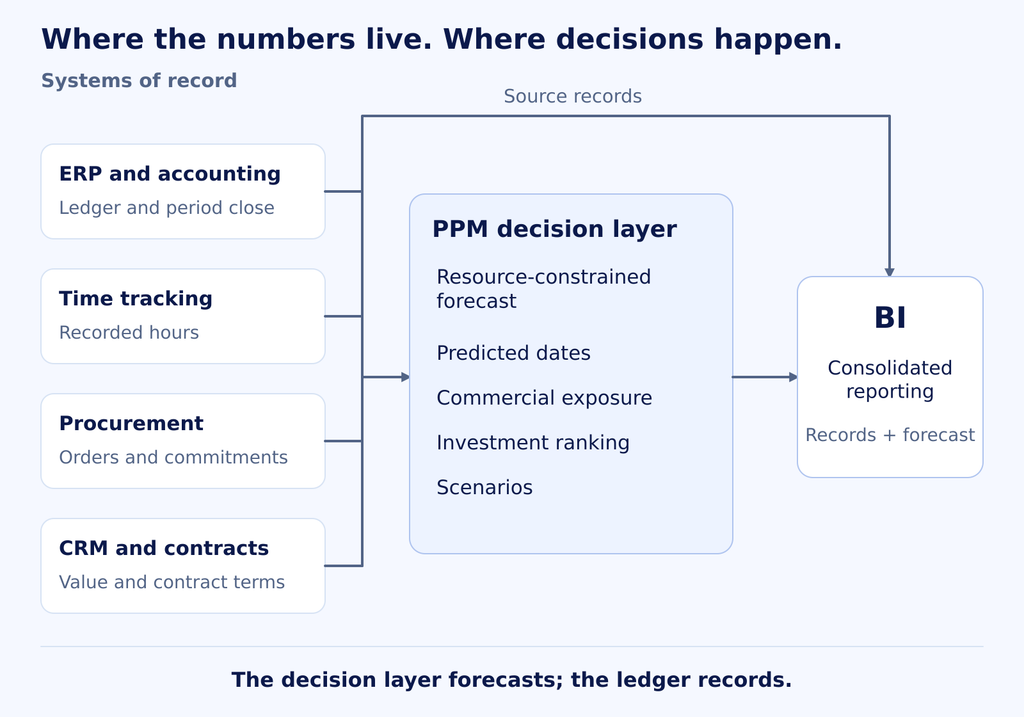
Figure 2. Systems of record keep the numbers; the decision layer turns them into dates and options.
In an enterprise project portfolio management software setup, the PPM layer reads cost and contract inputs from the systems of record and adds what none of them has: the dates the portfolio can reach with the people it has.
Roles follow the same split. Finance should not be accountable for operational data it cannot see, and the PMO should not interpret contracts. A model to adapt, with one accountable owner per row:
| Activity | Portfolio board | PMO | Finance | Resource owner | Project manager | System owner |
|---|---|---|---|---|---|---|
| Approve the spend envelope | A | C | R | C | I | I |
| Set Revenue and the contract rule | I | C | A/R | I | C | I |
| Maintain baseline, dates and remaining effort | I | A | I | C | R | I |
| Record costs and maintain rates | I | I | A | I | I | R |
| Run the forecast and publish exposure | I | A/R | C | C | I | I |
| Rank, park or stop investments | A | R | C | C | I | I |
| Release ready work to a team | I | A | I | R | C | I |
| Approve interventions above threshold | A | R | C | C | I | I |
| Execute and communicate the decision | I | C | I | C | A/R | I |
| Configure fields, permissions, integrations | I | C | C | I | I | A/R |
R: responsible, A: accountable, C: consulted, I: informed.
The eight-step project financial management process
The eight steps form a loop, not a sequence you run once. They group into six management moments: set up, validate, monitor, predict, decide and learn. The first three steps are project financial planning; the rest is control.
| Step | Moment | Accountable | Decision it serves | Rhythm |
|---|---|---|---|---|
| 1. Define the business case and assumptions | Set up | Sponsor | Is it worth funding? | At intake |
| 2. Estimate effort, cost and revenue | Set up | PMO | What will it need, and from whom? | At intake, at stage gates |
| 3. Approve work-hour and monetary baselines | Set up | Portfolio board | How much may be spent? | Annual or funding cycle |
| 4. Configure contract and change rules | Validate | Finance | What is each date worth? | At contract, at change |
| 5. Collect and reconcile actuals | Monitor | Finance | What has been spent? | After each period close |
| 6. Compare plan, actual and forecast | Predict | PMO | Where is exposure still preventable? | Monthly and after major changes |
| 7. Investigate and test interventions | Decide | PMO | Which option costs the portfolio least? | On exception |
| 8. Approve, communicate, close and learn | Decide, learn | Portfolio board | Continue, change, park or stop? | Periodic ranking, at closeout |
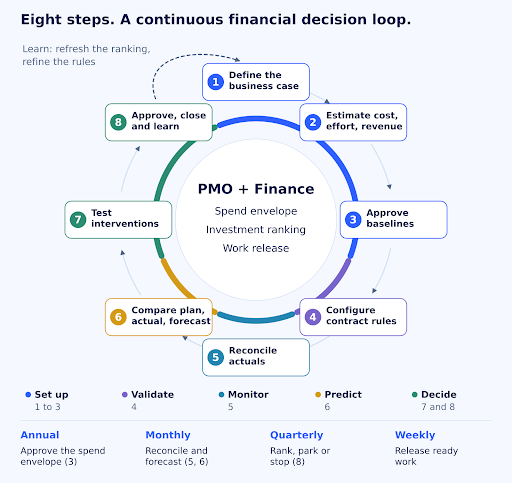
Figure 1. The eight steps as a loop: the budget is approved once a year, the ranking is refreshed every quarter, and work is released every week.
1. Define the business case and assumptions
Start with what the project is supposed to return. For contract work, that is revenue and the contract terms. For internal work, it is a benefit with a named owner: lower rework, a new capability, a compliance date met. Internal projects never send an invoice, but they still have a price of time. Every week they slip, the benefit arrives a week later.
Write the assumptions next to the numbers: scope, rates, the start window and the teams the work depends on. Without them, nobody can later tell whether the estimate was wrong or the world changed.
2. Estimate effort, cost and revenue
Estimate effort per team before you estimate money. The figure that matters most is the hours each project needs from the bottleneck: a resource constraint of people and skills, not a step in a process. In most engineering portfolios it is one or two specialist teams that every project needs at the same time.
Cost follows from hours, rates and additional costs such as materials. Finance owns the rates, resource owners the effort estimates, the contract owner the revenue. Keeping the three sources separate makes the plan auditable.
3. Approve the work-hour and monetary baselines
Approve two baselines, because they answer two questions. The work-hour budget says how much effort the project may use. The approved monetary budget says how much money it may consume. A project can stay inside its money while it overruns its hours on a cheaper team, and the reverse.
Approval sets the spend envelope, not start dates. A project can be worth funding without starting in January; released when its team has room, it is likely to finish sooner. Treat the approved list as an envelope, not an irrevocable twelve-month schedule. See project budgeting and cost control for how the two baselines sit next to the delivery plan.
4. Configure contract and change rules
Turn the contract into rules the forecast can price. Enter Revenue, then select the bonus and penalty rule that applies: grace period, rate per day or week late, cap. Finance or the contract owner interprets the contract. The PMO maintains the dates the rule is measured against.
In Epicflow, schemes can be kept per client or contract type, with one active per project, and a simulator tests a scheme against a project's revenue and an end-date variance before it is assigned.
A change order updates Revenue or the budget through a recorded decision, never a silent edit. Watch two exceptions here: a contract project with no Revenue shows no commercial exposure, and a project with no applicable scheme shows its dates but not what they are worth.
5. Collect and reconcile actuals
Hours come from time tracking, cost postings from the ledger, commitments from procurement. Reconcile them after each period close, so everyone compares the same snapshot.
Expect differences, and explain them. Labor cost in a PPM tool is hours multiplied by configured rates: a management figure, not a ledger entry. Accruals and close timing will make it differ from the ledger. Print the authoritative system next to each figure on the project financial report, and the argument about whose number is right becomes a reconciliation line.
Remaining Budget is Approved Budget minus Actual Costs. It shows unconsumed funds, not the cost to complete. A negative Remaining Budget is an exception: it goes to change control, with the sponsor deciding on a re-approval. It is never absorbed by a quiet rebaseline.
6. Compare plan, actual and forecast
This is the step most processes skip, and the one that turns a cost review into project management financial analysis. Rerun the resource-constrained forecast after each period close and after any major change: a new project, a lost specialist, a moved milestone. It predicts when each project will finish, given the work remaining and the people available across the whole portfolio.
Three dates now sit side by side: baseline end, current due date and predicted end. The contract rule prices the due date as the actual bonus or penalty and the predicted end as the predicted one. The gap is exposure that is still preventable. With project management forecasting software, you can act on a predicted penalty before it becomes an actual one.
Two cautions. Moving the due date changes the actual adjustment, not the feasibility of the predicted date. And a predicted profit that subtracts only recorded costs is not an estimate at completion; add the estimate to complete. Then ask the forward question: what does the remaining spend still buy?
7. Investigate and test interventions
Trace each variance to its cause first: overspend, delay or scope. Delay is the one cost reports miss, and in a shared-resource environment it usually comes from a queue in front of one team. Resource capacity planning shows which team that is, and which projects are waiting for it.
Then build options: keep the plan, add capacity at the bottleneck, change the sequence, reshape scope, park a project or stop one. Test each against the whole portfolio. On a single project, a week gained looks created. Across projects that share people, it is usually borrowed from another one. What-if analysis shows what each option does to every project's dates and money before the live plan changes. The PMO and resource owners build the options; Finance judges whether the amounts are material.
8. Approve, communicate, close and learn
The authorized forum takes the decision with the options and their prices on one page. It can remove work as well as add it. The project manager executes and tells the teams and sponsors affected, including the sponsor whose project now moves later.
Record the decision, its assumptions and its expected effect, then check the effect at the next review. Refresh the ranked list. Adjust schemes and escalation thresholds that produced noise or missed something.
At closeout, reconcile the final figures with the ledger and compare estimated with actual hours per team. That difference is how the next project financial plan gets better than this one.
Project financial review cadence and controls
A single monthly meeting cannot carry all three decisions. Give each its own rhythm:
| Rhythm | Decision | Inputs | Forum |
|---|---|---|---|
| Weekly | Release ready work; watch delivery signals | Predicted dates, load on the bottleneck team | PMO and resource owners |
| Monthly, after period close | Reconcile actuals; rerun the forecast; review exposure | Ledger actuals, hours, predicted adjustments | PMO and Finance |
| Quarterly or at a stage gate | Rank, park or stop investments | Remaining value against remaining investment | Portfolio board |
| Annual or funding cycle | Approve the spend envelope | Strategy, capacity, the ranked list | Executive team, Finance |
| On exception | Act on a trigger below | The exception and its options | Per threshold |
Exceptions should have a defined path, not a debate about who owns them:
| Exception | What it means | Who acts | Default response |
|---|---|---|---|
| No Revenue on a contract project | Commercial exposure cannot be calculated | Finance | Enter Revenue before the next review |
| No applicable contract rule | Dates are visible, their price is not | Finance, contract owner | Select or create a rule; test it first |
| Negative Remaining Budget | Spend exceeds approval | Controller, sponsor | Change control; no silent rebaseline |
| Predicted penalty beyond grace | Preventable exposure | PMO, resource owner | Model options; Finance judges materiality |
| Due date and predicted finish disagree | The commitment is not feasible | PMO | Fix the cause, not the date |
| Remaining case has deteriorated | Finishing returns less than before | Portfolio board | Continue, reshape, park or stop |
| Higher-return work arrives mid-year | The ranking is out of date | Portfolio board | Test in a scenario; re-rank; envelope may stay |
Two controls keep the numbers honest. Segregation of duties: whoever records costs does not approve budget changes, and whoever maintains dates does not set Revenue. An audit trail: every change to a baseline, date, Revenue or rule is logged with its author and reason. Calculated fields stay read-only, so nobody overwrites a result instead of its input. Exceptions with a contract or safety impact also belong in project risk management.
Worked example: forecast delay changes the financial decision
Illustrative example. All figures are teaching assumptions, not a customer result or software output.
An engineering company runs two projects through one verification team. The monthly review falls in week 26.
| Project A (customer contract) | Project B (internal platform) | |
|---|---|---|
| Approved Budget | $1,200,000 | $600,000 |
| Actual Costs | $900,000 | $350,000 |
| Remaining Budget | $300,000 | $250,000 |
| Estimate to complete | $350,000 | $400,000 |
| Forecast total cost | $1,250,000 ($50,000 over) | $750,000 ($150,000 over) |
| Value | $2,000,000 revenue | $700,000 benefit, cut from $1,500,000 after a product line was descoped |
| Baseline end and due date | Week 30 | Week 40 |
| Predicted end | Week 36 | Week 40 |
Contract rule for A: two weeks' grace, then 1% of revenue per full week, capped at 8%. B's benefit is spread over three years from completion, so a week of delay costs about $4,500 ($700,000 / 156 weeks).
Why is A predicted for week 36? The verification team is booked on B's test phase in weeks 29 to 32. A's verification waits behind it, runs weeks 33 to 36, and finishes six weeks late: four weeks beyond grace, so a predicted penalty of 4%, or $80,000.
The actual fields show nothing wrong: A's due date is still week 30, so the actual penalty is zero. The predicted state shows Predicted Revenue of $1,920,000. Including the estimate to complete, the margin is $670,000, an ROI of 53.6% on total investment. On what is left to spend, A returns 5.5x ($1,920,000 / $350,000).
B now loses money on total investment: $700,000 of benefit against $750,000 of cost, an ROI of -6.7%. On what is left to spend, it still returns 1.75x ($700,000 / $400,000). Stopping B would save $400,000 and give up $700,000. The $350,000 already spent does not count.
Three options go to the review:
| Option | Effect on A | Effect on B | Cost to the portfolio |
|---|---|---|---|
| 1. Keep the sequence | Week 36, penalty $80,000 | On plan | $80,000 |
| 2. Hire a contractor for A's verification ($70,000, available from week 31) | Week 33, penalty $20,000 | On plan | $90,000 |
| 3. Move B's test phase behind A's verificationLowest cost | Week 32, inside grace, no penalty | Four weeks later, about $18,000 of delayed benefit | $18,000 |
Option 3 costs the portfolio $62,000 less than option 1 and needs no new money. Option 2, the instinctive answer, costs more than doing nothing. The spend envelope does not change in option 3. The ranking does: B moves behind A for four weeks.
The decision follows the RACI. The PMO and the verification team's resource owner built the options. Finance confirmed the contract reading and that $80,000 is material. The portfolio board approved the new order, because it changes the ranking, and B's sponsor heard the price: about $18,000. A's project manager executes. Canceling B was rejected, because finishing it still returns more than it costs. In a larger portfolio, the scenario test in step 7 also checks that the move creates no new queue for a third project.
Common process failures
| Failure | What it causes | Fix |
|---|---|---|
| One number for the budget | Hour overruns go unseen | Separate work-hour and monetary baselines |
| Late actuals | Decisions use last quarter's position | Reconcile after each period close |
| Silent rebaselining | Variance vanishes without a decision | Rebaseline only through change control |
| No accountable owner | Exceptions wait for a meeting | One A per RACI row |
| False precision | Debates over cents | Round; show assumptions and data date |
| Mismatched calendars | Ledger month and delivery week disagree | Agree one cut-off per review |
| Stale rates | Labor cost drifts | Update rates on a fixed cycle |
| Missing assumptions | Nobody knows why estimates moved | Store assumptions with estimates |
| PPM and ERP confusion | Two versions of revenue | Name the authoritative system per figure |
Behind most of them sits one failure: the annual budget is treated as the whole process. The spend envelope is controlled; the ranking and the release happen by default.
How Epicflow fits the PMO-Finance workflow
Epicflow is the decision layer in this process, not the ledger. It builds a resource-constrained prediction of the whole portfolio, a plan built around the people you actually have, and puts the money on top of it. When the plan moves, the money moves with it.
- Set up and validate (steps 1 to 4). Approved Budget, Revenue and the bonus and penalty scheme are editable in the Pipeline. One scheme is active per project, and a simulator tests it before assignment. Business Value, Custom Fields and Attributes carry the case and its context.
- Monitor (step 5). Actual Costs and Remaining Budget are calculated, read-only fields next to the delivery dates.
- Predict (step 6). A Prediction run produces predicted end dates and the predicted bonus or penalty, revenue and profit for every project. Epicflow also shows whether each project is still worth finishing: what it returns per dollar still to spend, as a multiple, next to ROI. The technical name is RRI, return on remaining investment, built on Stephen Devaux's work (Devaux, 2014). Invoice Forecast and Cash Flow show when milestones become invoiceable and when payment is expected, derived from the schedule, not from a bank balance.
- Decide and learn (steps 7 and 8). What-If Analysis tests each option before the live plan changes. For larger portfolios, the Epicflow Portfolio Optimizer searches for the sequence that earns most; your people decide. Each role configures its own Pipeline view on the same numbers.
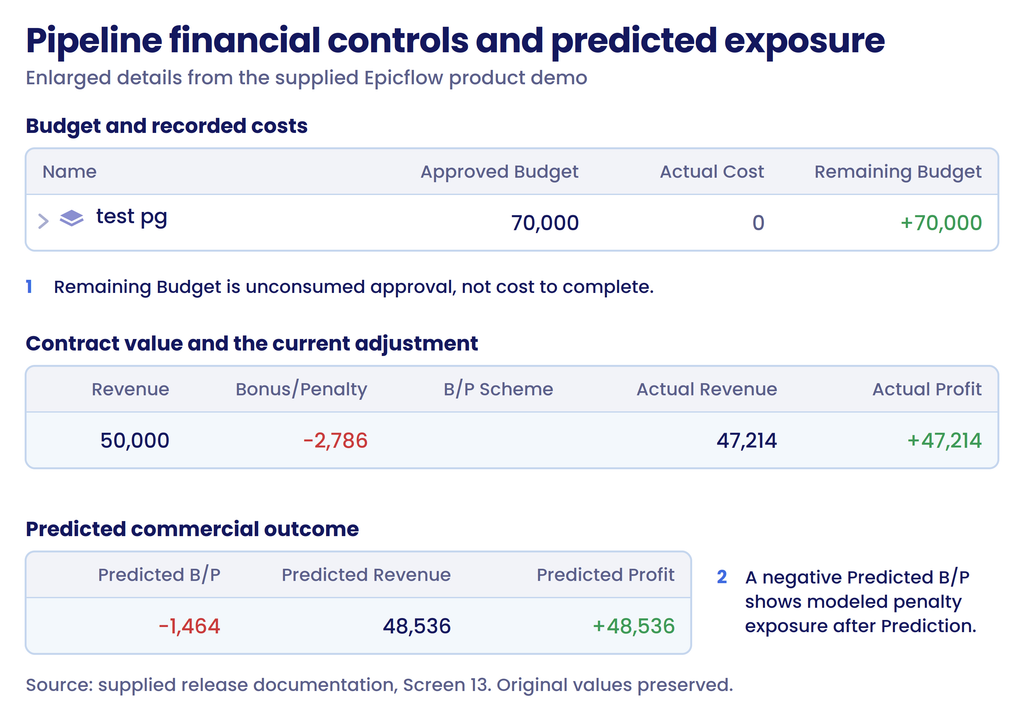
Figure 3. Budget, recorded costs and predicted financial exposure in Epicflow Pipeline. Enlarged details from the supplied product demo.
What stays in accounting and ERP: ledger postings, period close, invoicing, collections, revenue recognition, procurement, payroll and statutory reporting. Epicflow forecasts; the ERP records.
What changes when the review prices time
A PMO that reviews project financials asks: are we spending what we approved? A Value Management Office asks: is the work we are doing now still the best use of the money and people we have? A good project financial management process makes the second question routine: the budget stays approved, the ranking stays alive, and work starts when its team has room. Flow Economics sets out what a value management office does in more depth.
Bring your project list and one real decision, such as which project gets your busiest team next month. We run it on your own data and show how the dates and the money change. Schedule a Live Demo
Further reading: Flow Economics on how to know when a project is no longer worth finishing.
Frequently Asked Questions
What is the project financial management process?
The project financial management process is the governed cycle for planning, approving, recording, reconciling, forecasting and acting on a project's financial position. It has eight steps: define the business case, estimate, approve work-hour and monetary baselines, configure contract rules, reconcile actuals, compare plan with forecast, test interventions, and decide, close and learn. It links a feasible delivery forecast with budgets, actuals and contracts.
What are the main components of project financial management?
Assumptions, budgets and baselines, actual costs and commitments, a delivery forecast, contract rules, controls, reporting and closeout. The component most processes lack is the forecast: predicted finish dates that account for the people available across all projects. Without it, actuals show what was spent but not what the remaining dates will cost.
Who owns project financial management?
Ownership is shared, with one accountable owner per decision. Finance owns rates, cost records and the reading of contracts. The PMO owns dates, the forecast and the options. Resource owners own effort estimates and the release of work to their teams. The portfolio board owns the spend envelope and the ranking, including decisions to park or stop projects.
What is the difference between project financial management and project accounting?
Project accounting keeps the official record: ledger postings, period close, invoicing, revenue recognition and statutory reporting. Project financial management uses that record, plus a delivery forecast, to decide what to do next. Accounting looks back by period. Financial management looks forward and asks what each date is worth. The two need shared definitions and a named authoritative system for each figure.
How often should project financials be reviewed?
At several rhythms, one per decision. Release work and watch delivery signals weekly. Reconcile actuals and rerun the forecast monthly, after period close. Re-rank, park or stop investments quarterly or at stage gates. Approve the spend envelope once per funding cycle. Exceptions, such as a predicted penalty beyond the grace period, are handled when they appear.
How do you manage project financials across a portfolio?
Use the same definitions, rules and thresholds on every project, then forecast all projects together, because they share people. A move that helps one project usually delays another. Compare options by their effect on the whole portfolio, rank investments by what their remaining spend still buys, and release work when the team it needs has room.
References
Devaux, S. A. (2014). Managing projects as investments: Earned value to business value. CRC Press.