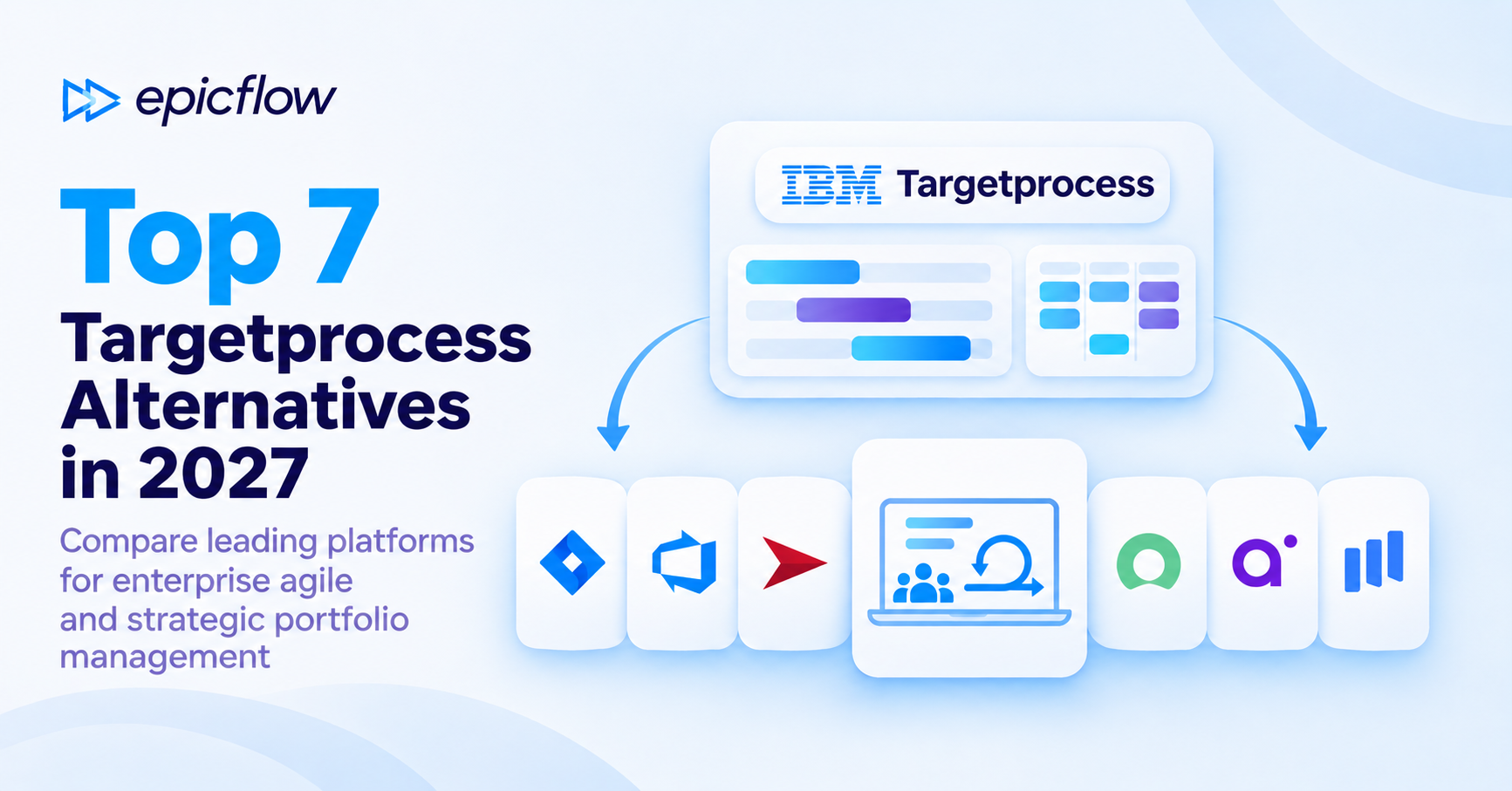
Top 7 Targetprocess Alternatives in 2027
 Mariia Zhorniak
.
Published
.
Project Management
.
34 mins READ
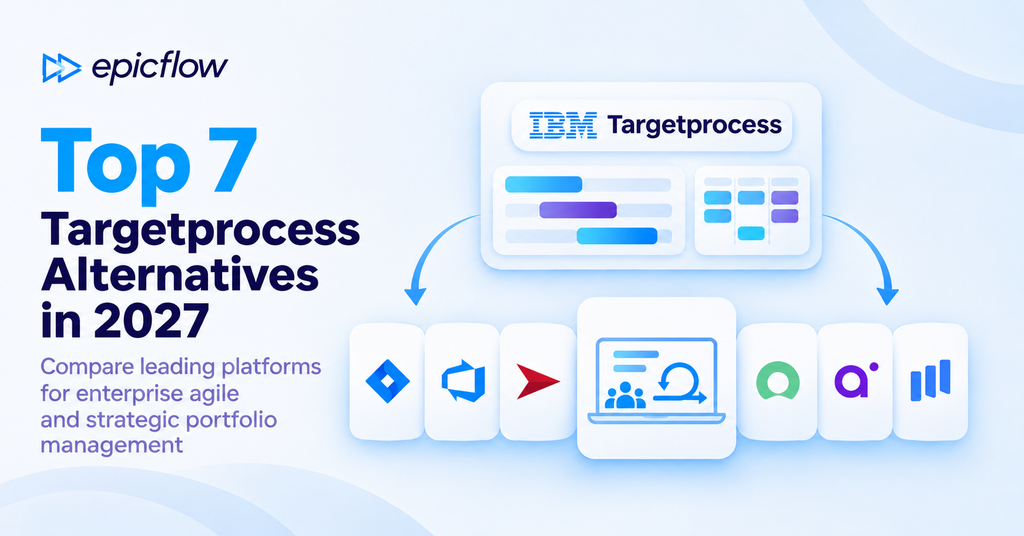
IBM Targetprocess (formerly IBM Apptio Targetprocess) is a strategic portfolio management platform built to align corporate strategy with agile delivery. Most organizations run it as SaaS on top of Jira or Azure DevOps, where it rolls team work up into release trains, value streams and portfolio epics. It also plans capacity by team and flags people and teams with more planned work than available hours.
Teams look for Targetprocess alternatives for three reasons. The contract comes up for renewal. The organization changes its agile framework or consolidates on one vendor's stack. Or the portfolio has a problem Targetprocess was not built to answer.
The third reason is the expensive one. In engineering portfolios, delivery dates are set by a few named specialists shared across dozens of projects: the two test engineers, the one certification lead. When three projects need them in the same month, one goes first and two wait. Each week of waiting has a price: a milestone payment that slips, a penalty, revenue that lands a quarter later. The gap between plan and outcome is wide: Gartner found that only 48% of digital initiatives meet or exceed their business outcome targets [1].
This guide compares 7 Targetprocess alternatives by the layer each one replaces, so you can keep what works and fix what does not.
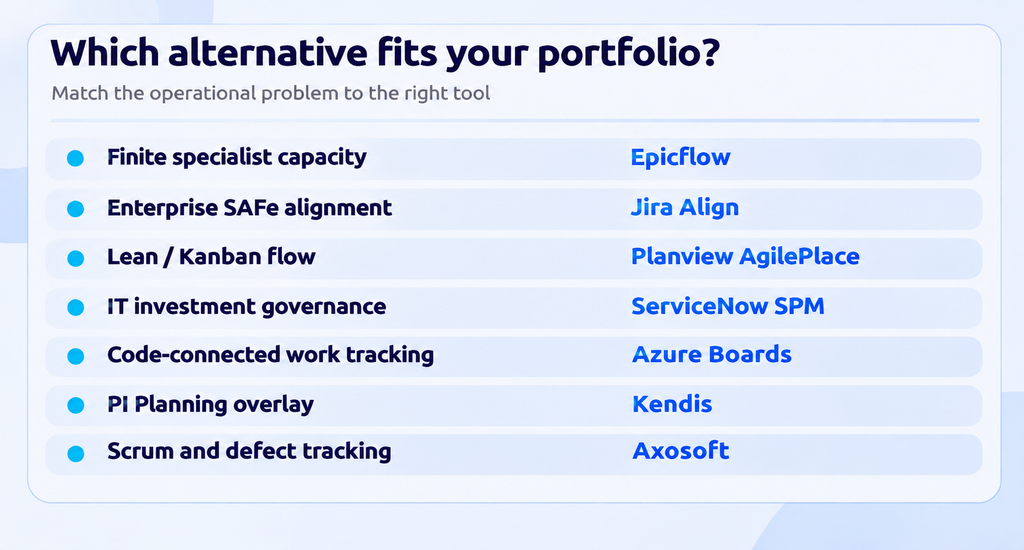
At a glance: which Targetprocess alternative fits your team?
Gartner Peer Insights reviewers compare IBM Targetprocess most often with Jira, and the platform also lists head-to-head comparisons with Azure Boards and ServiceNow Strategic Portfolio Management [2]. We started from those Targetprocess competitors and added tools that cover the other layers Targetprocess users replace: SAFe planning, Kanban flow, PI Planning and capacity across shared specialists.
Prices are published list prices or "quote only", checked on vendor pages in November 2026. They are not total cost of ownership.
| Tool | Relation to Targetprocess | Key strengths | Best fit | Primary trade-off | Pricing (checked Nov 2026) | Hosting |
| Atlassian Jira Align | Replace | Strategy-to-story roll-ups, OKRs, dependency tracking across teams and programs, SAFe configurations | Large enterprises running SAFe across many Jira instances | Sold only inside Atlassian Strategy Collection; requires Jira Cloud Premium | List USD 77,400 per year for 1-50 users, paid annually | Cloud; self-hosted releases still supported |
| Epicflow | Replace portfolio scheduling and capacity planning; teams stay in Jira | Plans every project around the specialists you actually have, prices each week of delay, shows which resource move recovers the most, forecasts cash flow from the schedule | Aerospace, defense, engineering and manufacturing PMOs with shared specialist pools | Not built for SAFe ceremonies, PI boards or accounting ledgers | Growth from EUR 22.50 per user per month paid annually (20-50 users); Enterprise from EUR 45, minimum 50 users | Cloud or defense-grade on-premise |
| Planview AgilePlace | Replace the flow layer | Enterprise Kanban, WIP limits, cross-team dependency mapping, flow metrics | Delivery organizations running Lean or Kanban across teams of teams | Budgeting and funding sit in separate Planview products | One plan, price on request; 30-day free trial | SaaS, multi-tenant or single-tenant private cloud |
| Axosoft | Downscale to team tracking | Scrum backlogs, burndown charts, defect tracking, release planning | Software and QA teams that need Scrum and bug tracking only | No portfolio layer documented | Hosted: per user per month; installed: yearly license, renewal at 35% of configuration cost | Hosted or installed (Windows Server, MS SQL Server) |
| ServiceNow SPM | Replace for IT portfolios | Demand intake, portfolio and investment governance, roadmaps inside ServiceNow workflows | CIOs and IT PMOs standardized on ServiceNow | Strongest where ServiceNow already runs IT workflows | Custom quote | Primarily SaaS; self-hosted and government-cloud options |
| Microsoft Azure Boards | Downscale to team tracking | Backlogs, Kanban boards, work-item hierarchies linked to Git and pipelines | Software teams standardized on Microsoft developer tools | Capacity per team and sprint; no project revenue or cost of delay | First 5 users free, then USD 6 per user per month (Basic) | Cloud (Azure DevOps Services) or on-premise (Azure DevOps Server) |
| Kendis | Augment Jira or Azure DevOps | Program Board, confidence vote, two-way sync with Jira and Azure DevOps | RTEs and agile leaders running SAFe PI Planning | Planning overlay; team execution stays in Jira or Azure DevOps | Premium Cloud USD 14 per user per month paid annually (USD 16 monthly) | Cloud (US or EU), private cloud or self-hosted |
Read more: 12 Best Jira Alternatives for Portfolio and Multi-Project Management
Our methodology: how did we evaluate Targetprocess alternatives?
We compared seven alternatives to Targetprocess on five criteria a portfolio office uses when it replaces the platform:
- Strategic portfolio alignment: roll-ups from team work to epics, value streams and objectives.
- Capacity and flow management: whether capacity is planned per team or per named specialist, and whether delay has a price.
- Framework and execution fit: SAFe, Scrum, Kanban or hybrid delivery.
- Ecosystem integration: connector type and sync direction with Jira, Azure DevOps and IT service tools.
- Total cost transparency: published prices, license unit, minimums and what sits in add-ons.
Facts come from official product, pricing and documentation pages checked in November 2026. This is documentary research: we did not run hands-on trials or score the products. The comparison contains no paid placements or affiliate links.
What should you preserve when replacing Targetprocess?
Targetprocess serves several operational layers at once. Switching tools creates blind spots if the core workflows are not audited first. Use this checklist to identify the capabilities your organization actually relies on before a Targetprocess migration:
- Strategy-to-delivery roll-ups: two-way roll-ups from daily engineering work to portfolio epics, value streams and executive OKRs.
- Portfolio and financial governance: actual labor against approved budgets, plus milestone-linked revenue or cash-timing forecasts.
- Finite capacity across shared specialists: Targetprocess plans capacity by team and person. If your delivery dates depend on specialists shared across projects, check whether the alternative plans them as finite capacity across the whole portfolio, and whether it shows which project waits and what the wait costs.
- Cross-team dependency mapping: blockers across projects, program-level risk networks and critical paths across concurrent initiatives.
- Hybrid methodology support: Scrum, Kanban, Waterfall phases or mixed delivery models in one portfolio view.
- Scaled Agile and PI Planning workflows: Program Increment boards, confidence voting, objectives tracking and cadence-based planning across teams of teams.
- Two-way ecosystem integrations: map your existing Targetprocess integrations and confirm sync direction with source-of-record platforms, notably Jira, Azure DevOps and enterprise IT service tools.
Read more: How to calculate the cost of delay and use it to prioritize
Compare 7 Targetprocess alternatives
1. Atlassian Jira Align for running SAFe across many Jira instances
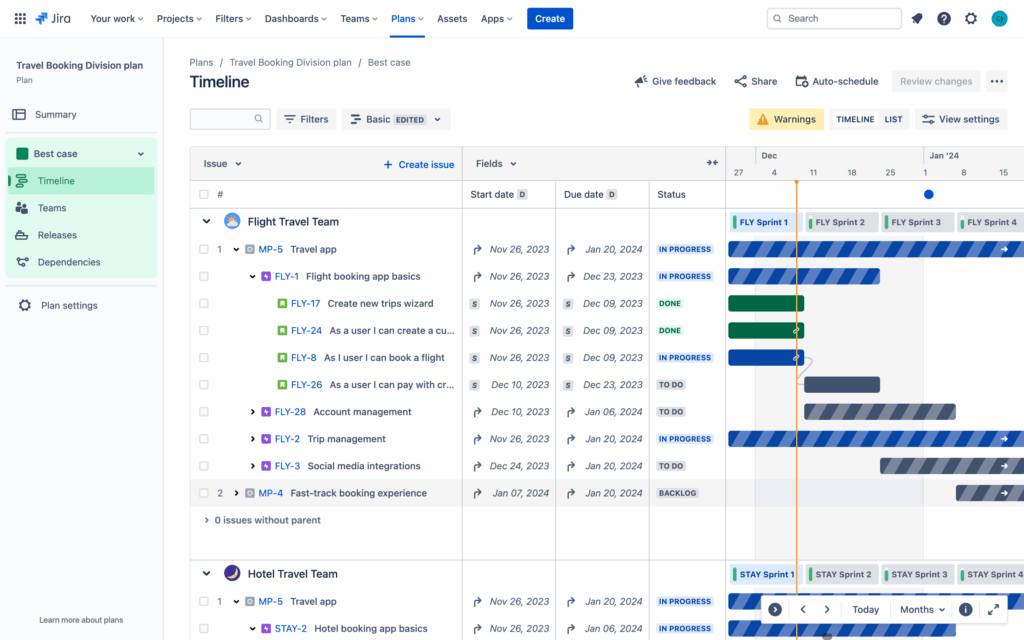
Atlassian Jira Align is enterprise agile planning software that connects executive strategy to software delivery across multiple Jira instances. It maps objectives and OKRs to epics and stories and tracks dependencies across teams and programs. Atlassian describes configurable settings for Essential, Large Solution, Portfolio and Full SAFe.
Best fit: large enterprises running SAFe in the Atlassian ecosystem.
Relation to Targetprocess: full replacement for the agile portfolio layer; teams keep working in Jira.
Pricing and hosting: since April 2025, Jira Align is sold only inside Atlassian Strategy Collection, together with Focus and Talent. List price USD 77,400 per year for 1-50 users, paid annually, with tiers up to 2,000 users; Jira Cloud Premium is required. Cloud, with self-hosted releases still supported.
Trade-off: organizations outside the Atlassian stack take on Jira Cloud Premium and the full collection, and teams that do not run SAFe use a fraction of the configuration.
Sources: Atlassian Jira Align product page; Atlassian Strategy Collection pricing page; Atlassian End of Support Policy; Atlassian blog on Jira Align and SAFe (2019).
2. Epicflow for engineering portfolios where shared specialists set the delivery dates
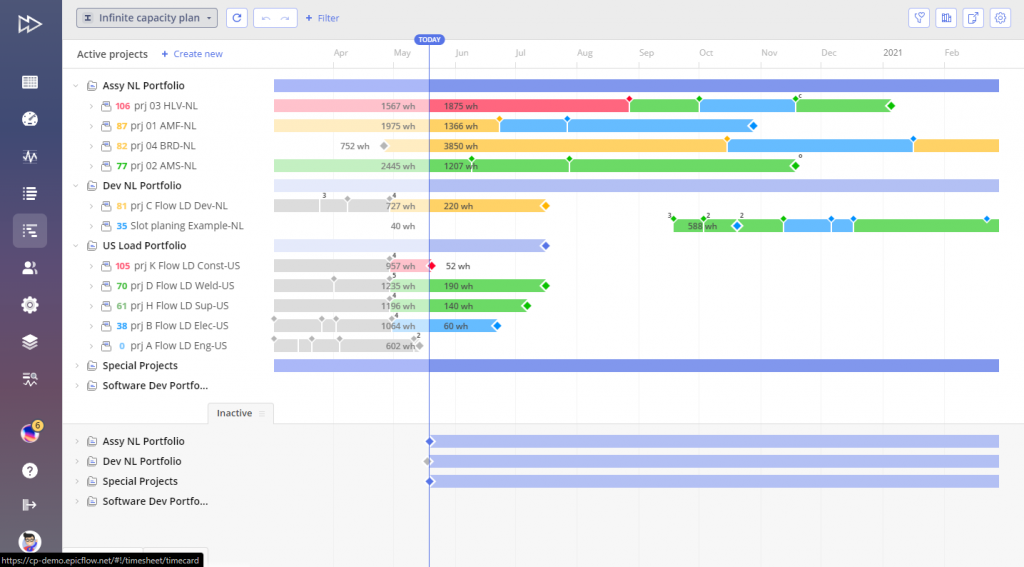
Epicflow is a portfolio platform that plans multi-project work around finite specialist capacity. It schedules every project against the people the organization actually has, finds the team everything else is waiting on, and puts a price on that wait. The PMO then sees which move recovers the most value: resequence two projects, move one specialist or start one project later. At KPN, the Dutch telecom operator, due-date performance rose from 18% to 80%.
Targetprocess shows whether a release train is on track. Epicflow shows what each week of delay at the bottleneck costs in revenue, margin, bonuses and penalties, and cash timing. What-If Analysis tests a new sequence against real capacity before it touches the live plan, and the cash flow forecast shows how the move shifts invoiceable value.
Best fit: aerospace, defense, engineering and manufacturing PMOs running 10-100 projects on a shared pool of specialists, especially where revenue is tied to milestones.
Relation to Targetprocess: replaces portfolio scheduling and capacity planning. Teams keep working in Jira through a ready-made integration that syncs issues and projects in real time; Azure DevOps connects through a custom integration.
Pricing and hosting: Growth from EUR 22.50 per user per month paid annually, 20-50 users; Enterprise from EUR 45, minimum 50 users; modules and implementation priced separately. Cloud, hosted on ISO 27001-certified infrastructure, or defense-grade on-premise.
Trade-off: not built for SAFe ceremonies, PI boards or accounting ledgers, and it does not replace Jira or Azure DevOps for team execution. The forecast is built from task effort, so every task needs an effort estimate.
Sources: Epicflow pricing plans page; Epicflow integrations and Jira integration pages; KPN case study.
3. Planview AgilePlace for Kanban flow across teams of teams
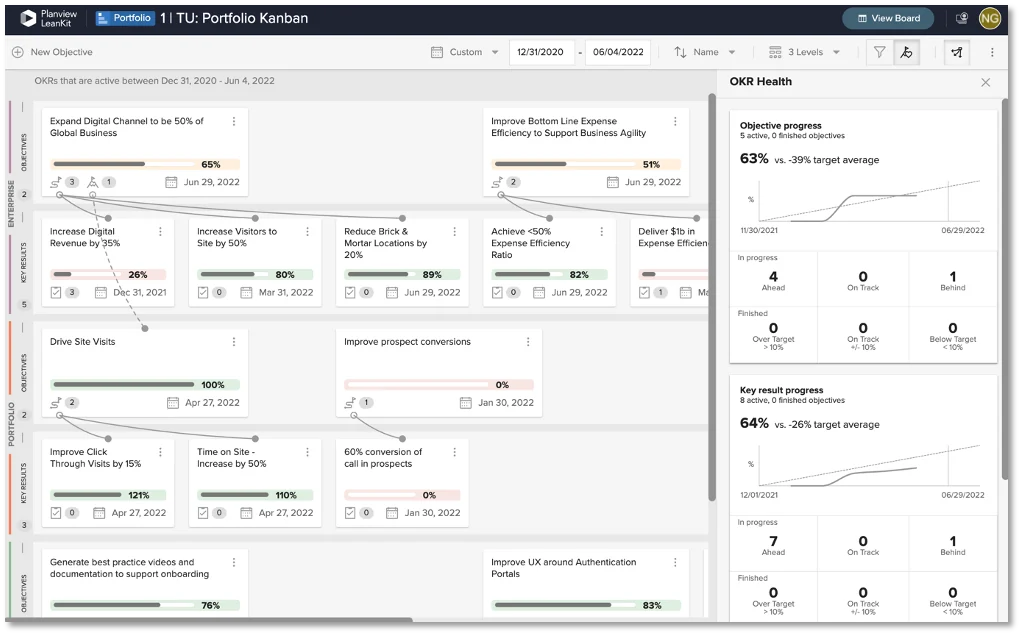
Planview AgilePlace, formerly LeanKit, delivers enterprise Kanban boards for flow, work-in-progress (WIP) limits and cross-team dependencies. Teams visualize delivery value streams without fixed sprint boundaries.
Best fit: PMOs and delivery organizations that run Lean or Kanban and want flow across teams in one view.
Relation to Targetprocess: replaces the flow and team-of-teams layer; portfolio budgeting moves to another tool.
Pricing and hosting: one plan with full functionality, price on request; 30-day free trial. SaaS on Microsoft Azure, multi-tenant or single-tenant private cloud.
Trade-off: budgeting and capital funding sit in separate Planview portfolio products, so organizations that fund work in Targetprocess need a second tool.
Sources: Planview AgilePlace product, pricing and integrations pages; Planview Security FAQ.
4. Axosoft for Scrum and bug tracking in software teams
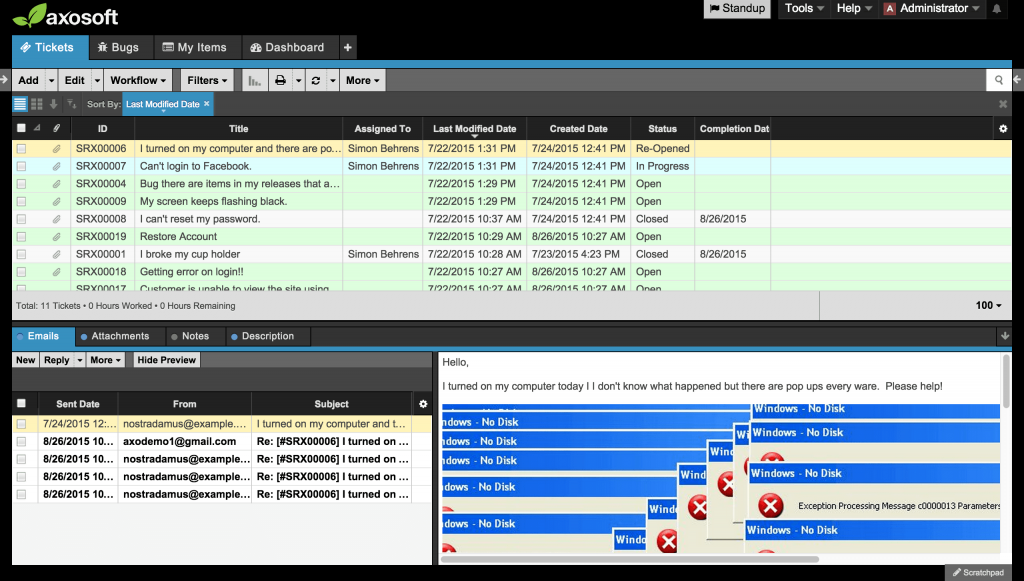
Axosoft is a team-level suite for Scrum backlogs, sprint burndown charts, defect tracking and release planning. The vendor, Axosoft LLC, has traded as GitKraken since December 2021.
Best fit: software engineering and QA teams that need Scrum tracking and defect handling without a portfolio layer.
Relation to Targetprocess: downscale. Axosoft replaces team-level tracking only; portfolio planning has no equivalent.
Pricing and hosting: hosted plans are priced per user per month, with a lower rate on an annual subscription. The installed edition is a yearly license renewed at 35% of its configuration cost and runs on Windows Server with MS SQL Server.
Trade-off: no portfolio governance, capacity forecasting or multi-project dependency features are documented. Check the product roadmap with the vendor before committing.
Sources: Axosoft pricing page; GitKraken press release on the Axosoft rebrand (December 2021).
5. ServiceNow Strategic Portfolio Management for IT investment governance on ServiceNow
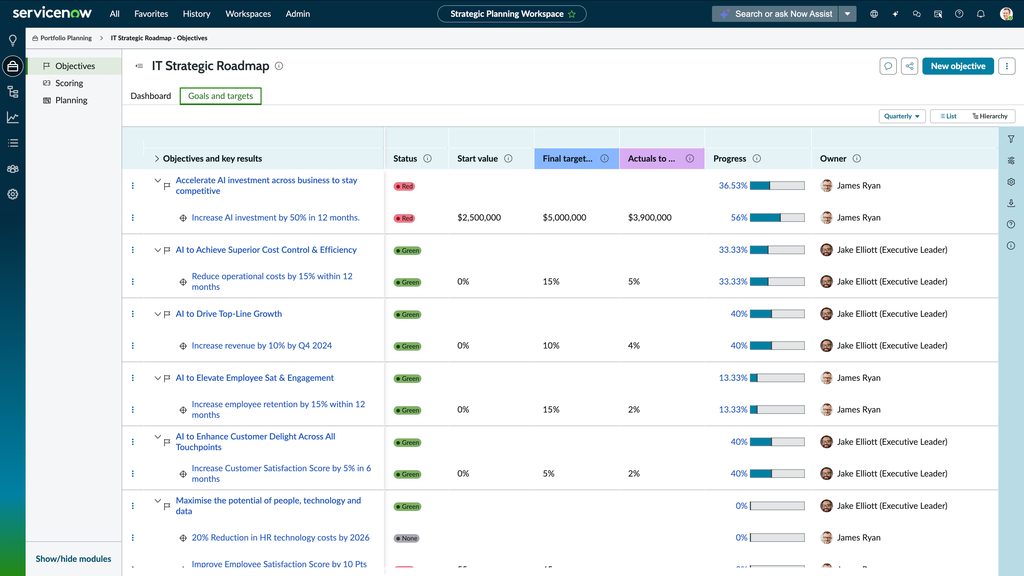
ServiceNow SPM brings project demand, operating and capital budgets and enterprise roadmaps into the ServiceNow platform, next to IT service management workflows.
Best fit: CIOs and enterprise IT PMOs already standardized on ServiceNow that want demand and investment governance in one place.
Relation to Targetprocess: full replacement for portfolio and investment governance.
Pricing and hosting: custom quote. Primarily SaaS; ServiceNow also offers self-hosted and government-cloud deployments, so confirm SPM availability for the option you need.
Trade-off: the value depends on ServiceNow already running IT workflows; organizations without that footprint add a platform, not just a portfolio tool.
Sources: ServiceNow SPM product and pricing pages; ServiceNow trust and compliance page; ServiceNow Community announcement of the self-hosted Private Stack (April 2026).
6. Microsoft Azure Boards for code-connected tracking in Microsoft-centered teams
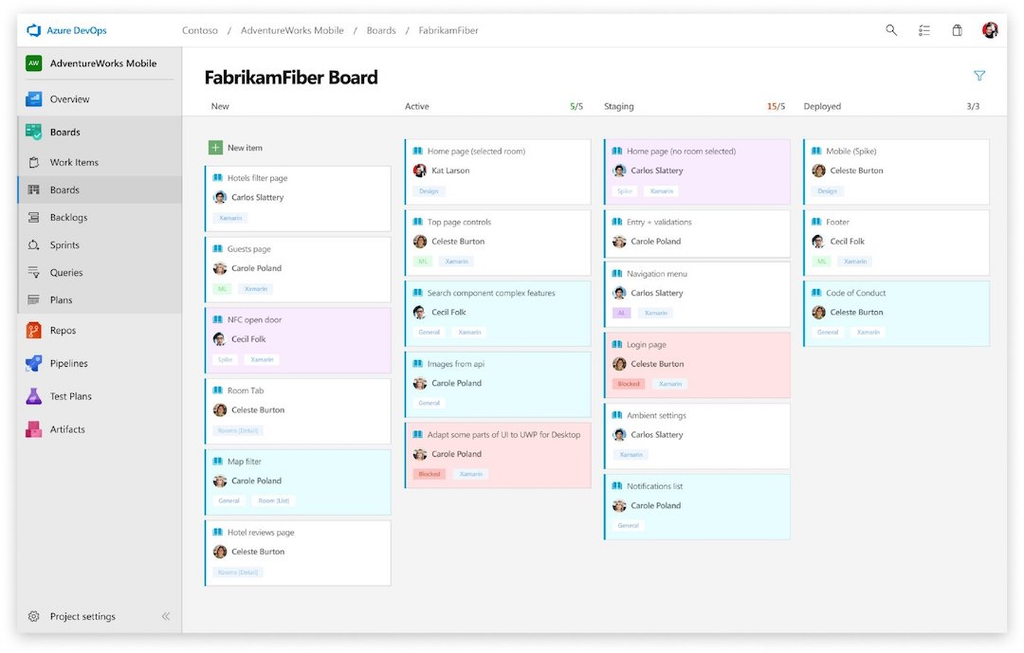
Microsoft Azure Boards is the work-tracking part of Azure DevOps. It offers Kanban boards, backlogs, sprints, work-item hierarchies and dashboards linked to Git repos and CI/CD pipelines.
Best fit: software engineering teams standardized on Microsoft developer tools that need code-connected work tracking.
Relation to Targetprocess: downscale. Teams keep tracking work; portfolio planning moves to another tool or goes away.
Pricing and hosting: Basic plan, first 5 users free, then USD 6 per user per month, paid through an Azure subscription and calculated daily per assigned user. Cloud (Azure DevOps Services) or on-premise (Azure DevOps Server).
Trade-off: capacity is planned per team and sprint. Project revenue, cost of delay, capacity across projects and a PI Planning board are not part of the product; overlays such as Kendis add the board.
Sources: Azure DevOps Services pricing page; Azure DevOps Server release notes; Azure Boards documentation.
7. Kendis for PI Planning on top of Jira or Azure DevOps
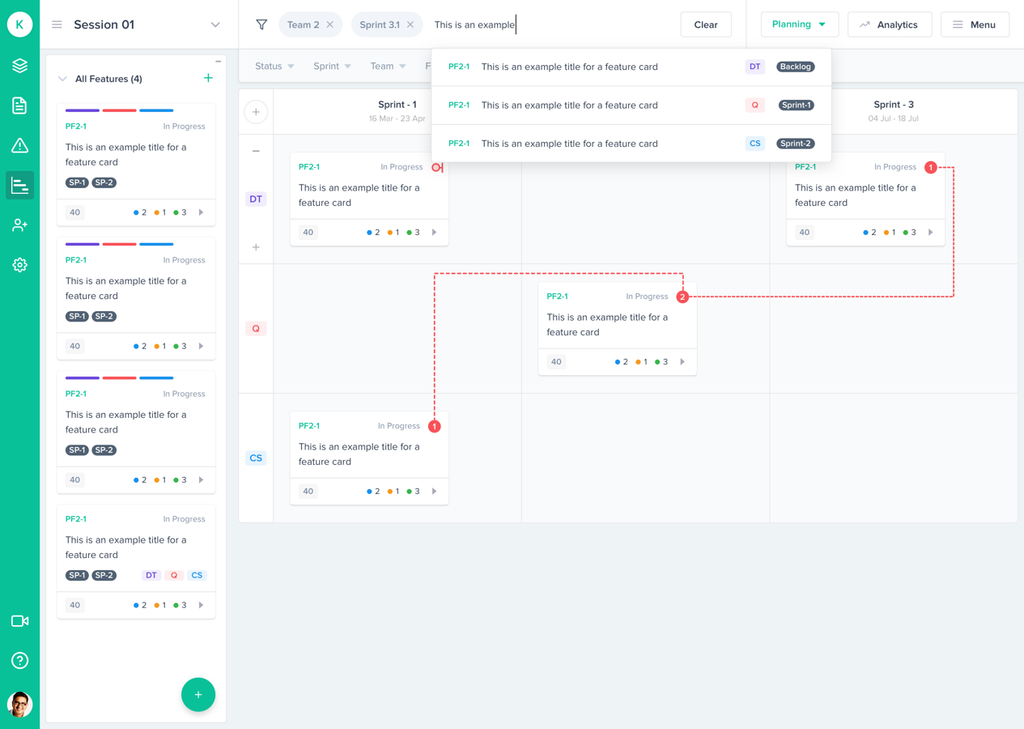
Kendis is PI Planning software that runs as a visual layer over existing developer tools. It provides Program Boards, the confidence vote ceremony and cross-team dependency tracking, and it syncs both ways with Jira Cloud, Jira Data Center and Azure DevOps, including Microsoft TFS.
Best fit: Agile Release Trains and RTEs that need dedicated, visual PI Planning cadences.
Relation to Targetprocess: extension. Kendis takes over PI Planning, while Jira or Azure DevOps stays the system of record for team work.
Pricing and hosting: per user per month, Premium Cloud USD 14 paid annually (USD 16 monthly); Enterprise Pro, self-hosted, USD 15 (USD 20); ORG Views USD 23 (USD 25); private cloud on request. Cloud in the US or the EU (Frankfurt), dedicated private cloud or self-hosted.
Trade-off: a planning overlay. Portfolio finance and long-range capacity are outside its documented scope.
Sources: Kendis homepage, pricing page and help center guide to the confidence vote.
Choose Targetprocess alternatives by scenario, not by star rating
Match your replacement to what actually limits delivery, rather than to generic software reviews:
| Core business scenario | Recommended path | Best-fit solution | Primary trade-off / rationale |
| Shared specialists set the delivery dates | Replace portfolio scheduling and capacity planning; teams stay in Jira | Epicflow | Plans around finite specialist capacity and prices each week of delay; no SAFe ceremonies |
| Dedicated SAFe PI Planning overlay | Augment | Kendis | Program Board with two-way Jira and Azure DevOps sync; planning overlay only |
| Enterprise IT and capital governance | Replace | ServiceNow SPM | Budgets and demand inside ServiceNow; strongest where ServiceNow already runs IT |
| Ecosystem-native digital delivery | Consolidate | Jira Align or Azure Boards | One vendor stack; Jira Align needs Strategy Collection, Azure Boards stays at team level |
| Team-of-teams Kanban flow | Replace | Planview AgilePlace | WIP limits and flow metrics; budgets sit in separate Planview products |
| Lightweight Scrum and bug tracking | Downscale | Axosoft | Scrum and defect tracking only; no portfolio layer |
| Functional fit with commercial friction | Retain | Keep and renegotiate | Avoids migration cost; Targetprocess administration stays |
Read more: 13 Best Planview Alternatives for Portfolio and Resource Planning in 2026
Illustrative example: when two specialists, not a team, set the dates
The figures are fictional and for illustration only. An engineering organization runs 30 projects. In May, three of them need the same two test engineers: 88 hours of work per week against 64 hours available (32 hours each after other commitments). A team capacity view flags the test team as overloaded. It does not say which project should wait.
Project A carries a contractual penalty of $15,000 for each week its May milestone slips. Each week of delay costs project B about $5,000 in deferred revenue and project C about $2,000.
Each project's May work is about the same size, so whichever project goes last slips about two weeks, and B goes second in both orders. If the engineers take the work in arrival order and project A arrived last, A slips about two weeks: $30,000. If A goes first and C waits, C slips about two weeks: $4,000. Same people, same hours, a $26,000 difference for one team in one month.
Epicflow runs this comparison for the whole portfolio at once. It prices each week of slip from each project's revenue, bonus and penalty, and shows which order recovers the most. For readers who want the technical names: the weekly price of delay is what Stephen Devaux called drag cost, and Epicflow's figure for whether finishing a project is still worth it is RRI, Return on Remaining Investment.
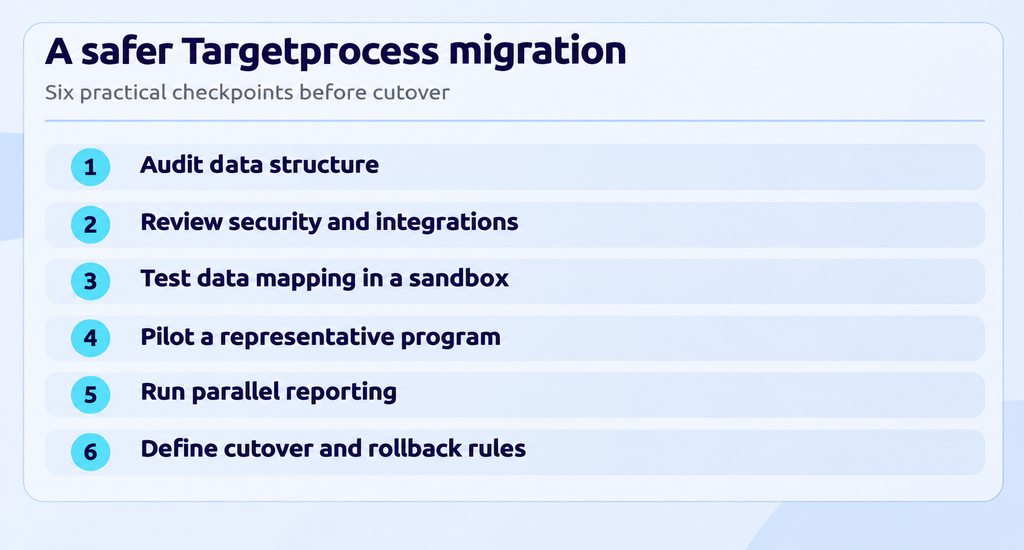
How to evaluate migration risk before you switch from Targetprocess
Treat this sequence as an internal operational safeguard, not a vendor capability or an automated guarantee.
- Audit data structures: catalog work hierarchies, custom fields, entity states, dependency networks, historical baselines and legal data-retention requirements.
- Review security and integrations: map access permissions, user roles, active API connections, webhooks and connected tools such as Jira or Azure DevOps.
- Execute test data mapping: run sandbox extracts and test imports to find field mismatches, lost metadata and broken links before touching live systems.
- Pilot a representative program: migrate one active value stream or project to test team cadences, reporting fidelity and administrative effort.
- Conduct parallel operations: run dual reporting alongside Targetprocess for at least one planning iteration to validate velocity, capacity metrics and financial outputs.
- Define cutover and rollback rules: set sign-off criteria, freeze changes to legacy data and document a rollback plan in case delivery disruption exceeds agreed thresholds.
For each object, decide whether it transfers as is (work items, users), transforms (custom fields, entity states, hierarchy levels) or has to be rebuilt (dashboards, automation rules, integrations). Ask each vendor which import path it supports for Targetprocess exports and what that path does not carry over.
What does a replacement really cost?
A fair comparison prices equivalent bundles, not a starter seat against an enterprise suite. Five lines belong in it:
- License: the plan that includes the capability you need, with its unit and minimum. Jira Align comes only with Atlassian Strategy Collection and Jira Cloud Premium; Epicflow Enterprise starts at 50 users; Targetprocess, ServiceNow SPM and AgilePlace are quote only.
- Implementation and configuration: workflows, hierarchies, integrations and security review.
- Migration: data mapping, test imports and cleanup of custom fields.
- Parallel run: at least one planning iteration in two tools, plus the people who reconcile them.
- Training and change: new ceremonies, new reports and new owners.
The line most comparisons leave out is the cost of the wrong sequence. While the tooling changes, the portfolio keeps queuing work at the same specialists. In the illustrative example above, the wrong order cost $26,000 for one team in one month. Price that wait before you price the software.
Summary: shortlist based on the capability you cannot lose
- If your delivery dates are set by shared specialists and you need to know what each week of delay costs and which move recovers it, choose Epicflow.
- If you need a visual PI Planning overlay on top of Jira or Azure DevOps, choose Kendis.
- If you need IT portfolio and capital governance inside ServiceNow, choose ServiceNow SPM.
- If you need full SAFe alignment across Jira instances in the Atlassian stack, choose Atlassian Jira Align.
- If you need Kanban boards with WIP limits across teams, choose Planview AgilePlace.
- If you need Scrum sprint tracking and bug reporting for software engineers, choose Axosoft.
- If you need code-connected backlog tracking inside the Microsoft ecosystem, choose Microsoft Azure Boards.
- If Targetprocess works and the issue is the renewal price, keep it and renegotiate.
Frequently asked questions
What are the best Targetprocess alternatives?
It depends on the layer you are replacing. For SAFe planning across many Jira instances, Atlassian Jira Align. For IT investment governance, ServiceNow SPM. For Kanban flow across teams, Planview AgilePlace. For aerospace, defense, engineering and manufacturing portfolios where shared specialists set the delivery dates, Epicflow plans every project around finite capacity, prices each week of delay and shows which resource move recovers the most.
What is the best Targetprocess alternative for PI Planning?
Kendis is built for PI Planning. It runs Program Boards and the confidence vote over Jira Cloud, Jira Data Center or Azure DevOps with two-way sync, without a portfolio platform deployment. Jira Align covers PI Planning inside a full SAFe portfolio suite.
What is the best Targetprocess alternative for strategic portfolio management with financial planning?
ServiceNow SPM fits IT portfolios that manage operating and capital budgets inside ServiceNow. For engineering PMOs whose revenue depends on milestones, Epicflow connects the capacity-based schedule to invoice timing: when a milestone moves, the cash flow forecast moves with it. The forecast shows invoiceable value and expected payment timing, not cash in the bank.
How much does IBM Targetprocess cost?
IBM does not publish Targetprocess pricing. The product page offers a free trial and a demo, and pricing comes as a quote from IBM sales.
What should a PMO compare before switching?
Start with the capability you cannot afford to lose, then the total cost of change. Compare portfolio roll-ups, capacity planning (per team or per named specialist), dependency management, two-way sync with Jira or Azure DevOps, implementation effort, license minimums, training and the cost of migrating history.
Who owns Targetprocess?
IBM. IBM completed its acquisition of Apptio on August 10, 2023, and Apptio had completed its acquisition of Targetprocess in February 2021. The product is now called IBM Targetprocess, formerly IBM Apptio Targetprocess.
Which Targetprocess alternatives support SAFe or multi-team planning?
Atlassian Jira Align is built for SAFe, and Atlassian describes configurations for Essential, Large Solution, Portfolio and Full SAFe. Kendis adds PI Planning boards on top of Jira or Azure DevOps, and Planview AgilePlace maps dependencies across teams on Kanban boards. Epicflow is not built for SAFe ceremonies. It plans all projects that share the same specialists as one schedule, so a slip in one shows how it moves the others.
Are there free, open-source or on-premise alternatives to Targetprocess?
No free tool replaces the whole platform. Azure Boards is free for up to 5 users, and Taiga is open source with cloud and self-hosted versions; both cover team-level agile tracking. On-premise options include Azure DevOps Server, Kendis Enterprise Pro, the installed edition of Axosoft, self-hosted Jira Align releases and Epicflow's defense-grade on-premise deployment.
How difficult is it to migrate from Targetprocess?
Complexity depends on your data architecture. Work items and users are the simplest part. Custom hierarchies, multi-level dependencies, historical velocity baselines and integration webhooks need data mapping, sandbox test imports and a parallel run before final cutover. Ask each vendor which import path it supports for Targetprocess exports and what it does not carry over.
See how Epicflow finds the team that sets delivery dates
Book an Epicflow demo to see how a multi-project portfolio is planned around finite specialist capacity and how the wait at the bottleneck is priced. Bring your active project list and the specialists those projects share, so the conversation starts from the team your projects wait on.
References
- Gartner, "Gartner Survey Reveals That Only 48% of Digital Initiatives Meet or Exceed Their Business Outcome Targets", press release, October 22, 2024. https://www.gartner.com/en/newsroom/press-releases/2024-10-22-gartner-survey-reveals-that-only-48-percent-of-digital-initiatives-meet-or-exceed-their-business-outcome-targets
- Gartner Peer Insights, IBM Targetprocess alternatives and comparisons, accessed November 2026. https://www.gartner.com/reviews/product/ibm-targetprocess/alternatives
Vendor facts were checked on official pages on November 11, 2026 (listed under each profile).