Milestone Payments: How They Work and What a Late Milestone Really Costs
 Victoria Sokolova
.
Published
.
Project Portfolio Management
.
32 mins READ
Imagine the situation: it’s the last week of the quarter, finance expects $960,000 from a factory acceptance test, but the test engineers are still on another project.
This scenario highlights why milestone payments are rarely a simple scheduling exercise. While payment terms are locked in on paper, actual invoice timing is driven by the reality of finite specialist capacity, shared resource availability, and multi-project dependencies across your portfolio.
Read the article to learn how milestone payments work, how to structure them effectively, and how to keep payment schedules realistic across a portfolio of projects.
Key takeaways:
- A milestone payment is triggered by specified contract work or an agreed event
- Its likely date depends on work remaining, dependencies, and specialist capacity.
- A slip moves invoiceable value, reduces the time value of later cash, and may create penalties or remove bonuses.
- Quarter-end boundaries and penalty thresholds make some weeks of delay more expensive than others.
- Protecting milestone payments requires bridging contractual payment dates with real-world specialist capacity across the portfolio.
What Are Milestone Payments?
Milestone payments are staged contract amounts that become invoiceable or due when specified work, an event, or an agreed acceptance condition is met. The signed agreement defines the trigger, so customer acceptance isn’t mandatory in every contract.
Payment milestones can release a fixed amount, a percentage of contract value, the remaining balance, or recurring service fees beginning after an event. They are common in engineering equipment contracts, EPC projects, defense programs, and pharmaceutical licensing. For example, in manufacturing project management, completing a factory acceptance test or handing over equipment may trigger the next invoice.
Read more: Project Financials Explained: Budget, Cost, Revenue, Penalties, and Profit
At the portfolio level, we can describe milestone payments as interdependent financial checkpoints: multiple concurrent projects compete for the same pool of resources to reach their respective payment milestones. This means that in addition to contract terms, the reliability of a payment schedule depends on how PMOs manage finite specialist capacity and cross-project queues across the portfolio.
How Do Milestone Payments Work?
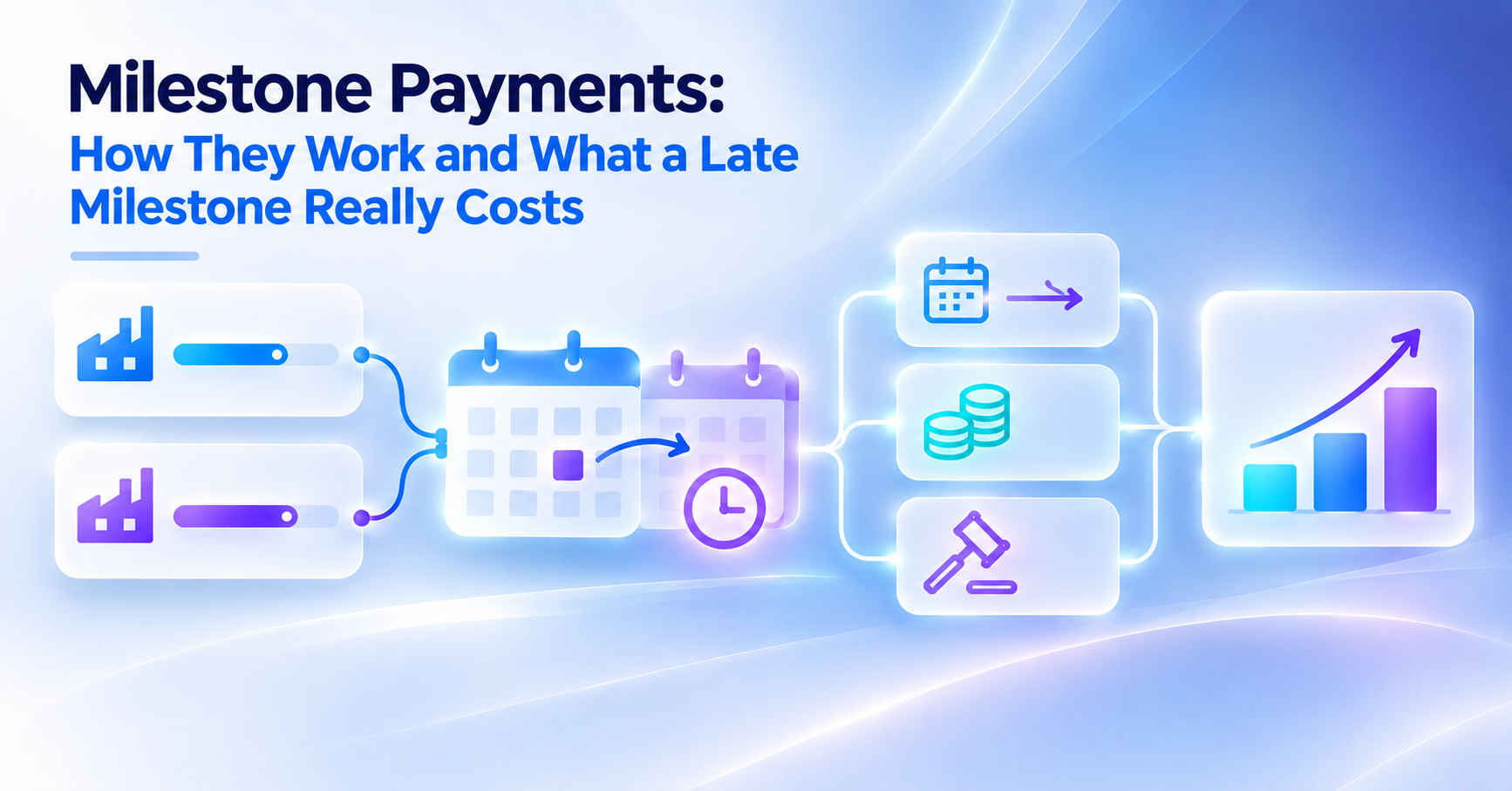
Milestone payments follow a straightforward principle: the contract defines what must happen before a payment becomes due, while portfolio capacity determines when that condition can realistically be met. Depending on the agreement, the trigger can be a completed deliverable, a successful test, formal customer acceptance, or another specified event. But the actual date depends on shared specialist availability and cross-project queues.
In practice, the process involves six steps:
Step 1: Agreeing on the payment trigger. This involves defining the milestone, its deliverables, the evidence of completion, the payment amount, and any approval requirements in the contract.
Step 2: Completing the required work. Project teams deliver the agreed scope, where cross-project dependencies, shared specialist availability, and portfolio-wide queues govern when the milestones can be reached based on current conditions. This connection is confirmed by a 2021 study in Applied Sciences that examples the financial implications of resource-constrained scheduling with milestone payments.
Step 3: Confirming milestone completion. This step involves providing the required documentation and obtaining customer review or formal acceptance of the contract calls for it.
Step 4: Issuing the invoice. Once the contractual trigger is satisfied, the supplier can invoice according to the agreement.
Step 5: Determining expected cash timing. Here, the agreed payment terms, e.g., net 30 days, should be applied to the calculated milestone completion date to establish realistic cash expectation dates.
Step 6: Tracking expected and actual cash. Finally, Finance forecasts incoming payment timing based on remaining effort, real-time specialist availability, and contractual terms, then reconciles those forecasts with invoices and receipts recorded in ERP systems.
This approach is also known as milestone billing; it creates a clear link between project progress and payment obligations, but three dates must remain distinct: the predicted milestone completion date, the actual invoice date, and the expected cash receipt date. Tracking these stages separately gives a more reliable view of upcoming events.
What Is the Difference Between Milestone Payments vs Progress Payments?
The key difference between milestone and progress payments is what triggers the payment. Milestone-based contracts tie payments to predefined events or deliverables (e.g., design approval, a successful factory test, or equipment handover). In contrast, progress payments generally reflect work completed or are calculated using a contract-specific financing formula.
Event-based triggers also appear in US aerospace and defense programs. For example, FAR Subpart 32.10 permits certain federal performance-based financing payments tied to specified events or milestones, although these differ from payments for accepted deliverables.
Both approaches divide payments across a project's lifecycle, but they differ in how amounts are determined, what evidence is required, and how payment timing can be forecast.
| Dimension | Milestone approach | Progress approach |
| Trigger | Defined event or deliverable | Periodic valuation or measured progress |
| Amount | Agreed tranche or percentage | Value of completed work or financing formula |
| Cadence | Uneven, event driven | Often monthly or periodic |
| Evidence | Test report, handover, specified acceptance | Progress certification or work valuation |
| Forecast risk | One missed event may shift a large tranche | Regular assessments can smooth timing, subject to approval |
| Who carries the risk | Supplier: no event, no invoice | Shared: payment follows measured work, subject to approval |
Which approach is better?
Neither is universally preferable. Milestone payments work well when projects have clearly defined deliverables and verifiable completion events; progress payments can be more suitable when work is continuous and can be measured incrementally.
For example, milestone payments can be particularly suitable for equipment manufacturers at a supplier’s facility, while the buyer may find it difficult to access work in progress. As discussed in a PMI community article on contract payment methods, payments can instead be tied to defined deliverables, with milestone values aligned to the contract estimate.
How To Set Up a Milestone Payment Schedule?
To establish an effective milestone payment schedule, you need to connect verifiable project outcomes, contractual payment rights, and realistic delivery dates. Follow the six principles listed below:
Define clear and measurable milestones
First, link each payment to an observable event, such as design approval, a successful factory acceptance test, or completed installation. Specify the documentation needed to demonstrate the completion.
Establish acceptance and approval rules
Set measurable acceptance criteria, review deadlines, and responsible approvers. Also, you need to clarify what happens if the customer requests corrections or does not respond within the agreed period.
Align payment amount with project value and financing needs
Distribute payments according to contractual deliverables, expected expenditure, and the supplier’s working-capital requirements. Avoid leaving a disproportionate share of the contract value until final acceptance without assessing the financial implications.
Clarify invoicing and payment terms
Specify when invoices may be issued, when payment becomes due, and how retention, disputed amounts, or other contractual conditions affect the schedule.
Account for changes and contractual risks
Define how scope changes, customer-caused delays, grace periods, bonuses, and penalties affect milestones dates and payment entitlements.
Validate the schedule against portfolio capacity
Finally, before committing to dates, check whether the required engineers, equipment, and other critical resources will be available. Remember that in a multi-project environment, a milestone that looks achievable in isolation may conflict with commitments elsewhere in the portfolio.
Why Do Milestone Dates Slip in Engineering Portfolios?
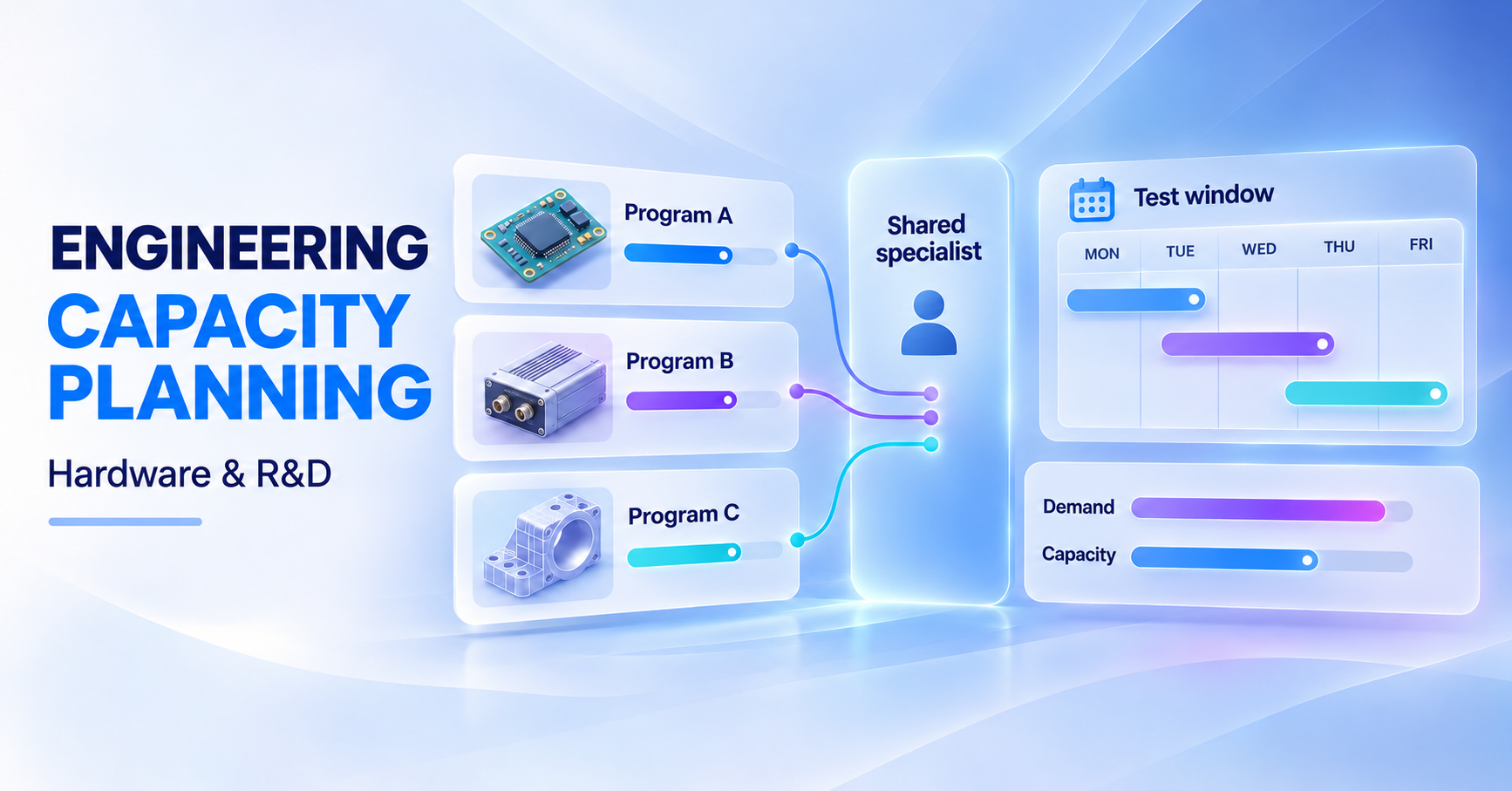
In engineering portfolios, a few specialists (such as engineers) are the team every project waits for. That is a resource constraint: a limit set by people and skills. And if the contract date assumes the team is free, the queue decides when it is.
Let’s consider three engineering projects that all require the same two test engineers. Each project has a realistic schedule when viewed separately. However, across the portfolio, those engineers cannot conduct three test campaigns simultaneously. This situation requires coordinated resource capacity planning and visibility into cross-project dependencies; otherwise, competing priorities will create bottlenecks that push contractual milestones beyond their planned dates.
Except for shared resource contention, milestone dates typically slip across an engineering portfolio due to four factors:
- Shared specialist bottlenecks: Scarce experts are queued across multiple active initiatives simultaneously, forcing projects to wait for capacity to free up.
- Cascading buffer consumption: As Dr. Ir. Albert Ponsteen observes, “A project that falls behind in a shared pool rarely catches up”. In his analysis of why projects remain behind schedule, he explains how reallocating specialists from seemingly healthy projects consumes their remaining schedule buffers, spreading delays across the entire portfolio.
- Invisible dependency queues: Traditional schedule variance tracking reveals which project is currently late, but fails to show how shared resource constraints and cross-project dependencies threaten upcoming payment milestones elsewhere.
- Execution and external disruption: Design interactions, supplier lead-time changes, delayed customer sign-offs, and unexpected reworks can stall competition events.
To sum up: as shared capacity ultimately governs throughput, portfolio managers must forecast milestone dates using live resource availability, cross-project dependencies, and real-time progress rather than rely on static contractual dates that no longer reflect delivery feasibility.
Read more: Engineering Capacity Planning for Hardware and R&D Teams
What Does a Late Milestone Payment Cost?
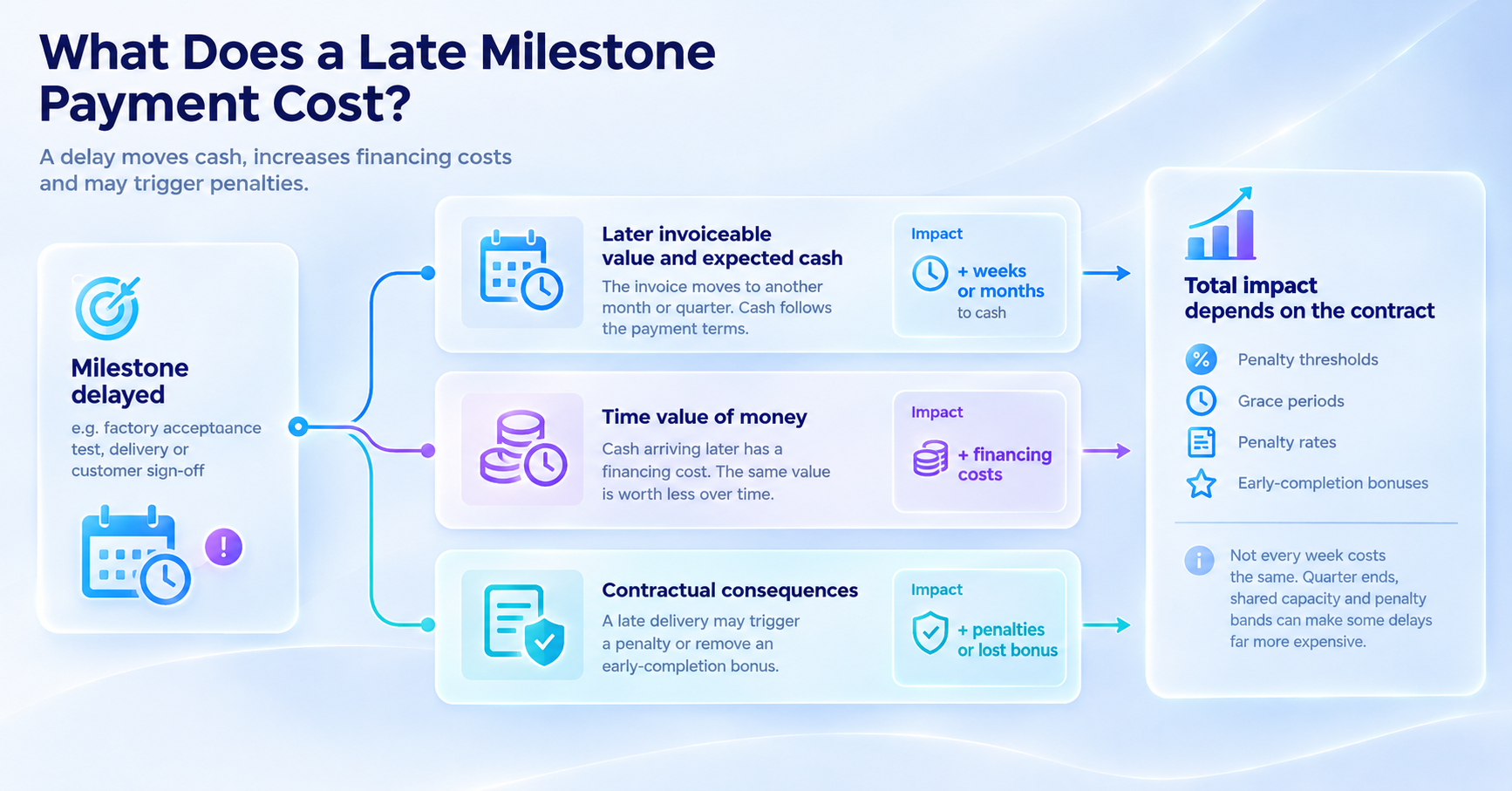
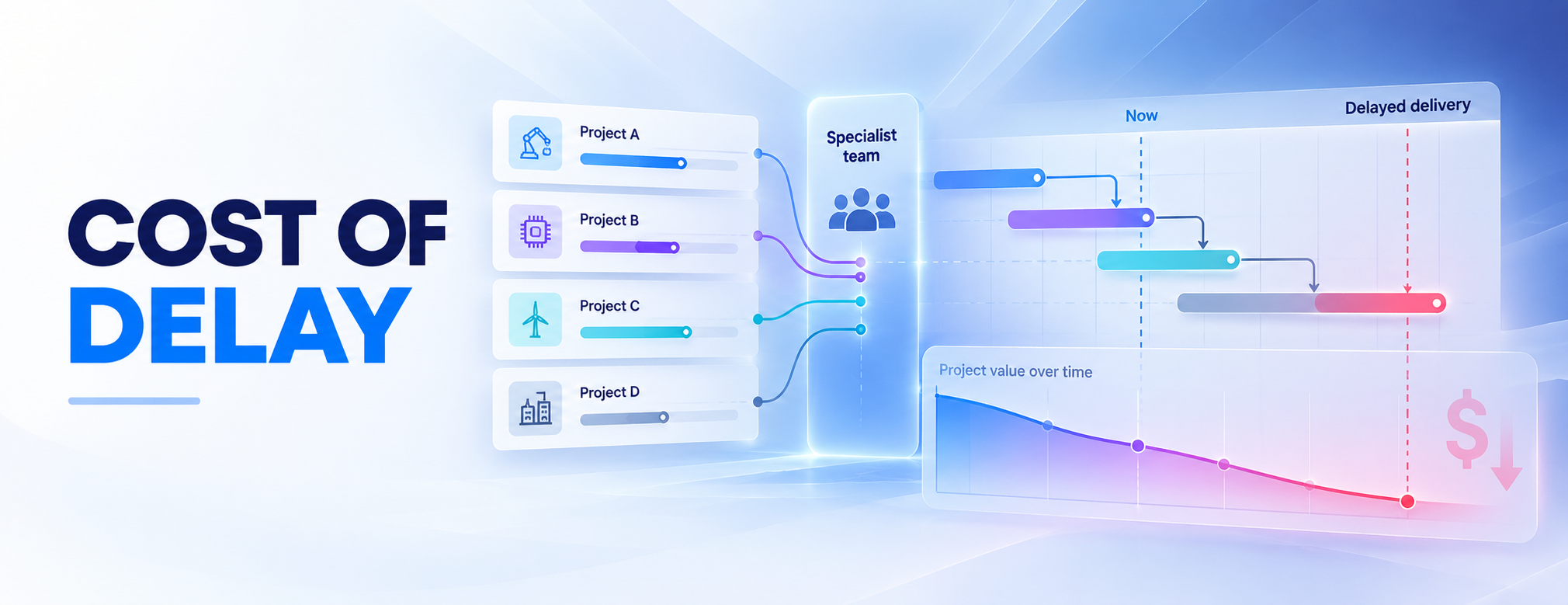
As project management theorist Stephen Devaux emphasizes, time has a direct financial impact on project value. For milestone-based payments, this relationship becomes measurable: a delayed deliverable can postpone expected cash, increase financing costs, and trigger contractual penalties. Therefore, you need to assess these three effects separately before deciding which project receives scarce capacity.
- Later invoiceable value and expected cash. A missed acceptance event may move an invoice into another month or quarter. The associated cash follows the contractual payment terms. This timing shift is a liquidity constraint rather than automatically lost revenue under accounting rules.
- Time value of money. Cash arriving later has a financing cost. As Stephen Devaux states: “The monetary value received a week later is less than the same value received a week earlier.” His portfolio value analysis supports pricing time rather than looking only at static completion dates.
- Contractual consequences. A late delivery may trigger a milestone payment penalty, or remove an early-completion bonus, when the agreement provides for one.
When assessing the cost of delay and conducting project profitability analysis, teams should account for the specific contractual thresholds, grease periods, and penalty rates rather than applying a flat daily estimate. Not every week costs the same: a week that crosses a quarter end, delays shared specialist availability elsewhere, or enters a penalty band costs far more.
Research on contact payment schedules shows that the client’s payment schedule and the contractor’s activity schedule affect each other (Dayanand and Padman, Management Science, 2001). To establish what a week of delay costs across a multi-project environment, finance must identify the affected cash, financing period, capacity constraints, and actual contract clauses.
Milestone Payment Example: What Does a Three-Week Slip Change?
Illustrative example. An equipment manufacturer sells a $2,400,000 test system. The design approval payment of 20% (or $480,000), has already been received. However, two shared test engineers remain assigned to another project, delaying factory acceptance, delivery, and site acceptance by 21 days.
Let’s assume the delay carries through all remaining milestones; planned delivery is the contractual date; invoices are issued when each milestone is reached; payment terms are 30 calendar days; and the penalty is deducted from the delivery payment. The annual cost of capital is 8% (figures are rounded). The contract allows one grace week, followed by a penalty of 0.5% of contract value ($12,000) per late week, capped at 5% ($120,000).
| Milestone | Payment | Planned milestone | After 3-week slip | Planned cash date | Cash date after slip |
| Factory acceptance (40%) | $960,000 | Aug 25, 2027 | Sep 15, 2027 | Sep 24, 2027 | Oct 15, 2027 |
| Delivery and installation (30%) | $720,000; $696,000 after penalty | Oct 20, 2027 | Nov 10, 2027 | Nov 19, 2027 | Dec 10, 2027 |
| Site acceptance (10%) | $240,000 | Nov 30, 2027 | Dec 21, 2027 | Dec 30, 2027 | Jan 20, 2028 |
The delay shifts cash across reporting periods. Q3 loses $960,000 in expected receipts. Q4 receives $1,656,000 instead of $960,000 after the $24,000 penalty, while another $240,000 moves from 2027 into Q1 2028. These changes concern cash timing, not accounting revenue recognition.
The financial impact is approximately $32,700. Delaying $1,896,000 in net expected cash by 21 days at an annual cost of capital of 8% produces a time-value impact of about $8,700 ($1,896,000 × 8% × 21 ÷ 365). Adding the $24,000 contractual penalty brings the total to roughly $32,700. Ordinary engineering labor costs are incurred regardless and should not be counted again.
Each week has a different price. The first week adds approximately $2,900 in time-value cost and pushes $960,000 in expected cash beyond quarter-end. Weeks two and three each add $12,000 in penalties plus roughly $2,900 in time-value cost, about $14,900 each. But the PMO must compare this exposure with the cost of delaying the project currently using the engineers. If that project faces no payment or penalty consequences during the same period, reallocating the engineers may be the less expensive option. The decision will depend on comparing the financial impact on both projects.
How to Protect Milestone Payments Across a Project Portfolio?
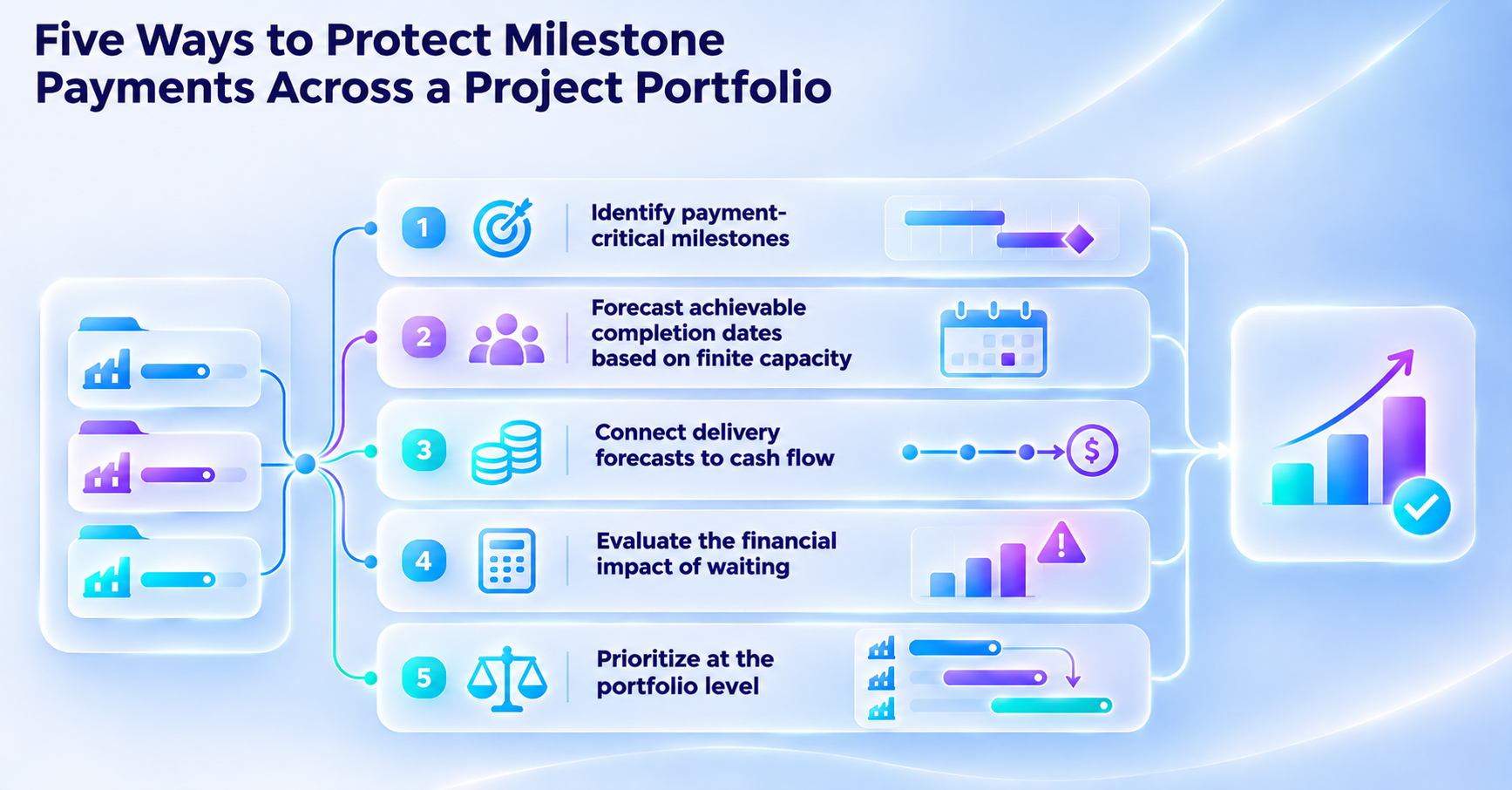
To protect milestone payments, the PMO and Finance need a joint delivery and finance decision process before the quarter closes. The following five practices can make the risk measurable and actionable across the portfolio.
- Identifying payment-critical milestones. Map upcoming contractual payment directly to the specific specialist skills, shared teams, and critical deliverables required to earn them.
- Forecasting achievable completion dates based on finite capacity. Base milestone forecasts on remaining effort, task dependencies, project priorities, and actual resource capacity instead of relying on static contractual deadlines alone.
- Connecting delivery forecasts to cash flow. Track predicted milestone dates, invoice dates, and expected payment tinting separately to forecast cash flow based on realistic delivery schedules.
- Evaluating the financial impact of waiting. Calculate how a slip in milestone timing affects cash timing, reporting periods, grace periods, penalties, and lost bonuses.
- Prioritizing at the portfolio level. Evaluate trade-offs across all competing initiatives to determine which project can absorb a delay based on total financial impact. It will be more effective than solving one project’s bottlenecks by creating a costlier constraint everywhere.
These practices are most effective when delivery forecasts, resource capacity, and final consequences are connected in one portfolio-wide view. Epicflow is a portfolio platform that brings these elements together to allow PMO and Finance to evaluate payment risks and resource trade-offs before making decisions.
How Does Epicflow Tie Milestone Payment to Delivery?
Epicflow plans multi-project work around finite specialist capacity; its forecasts connect delivery predictions directly with contractual financial events to support payment decisions across a project portfolio.
It aligns milestone payment timing with specialist capacity
Epicflow doesn’t rely on rigid calendar estimates; instead, it continuously predicts milestone dates based on remaining effort, task dependencies, recorded progress, organizational priorities, and the actual availability and skills of specialists shared across projects. If a critical test engineer or systems specialist is delayed on another project, the calculated completion date dynamically reflects that queue. This calculated date isn’t a contractual promise; it’s a forecast that enables project leaders to explain why an expected delivery date has shifted.
Money consequence: An invoice forecast follows the work that earns it instead of a manually retyped date.
It connects invoice forecast with bonus and penalty schemes
Finance teams require distinct dates and visibility to manage cash flows effectively across complex delivery schedules. Epicflow provides two distinct views for every contractual payment: the predicted invoice date follows the calculated forecast milestone date. The expected cash adds the applicable payment terms, which can be configured at the company level and adjusted for specific projects or groups. Each payment item can display whether it’s ready to invoice, which gives teams operational visibility without assuming that an invoice has already been issued. Project and portfolio views allow cross-functional teams to monitor how moving milestone dates impact incoming revenue across reporting periods. Epicflow forecasts invoiceable value and expected payment timing from the schedule, while your ERP still holds what was actually received.
Also, configured bonus and penalty schemes can incorporate precise contractual parameters (grace period, rate, escalation, cap, and an optional bonus side). The predicted financial amount is automatically recalculated whenever the plan prediction runs and remains directly attached to the milestone that pays. This allows project leaders and finance managers to discuss potential exposure early while delivery options still exist.
Money consequence: Finance can see which payments may leave a quarter, and the PMO can see a predicted exposure before the due date.
What-if Analysis before moving specialists
Portfolio leaders rarely have the option to solve a resource constraint on one project without impacting another. Epicflow's What-If Analysis allows teams to evaluate a different sequence of work or the reassignment of key specialists before committing changes to live operational plans. The scenario comparison evaluates the resulting milestone dates, expected cash timing, and configured penalty or bonus adjustments against the baseline plan milestone by milestone. For example, if moving two senior test engineers forward protects a major factory acceptance payment, the scenario highlights which downstream project faces delay, along with any resulting shift in cash receipts or contract penalties.
Note that scenario results are predictive comparisons based on current effort estimates, dependencies, skills, and progress data, rather than absolute guarantees.
In a separate delivery context at KPN, the Dutch telecom company: due-date performance rose from 18% to 80%. While that historical outcome reflects overall delivery reliability rather than a specific milestone cash-flow improvement, it illustrates the impact of aligning portfolio execution around finite capacity limits.
Money consequence: The decision shows which other project's payment or penalty changes when capacity moves.
Summary: What Should Leaders Remember about Milestone Payments?
- The contract defines the event. Delivery capacity determines whether the date is feasible.
- The invoice and expected cash belong to different areas. Payment terms create a second timing step.
- A slip has several prices. Separate delayed cash, financing cost, and contractual penalties.
- Thresholds are essential. Know what a week of delay costs before crossing quarter-end or a grace period.
- Portfolio decisions are comparisons. Protecting one payment may move another.
Tell us what keeps going wrong: late projects, clashing priorities, too much work in progress, and see only the parts of Epicflow that deal with it.
Frequently Asked Questions
What are milestone payments?
Milestone payments are contract amounts linked to defined events or completed work, e.g., a test, handover, or other verifiable event. The agreement determines when an amount becomes invoiceable or due; customer signoff matters only when the contract requires it.
How do milestone payments work in a contract?
The agreement specifies the trigger, evidence, amount, and payment terms. Delivery teams complete the event, obtain any required acceptance, and issue an invoice when entitled. The payment term then determines the expected cash date, subject to actual customer payment behavior.
What is the difference between milestone payments and progress payments?
Milestone arrangements release amounts after named events. In turn, progress arrangements usually follow periodic assessments of completed work or another contractual financing formula. Both can require documentation and approval. The right choice depends on deliverables, financing needs, and the risks each party accepts.
What is a milestone payment schedule?
Milestone payment schedule is the contract’s map of payment events, amounts, and timing rules. A clear schedule identifies the evidence needed, any acceptance window, invoice entitlement, and payment term. The percentages should reflect the agreement rather than an assumed industry standard.
When can a milestone payment be invoiced?
An invoice can be issued when the signed contract allows it: it may be completion, a certified test, formal acceptance, or another defined event. The forecast date is not automatically the legal invoice date. Review procedures and customer-caused delays may affect entitlement.
What happens to a milestone payment if the milestone is late?
The expected invoice date usually moves when the contractual trigger has not occurred. Expected cash can then move by the payment term. The contract may also provide grace periods, damages, bonuses, or revised dates. However, a delay alone does not prove a penalty applies.
How should milestone payments be structured for engineering projects?
Several steps can be useful:
- Use measurable deliverables and realistic review windows.
- Align payment amounts with delivered value and the supplier’s financing exposure.
- Test whether shared engineers, equipment, and dependencies can support the promised dates.
- Agree how changes and customer delays affect the schedule.
How do penalties and bonuses affect milestone payments?
They change the financial consequence of reaching an event early or late, but only where the agreement provides for them. Check grace periods, weekly rates, escalation, caps, and deductions. Model predicted exposure separately from amounts formally determined under the contract.
How do milestone payments affect cash flow?
They concentrate expected inflows around delivery events rather than evenly across a calendar. When a large event slips, expected cash may cross a reporting boundary. Forecast the event, then add invoice and payment terms. Reconcile actual collections separately in finance records.
References
- FAR Subpart 32.10: Defined events and contract-financing distinction. https://www.acquisition.gov/far/subpart-32.10
- Dayanand and Padman, Management Science, 2001: Relationship between client payment schedules and contractor activity schedules. https://doi.org/10.1287/mnsc.47.12.1654.10242
- Klimek, M. (2021). “Financial Optimization of the Resource-Constrained Project Scheduling Problem with Milestones Payments.” Applied Sciences, 11(2), Article 661. https://doi.org/10.3390/app11020661
- ProjectManagement.com (PMI Community). “Do You Know the Entire Contract? Part 7.” Rail Transit Programs and Projects blog. https://www.projectmanagement.com/blog-post/47797/part-7---do-you-know-the-entire-contract-