Nuclear Workforce Planning: Aligning Specialist Capacity with Project Demand
 Victoria Sokolova
.
Updated
.
Project Portfolio Management
.
39 mins READ
A nuclear portfolio can have enough engineers on the payroll and still miss a commissioning milestone, because the two people authorized for the work are booked on three projects in the same month. Nuclear workforce planning exists to catch that early. It forecasts which qualified specialists the work will need, when and on which project, and links long-term recruitment and training to the hours actually available for delivery.
This guide is for portfolio and PMO leaders who run several nuclear projects on shared specialists. It shows how to forecast demand across the lifecycle, count qualified capacity instead of headcount, compare ways to close a gap, and decide which project waits by its cost of delay, without trading away safety. It draws on Epicflow's client implementations and discovery work with nuclear organizations.
Key Takeaways
- Capacity means qualified hours, not headcount. Count the hours of people who are authorized, cleared and on site, per discipline and planning window.
- Three levels: national skills supply, company workforce strategy and project capacity across the portfolio.
- Demand follows the lifecycle, and the phases overlap.
- Every gap has four answers: build, hire, borrow or resequence, each with its own lead time.
- Cost of delay decides who waits. Safety and compliance work never moves for commercial reasons.
Running several nuclear projects on the same specialists? Epicflow can build a model of your portfolio and show which delay costs you the most.
What Is Nuclear Workforce Planning?
Nuclear workforce planning is the process of forecasting which specialists, skills and authorizations a nuclear project portfolio will need over time, and aligning recruitment, training and available capacity with that demand. It answers two questions: will the organization have the qualified people it needs, and will they be free when the work is due?
It connects three levels:
- Sector and national skills supply. Governments and industry bodies grow the nuclear workforce through training hubs, apprenticeships and graduate programs. The UK's National Nuclear Strategic Plan for Skills aims to fill 40,000 new jobs in the nuclear sector by 2030, recruiting at double the current rate.
- Company workforce strategy. Recruitment, upskilling, succession and retention that build long-term capability inside one organization.
- Project and portfolio capacity. The operational layer of nuclear project management, where qualified specialists are matched to time-phased work packages across all active projects.
Most delivery problems start at the third level, because national programs and company strategy say nothing about next quarter's commissioning window.
Three related terms are often mixed up:
| Function | What it decides | Horizon |
|---|---|---|
| Strategic workforce planning | Future skills needs, recruitment, development and retention | Years |
| Capacity planning | Whether qualified, available hours cover time-phased project work | Weeks to quarters |
| Nuclear workforce scheduling (rostering) | Which named, authorized people work which shifts and tasks | Days to weeks |
This guide covers strategic workforce planning and multi-project capacity planning. Nuclear workforce scheduling sits downstream of both: it can only roster people the capacity plan has already confirmed as available and authorized.
Read More: Resource Capacity Planning: What, Why, and How
Why Is Nuclear Workforce Planning More Than a Headcount Forecast?
Standard workforce scheduling assumes that if total payroll hours cover total project hours, the plan works. In the nuclear sector that assumption fails. A job title is not an authorization, and a payroll number is not available capacity. In nuclear programme management, an overall staffing surplus and a shortage in one critical discipline often exist at the same time.
Five factors explain why a portfolio can look fully staffed and still stall:
- Long capability lead times. Accredited training, supervised practice and qualification take years, so today's hiring decisions shape what the portfolio can deliver years from now.
- Role-specific authorization. A person needs verified competence and formal authorization for each type of work package. Requirements differ by task and facility, so people cannot be swapped freely between sites.
- Site access and mobilization. Security clearance, site induction and travel set how fast a qualified person can move between facilities.
- Succession and knowledge transfer. Experienced specialists need planned overlap with successors to pass on what is not written down, and that overlap costs senior hours.
- Shared scarce disciplines. Quality inspectors, commissioning leads and project controls specialists often serve several projects at once. The conflict shows up only when you look at workload across the whole portfolio.
Demand is rising at the same time. The US Department of Energy estimates that building and operating 200 GW of new nuclear capacity by 2050 would take about 375,000 additional workers. A nuclear workforce that takes years to qualify cannot grow at short notice.
The real question is whether a specific authorized discipline has free hours in a specific milestone window. One missing commissioning lead can hold a whole project, and every day it waits has a price. Nuclear already counts that price: Stephen Devaux, in Managing Projects as Investments, puts a US refueling outage at $500,000 to $2 million per day offline. Good nuclear workforce planning applies the same logic to specialist hours.
Where Do Nuclear Capacity Plans Break in Practice?
Epicflow's work with nuclear organizations, from client implementations to discovery sessions with manufacturers, shows three points where nuclear workforce planning typically breaks.
- The planning unit is too coarse. An Epicflow client running a nuclear testing lab works in hours: setups, test runs, teardowns and reports. Before Epicflow, the team had trialed planning systems that could not hold a task shorter than a day, so every plan either inflated short tasks or hid the sequence inside larger blocks. Plan in the unit the work actually runs in.
- People are hidden inside machine availability. In discovery sessions, a nuclear manufacturer's central planning team described planning equipment only. A machine short of operators simply showed as less available. The forecast still came out roughly right, but every flagged bottleneck needed a manual translation, and when asked what to add, the model could only point to another machine. The real constraint was trained operators: a hiring or training decision with a different lead time, a different budget holder and a fraction of the cost. Modeling people properly is worth roughly the equipment purchases the old model over-recommends.
- The constraint is not a person. The same team saw work wait for floor space, a test rig or a storage area while specialists were free. Equipment can be planned as a material resource next to the disciplines, and so can any other constraint with a finite capacity.
Read More: Bottlenecks in Project Management: When One Constraint Slows Down Progress
How Workforce Demand Changes Across the Nuclear Lifecycle
Specialist demand in the nuclear sector rises and falls as projects move through their phases, and the phases overlap. The table shows typical needs, constraints and workforce decisions per phase.
| Phase | Typical capability needs | Planning constraint | Workforce decision |
|---|---|---|---|
| Design and engineering | Nuclear safety engineers, system designers, project controls specialists | Long lead times for design verification and safety case approval | Secure design authority capability early and start knowledge transfer |
| Construction | Civil, mechanical and electrical engineers, site quality inspectors | Site access limits, security clearance lead times | Time contractor onboarding to the civil works schedule |
| Commissioning | Commissioning engineers, systems integration leads | Authorization checks, tight dependencies between test packages | Reserve scarce commissioning leads before milestones are set |
| Operations and maintenance | Reactor operators, radiation protection staff, maintenance technicians | Fixed shift patterns, mandatory training hours | Balance routine staffing with temporary upskilling for outage peaks |
| Life extension | Structural integrity and aging management specialists | Work must fit around generation and fixed outage windows | Resequence non-critical refit tasks around outage windows |
| Decommissioning and waste | Waste engineers, radiological protection advisors, environmental leads | Uncertain asset condition, multi-decade funding horizons | Retrain operations staff for decommissioning roles |
Note: the roles listed are illustrative examples, not regulatory staffing standards.
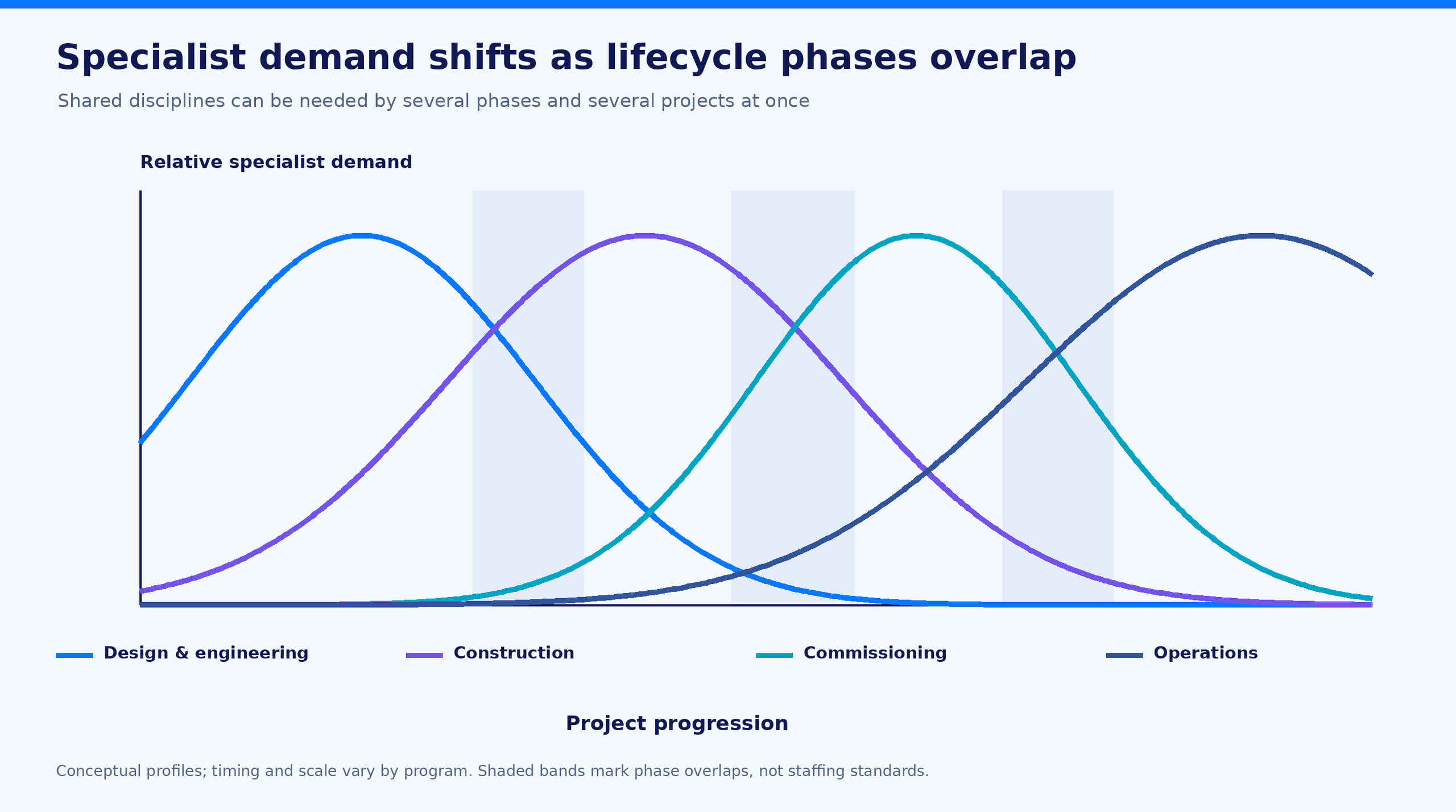
For nuclear project management, the hard part is the overlap. A new build, a sister unit in a refueling outage and a decommissioning project can all need the same project controls and quality assurance specialists in the same quarter. The nuclear construction workforce peaks just as commissioning teams must mobilize, and in nuclear operations the outage calendar decides when life-extension work can happen at all.
Small modular reactors (SMRs) change the delivery model, not the lifecycle, so treat vendor staffing figures as design-specific inputs.
Read More: Project Management in Renewable Energy: Strategies, Challenges, and Future Trends
A Six-Step Nuclear Workforce Planning Framework
Nuclear workforce planning connects the strategic horizon with project delivery through a repeatable decision cycle. The six steps run on one shared model of demand and capacity, and each one carries lessons from Epicflow client implementations.
| Step | Output | Owner |
|---|---|---|
| 1. Map pipeline and constraints | Portfolio demand horizon and a register of fixed constraints | PMO leadership with nuclear assurance |
| 2. Translate work into skills demand | Time-phased demand per discipline, with assumptions | Project managers with discipline leads |
| 3. Establish qualified capacity | Net qualified hours per discipline and window | Resource managers with competence owners and HR |
| 4. Identify gaps and conflicts | Gap and conflict log with owners | PMO and resource management leads |
| 5. Compare scenarios | Recommended scenario with cost of delay, risk and residual gaps | Delivery leadership with HR and nuclear assurance |
| 6. Review and update | Updated plan and tracked actions | Portfolio board and PMO |
1. Map the Project Pipeline, Lifecycle Stages and Fixed Constraints
Put every active and proposed project into one project pipeline with its work packages and milestones. Record non-negotiable constraints separately from commercial preferences: statutory safety requirements, licensing conditions, supervision ratios and competence frameworks. Nuclear project management teams own this step together with nuclear assurance.
2. Translate Work Packages into Time-Phased Skills Demand
Convert each work package into the disciplines and hours it needs, week by week or month by month. Add the work that sits on no project plan: mandatory training, professional development, supervision of trainees and on-call duties. Keep confirmed demand apart from pipeline proposals, so a speculative bid does not lock up specialists that a signed contract needs.
Three lessons from Epicflow implementations apply here:
- No effort estimate, no capacity plan. Capacity planning computes load from the hours each task consumes. A task with only a deadline is invisible to it, so every work package needs at least a rough effort estimate per discipline.
- Overlaps hide task boundaries. When we review imported schedules, start-to-start offsets and negative lags ("the next task can start when this one is two-thirds done") are the first thing we check. Each one hides a point inside a task that the successor really waits for, and a fixed offset does not move when the estimate changes. Split the task at that point, and the dependency moves with the work.
- First-of-a-kind work learns at the work center. A nuclear manufacturer's central planning team asked us how estimates should improve from the first unit to the tenth. The gain sits in tooling, work instructions and sequence, so it belongs to the competence group or work center, not to the individual, and it survives when people move on. Estimated at that level, it is available before anyone is assigned, which is when bids and capacity checks happen.
3. Establish Qualified and Available Capacity
Subtract non-project time, absence, training blocks and existing commitments from gross headcount. One client plans at about 80% of contracted hours to absorb leave, training and admin. Then count only people who hold the right authorization, clearance and site access on the date the work starts. An engineer whose authorization lapses in March is not March capacity. Group specialists by competence, not by job title, so capacity is counted in qualified hours per discipline.
Most capacity errors we find in client implementations are silent: the system shows a number, not an error. Check these before anyone reads load:
- Reconcile headcount first. A first import often covers only the teams in the pilot conversation, so every other team shows a handful of people against a wall of demand. That looks exactly like a real shortage. Confirm that the imported pool matches the headcount the organization believes it has.
- Turn placeholders into pools. A to-be-decided entry such as "test" or "fabrication", imported as one named person, gives the whole function the capacity of one person. Its milestones slip by months until the record becomes a pool of the right size.
- Fix the few broken records. A person who was never set up as a resource, an extended leave that was never entered, or an availability record with a nonsense start date can distort the forecast for the whole portfolio.
- Keep external parties out of your capacity. A partner lab, supplier or regulator that you do not staff should hold time in the plan, not consume your capacity. Otherwise it raises phantom overloads that bury the real bottleneck.
- Model people even when HR data is hard to reach. In nuclear manufacturing, availability data often sits in an HR system on a separate network. A single pooled group with a headcount tells you more than a machine calendar reduced to cover absent operators. If people are left out of a first phase, say so on every output: it answers "what do we need, assuming people are free", not "what do we need".
4. Identify Gaps, Shared Specialists and Timing Conflicts
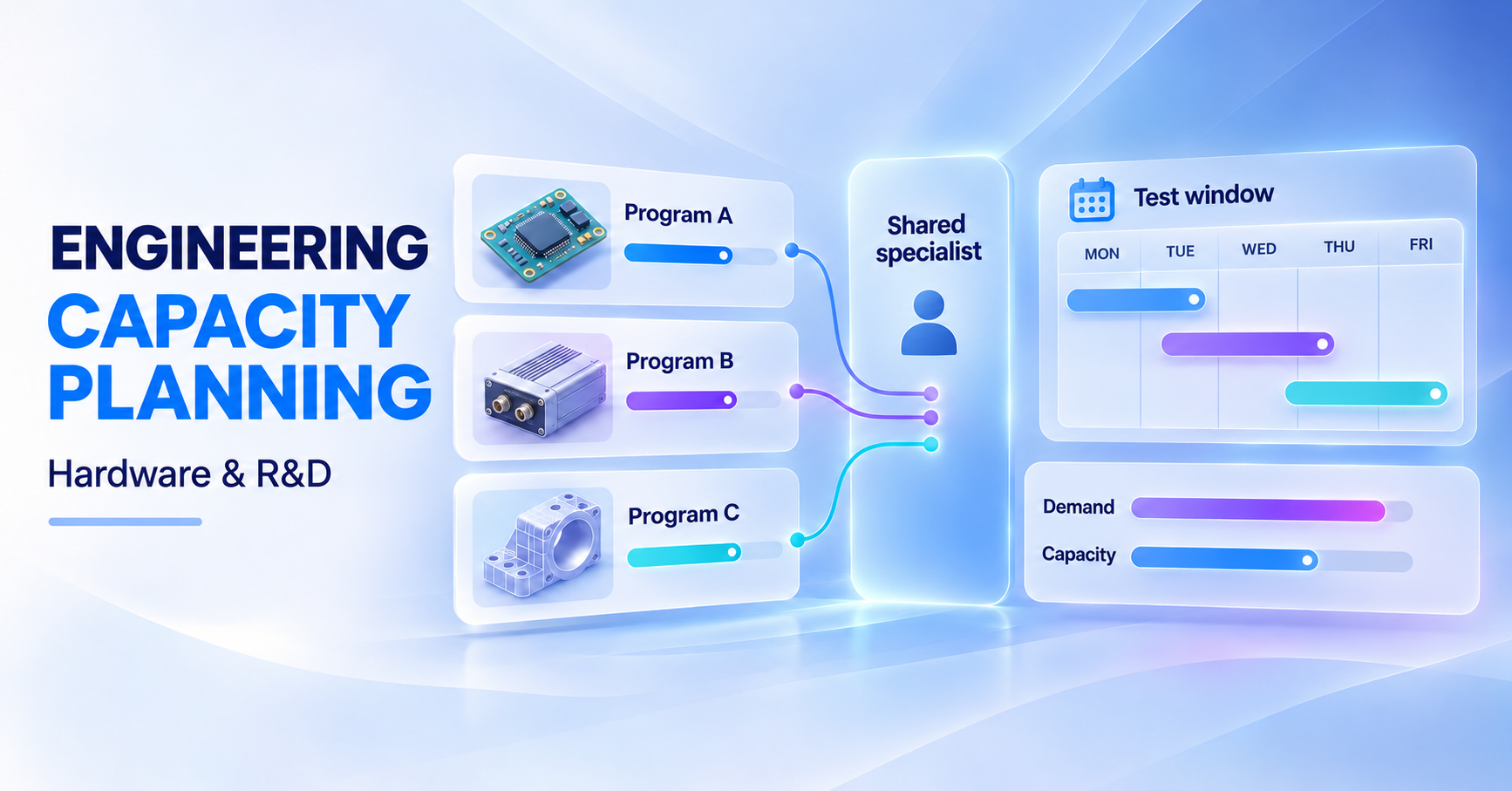
Compare demand and qualified capacity window by window. Look for disciplines short of hours and for individual specialists booked on overlapping critical tasks at different sites. Shared specialists are where portfolio bottlenecks form, and they stay hidden when each project checks only its own plan.
Two lessons from client onboarding keep this step honest:
- Record progress before you trust a gap. On a fresh plan where every task shows zero progress, all estimated effort still lies ahead, and the forecast shows overload everywhere. Managers first estimate the effort already spent on work in flight. The next planning cycle is the first real one.
- Trace implausible dates to one person. When dates look wrong across unrelated projects, the cause is often one overloaded specialist whose queue pushes every successor out. A lower-value task sitting ahead of a higher-value one in that queue starves the work that matters. Trace one bad date back to that person once, and teams learn to use the forecast as a diagnostic instead of ignoring it.
5. Compare Capability-Building and Delivery Scenarios
For each gap, build a few realistic responses: upskill, hire, bring in accredited contractors, transfer people from other sectors or resequence flexible milestones. Give each its real lead time before it counts as capacity. Then price the gap: the weekly cost of delay of the project that would wait shows which response is worth paying for. Check every scenario against the constraints register.
6. Review the Plan and Update Decisions as Conditions Change
Nuclear workforce planning is a cycle, not an annual exercise. Refresh demand and capacity at every stage gate and whenever scope, schedules or authorizations change. In nuclear programme management, the governing board reviews the gap log at each gate and decides what to escalate. Confirmed assignments then pass to nuclear workforce scheduling, which rosters named people into shifts.
Read More: Project Pipeline Management: How to Turn a Project List into a Decision Workspace
Choosing Between Building, Hiring, Borrowing and Resequencing Capacity
When a gap appears, portfolio leaders have four responses. Each has its own lead time and its own trap.
| Response | Useful when | Lead time and constraints | What not to assume |
|---|---|---|---|
| Build (training and succession) | Core skills are short for years, or key experts near retirement | Long; needs trainer time and supervision | That trainees add capacity at once. Training consumes senior hours first. |
| Hire (recruitment) | The portfolio needs a larger permanent talent base | Recruitment time plus clearance and induction | That an approved requisition is capacity on the start date. It counts only after site readiness. |
| Borrow (contractors or reassignment) | A local peak or a temporary specialist shortage | Qualification checks, contract terms, site access setup | That reassigning a shared expert adds capacity. It moves the shortage to another project. |
| Resequence (schedule shifts) | Demand exceeds available hours and some milestones have float or a low cost of delay | Governance review, contract milestones, downstream dependencies | That a schedule shift is free. Price it with cost of delay; never delay mandatory safety or compliance work. |
In the nuclear sector, nuclear workforce development is the only response that grows the pool for good, which is why it starts years before the work. Retention and knowledge transfer keep authorizations inside the company.
Worked Example: Three Projects Competing for the Same Specialist Team
The figures below are hypothetical and illustrate the method, not a nuclear staffing standard.
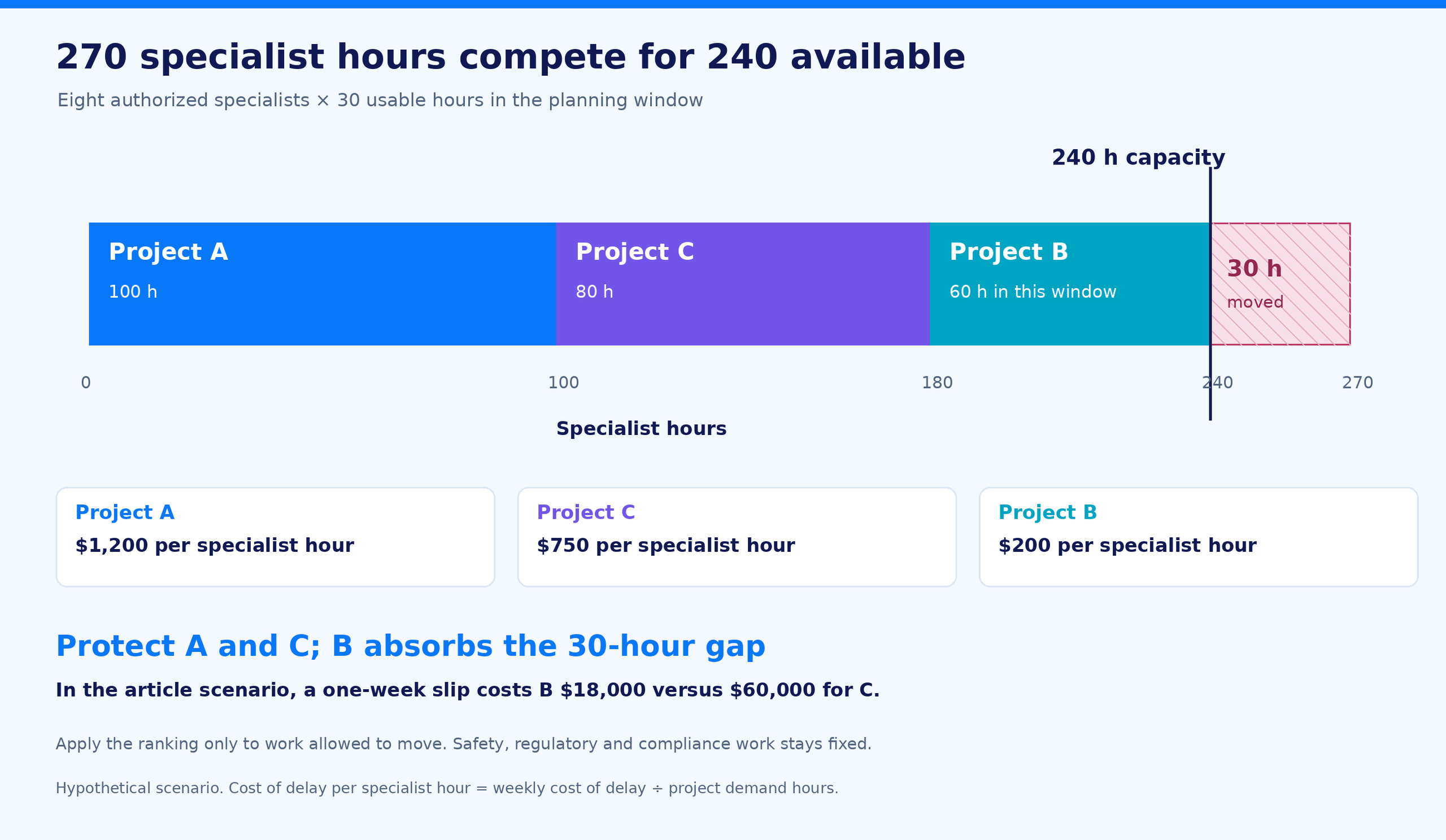
Eight specialists are authorized for one critical engineering discipline. After non-project duties, each has 30 usable hours in the next planning window: 240 hours in total. Three projects need them in that window, and the table adds what one week of delay would cost each.
| Project | Demand (hours) | Cost of delay per week | Cost of delay per specialist hour |
|---|---|---|---|
| A: Life-extension work tied to an outage window | 100 | $120,000 | $1,200 |
| B: Decommissioning characterization with a flexible milestone | 90 | $18,000 | $200 |
| C: Commissioning milestone with liquidated damages | 80 | $60,000 | $750 |
| Total demand | 270 | ||
| Available capacity (8 specialists × 30 hours) | 240 | ||
| Capacity gap | -30 |
The arithmetic finds a 30-hour gap. It does not say how to close it.
Scenario 1: Approved External Capacity
Thirty contractor hours close the gap on paper, but only if competence checks, security clearance, site access and the contract are complete before the window opens. If onboarding takes eight weeks and the window starts in four, this option does not exist.
Scenario 2: Resequence Work That Has Float
If 30 hours of work can move to the next window without moving any milestone, shift them and the gap closes at no cost. Confirm first that dependencies, contract milestones and mandatory safety work stay untouched.
Scenario 3: Resequence by Cost of Delay
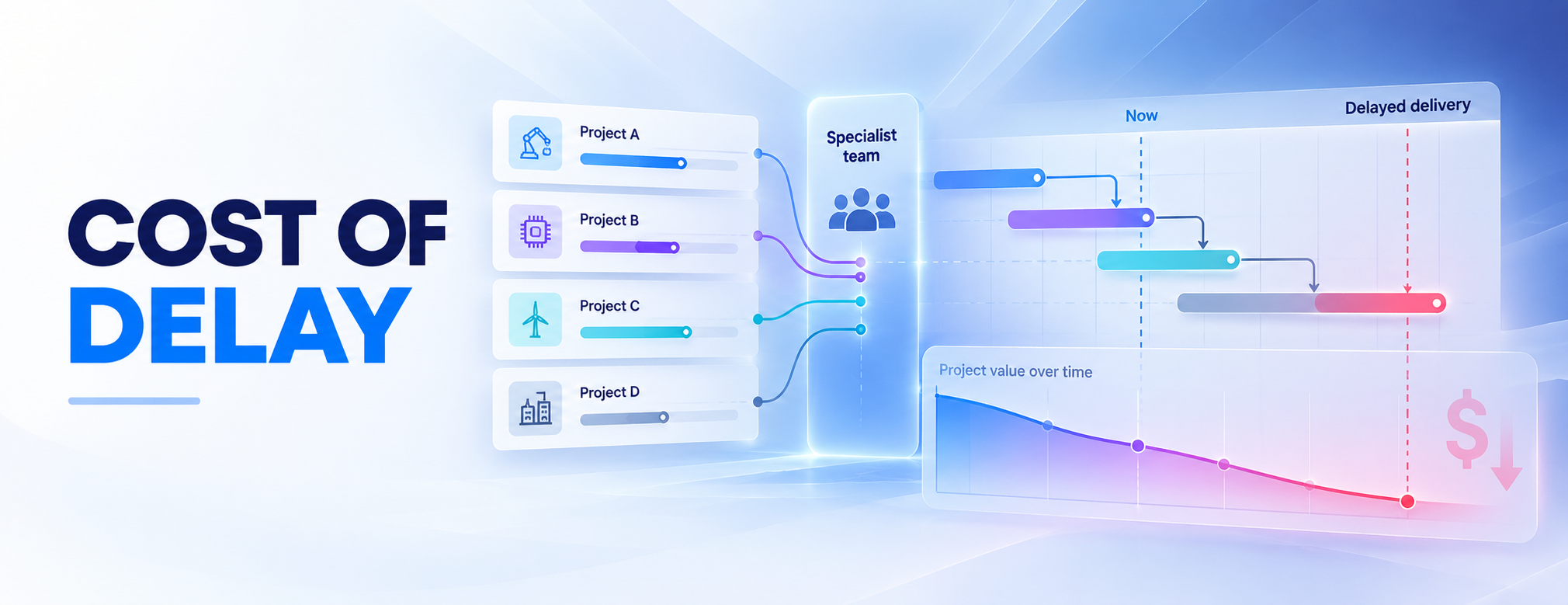
Often no work has float, and one milestone has to slip. Divide each project's weekly cost of delay by the specialist hours it needs. The result, cost of delay per specialist hour, is what one scarce hour is worth to each project: $1,200 for A, $750 for C and $200 for B.
Serve A and C in full and let B absorb the gap. A one-week slip on B costs about $18,000. Delaying C instead would cost $60,000 for the same 30 hours, more than three times as much. The ranking applies only to work that is allowed to move: safety, regulatory and compliance work never moves for commercial reasons.
A capacity match at this level is a screening step. The plan becomes executable only when assignments, authorizations and site readiness are confirmed and nuclear workforce scheduling can roster the named people.
Which of your projects should wait? In Epicflow, you can model your portfolio and show the cost of delay for every project that competes for your scarcest specialists.
Read More: Cost of Delay: How to Calculate It and Prioritize Projects
Metrics That Show Whether the Workforce Plan Is Deliverable
Six metrics show whether the people the plan counts on will be qualified, free and on site when the work starts.
| Metric | What it measures | Act when |
|---|---|---|
| Capacity gap hours | Required minus qualified available hours, per discipline and window | A gap appears inside the lead time of your fastest response |
| Critical-role coverage | Qualified people per critical role against the approved minimum | Coverage reaches the minimum: start succession or upskilling |
| Readiness lead time | Time from decision to deployable person: onboarding, clearance, access, authorization | It exceeds the time left before the work starts: move the start or onboard now |
| Forecast vs. actual demand | Planned against recorded hours per discipline | The same variance repeats: recalibrate estimates and assumptions |
| Conflicting specialist commitments | Specialists booked on overlapping critical tasks | Any double booking on critical work: reassign or level the load |
| Cost of delay exposed by open gaps | Weekly cost of delay of milestones that depend on unstaffed work | Exposure grows: take the trade-off to the portfolio board with the number |
The first five show whether the plan works. The sixth shows what it costs if it does not.
Which Systems Support Nuclear Workforce Planning?
No single system covers all three levels of nuclear workforce planning. Organizations in the nuclear sector usually split the work across three kinds of systems:
- HR, recruitment and learning systems build and record long-term capability.
- Competence and authorization registers hold the formal record of who is qualified for which work. They remain the authority.
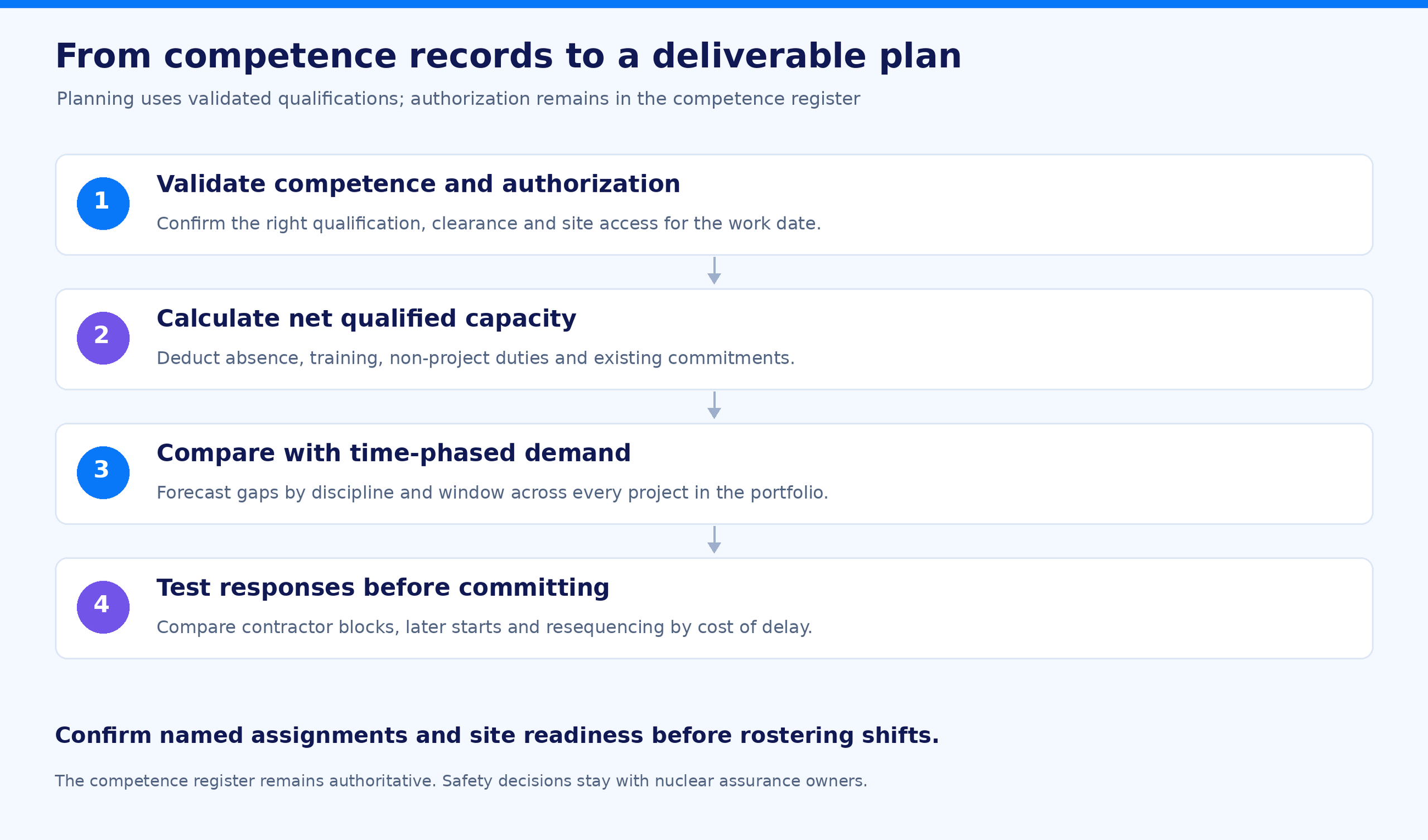
- Multi-project planning systems connect validated capacity to project schedules and test responses before anyone commits.
Epicflow (a multi-project resource planning system built on the Theory of Constraints) belongs to the third group. Three of its capabilities map onto the framework above.
Capacity counted by competence. Epicflow groups people by competence, so capacity is counted in qualified hours per discipline, not in headcount. The Future Load Graph forecasts each group's load against its capacity months ahead, including projects still in the pipeline. A shortfall of commissioning engineers next quarter shows up while there is still time to train, hire or resequence.
Scenarios priced in cost of delay. What-if analysis tests a response before you commit it: a contractor block, a later start for a pipeline project or a resequenced work package. Every scenario shows which milestones slip, behind which team, and the cost of delay. Scenario 3 above becomes a comparison of numbers, not a negotiation.
Sequencing around the bottleneck. Epicflow staggers project starts against the future load of the bottleneck team, so lower-value starts move later and scarce specialists work on what costs most to delay. KPN, the Dutch telecom operator, raised on-time delivery from 18% to 80% in less than a year with Epicflow.
Epicflow plans with the competence and availability data you give it. Authorization stays in your competence register, and safety decisions stay with your nuclear assurance owners.
How Should Nuclear Organizations Evaluate a Planning System?
Nuclear and defense organizations choose systems for nuclear workforce planning under constraints most vendors never see. Four lessons from recent evaluations:
- Build one anonymized dataset and give it to every vendor. Real plans cannot leave the building, so a trial needs a sanitized copy with real shapes: dependencies, resource pools and volumes. Preparing it is the most common reason an agreed trial never starts, yet it only has to be built once for the whole shortlist.
- Make the dataset a fair test. An extract from one clean corner of the business makes every product look fine and settles nothing. Include the hard parts: overlapping dependencies, shared specialists, external parties and enough projects to test scale.
- Test at the volume you are growing into. An Epicflow client in nuclear testing runs about 30 concurrent projects but measured candidates against the volume of a much larger rival, because that is where the business is heading.
- Check who sees the data. Security checklists for nuclear work cover people as well as systems: who may see plan data during implementation, and whether support staff hold the required national clearance. Clearance is granted to individuals, so encryption or on-premises hosting cannot replace it. A cleared local partner can.
Conclusion
Nuclear workforce planning works when the long-term pipeline and the project plan use the same numbers. Recruitment and qualification grow the nuclear workforce over years. Capacity planning decides, window by window, where qualified hours go and which project waits when there are not enough.
- Count qualified, authorized and available hours per discipline, not headcount.
- Check the data before you trust a shortage: reconciled headcount, effort estimates and progress to date.
- Plan by lifecycle phase and watch the overlaps where shared specialists get booked twice.
- Give every response its real lead time before it counts.
- Let cost of delay decide which project waits, and never move safety or compliance work.
See how Epicflow supports workforce capacity planning across multiple projects.
Pick your role and the problems you want solved. Watch a short demo built around them, no call needed.
Frequently Asked Questions
What does nuclear workforce planning include?
Nuclear workforce planning includes forecasting skills demand, recruitment, training pipelines, retention, succession and knowledge transfer. On the delivery side it covers site readiness and time-phased capacity, so that qualified, authorized specialists are free when each milestone needs them.
How is nuclear workforce planning different from capacity planning?
Nuclear workforce planning looks years ahead and decides which skills to build, hire and keep. Capacity planning looks weeks to quarters ahead and tests whether qualified, available hours cover time-phased project work. Nuclear workforce scheduling then assigns named people to shifts.
How can nuclear projects forecast specialist demand?
In nuclear project management, forecasting starts from work packages: hours per discipline for each planning window, plus non-project duties and mandatory training, with confirmed work kept apart from pipeline proposals. Compare the result with qualified capacity across the whole portfolio.
What data does a capacity plan need before you can trust it?
Four things: a resource pool reconciled to real headcount, effort estimates for every work package, progress to date on work already underway, and current authorizations per person. Without them, the forecast reports artifacts such as phantom shortages and false overloads, not real gaps.
When should recruitment and training start?
Work backward from the date the work needs a deployable person. The lead time includes sourcing, accredited training, supervised practice, security clearance and site induction. For many specialist roles that adds up to years, so these decisions belong in the same plan as the milestones they serve.
Can specialists from other industries move into nuclear work?
Yes. Engineers from oil and gas, defense, aerospace and conventional power bring transferable skills. They still need a competence assessment, targeted training and formal authorization for nuclear work, so plan their start as a lead time, not a hire date.
Can a planning system replace competence assurance?
No. A planning system uses competence data to match people to work and show where qualified capacity runs short. The competence register stays the record of who is authorized, and the licensed organization keeps its safety obligations.
Why does the nuclear sector need better workforce planning now?
Demand for a qualified nuclear workforce is rising faster than supply: the UK aims to fill 40,000 new nuclear jobs by 2030, and the US Department of Energy estimates about 375,000 additional workers by 2050. Qualification takes years, so the nuclear sector cannot hire its way out of a gap at short notice.
References
- Nuclear Skills Delivery Group, National Nuclear Strategic Plan for Skills, 2024. Reported in World Nuclear News, UK sets out plan for boosting nuclear workforce, 16 May 2024.
- US Department of Energy, Pathways to Commercial Liftoff: Advanced Nuclear, March 2023. Key jobs finding as presented in the DOE workforce presentation, 2023.
- International Atomic Energy Agency, Human Resource Management for New Nuclear Power Programmes, IAEA Nuclear Energy Series No. NG-T-3.10 (Rev. 1), Vienna, 2022.
- Stephen A. Devaux, Managing Projects as Investments: Earned Value to Business Value, CRC Press, 2014 (ISBN 978-1-4822-1270-9).